100 Million Star 3D Stellar Density Isosurface Data Visualization Using Python and Claude.ai
by matt392 in Circuits > Computers
85 Views, 0 Favorites, 0 Comments
100 Million Star 3D Stellar Density Isosurface Data Visualization Using Python and Claude.ai
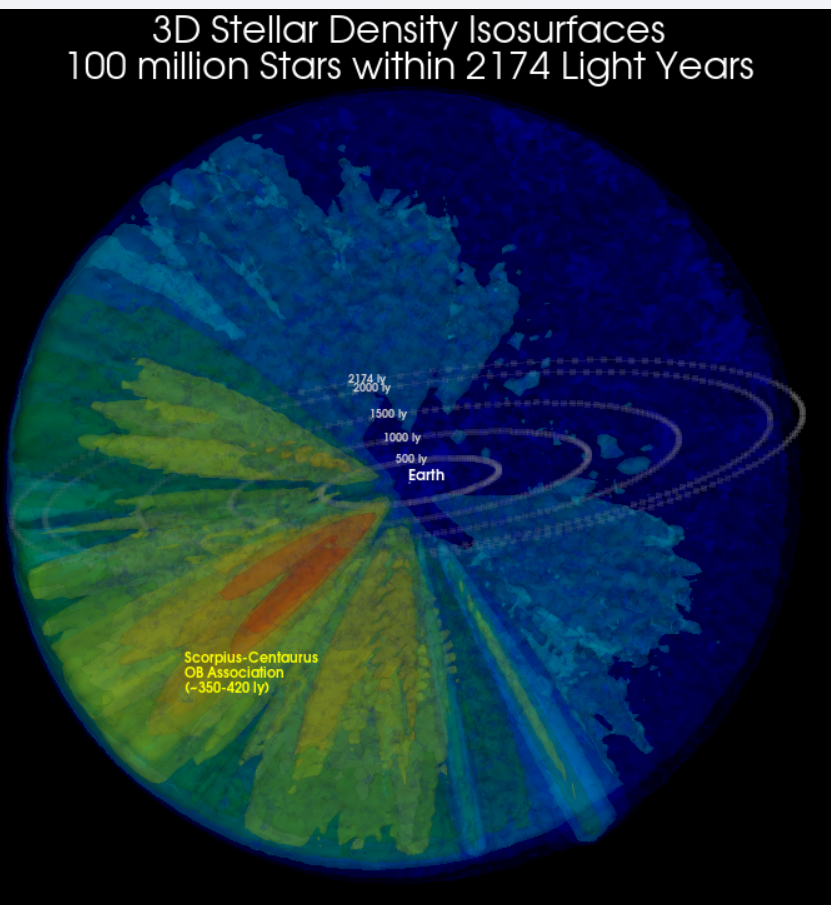

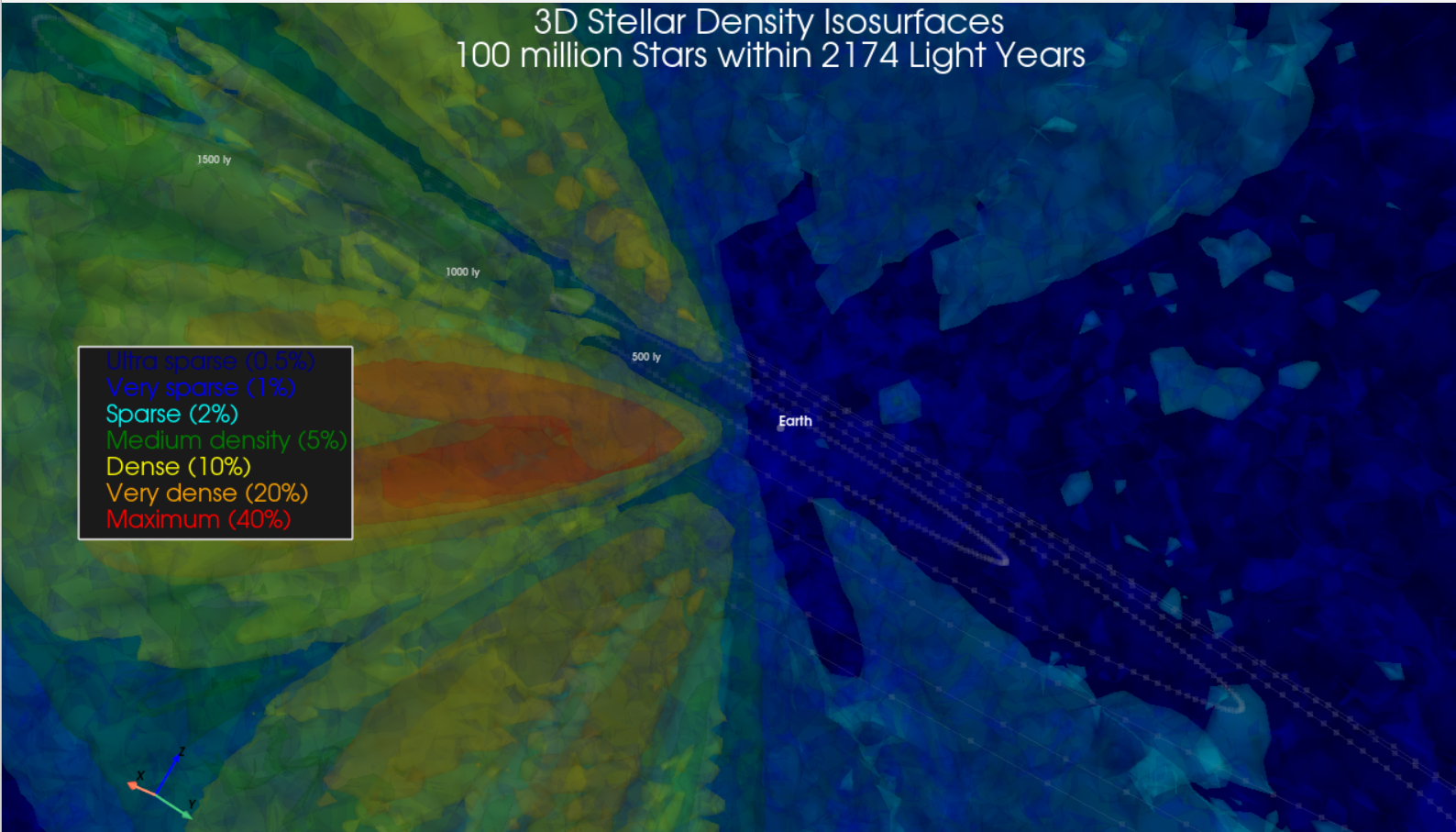

Image of 100 million star 3D stellar density isosurface data visualization using Python and Claude.ai.
Data downloaded from Flathub.FlatironInstitue/gaiadr3.
Summary:
- Total stars loaded: 109,408,991
- Distance cap: 2174 ly
- Grid resolution: 120^3 = 1,728,000 cells
- Density range: 0.00 to 9429.00
- Surfaces generated: 7
import pandas as pd
import numpy as np
from scipy.ndimage import gaussian_filter
import pyvista as pv
# Load data
df = pd.read_csv('100-million-stars.csv')
# Convert parallax to distance (light years)
df['distance_ly'] = 3262 / df['parallax']
# Remove bad rows
df = df.dropna(subset=['ra', 'dec', 'distance_ly', 'parallax'])
df = df[np.isfinite(df['distance_ly'])]
# ── DISTANCE FILTER ──────────────────────────────────────────
MAX_DISTANCE_LY = 2174
df = df[df['distance_ly'] <= MAX_DISTANCE_LY]
df = df.reset_index(drop=True)
print(f"Stars within {MAX_DISTANCE_LY} ly: {len(df):,}")
# Convert RA/Dec to Cartesian coordinates
ra_rad = np.radians(df['ra'])
dec_rad = np.radians(df['dec'])
x = df['distance_ly'] * np.cos(dec_rad) * np.cos(ra_rad)
y = df['distance_ly'] * np.cos(dec_rad) * np.sin(ra_rad)
z = df['distance_ly'] * np.sin(dec_rad)
# ── 3D GRID ──────────────────────────────────────────────────
grid_size = 120
lim = MAX_DISTANCE_LY + 5
x_range = np.linspace(-lim, lim, grid_size)
y_range = np.linspace(-lim, lim, grid_size)
z_range = np.linspace(-lim, lim, grid_size)
# Calculate density via 3D histogram
H, edges = np.histogramdd(
np.column_stack([x, y, z]),
bins=(x_range, y_range, z_range)
)
# Smooth the density field
H_smooth = gaussian_filter(H, sigma=.5)
print(f"Density stats: min={H_smooth.min():.4f}, max={H_smooth.max():.4f}, mean={H_smooth.mean():.4f}")
print(f"Non-zero cells: {np.sum(H_smooth > 0):,}/{H_smooth.size:,}")
# ── DIAGNOSTIC: RA/Dec of densest regions ────────────────────
print("\n── Top 20 Densest Grid Cells ──")
x_centers = (x_range[:-1] + x_range[1:]) / 2
y_centers = (y_range[:-1] + y_range[1:]) / 2
z_centers = (z_range[:-1] + z_range[1:]) / 2
flat_indices = np.argsort(H_smooth.ravel())[-20:][::-1]
ix, iy, iz = np.unravel_index(flat_indices, H_smooth.shape)
print(f"{'Rank':<5} {'Density':<10} {'X (ly)':<10} {'Y (ly)':<10} {'Z (ly)':<10} {'RA (deg)':<10} {'Dec (deg)':<10} {'Dist (ly)':<10}")
for rank, (i, j, k) in enumerate(zip(ix, iy, iz), 1):
cx = x_centers[i]
cy = y_centers[j]
cz = z_centers[k]
dist = np.sqrt(cx**2 + cy**2 + cz**2)
ra_deg = np.degrees(np.arctan2(cy, cx)) % 360
dec_deg = np.degrees(np.arcsin(np.clip(cz / dist, -1, 1))) if dist > 0 else 0
density = H_smooth[i, j, k]
print(f"{rank:<5} {density:<10.2f} {cx:<10.1f} {cy:<10.1f} {cz:<10.1f} {ra_deg:<10.1f} {dec_deg:<10.1f} {dist:<10.1f}")
print("\nLook up these RA/Dec coordinates to identify known stellar structures.")
print("Hint: Scorpius-Centaurus ~ RA 240, Dec -40 | Orion OB1 ~ RA 84, Dec 0")
print(" Local Bubble boundary ~ 200-300 ly | Pleiades ~ RA 56, Dec +24\n")
# ── PYVISTA GRID ─────────────────────────────────────────────
grid = pv.ImageData()
grid.dimensions = H_smooth.shape
grid.spacing = (
(x_range.max() - x_range.min()) / (grid_size - 1),
(y_range.max() - y_range.min()) / (grid_size - 1),
(z_range.max() - z_range.min()) / (grid_size - 1)
)
grid.origin = (x_range.min(), y_range.min(), z_range.min())
grid.point_data['density'] = H_smooth.flatten(order='F')
# ── DENSITY THRESHOLDS ───────────────────────────────────────
d_max = H_smooth.max()
thresholds = [
(d_max * 0.005, 'darkblue', 0.15, 'Ultra sparse (0.5%)'),
(d_max * 0.01, 'blue', 0.20, 'Very sparse (1%)'),
(d_max * 0.02, 'cyan', 0.30, 'Sparse (2%)'),
(d_max * 0.05, 'green', 0.45, 'Medium (5%)'),
(d_max * 0.10, 'yellow', 0.55, 'Dense (10%)'),
(d_max * 0.20, 'orange', 0.70, 'Very dense (20%)'),
(d_max * 0.40, 'red', 0.85, 'Maximum (40%)'),
]
print(f"Auto-scaled thresholds (max density = {d_max:.2f}):")
for t in thresholds:
print(f" {t[3]}: {t[0]:.4f}")
# ── PLOTTER ──────────────────────────────────────────────────
plotter = pv.Plotter()
plotter.set_background('black')
surfaces_added = 0
for threshold, color, opacity, label in thresholds:
try:
contour = grid.contour([threshold], scalars='density')
if contour.n_points > 0:
plotter.add_mesh(
contour,
color=color,
opacity=opacity,
show_edges=False,
smooth_shading=True,
label=label
)
surfaces_added += 1
print(f"Added surface at {threshold:.4f}: {contour.n_points:,} points")
else:
print(f"No surface at threshold {threshold:.4f}")
except Exception as e:
print(f"Failed at threshold {threshold:.4f}: {e}")
print(f"\nTotal surfaces added: {surfaces_added}")
# ── ANNOTATIONS ────────────────────────────
plotter.add_text(
f'3D Stellar Density Isosurfaces\n100 million Stars within {MAX_DISTANCE_LY} Light Years',
position='upper_edge',
font_size=12,
color='white'
)
plotter.add_text(
'Thin shells near Earth = Stellar Desert\nThick shells at distance = Dense regions',
position='lower_left',
font_size=9,
color='white'
)
plotter.show_axes()
# Earth marker
origin_sphere = pv.Sphere(radius=8, center=(0, 0, 0))
plotter.add_mesh(origin_sphere, color='white', opacity=0.9)
plotter.add_point_labels(
[[0, 0, 0]],
['Earth'],
font_size=12,
text_color='white',
point_color='white',
point_size=0,
always_visible=True,
shape_opacity=0
)
# ── DISTANCE SCALE RINGS ──────────────────────────────────────
# Flat equatorial circles at various light year distances
ring_distances = [500, 1000, 1500, 2000, 2174]
for dist in ring_distances:
# Build a circle in the XY plane (galactic equator)
theta = np.linspace(0, 2 * np.pi, 180)
ring_x = dist * np.cos(theta)
ring_y = dist * np.sin(theta)
ring_z = np.zeros_like(theta)
points = np.column_stack([ring_x, ring_y, ring_z])
# Create polyline
n = len(points)
lines = np.zeros((n, 3), dtype=int)
lines[:, 0] = 2
lines[:, 1] = np.arange(n)
lines[:, 2] = np.roll(np.arange(n), -1)
ring = pv.PolyData(points)
ring.lines = lines.flatten()
plotter.add_mesh(ring, color='gray', opacity=0.35, line_width=1)
# Label at positive X edge of each ring
plotter.add_point_labels(
[[dist, 0, 0]],
[f'{dist} ly'],
font_size=9,
text_color='lightgray',
point_color='lightgray',
point_size=0,
always_visible=True,
shape_opacity=0,
)
# ── SCO-CEN LABEL ─────────────────────────────────────────────
# Sco-Cen centroid from diagnostic: RA~269, Dec~-35, dist~350 ly
# Convert to Cartesian for label placement
sco_cen_ra = np.radians(269.0)
sco_cen_dec = np.radians(-35.0)
sco_cen_dist = 1700.0 # Put label on Complex
sco_cen_x = sco_cen_dist * np.cos(sco_cen_dec) * np.cos(sco_cen_ra)
sco_cen_y = sco_cen_dist * np.cos(sco_cen_dec) * np.sin(sco_cen_ra)
sco_cen_z = sco_cen_dist * np.sin(sco_cen_dec)
plotter.add_point_labels(
[[sco_cen_x, sco_cen_y, sco_cen_z]],
['Scorpius-Centaurus\nOB Association\n(~350-420 ly)'],
font_size=11,
text_color='yellow',
point_color='yellow',
point_size=12,
always_visible=True,
shape_opacity=0
)
# ── COLOR LEGEND ─────────────────────────────────────────────
legend_entries = [
["Ultra sparse (0.5%)", "darkblue"],
["Very sparse (1%)", "blue"],
["Sparse (2%)", "cyan"],
["Medium density (5%)", "green"],
["Dense (10%)", "yellow"],
["Very dense (20%)", "orange"],
["Maximum (40%)", "red"],
]
plotter.add_legend(
legend_entries,
bcolor=(0.1, 0.1, 0.1),
border=True,
loc="center left",
size=(0.18, 0.22),
)
# ── INTERACTIVE WINDOW ───────────────────────────────────────
# Mouse controls:
# Left-click + drag → rotate
# Right-click + drag → zoom
# Middle-click + drag → pan
# Scroll wheel → zoom in/out
# R → reset camera
# Q or close window → quit
plotter.camera_position = 'iso'
plotter.camera.zoom(1.2)
print("\nOpening interactive window — rotate and zoom freely...")
plotter.show()
print(f"\nSummary:")
print(f" Total stars loaded: {len(df):,}")
print(f" Distance cap: {MAX_DISTANCE_LY} ly")
print(f" Grid resolution: {grid_size}^3 = {grid_size**3:,} cells")
print(f" Density range: {H_smooth.min():.2f} to {H_smooth.max():.2f}")
print(f" Surfaces generated: {surfaces_added}")
Downloads
Supplies
- Python
- Pandas library
- Numpy library
- Scipy library
- PyVista library
- Data for 100 million stars from flathub.flatironinstitute.org/gaiadr3
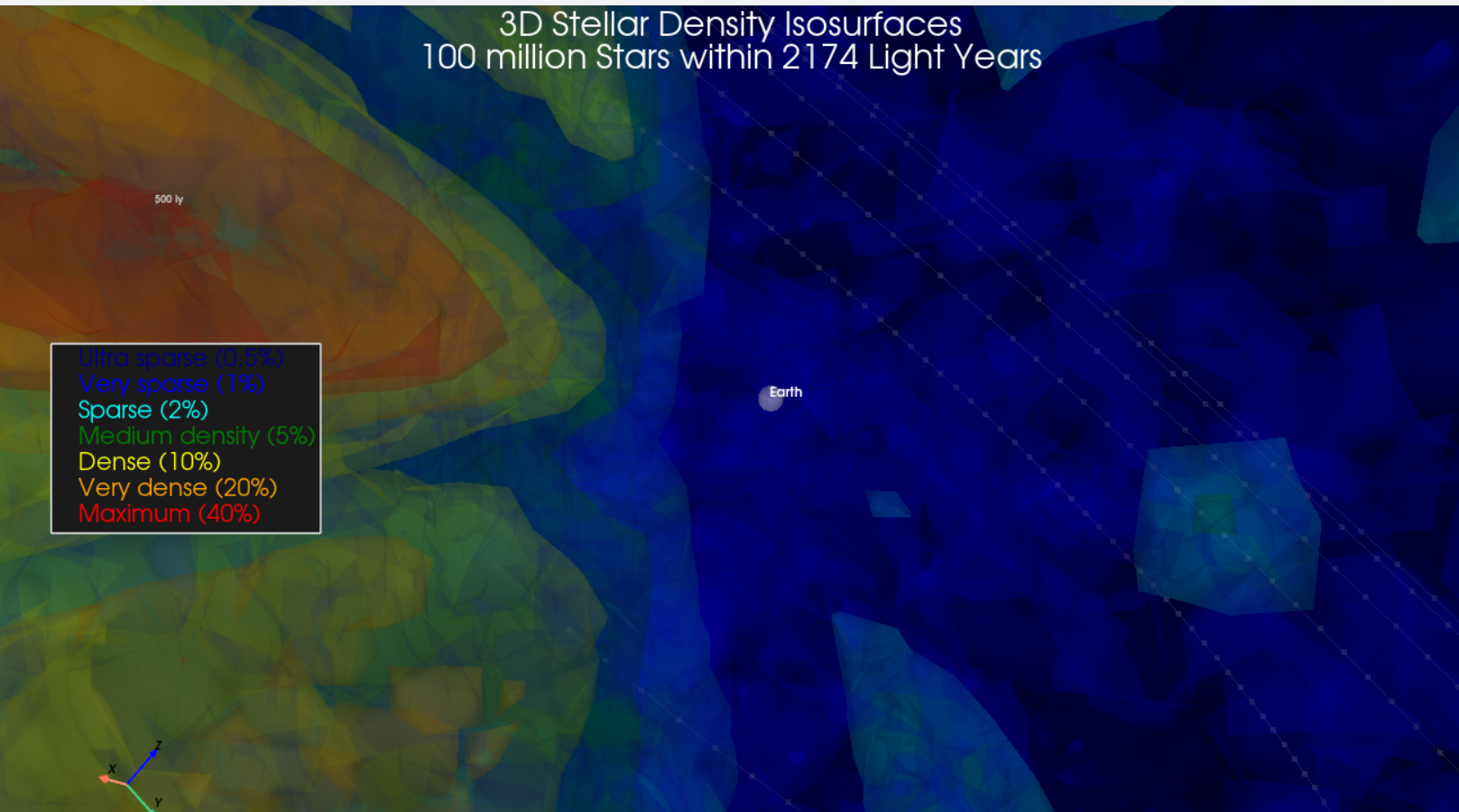
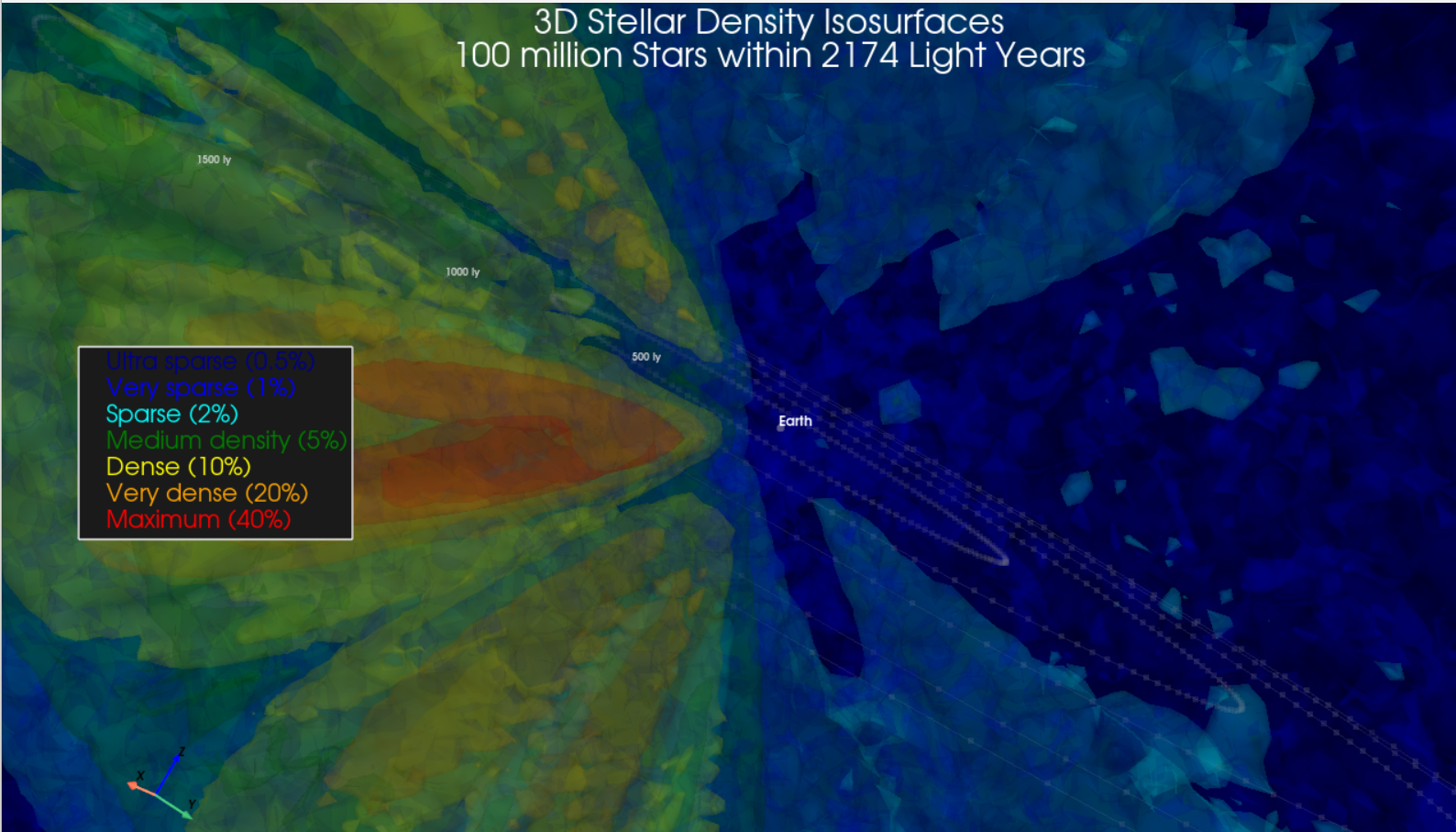
100 Million Star 3D Stellar Density Isosurface Data Visualization Using Python


import pandas as pd
import numpy as np
from scipy.ndimage import gaussian_filter
import pyvista as pv
# Load data
df = pd.read_csv('100-million-stars.csv')
# Convert parallax to distance (light years)
df['distance_ly'] = 3262 / df['parallax']
# Remove bad rows
df = df.dropna(subset=['ra', 'dec', 'distance_ly', 'parallax'])
df = df[np.isfinite(df['distance_ly'])]
# ── DISTANCE FILTER ──────────────────────────────────────────
MAX_DISTANCE_LY = 2174
df = df[df['distance_ly'] <= MAX_DISTANCE_LY]
df = df.reset_index(drop=True)
print(f"Stars within {MAX_DISTANCE_LY} ly: {len(df):,}")
# Convert RA/Dec to Cartesian coordinates
ra_rad = np.radians(df['ra'])
dec_rad = np.radians(df['dec'])
x = df['distance_ly'] * np.cos(dec_rad) * np.cos(ra_rad)
y = df['distance_ly'] * np.cos(dec_rad) * np.sin(ra_rad)
z = df['distance_ly'] * np.sin(dec_rad)
# ── 3D GRID ──────────────────────────────────────────────────
grid_size = 120
lim = MAX_DISTANCE_LY + 5
x_range = np.linspace(-lim, lim, grid_size)
y_range = np.linspace(-lim, lim, grid_size)
z_range = np.linspace(-lim, lim, grid_size)
# Calculate density via 3D histogram
H, edges = np.histogramdd(
np.column_stack([x, y, z]),
bins=(x_range, y_range, z_range)
)
# Smooth the density field
H_smooth = gaussian_filter(H, sigma=.5)
print(f"Density stats: min={H_smooth.min():.4f}, max={H_smooth.max():.4f}, mean={H_smooth.mean():.4f}")
print(f"Non-zero cells: {np.sum(H_smooth > 0):,}/{H_smooth.size:,}")
# ── DIAGNOSTIC: RA/Dec of densest regions ────────────────────
print("\n── Top 20 Densest Grid Cells ──")
x_centers = (x_range[:-1] + x_range[1:]) / 2
y_centers = (y_range[:-1] + y_range[1:]) / 2
z_centers = (z_range[:-1] + z_range[1:]) / 2
flat_indices = np.argsort(H_smooth.ravel())[-20:][::-1]
ix, iy, iz = np.unravel_index(flat_indices, H_smooth.shape)
print(f"{'Rank':<5} {'Density':<10} {'X (ly)':<10} {'Y (ly)':<10} {'Z (ly)':<10} {'RA (deg)':<10} {'Dec (deg)':<10} {'Dist (ly)':<10}")
for rank, (i, j, k) in enumerate(zip(ix, iy, iz), 1):
cx = x_centers[i]
cy = y_centers[j]
cz = z_centers[k]
dist = np.sqrt(cx**2 + cy**2 + cz**2)
ra_deg = np.degrees(np.arctan2(cy, cx)) % 360
dec_deg = np.degrees(np.arcsin(np.clip(cz / dist, -1, 1))) if dist > 0 else 0
density = H_smooth[i, j, k]
print(f"{rank:<5} {density:<10.2f} {cx:<10.1f} {cy:<10.1f} {cz:<10.1f} {ra_deg:<10.1f} {dec_deg:<10.1f} {dist:<10.1f}")
print("\nLook up these RA/Dec coordinates to identify known stellar structures.")
print("Hint: Scorpius-Centaurus ~ RA 240, Dec -40 | Orion OB1 ~ RA 84, Dec 0")
print(" Local Bubble boundary ~ 200-300 ly | Pleiades ~ RA 56, Dec +24\n")
# ── PYVISTA GRID ─────────────────────────────────────────────
grid = pv.ImageData()
grid.dimensions = H_smooth.shape
grid.spacing = (
(x_range.max() - x_range.min()) / (grid_size - 1),
(y_range.max() - y_range.min()) / (grid_size - 1),
(z_range.max() - z_range.min()) / (grid_size - 1)
)
grid.origin = (x_range.min(), y_range.min(), z_range.min())
grid.point_data['density'] = H_smooth.flatten(order='F')
# ── DENSITY THRESHOLDS ───────────────────────────────────────
d_max = H_smooth.max()
thresholds = [
(d_max * 0.005, 'darkblue', 0.15, 'Ultra sparse (0.5%)'),
(d_max * 0.01, 'blue', 0.20, 'Very sparse (1%)'),
(d_max * 0.02, 'cyan', 0.30, 'Sparse (2%)'),
(d_max * 0.05, 'green', 0.45, 'Medium (5%)'),
(d_max * 0.10, 'yellow', 0.55, 'Dense (10%)'),
(d_max * 0.20, 'orange', 0.70, 'Very dense (20%)'),
(d_max * 0.40, 'red', 0.85, 'Maximum (40%)'),
]
print(f"Auto-scaled thresholds (max density = {d_max:.2f}):")
for t in thresholds:
print(f" {t[3]}: {t[0]:.4f}")
# ── PLOTTER ──────────────────────────────────────────────────
plotter = pv.Plotter()
plotter.set_background('black')
surfaces_added = 0
for threshold, color, opacity, label in thresholds:
try:
contour = grid.contour([threshold], scalars='density')
if contour.n_points > 0:
plotter.add_mesh(
contour,
color=color,
opacity=opacity,
show_edges=False,
smooth_shading=True,
label=label
)
surfaces_added += 1
print(f"Added surface at {threshold:.4f}: {contour.n_points:,} points")
else:
print(f"No surface at threshold {threshold:.4f}")
except Exception as e:
print(f"Failed at threshold {threshold:.4f}: {e}")
print(f"\nTotal surfaces added: {surfaces_added}")
# ── ANNOTATIONS ────────────────────────────
plotter.add_text(
f'3D Stellar Density Isosurfaces\n100 million Stars within {MAX_DISTANCE_LY} Light Years',
position='upper_edge',
font_size=12,
color='white'
)
plotter.add_text(
'Thin shells near Earth = Stellar Desert\nThick shells at distance = Dense regions',
position='lower_left',
font_size=9,
color='white'
)
plotter.show_axes()
# Earth marker
origin_sphere = pv.Sphere(radius=8, center=(0, 0, 0))
plotter.add_mesh(origin_sphere, color='white', opacity=0.9)
plotter.add_point_labels(
[[0, 0, 0]],
['Earth'],
font_size=12,
text_color='white',
point_color='white',
point_size=0,
always_visible=True,
shape_opacity=0
)
# ── DISTANCE SCALE RINGS ──────────────────────────────────────
# Flat equatorial circles at various light year distances
ring_distances = [500, 1000, 1500, 2000, 2174]
for dist in ring_distances:
# Build a circle in the XY plane (galactic equator)
theta = np.linspace(0, 2 * np.pi, 180)
ring_x = dist * np.cos(theta)
ring_y = dist * np.sin(theta)
ring_z = np.zeros_like(theta)
points = np.column_stack([ring_x, ring_y, ring_z])
# Create polyline
n = len(points)
lines = np.zeros((n, 3), dtype=int)
lines[:, 0] = 2
lines[:, 1] = np.arange(n)
lines[:, 2] = np.roll(np.arange(n), -1)
ring = pv.PolyData(points)
ring.lines = lines.flatten()
plotter.add_mesh(ring, color='gray', opacity=0.35, line_width=1)
# Label at positive X edge of each ring
plotter.add_point_labels(
[[dist, 0, 0]],
[f'{dist} ly'],
font_size=9,
text_color='lightgray',
point_color='lightgray',
point_size=0,
always_visible=True,
shape_opacity=0,
)
# ── SCO-CEN LABEL ─────────────────────────────────────────────
# Sco-Cen centroid from diagnostic: RA~269, Dec~-35, dist~350 ly
# Convert to Cartesian for label placement
sco_cen_ra = np.radians(269.0)
sco_cen_dec = np.radians(-35.0)
sco_cen_dist = 1700.0 # Put label on Complex
sco_cen_x = sco_cen_dist * np.cos(sco_cen_dec) * np.cos(sco_cen_ra)
sco_cen_y = sco_cen_dist * np.cos(sco_cen_dec) * np.sin(sco_cen_ra)
sco_cen_z = sco_cen_dist * np.sin(sco_cen_dec)
plotter.add_point_labels(
[[sco_cen_x, sco_cen_y, sco_cen_z]],
['Scorpius-Centaurus\nOB Association\n(~350-420 ly)'],
font_size=11,
text_color='yellow',
point_color='yellow',
point_size=12,
always_visible=True,
shape_opacity=0
)
# ── COLOR LEGEND ─────────────────────────────────────────────
legend_entries = [
["Ultra sparse (0.5%)", "darkblue"],
["Very sparse (1%)", "blue"],
["Sparse (2%)", "cyan"],
["Medium density (5%)", "green"],
["Dense (10%)", "yellow"],
["Very dense (20%)", "orange"],
["Maximum (40%)", "red"],
]
plotter.add_legend(
legend_entries,
bcolor=(0.1, 0.1, 0.1),
border=True,
loc="center left",
size=(0.18, 0.22),
)
# ── INTERACTIVE WINDOW ───────────────────────────────────────
# Mouse controls:
# Left-click + drag → rotate
# Right-click + drag → zoom
# Middle-click + drag → pan
# Scroll wheel → zoom in/out
# R → reset camera
# Q or close window → quit
plotter.camera_position = 'iso'
plotter.camera.zoom(1.2)
print("\nOpening interactive window — rotate and zoom freely...")
plotter.show()
print(f"\nSummary:")
print(f" Total stars loaded: {len(df):,}")
print(f" Distance cap: {MAX_DISTANCE_LY} ly")
print(f" Grid resolution: {grid_size}^3 = {grid_size**3:,} cells")
print(f" Density range: {H_smooth.min():.2f} to {H_smooth.max():.2f}")
print(f" Surfaces generated: {surfaces_added}")