3D Risk Game


I get very bored & love to try my hand making my crazy ideas into reality. I found out this year that my brother has gotten very into online Risk the past couple years. I'd mentioned I had an idea years ago for 3D Risk, using magnetic pieces & a steel globe. He thought it sounded amazing, so I quietly started working on what would be his Christmas gift. The design ended up being a 12" steel globe on a hexagonal base that was about 16" at the corners. I chose a hexagonal base because the game came with 6 sets of different color pieces, and I gave each one a cubby. A triangle-shaped drawer with a layer of sheet metal means the magnetic pieces are held upright in place during storage. I also ended up making little boxes to hold the Risk cards & the dice.
What started out as a fun idea, as always, ended up more frustrating, expensive, and time consuming than I ever expected. But if you're interested in the project, the supply list provided is the final one. I probably re-designed this thing 4 times during building, so I ended up wasting quite a bit of materials. Learn from my mistakes. Overall, it was an incredibly fun challenge to figure out. I'm very happy with the end result, and this is the first 3D Risk set I've ever heard of/seen in my life, so I think I successfully actually made something. Very fun.
Supplies


2 - 12" Steel Hemispheres (King Metals)
500 - 1/4"x1/8" Rare Earth Magnets (Ebay)
1 - 2'x4'x1/4" Plywood panel (Hardware store)
1 - 1/2"x6"x4' Aspen Board (Hardware store)
1 - 3/4"x6"x4' Aspen Board (Hardware store)
1 - 6"x24" Sheet metal (Hardware store)
1 - 5/16"-18 x2' Threaded rod (Hardware store)
2 - 5/16"-18 Threaded rod coupling (Hardware store)
4 - 5/16"-18 Nuts, ground round (Hardware store)
4 - 5/16"ID Washer (Hardware store)
2 - 5/16"ID Lock washer (Hardware store)
2 - 5/16"ID x 7/8"OD Bearing (Grainger)
1 - 1/4" Dowel rod (Hobby Lobby)
9 - Dowel rod caps (Hobby Lobby)
2 - 12"x18" Black felt sheet (Hobby Lobby)
1 - Water transfer decal paper (Hobby Lobby)
And of course, a Risk game. The one I remembered from growing up was the 1993 version. He's now playing custom maps online, even in different time periods. I decided that he wouldn't really care what version I used, and it seemed like an earlier board would be simpler to trace out. Also the pieces were just little plastic shapes, the 1993 version were cast plastic people, horses & cannons. They seemed like they'd be bulkier in the trays, plus I was worried about having a good surface to glue the magnet on. Long story short, I found a 1962 game board on Ebay. If you go for a used board, take a minute to make sure you get all the dice & Risk cards. I was lucky, mine even had the original instructions after 63 years!
I went through a few Extra fine tip sharpies, they were extremely helpful. I used superglue, clear Gorilla glue, JB Weld, wood stain, shellac, spray varnish, and various assorted Testor's model paints. Power tools included a table saw, scroll saw, drill, palm sander, router, welder, and angle grinder.
Glue Magnets

Gluing the magnets onto the pieces was going to take a while, so I started on that first. I counted around 430 pieces in 6 colors, and I had to keep them separated while gluing or they'd all just snap together into a pile. I put a piece of adhesive-backed 220 grit sandpaper onto a scrap piece of wood, and lightly sanded one side of each piece. This gave me a flat surface & also roughed up the plastic to help the magnet grip. I decided to have each magnet have the same polarity facing down. It doesn't matter, but that's what I wanted. The magnets came in stacks, I'd just take them off one by one & lay them out a few inches apart. A drop of superglue on the magnet, center the piece on top, and press down for a few seconds.
This worked great, was fast & easy. One thing I found was that the superglue turned like a smokey white on the plastic. I don't know if it was the fumes of the glue drying, a reaction to the plastic, or both, but I could scrape it off with a fingernail0
Build the Globe

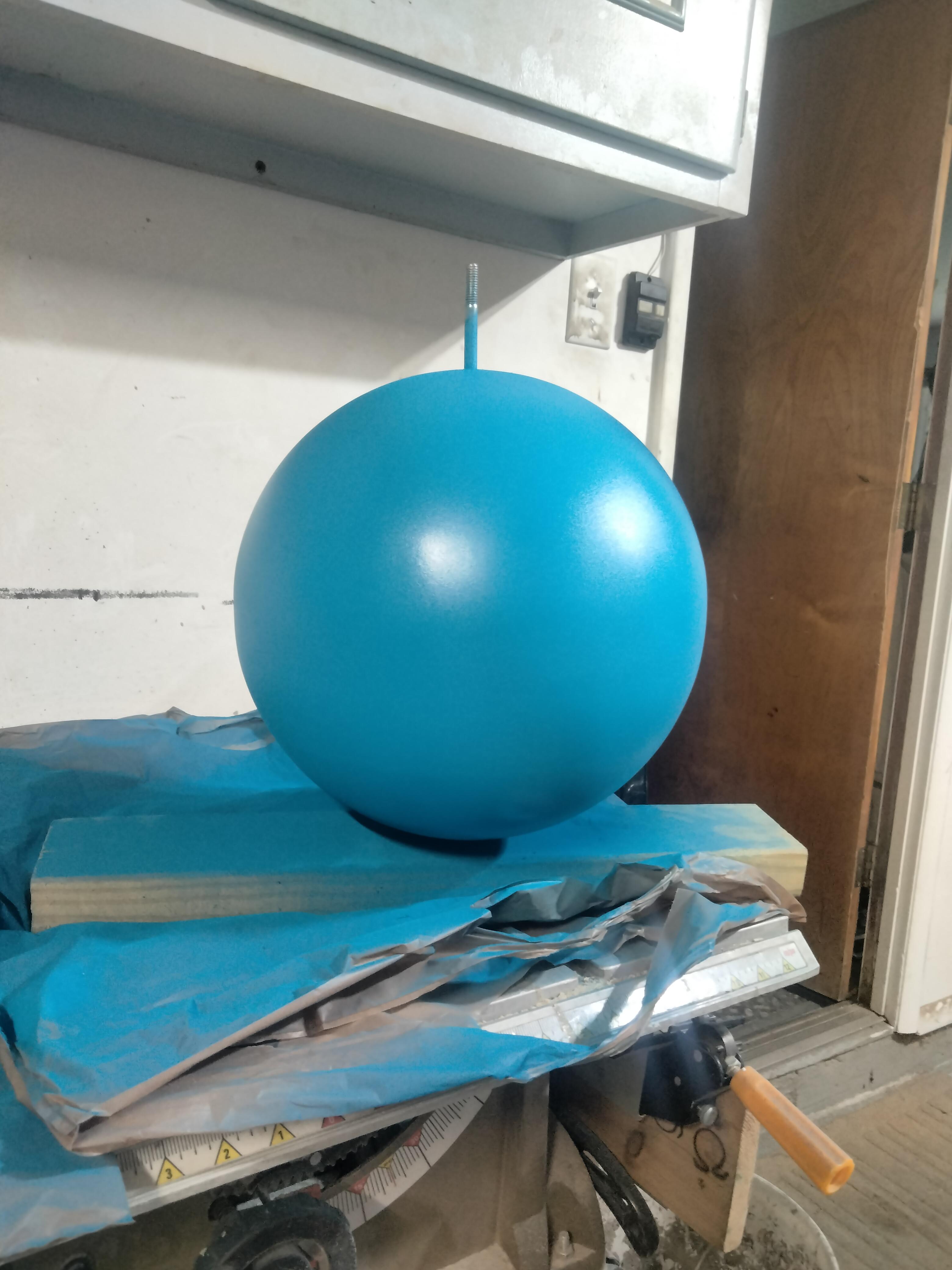


The hemispheres came from King Metals, shoutout to them. Fairly cheap for a 12" steel globe, and customer service was very helpful during a backorder. Each piece had a hole punched into the top, so my original idea was to weld a bolt through the inside and then weld the halves together. DON'T DO THIS. Somehow or another something wasn't lined up right, and it would immediately fall to one spot. I tried to balance it by slightly bending the bolts to offset the center, but it just looked incredibly bad & wobbly. I ended up cutting the bolts off, drilling holes, and using a piece of threaded rod going straight through the centers. As you can see in the pictures, I was stubborn & waited way too long to abandon the bolts. I already had the thing painted. Learn from my mistake, and make sure it's balanced before you paint anything. I tacked the two sides together, ground down my equator welds, and melted a plastic scraper on the globe to get its exact contour. I covered the equator seam with JB weld & smoothed it out with the scraper. That worked great, very little finishing touches needed.
I gave it a few coats of Oasis blue spray paint. I had to have it movable but steady, so I built a frame to hold it upright out of some scrap 2x4s. Cut some painter's tape into thin strips so they conform to the curves, and start covering. I measured around the equator and divided it into 24 sections. Tie a thread from one bolt to the other, lining it up with one of the 24 equator marks made, and trace it with a pencil. Line the thread up the the next mark, trace, repeat. you'll end up with 24 longitude lines. Now measure from bolt to bolt (which should be 1/2 the equator measurement), and make 18 marks along the longitude lines. Depending on the board you're going off of, these numbers will vary. My board was 24"x24", but the map itself was more like 24"x18". Thus a 1"x1" square on the flat map would be one section on the globe when marked with 24 longitude lines & 18 latitude. I marked what I deemed to be the point of equator/prime meridian (which on a blank globe is just anywhere a meridian crosses the equator), then I went point by point on the map, found the corresponding point on the globe, and made mark after mark. With enough marks transferred from map to globe, you can eventually connect the dots into boarders. This is very tedious, and there's enough lines going in every direction to get you lost long before you realize it. You'll get two territories traced, feel great, then realize you're on the wrong latitude line. Clearly mark everything, number the lines on the map & the globe.
Then I took a utility knife and very carefully traced the boarders. Since each continent has a different color scheme, I cut one territory out of each so I could paint multiple at a time between drying days. I mixed up my Testor's paint in the bottom of soda cans (concave, recyclable, washable, and free) custom for each territory. So cut, uncover, and paint them one at a time letting it dry in between. If I made an error painting a neighbor territory later, I could clean wet paint off dry. The game board had fluffy white boarders where the land meets the sea, so I did that too. The water-decals were easy, I typed the name of every territory & Ocean, found the right size/font, and printed. Instructions said to spray-seal, so I hit the sheets with a few coats of poly & let dry. Cut out the name, dip it in water, and it'll slide off its backing onto the globe. Take a second to make sure it's flat & exactly where you want it.
I traced all boarders over again with extra-fine tipped sharpies, and added the lines showing territory boundaries in water & attack lines over water before coating with spray polyurethane. DON'T DO THAT. Even with very light coats I had problems with the poly making the sharpie run. Spray finish, then sharpie. Use plenty of poly, or even an epoxy finish if you can, it has to protect the paint from the magnets clicking on.
Build the Frame

The globe is 12" diameter, and the threaded rod couplings I was using as spacers were 7/8" long. So, with a washer, I made the inside arc of the frame follow a 7" radius. The frame was laminated Aspen boards 1.5" thick. I marked out the 7" radius, making sure that it went high enough to hold the top axel at 23.5deg. I decided to sweep the base out to make it more sturdy on the plywood base, and it looks nicer. Cut the curves & sanded. To properly space it off with the base I needed to add a 3/4" board under the arm. I marked where the axis would cross at 23.5deg, marked a line 1.5" further and cut the arm to size. For the south pole side, I took the scrap I cut from the inside of the arc and cut out a block 1.5"x1.5", squaring one end. I marked the proper height needed & cut it at a complimentary 23.5deg, and rounded all the edges.
The OD of the bearings used was 7/8". I was using a ground-round nut as a spacer on the threaded rod inside the wood which was roughly 1/4" thick, and a washer before the bearing. From the outside, I drilled into the arm until there is about 3/8" thick. Through the remaining 3/8" I drilled out to 5/8" to leave clearance around the ground nut. For the small one it was the 3/8" + the width of the bearing deep, then drilled to 5/8".
Build the Base


The whole focus of the design was to maximize the size of the sheet metal triangles I could cut out. 6" sided equilaterals glued to 1/4" ply, then attached to a strip of Aspen about 1.5" tall. I wanted magnets to hold them in place in the frame, so I laid them out.
The base was made of 1/4" ply I glued 1/4" Aspen strips to the edges of. Every measurement was custom around the size of the drawers, I really didn't make plans I can give to you. Made dividers of .5"x1.5" Aspen strips, they ended up around 8". Mitered corners that would hold magnets to hold the drawers, drilled those out & added magnets. I decided to pre-stain the inside walls before shutting it together for ease.
To assemble to globe on its shaft it went:
ground nut-washer-bearing-washer-ground nut-coupling-lock washer-globe-lock washer-coupling-ground nut-washer-bearing-washer-nut
Secured the small stand to the top, added the globe & arm, then secured the arm. Everything was attached to the base with glue & screws from the underside. Glued the top plywood to the bottom base, clamp.
Finish


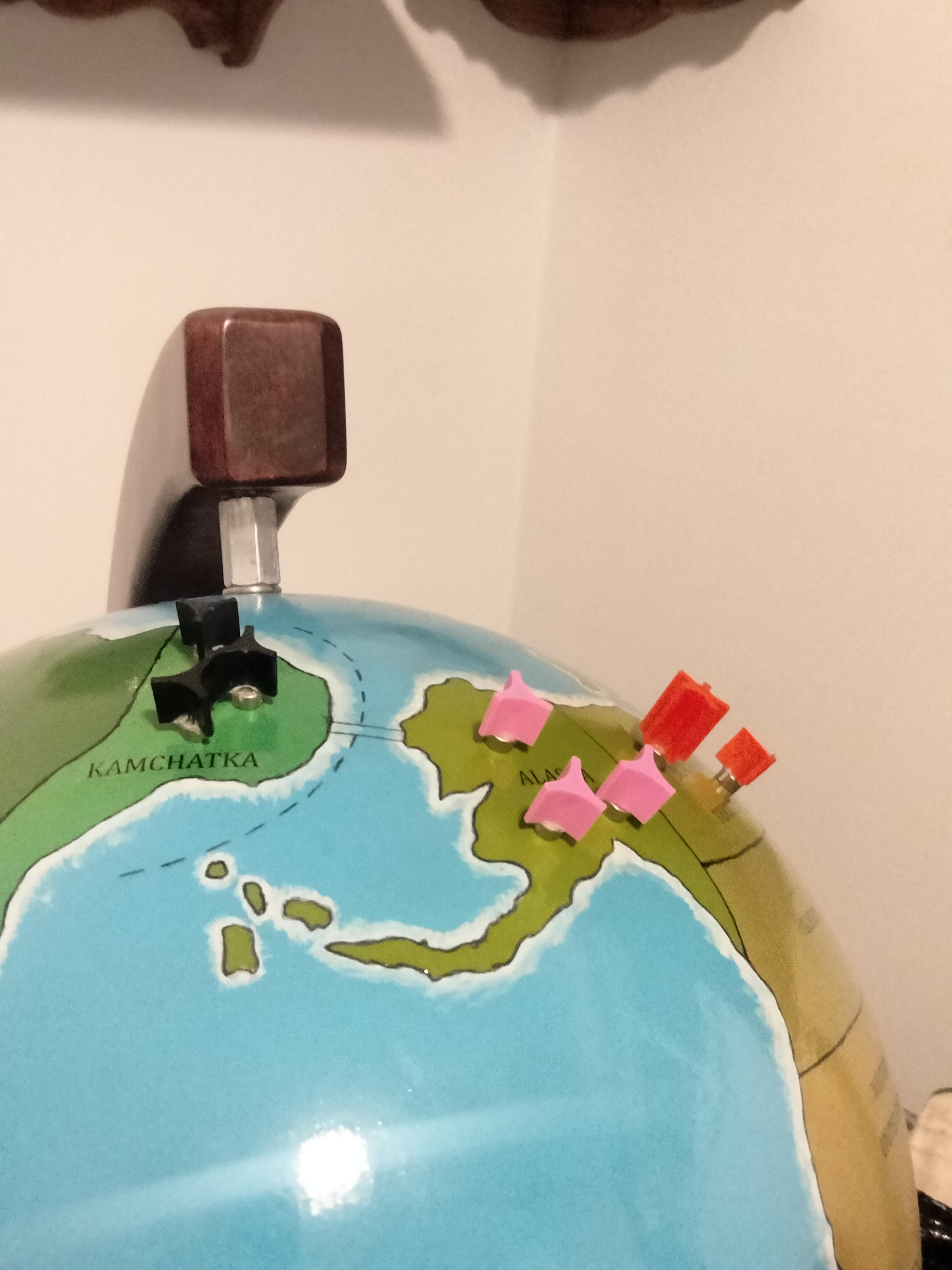
The final touches were knobs & feet made of decorative dowel caps & dowels, as well as little drawers made specifically to the size of the dice & cards. Sand, stain, & finish.
After that I covered the sheet metal with black felt, wrapping it over the edges of the plywood triangles. I also ended up felting the inside of the dice & card boxes.
Overall, this was extremely fun. Almost every measurement was improvised, I just got to riff.