A Radio Made From Air and Light (Proof of Concept)
by Piffpaffpoltrie in Circuits > Audio
635 Views, 2 Favorites, 0 Comments
A Radio Made From Air and Light (Proof of Concept)
 2.jpg)
The Idea For This Project...
... caught up with me when I was thumbing through the Italian 'Dossier Design no 1 – 100 icone del design', issued by www.sprea.it, while searching for something entirely different. But then, I came across a short article about the 'Radio in Cristallo' – and was immediately hooked.
Would you believe that the radio set shown in the original, vintage photograph above is almost 90 years old? Ok, the cracks and fissures in the speaker's paper diaphragm might hint to its age.
I'm glad to have found an original picture of this one-of-a-kind radio receiver at all, because they are few and far between.
The Story
Legend has it that Italian architect and designer Franco Albini was given a radio as a wedding present back in 1938 – that is, almost a century ago!
In these times there existed analog AM radio only, and the available radio sets were ugly, over-designed, giant pieces of furniture rather than real design objects. Ok, if you like the baroque design from these times, with dark brown, rounded, wooden enclosures and lots of gold-coloured curlicues, they were pieces with a lot of 'design' indeed.
Needless to say that then, purchasing such a radio set was quite an investment – it required about a working man’s monthly pay at least, if not two or even three – that is, about the same amount you might spend now when buying a decent, entry-level, audiophile HiFi setup.
I'm not surprised that Mr. Albini didn't like the looks of his present. He dismantled the unit and customised a case made from glass around the vacuum tube electronics, according to his statement that 'air and light are construction elements'. I think it is absolutely amazing that someone could have the idea for such a minimalistic design in these olden times, and it becomes crystal clear (pun intended) that the name it was given – Radio in Cristallo – has nothing to do with the experimental, crystal detector radio setups popular in these days.
Today's Version
Italian manufacturer Cassina sells a re-interpretation of Mr. Albini's design since a few years now (https://www.cassina.com/gb/en/products/radio-in-cristallo.html), featuring both a DAB+/FM tuner and a Bluetooth receiver. It is combined with a 50 W amplifier and a pro grade, Italian-made loudspeaker – and with a price tag, fasten your seat belt, of around 6000 Euro!
My Concept
I like the design nevertheless, so I came up with the idea to build a similar radio receiver – or at least to suggest a proof of concept for such a unit, and for considerably less money, at that.
The setup between two large slabs of thick glass – calling it an 'enclosure' would be an oxymoron – looks fascinating to me. However, when trying to DIY such a setup from glass, there is the problem of cutting and drilling holes in the glass, the one for the loudspeaker very large. Apart from that, glass doesn't come really cheap. The next idea was using clear acrylic glass (a.k.a. plexiglass or Perspex) that is somewhat easier to be machined but not significantly cheaper.
Therefor I decided to test the concept with a different material that clearly looks less remarkeable but is much cheaper: I use two pieces of 15 mm thick, 'oriented strand board' (a.k.a. OSB), the surface structure of which is, to me at least, interesting enough – the more so when painted in silver. Of course, should my concept prove successful, I might upgrade it with acrylic glass at a later date.
The original's electronics section consists of a chassis with its components visible from above (several vacuum tubes, large capacitors, a mains and an output transformer etc.). It features four large rotary buttons on the front. This chassis is duplicated in my version by a setup made from black-dyed MDF.
So, what is needed to complement the mechanical framework? A DAB+/FM/bluetooth receiver, a (mono) amplifier with its power supply, and a full-range loudspeaker. The electronics section can be built in such a way that the components are visible from above, too, although their modern equivalents will look totally different from the ones in the original design.
When cleverly selecting components not too expensive or, even better, using units already available in my junk box, this will be a project quite a bit cheaper than Cassina's modern, commercial version.
Some Additional Info
In an Italian online newspaper I found an article about some of Mr. Albini's works and his heritage, containing his picture together with his radio creation in the background. I felt free to make it available in PDF format in German and English, courtesy of DeepL, see below. There also exists a video clip featuring Mr. Albini's son Marco, giving a short statement about his father's design philosophy (https://youtu.be/0UuN6hyjvzg).
Supplies
'Enclosure'
- 2 pieces of oriented strand board / OSB-3 (or MDF / medium-density fibreboard, or particle board, glass, acrylic glass), 15-16 mm thick, cut to size (720 x 660 mm)
- Black-coloured MDF, 8 mm thick, for the electronics chassis
- 4 x M10 threaded rods, 300 mm long
- 4 x stainless steel tubes, 240 mm long, outer diameter 12 mm, inner diameter min. 10 mm
- 4 x stainless M10 cap nuts
- 8 x stainless M10 nuts
- 16 x stainless M10 washers
- 4 x knurled-head screws M4 x 40 (for attaching the front panel and the electronics chassis to the OSB)
- 4 x knurled-head screws M4 x 25 (for attaching the loudspeaker to the OSB)
- 8 x stainless M4 nuts
- 16 x stainless M4 washers
- Misc. mounting hardware for installing the electronics, such as M3 screws, nuts, washers, hexagonal threaded studs, zip ties
- Double-sided mounting tape
- Optional: some zip ties for fixing the transformer if it doesn’t have mounting brackets
- 4 x auto-adhesive equipment feet (rubber or teflon)
- Aluminium sheet metal cut to measure - or perhaps some 3 mm thick, black ‘gutta hobby color’ PVC sheet (easier to cut with an Xacto knife or a scalpel)
- Optional: Silver paint (e.g. Hammerite) (I prefer paint applied with a brush or a roller to spray paint)
The OSB and MDF pieces were cut to measure by my local DIY store where I also purchased the PVC sheet, total cost about €40.-. OSB is a bit more expensive than particle board, but cheaper than MDF.
Don't forget to wear work gloves when handling the OSB. If not you will for sure suffer from some nasty wood splinters getting under your skin - which I had to learn the hard way. Therefor I recommend you to chamfer the OSB's sharp edges with a sanding block wrapped in sandpaper to avoid this.
All hardware except the M3 screws etc. were purchased from amazon.de, cost about €30.-.
All other parts come from my junk box.
Electrical and Electronical Components
- DAB+ receiver, with its remote control, its mains adapter (a.k.a. wall wart) and a throw-out aerial, details in step 1
- Power amplifier, details in step 1
- Power supply for the amplifier (depends on the amp used – in the best case, only a matching mains transformer is required), details in step 1
- Full-range or coaxial loudspeaker, diameter approx 20 to 25 cm (8 to 10”), details in step 1
- Mains cable
- Audio cable
- Some stranded and/or shielded wire for additional internal wiring
- For the mono mixer: A piece of matrix board, some connectors and resistors, some bare, tinned copper wire of about 0.5 mm diameter
- Optional, if remote-controlled power-on of the amp is desired: A piece of matrix board, a relay, some other electronical components, some bare, tinned copper wire of about 0.5 mm diameter, together with a matching mains adapter (‘wall wart’) – details in step 4.
All these components were already available in my junk box; the DAB+ receiver was purchased in October 2024 from Amazon.de, it cost me then about €70.-. The power amp module purchased in kit form from Aliexpress was about €8.-.
Required Tools
- Cordless Drill
- Wood drill bits, 5 and 10 mm diameter
- Power jigsaw
- Various screwdrivers, among others both a Torx No. 8 and 6 (for opening the Technisat Digitradio 10C's rear cover and to remove its PCB)
- Xacto knife, box cutter, or scalpel
- Cutting mat
- Sandpaper and sanding block
- Two open-end wrenches size 17 mm (or adjustable spanners a.k.a. monkey wrenches)
- Soldering iron and solder
- Multimeter
- Optional: Neoprene paint roller
Component Selection



Radio Receiver
I selected a Technisat Digitradio 10C (being honest, I already had one of these in my junk box from a successful earlier experiment). It is a DAB+/FM/bluetooth receiver that comes with an IR remote control, a 5 V DC wall wart (a.k.a. mains adapter) with USB mini connector, and a throw-out aerial. Originally it was designed as a supplement to earlier HiFi equipment lacking a DAB tuner and therefor has line-level outputs only. No loudspeakers can be connected directly, you need an amplifier and loudspeakers for listening to its output signal.
It features a not-too-small colour LCD screen that also shows the time in standby mode; the screen is, however, quite a bit smaller than the old, analog frequency scale of the earlier design, and also smaller than the 7" screen of the modern version suggested by Cassina. In addition, this receiver has no knobs or pushbuttons but is controlled only by its remote, so the four large rotary knobs of the early design can be left out.
Amplifier
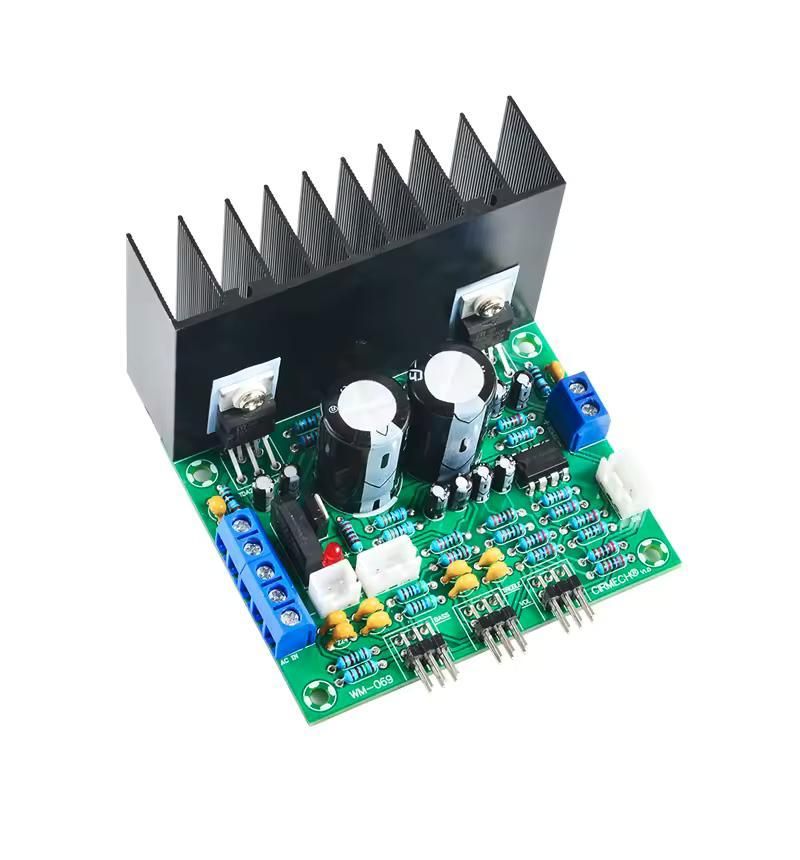
I had that already in my junk box as well (3rd picture): a not-too-powerful Chinese module that comes in handy for my first test setup. It is the sibling of the one described here: https://www.instructables.com/Re-Engineering-a-Chinese-Amplifier-Module/. This is a stereo amplifier, although for the first steps with my mono setup I only use one channel, since I only use one loudspeaker, too. Its volume and tone controls will be set to fixed values, they don't need access from the outside. Its output power depends on the supply voltage; together with the transformer I have available, it can deliver about 10 W – which isn’t overwhelming but considered sufficient for the application, in particular when paired with a loudspeaker having reasonable efficiency. The vacuum tube amplifiers in the early radio sets seldom put out more than about 3 to 6 W, by the way.
Auto Power On
Switching on the amp automatically, simultaneously with the DAB receiver using its remote control, had me thinking for a while – more about that a little later in step 4.
Mono Mixer
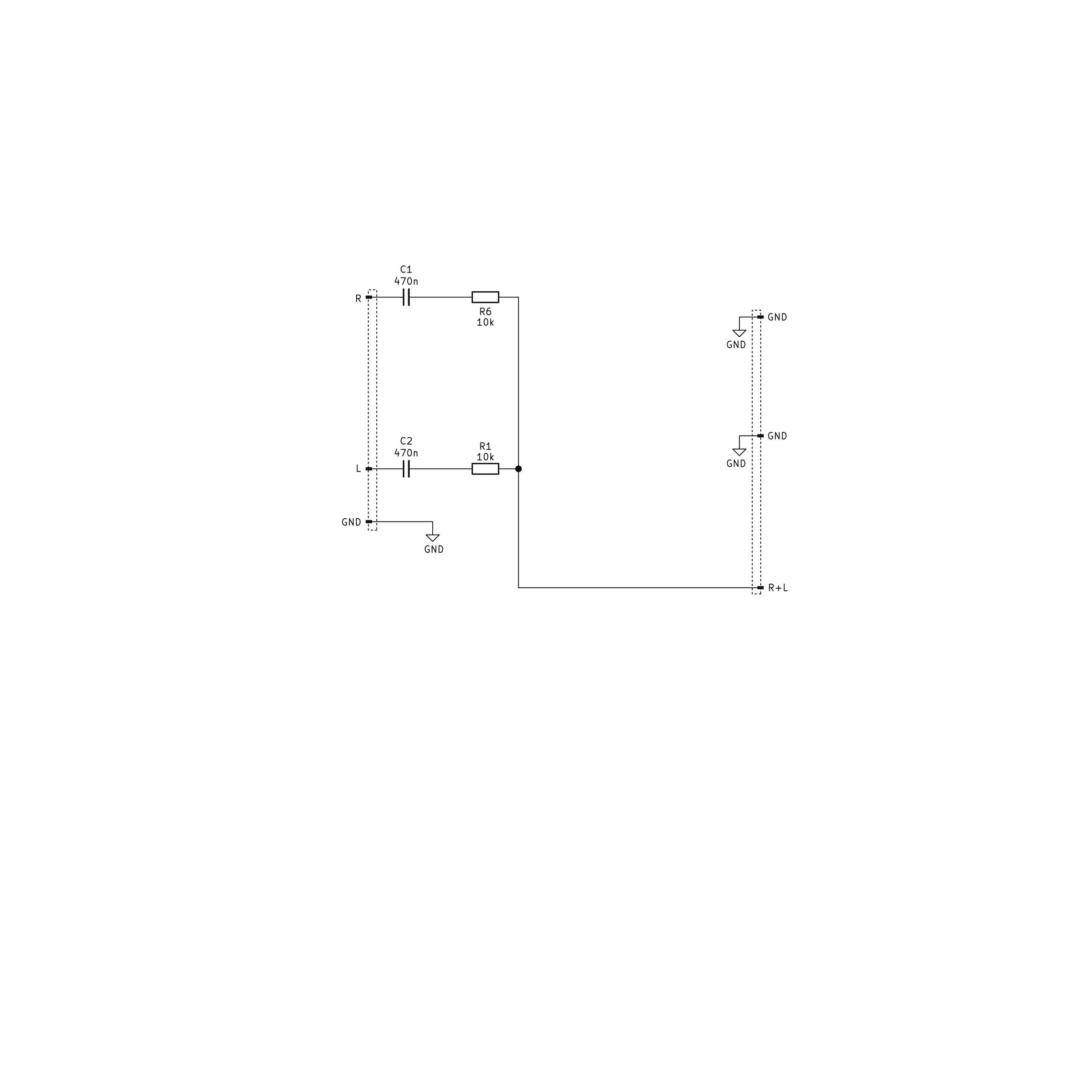
The two (left- and right-channel) audio signals coming from the DAB receiver need to be mixed together in order to be reproduced in mono with the single loudspeaker; this is done with two resistors on an additional piece of matrix board; details in step 4.
I have, by the way, also an idea about how to make use of the amp's second channel in a kind of experimental stereo setup, but this has lesser priority and isn’t contained in this Instructable for the time being. The same piece of matrix board used for the mono mixer will be used for this later addition, with several components added.
Power Supply
Depending on the selected amplifier, some kind of power supply unit is required. For the amplifier module suggested above, a simple mains transformer with a center-tapped, 12-0-12 V secondary winding is sufficient that was available in my junk box.
Loudspeaker
The original design – and its modern Cassina interpretation – feature a rather large, 25 cm (10") diameter, full-range loudspeaker. The driver in the current model seems to be a coaxial, two-way unit that offers improved treble reproduction. In such an open setup, not every HiFi loudspeaker can be used; without going into too much detail, its diaphragm must have a rather stiff suspension, quite different from the units used in closed, air tight enclosures.
For my experiment I use a vintage, NOS (‘new old stock’) Philips AD9710/M8 full range speaker that was hanging around, you guessed it, in my junk box (4th picture). Its efficiency is rather high, and it is appreciated in some audiophile circles for its sound quality. It is a bit smaller (about 20 cm / 8") than the one in the original setup, but I think it might serve well for a first test.
This speaker has been out of production for many years now, but it can be found from time to time in online auctions. It never comes really cheap, but with a bit of luck you might snatch a nice or even bargain unit. A data sheet of this driver is attached below.
Visaton B 200 and Visaton BG 20 are two modern alternatives that you might try; their data sheets are attached below as well.
Mechanical Design

.jpg)

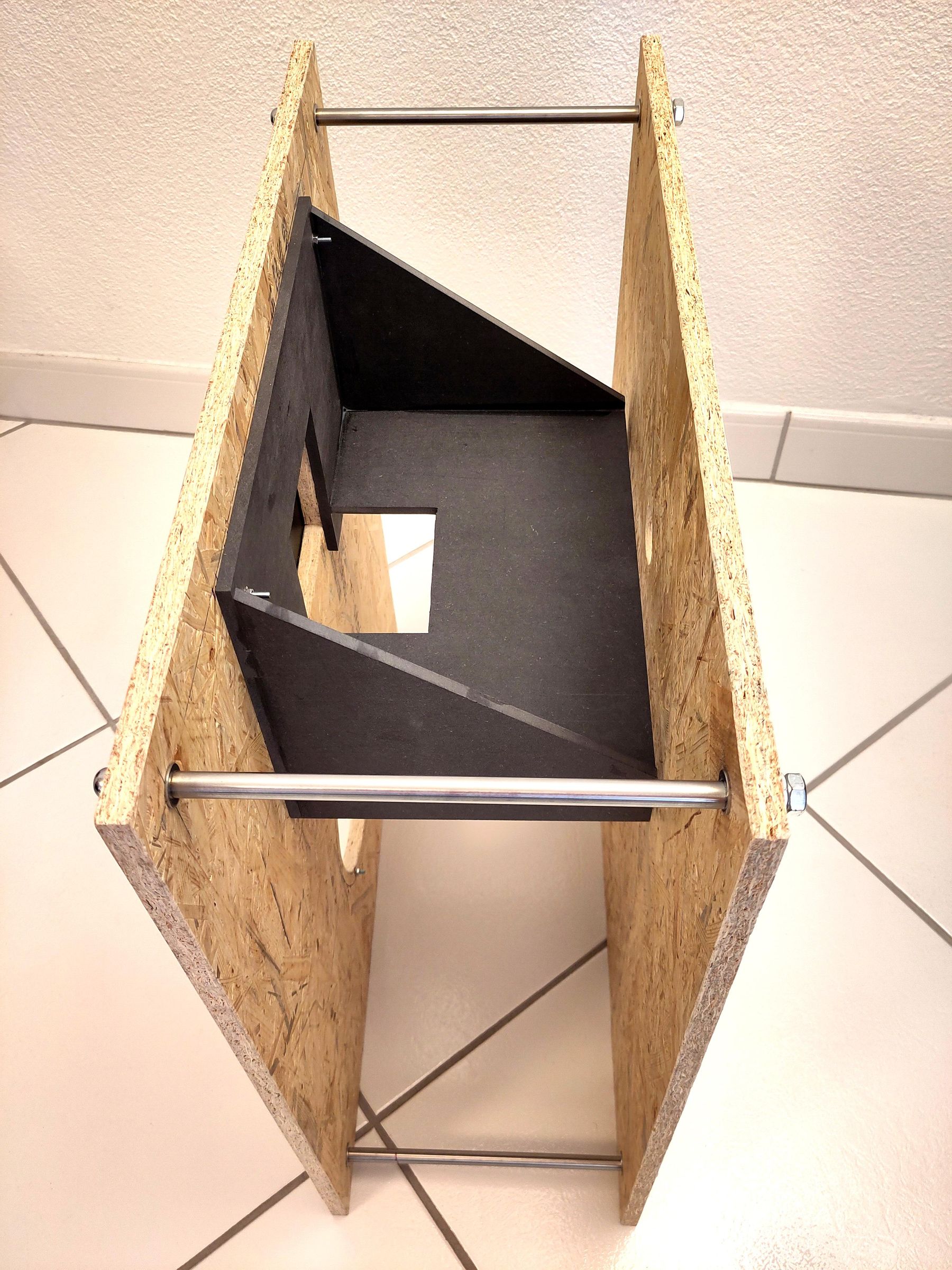
The 1st picture above is a lucky find of the original, historical blueprint by Mr. Albini. The 2nd picture is a drawing of the version suggested by yours truly, showing some details.
I tried to follow the original dimensions but decided to connect the front and rear OSB boards with M10 threaded rods hidden within stainless steel tubes. These tubes at the same time keep the distance between front and rear. At the front there are M10 hex cap nuts, the rear is fixed with two normal M10 hex nuts each that are jammed together.
The mounting chassis for the electronics located behind the front consists of some black-coloured MDF. The front panel made from black PVC and the electronics chassis are both attached with four knurled M4 screws at the front and nuts and washers at the inside (3rd and 4th picture). Shorter versions of the same knurled M4 screws are used for fixing the loudspeaker in its circular cutout, with nuts and washers as well.
The DAB receiver is located behind the cutout in the black PVC front panel and, for the time being, attached using double-sided, adhesive mounting tape; the cutout in the wooden parts needs to be somewhat larger to accommodate the DAB receiver.
Wiring

The wiring of the different electrical and electronical components is no rocket science, see the birds-eye view wiring diagram above. More info will follow asap.
Auto Power On, Mono Mix






Disclaimer: Before opening or modifying your DAB receiver, please consider that you will forfeit any warranty claims when doing so.
Of course switching the amplifier on and off automatically isn't mandatory; you can do that with a manual switch as well. But since the DAB receiver is operated by its remote control only and I'm a convenience fanatic (others might just say that I'm lazy), I prefer the amp being powered up simultaneously with the DAB receiver.
To do so, my first idea was to find a control signal inside the receiver that might be (ab-)used for this purpose. But alas, since it is rather small and full of tiny SMD components, see the 1st photograph above, I didn't succeed.
Then I realised that there is a menu setting for varying the display's brightness – high when powered on, low when in standby mode. The video clip attached below shows the light spill from the right-hand edge of the receiver's display, first in standby, later in active mode. The brightness variation is clearly visible.
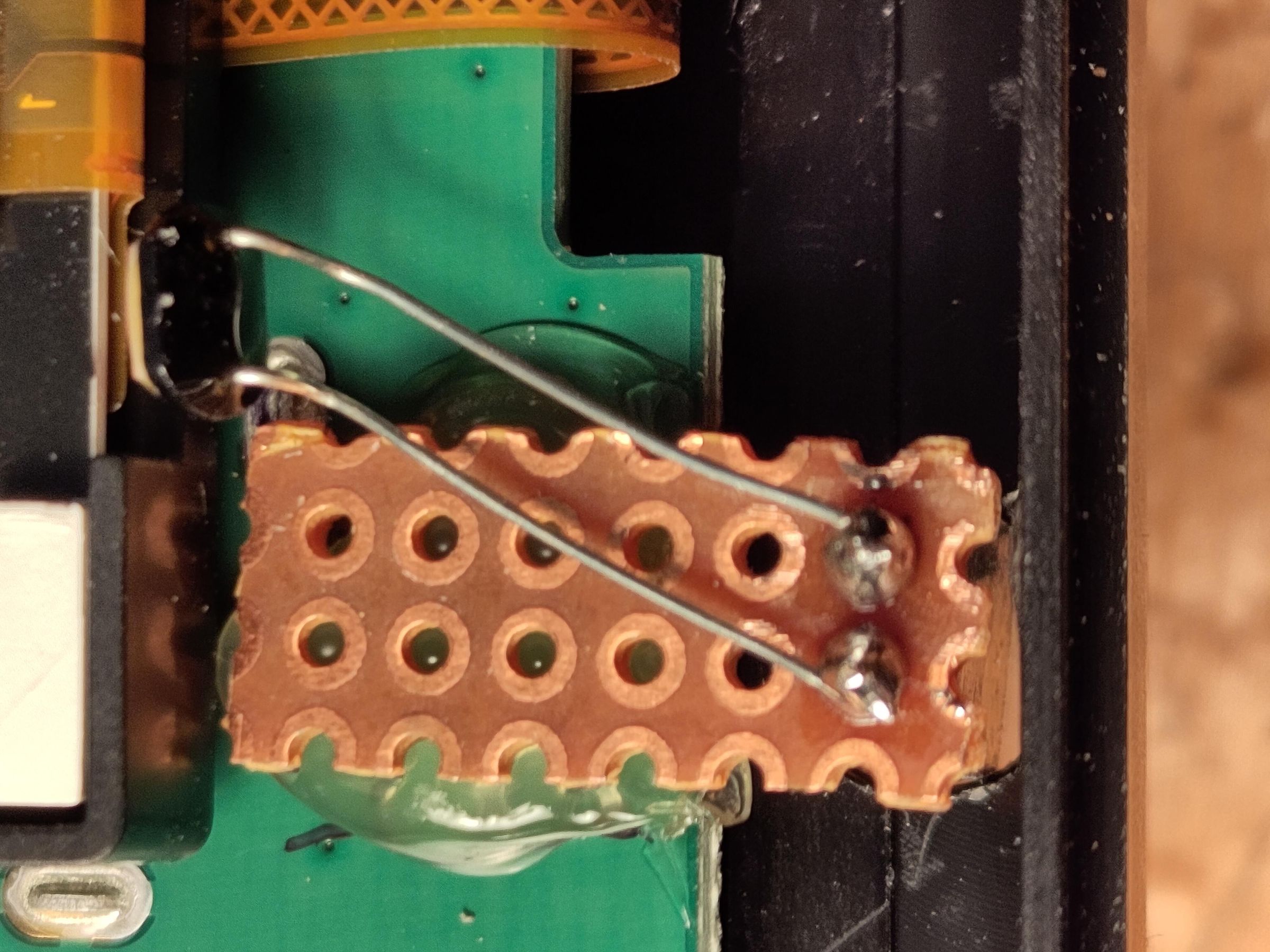
I found a small, light-dependent resistor (LDR) in my junk box, see the 2nd photograph above. An M3 screw and nut are shown next to it for reference. I installed it inside the receiver, facing the side of the display you can see in the video, using a small piece of matrix board and some hot glue (3rd photo); its two terminals are fed to a small, female connector accessible through the back of the receiver's enclosure (4th photo). This way I get an electrically insulated control signal from the DAB receiver that can be processed with some simple analog electronics.
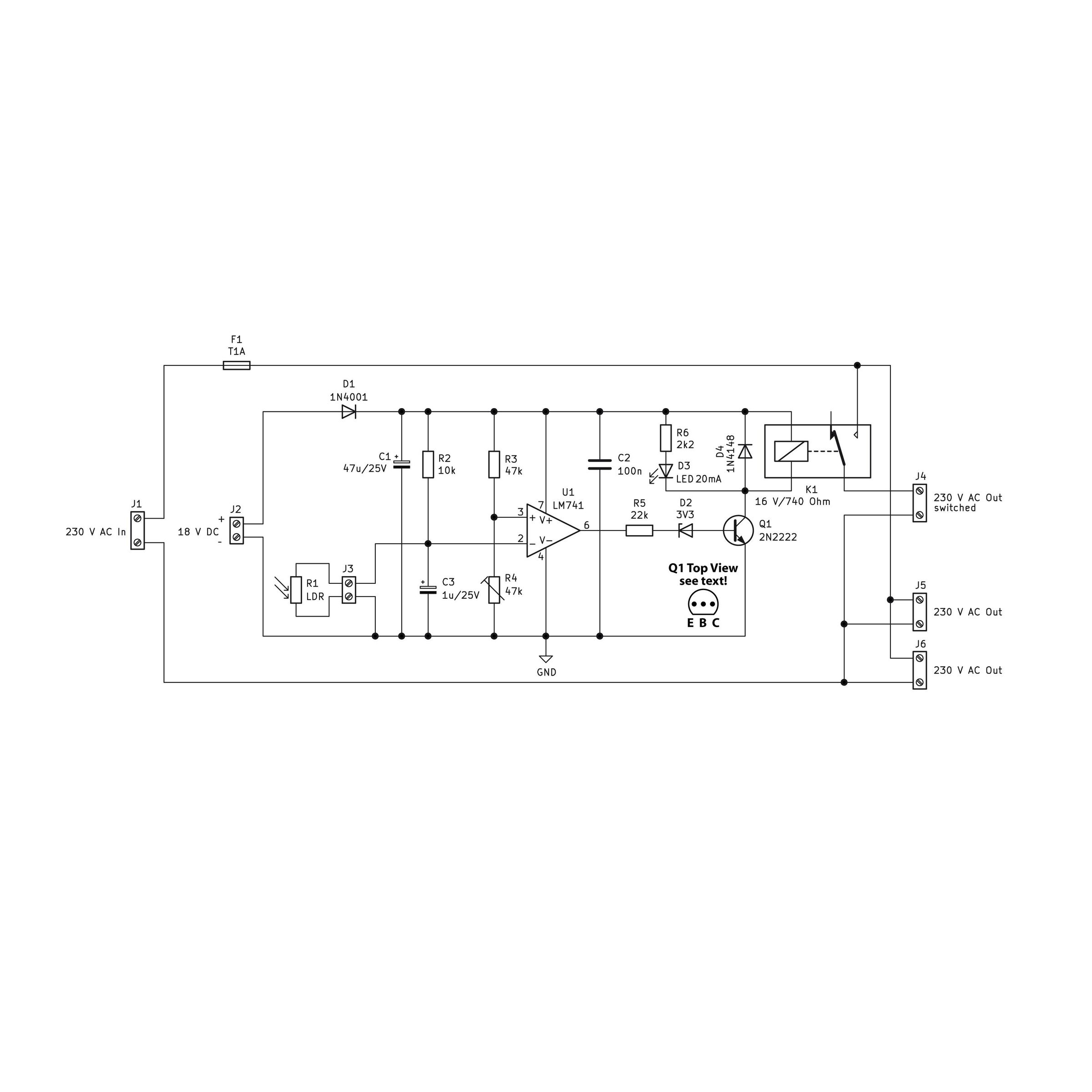
The LDR (R1) is part of a kind of inverted twilight sensor that switches on when the display's brightness increases. Standard twilight switches do the opposite, they switch on when the ambient illumination decreases. The circuit (5th picture) uses a relay (K1) to switch the amplifier's transformer on.
Diode D1 protects against inverted polarity of the supply voltage.
The LM741 operational amplifier (U1) in this configuration works as a voltage comparator. I set the voltage on pin 3 with trimmer potentiometer R4 to a reference value of about 4.7 V, that is, halfway between the voltage in standby mode and the voltage when switched on (6.1 V or 3.3 V, respectively in my setup), measured on pin 2. When the DAB receiver is powered on, the voltage on pin 2 drops below the threshold of 4.7 V, the output of U1 goes high, switching transistor Q1 and relay K1 on - and vice versa: When switching to standby, the voltage on pin 2 rises above the threshold, the output of U1 goes low and switches Q1 and K1 off.
It's nice to have, btw, that the circuit also switches off when the DAB receiver should lose its 5 V supply or when the LDR is disconnected.
For Q1 used a 2N2222 in the TO-92 plastic package I had readily available. This transistor exists in different pinout versions, consult its data sheet before using it. It may be replaced by other NPN transistors, e.g. a BC548 (TO-92), or even one of the venerable BC107 or BC108 series in their metal TO-18 package.
In the beginning I had intended to use a direct supply from the mains, similar to the one used here (https://www.instructables.com/Modified-Laminator-for-PCB-Toner-Transfer-Revisite/). But I ditched the first idea for safety reasons and simply used an additional wall wart delivering 18 V DC.
I built the circuit on a piece of matrix board – see the 'Lochmaster' sketch and the photograph (6th and 7th pictures). The second video clip below shows the first test of this setup connected to the DAB receiver, and switching it on using its remote. You can see both the LED on the matrix board lighting up and the relay energising at the same moment. On this board also the mains voltage is distributed; there are screw terminals not only for the mains input and the switched output for the amp's transformer, but also unswitched outputs for the two wall warts.
Apart from the LDR, only standard components are used. But depending on your DAB receiver, the LDR and the relay you use in your setup, some modifications will certainly be necessary for your own circuit. So I think you can compile your own BOM from the circuit diagram.
Please note: When designing your own circuit or PCB, take care to provide sufficient clearance between the low-voltage part (around the operational amplifier) and the mains-voltage part (relay contact and mains in-/outputs).
The mono mixer used to combine the two stereo channels into a mono signal is built on an additional piece of matrix board that is largely empty for the time being; two resistors, input/output connectors and some bare wire are sufficient. The somewhat strange looks of the diagram and the matrix board layout (pictures no. 8 and 9) are due to the fact that it might be modified in the future for an experimental stereo setup; this isn't part of this instructable right now.
How It Looks (and Sounds)
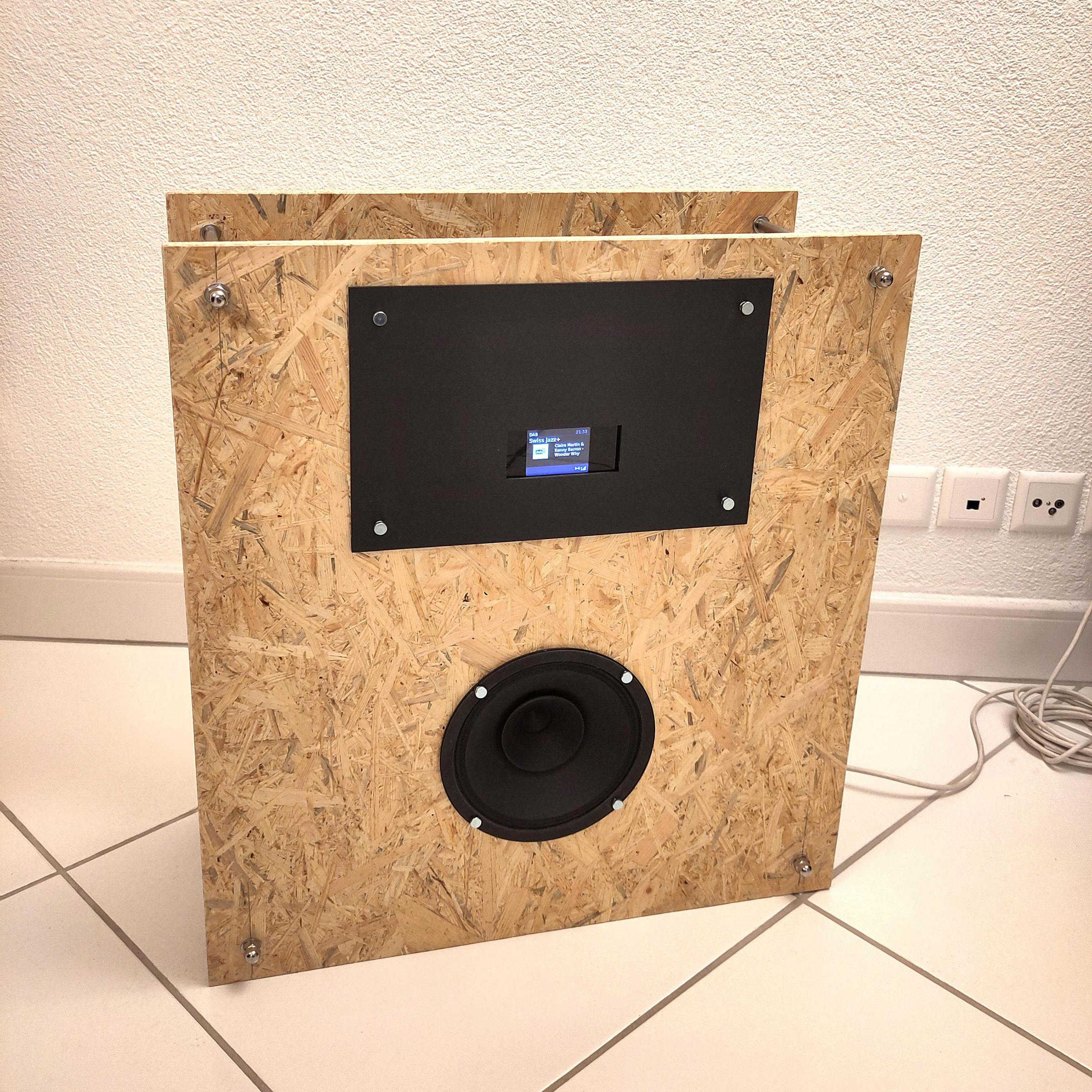
I admit that, although the dimensions are the same, my project looks larger and heavier than the original version, due to the fact that I used wood instead of glass. Apart from that I didn’t have sufficient time to paint the OSB wood with silver paint as intended in the beginning. Once this is done, updated pictures will be posted.
The deadline for the contest caught up with me much faster than expected. Unfortunately I could not perform extended listening tests because it was late at night already; however I will happily post an update as soon as possible – apologies for that.