Building a Regenerative Vacuum Tube Radio: the 20th Century Invention That Made Home Radio Practical
by CapeGeek in Circuits > Wireless
2685 Views, 3 Favorites, 0 Comments
Building a Regenerative Vacuum Tube Radio: the 20th Century Invention That Made Home Radio Practical

One of the earliest radio receivers was the crystal set, used as early as the 1900s, but it required long wire antennas and was not very sensitive. Fleming and Lee de Forest invented the vacuum-tube radio in 1906, which significantly improved convenience. However, early tubes were expensive and only slightly improved sensitivity until Edwin Armstrong invented the regenerative receiver in 1912. In a regenerative receiver, the vacuum tube first amplifies the tuned signal, then feeds a small amount back via a tickler coil. This positive feedback loop greatly increases sensitivity and selectivity while using fewer tubes. This simple improvement enabled receivers to detect signals hundreds or even thousands of miles away, making long-distance wireless communication practical. As a result, regenerative radios were widely used from the mid-1910s through the 1920s.
While we currently live in the age of the Internet and streaming broadcasts, I have always been fascinated by historical radio technology. Previously, I've built a crystal set and a de Forest radio using vintage components that you can still find. Both have the disadvantage of requiring long wire antennas to perform well, so I wanted to build a regenerative radio to compare performance. Part of the fun was trying to build one as close as possible to the original components. Fortunately, that is not difficult to find with internet searching.
There are many articles on the construction of this classic radio circuit, so I will focus on the physical construction here rather than on the circuit itself. Search for articles on Vacuum Tube Reflex Radios and Loop Antenna Coil Radios. Here are good examples:
https://earlyradiohistory.us/1922sup.htm
http://www.analogdial.com/MRLClone/MRLClone3.htm
https://www.iw5edi.com/ham-radio/5909/daves-homemade-loop-antennas#google_vignette
https://www.circuits-diy.com/am-loop-antenna-radio-signals/#google_vignette
The regenerative radio described in this Instructable uses a loop antenna coil instead of the typical "oatmeal box" coil used in most homemade crystal set radios. Instead of enameled magnet wire, I obtained authentic Litz wire, which yields higher-quality (called "Q") coils with lower loss. Instead of using today's PCB or breadboard for connections, I hand-wired it using brass screw posts and Fanstack clips. The final result is very close to one that would have been home-built in the 1920s.
This article reviews the history in more detail:
Supplies
While these are primarily vintage-style components, they are all readily available on Amazon or eBay using the labels listed here. Shop around for the best price, as they will vary widely.
Vintage vacuum tube type 30, 56, or equivalent (check eBay)
Matching 4 or 5-pin tube socket
Wood lath: 8 ft x 3 in x 5/16" (for antenna loop)
Plywood 10 in x 6 in x 1/8" (project base)
Litz wire, 50 meters (24-gauge enameled magnet wire can be substituted): https://a.co/d/0bSAqOLh
- 40 turn loop coil on a square frame 1 ft x 1 ft (see pics)
- 16 turn tickler coil on a 3-6" embroidery hoop: https://a.co/d/03YaoMkU
2 meg Resistor
.001 uf disk capacitor
.0001 uf disk capacitor
5 mh RF choke
365 uuf, single gang, variable capacitor: https://a.co/d/08GVA1Ds
Old-fashioned, high impedance earphones (2K ohm NOT a low ohm newer earphone or crystal)
(2) 1.5 volt batteries for filament A supply
(4) 12 volt batteries in series to provide 48 volt plate voltage B supply (22 to 90 volts will work) https://a.co/d/0irapcVr
Miscellaneous hook-up wire
Fahnstock Clips: (check Electronix Express)
(20) 6-32 x 2/3" brass nuts and bolts (used for solder posts)
Building the Loop Antenna Coil Frame


The first step is to build a frame for the loop antenna coil. I consulted several design references and chose a design with a frame that forms a coil measuring 12 inches on each side. It is made of 5/16" wood lath, with two 17" pieces forming the X cross, as shown in the picture. There is nothing elaborate about this construction. Just use your own judgment. It can also be made larger. The theory states that the larger the coil area, the higher the sensitivity. I went with a small size to make it tabletop scale.
Make the Loop Antenna Coil and Base
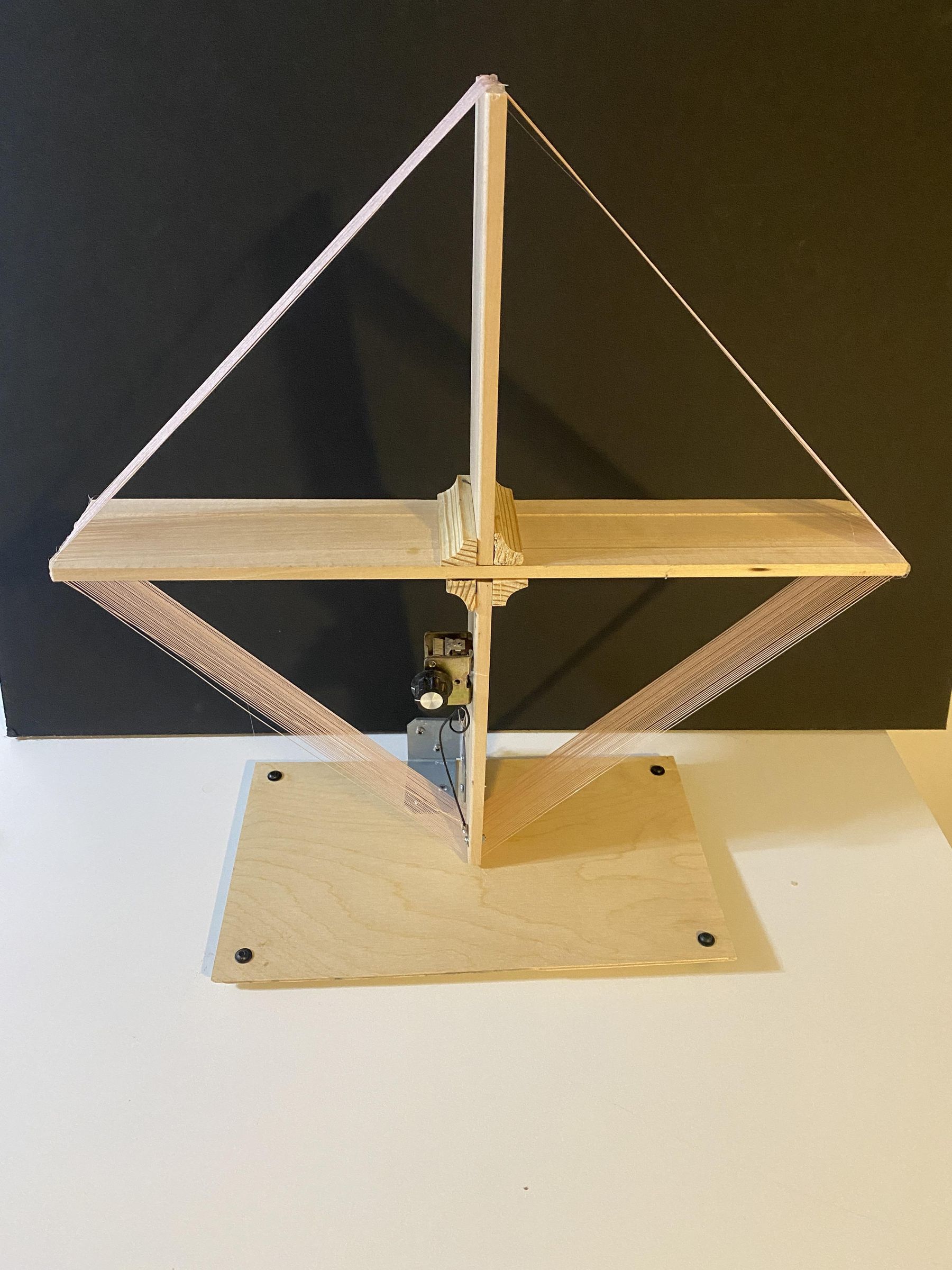

First, wind the coil. If available, use Litz wire. Instead of a single strand of copper, Litz wire has multiple thin, individually insulated wire strands woven together, which reduces its resistance at radio frequencies. If not available, traditional 24-gauge enameled magnet wire can be substituted.
I found a trick to make winding the wire more stable while winding. I coated the ends of each leg of the X frame with a strip of hot glue (see picture). Let that dry. It will then anchor the wire as you wind it, keeping it from sliding off. Then wind 40 turns of the wire around the frame. The ends can be soldered to small brass screws.
Looking at the picture, you can devise your own method for attaching the X-frame to the plywood base. I used angle brackets, which are easy to adapt.
Finally, mount the variable capacitor (with the tuning knob attached) to the wooden frame. It can also be mounted elsewhere. Connect one wire of the antenna loop to one side of the variable capacitor, then connect the other loop wire to the other side of the variable capacitor. You will connect this to the rest of the circuit in step 4.
Wind the Tickler Coil

The tickler coils are wound on 3-6" embroidery hoop frames, available in fabric or craft stores. The term "tickler" is jargon, as this coil is the means by which feedback is fed back, or the input stage. I used 24-gauge magnet wire instead of Litz wire here, but that is your choice. Again, apply a few hot-glue stripes to help anchor the wire as you wind it. You can drill two small holes to anchor the start and ends of the wire. Once this is finished, you can hot-glue it toward the bottom of your loop antenna coil, as s "tickled," to thown in the earlier photos. Leave several inches of wire at the start and end of the coil to connect to the circuit. Also, use a knife to carefully scrape off the insulation from the wires so they can be soldered.
Attach the Tube Socket and Components


Make a selection of the type of vintage tube you are going to use. Probably a 30 or 56 or equivalent. You can find circuit descriptions in the many articles on regen receivers listed in the introduction. Once you pick a tube you can look up the specs and socket connections online. You also need to find a matching tube socket. It may take some searching on eBay, but you can locate sockets for the type of tube you have selected. Screw this to the bottom frame of your project.
Once the socket is attached to the plywood project base, you can mount the components (capacitors, resistors, etc.). It is not very complicated. There is nothing special about the wiring arrangement. I drilled holes and inserted brass screws in the plywood base to attach the wires and components. You may find a different solution.
The circuit for this regenerative receiver is fairly simple. Checking the online diagram for the tube socket pin connections. Below is a rough description of the connections that need to be made, but the steps should be fairly obvious. There is no absolute sequence, but the steps will include:
- Drill holes and insert brass screws to use as solder posts as needed.
- Solder the 5mh RFC choke between a post and one of the earphone Fahnstock clips
- Solder the .0001 disk capacitor in parallel with the 2 meg grid leak resistor between two posts
- Connect a link between the other earphone clip and the a second clip that will become the B+ battery connection.
- Connect one tickler coil wire to the tube plate contact on the tube socket and the other to the RFC choke solder post. Then connect the other tickler wire to the RFC choke post.
- Connect a wire between the two filament contacts on the tube socket and the two tube socket Fahnstock clips.
- Connect one wire from the variable capacitor to the B- and one filament post, and the other wire to the other post of with the 2 meg resistor and .0001 disk capacitor.
- Solder the .001 disk capacitor between the RFC choke post and the B- Fahnstock clip.
- Connect a wire between the B- clip and one of the filament clip.
Attach Earphones and Power Supply and Test
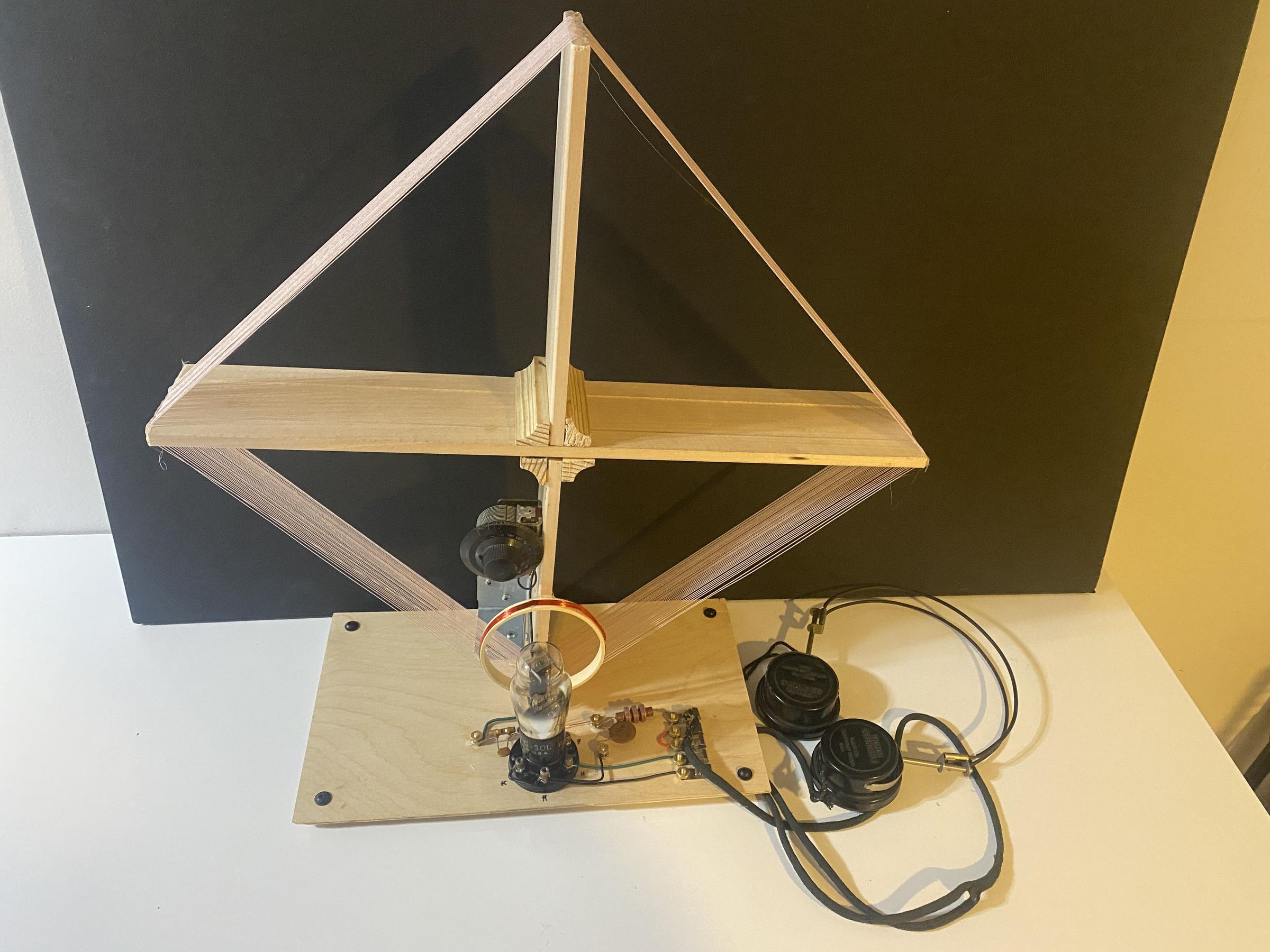
This completes the basic construction. Connect the batteries or other power supply sources and the earphones. Check the specs of your chosen vintage vacuum tube online. Most have a filament voltage of 2.5 volts. This can be supplied by two 1.5-volt batteries in series. The plate voltage will be in the range of 22 to 90 volts. I supplied this by connecting four miniature 12-volt batteries in series for a total of 48 volts. You can also use external DC power supplies if available.
If you are fairly near an AM radio station, you should be able to pick it up. If you hear static, you may be picking up interference from fluorescent or LED lights. You can also try reversing the wires on the tickler coil, as they may be out of phase. If you do not get a signal, you can increase the range by adding a length of wire antenna to the loop coil. Connect it to the top end, not the ground end of the coil.
Be aware that many modern earphones have low impedance. You need an old style with around 2K ohms.
Enjoy

Enjoy, and picture yourself sitting in your living room, wearing earphones to listen to early radio broadcasts from the 1920s! It certainly was a different time. Notice the huge loop antenna in the background.