DIY Tabletop Mobile | How to Make a Hanging Mobile Using Clay, Wire & Packaging!
790 Views, 5 Favorites, 0 Comments
DIY Tabletop Mobile | How to Make a Hanging Mobile Using Clay, Wire & Packaging!
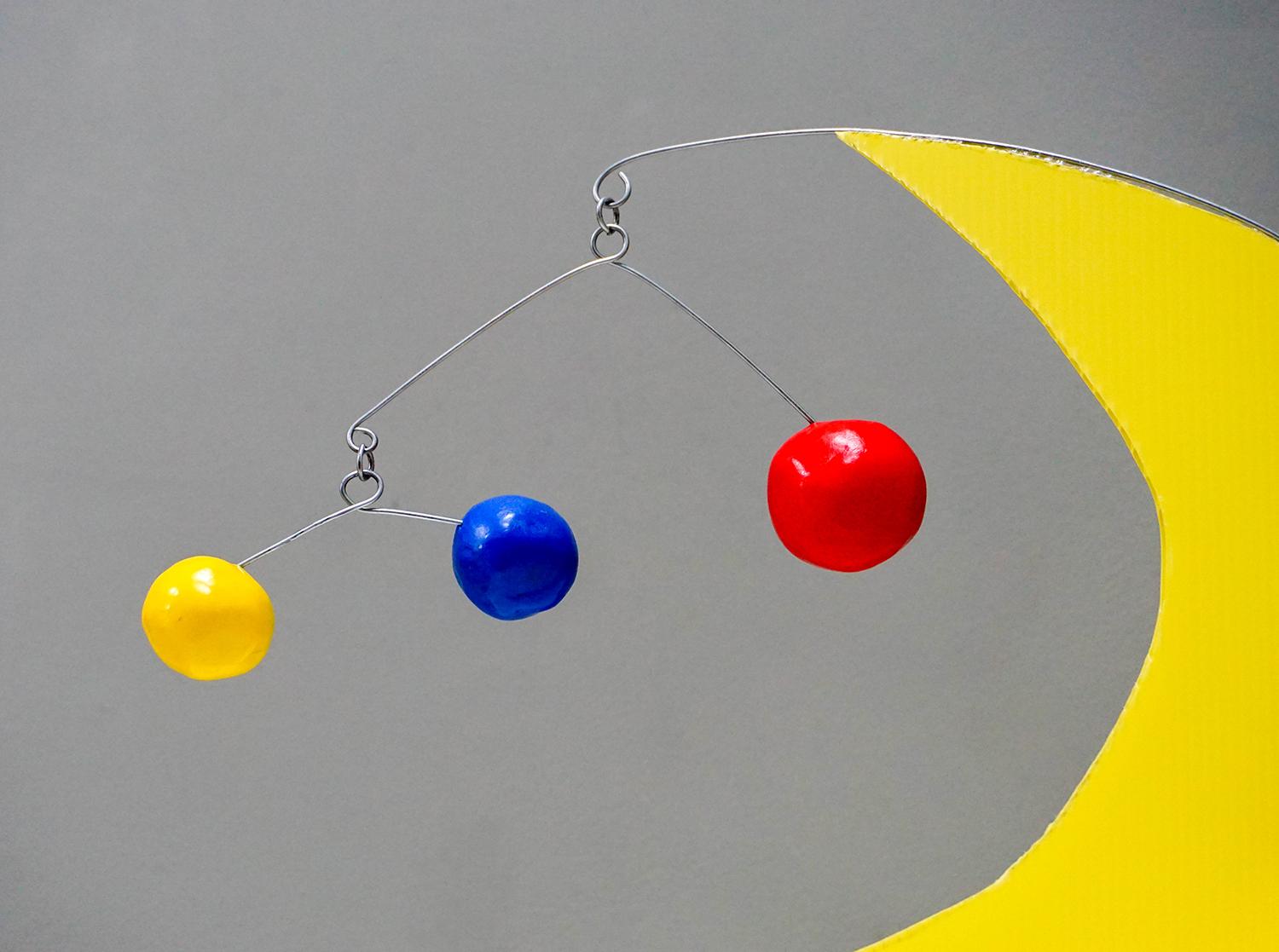


I’ve always loved mobiles - particularly the kinetic sculptures by Alexander Calder – and I so decided to make my own very simple tabletop version. I’m going to mostly be using wire and polymer clay, plus I’ll recycle some corrugated plastic packaging for the stand.
I hope you enjoy this project!
Supplies


- Polymer clay; I used Fimo clay in yellow, blue and red. I assume air dry clay could also work, but I haven’t tried that.
- Clay tools & necessities - acrylic roller (optional), cutting blade, oven, and a ceramic tile or another surface to bake the clay on
- Corrugated plastic sheet: I already had a piece of this packaging that I wanted to find a new use for. Obviously something sturdier and more versatile like MDF or plywood would be the ideal choice if you have access to it.
- Small amount of sandpaper; in around 350 grit and at least 800 grit.
- Scrap of white fabric for buffing the clay (optional); I used a scrap of woven cotton denim
- Utility knife
- Ruler
- Strong clear glue; I used UHU all-purpose adhesive
- Cutting mat
- A way of marking material in a non-permanent way; I used a whiteboard marker
- Stiff wire; I used 1.6 mm galvanized steel wire
- Wire bending pliers; ideally, round nose pliers and looping jewellery pliers
- A piece of paper & a pen/pencil
- Masking tape
- Strong wire cutters
- Varnish or other clay finish (optional); I used FIMO gloss varnish (& an old paintbrush)
- Scales to weigh your clay
- Aluminium foil
Cut Out the Stand Pieces
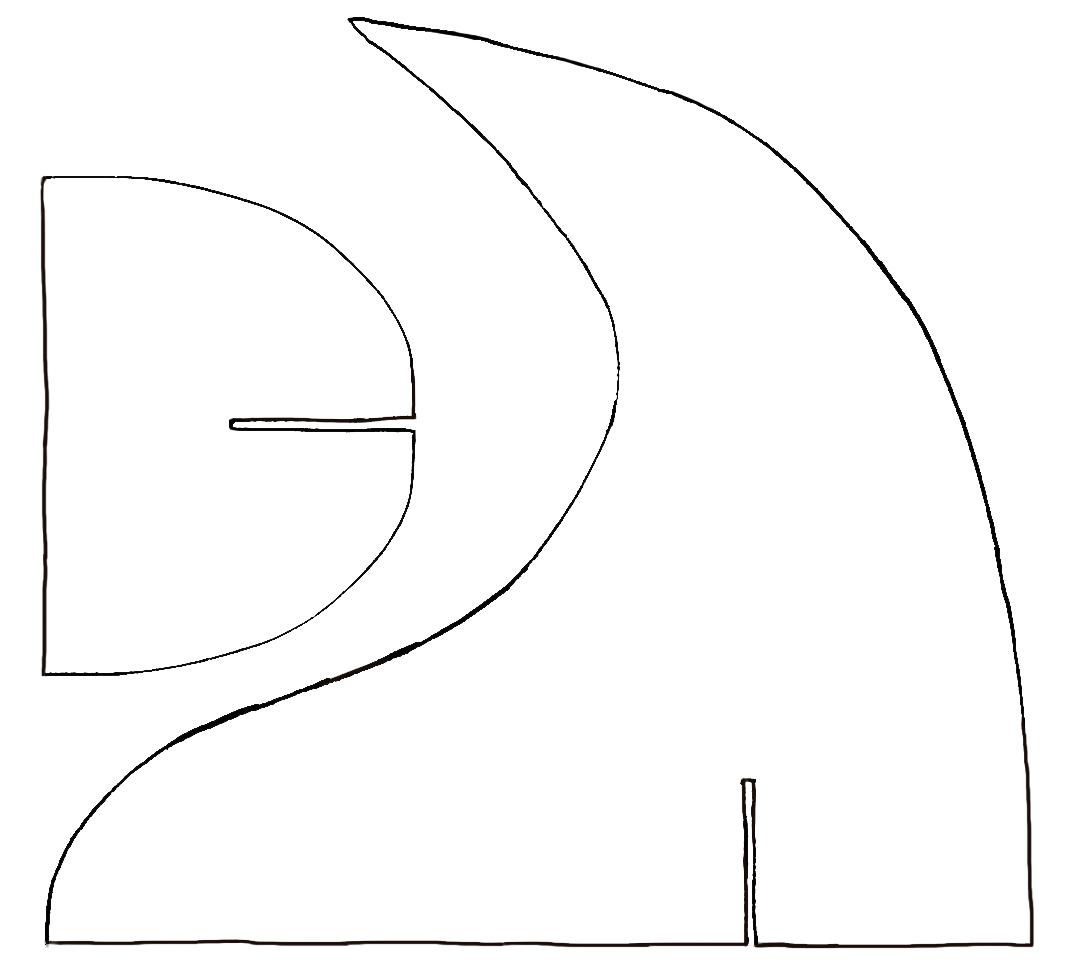


You will first need to draw and cut out paper templates for the 2 pieces of the stand; these will need to slot together at right angles.
Above you'll see a rough outline of the shapes I used. Because I wanted to reuse some corrugated plastic I already had, I made sure to fit the design into this area, but you likely won’t have the same limitations. Just think about the design you’d like, think about stability, and maybe have a look online for inspiration. You don't need to use the same shape I've used. My mobile overall was about 12 x 12” (or 30 x 30 cm) when finished.
Trace around the template onto the plastic (or whatever material you're using). I used a whiteboard marker so it could be wiped off later.
Once you’ve done that, carefully cut along these lines with a utility knife, making sure there’s a cutting mat underneath.
You’ll notice that there’s a slot in the top of the sort-of semi-circle shape on the left, and a slot in the base of the wave shape on the right. These slots will allow the pieces to fit together into a 3D freestanding shape, so test the slot sizes with a paper template first to make sure these will fit together well. In this case, the length of the slot in the wave shape needs to be the same as the gap underneath the slot in the other shape. The width of the slots needs to be a tiny bit more than the thickness of the material you’re using.
In hindsight, I should’ve put the slot in the wave shape closer to the left-hand-side, since that’s where all of the weight is going to be in this particular design. It worked out perfectly fine like this, but where you place the support is something to think about in your project, since the weight won’t be balanced evenly across the entire stand.
Add the Wire Support


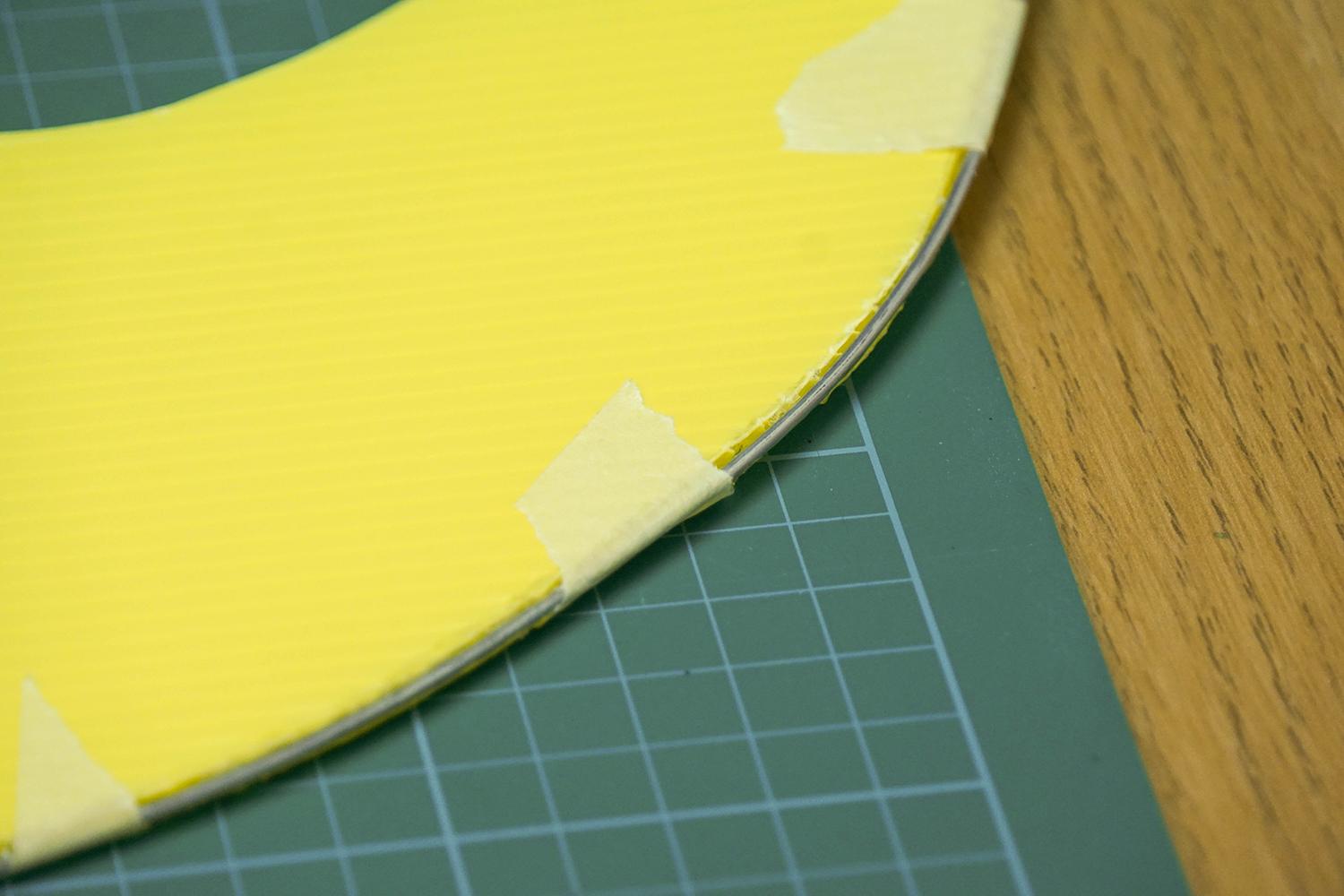


Next, attach a length of wire to the stand. This wire will become the hanging loop that will hold the mobile section aloft.
I bent a short section of the wire at one end and pushed it into the edge of the plastic, at the base (see photo), then glued this in place. Next, I shaped the wire up along the outside edge, leaving a good amount of excess at the top to turn into a hanging loop later.
Glue the wire into place on the edge of the plastic once you've made it the correct shape. I used UHU all-purpose adhesive. Use masking tape to keep the wire in position until the glue dries.
Note: If you’re using a stronger material like wood then you can skip this step; in that case you'd be able to drill a hole in the pointed section at the top of the the stand and hang the mobile section from there instead.
Wire Plan
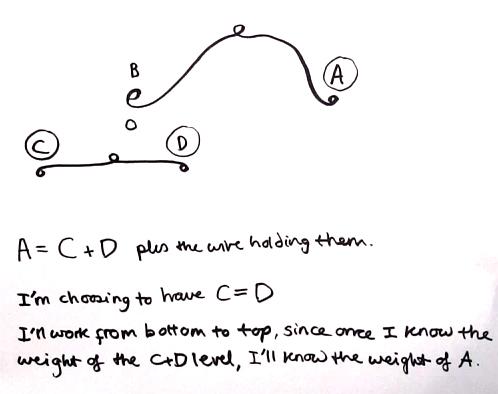

I started by making a diagram of my plan; a 2-level mobile with one piece of wire being curved, and the other straight. Note that I ended up curving both pieces of wire.
The 'lower level' of wire will hang from point B. In order for this to be balanced, the clay I put at points C & D must pretty much equal the weight of the clay at point A. To make it simple, I’ll make the clay at points C & D equal in weight, (and I’ll be starting with that level).
When you’re designing your mobile, just keep in mind the space that is available for the pieces on your stand. The maximum size of space I had to work with was nearly 30 by 30 cm, but I made mine smaller than that so it would fit on my windowsill. Remember that the wires will be able to move and rotate so it may take up more space that you think!
You want to start by making the two wire pieces. For the 'lower level' section, I straightened out some of the wire and cut a length of 17 cm. I added a loop in the centre of this wire (using looping jewellery pliers), which made the wire 14 cm long. I made 2 further loops - one at each end - making the wire length now approx. 10.5 cm. And finally, unlike the diagram, I decided to add a curve to it so the mobile will be longer.
Note that if you want to have more clay at one end of the wire than the other, you’ll need the middle loop to be closer to the heavier weight in order to balance it out. You can calculate the measurements and weights by using a counter balance weight calculator that you can find online. I don’t need to do that though because I’m making mine symmetrical.
For the 'upper level' wire, do pretty much the same steps, but start with a length of 24 cm. My piece of wire, after adding the loops, measured 18 cm long. Remember to add a nice curve to it too.
Clay Ball #1


You need to begin this step by conditioning as much clay as you think you’ll need, bearing in mind that you can reuse any that’s left over, and you can always condition more if you need to. I’m using yellow Fimo polymer clay, and I’ll be using a ceramic tile as my work surface (and my baking surface).
Conditioning clay is the process of making it workable. My clay was quite hard, so I conditioned it bit-by-bit instead. To do this, take a smaller amount and simply keep reshaping the clay – squashing and rolling it – until it becomes pliable and doesn’t crack when you fold it. You want to heat it up with the warmth from your hands as you go, and I find it most effective to roll it into a sausage shape, then into a ball, then a sausage shape and so on to get it conditioned thoroughly.
Once you’ve conditioned one section, repeat again and again until all of the clay is warmed up, then smush all of the sections back together and condition it all at once.
I made the clay into a ball and pushed one end of the wire into it. Try and mould the clay around the wire closely, so the wire is firmly embedded.
Clay Ball #2


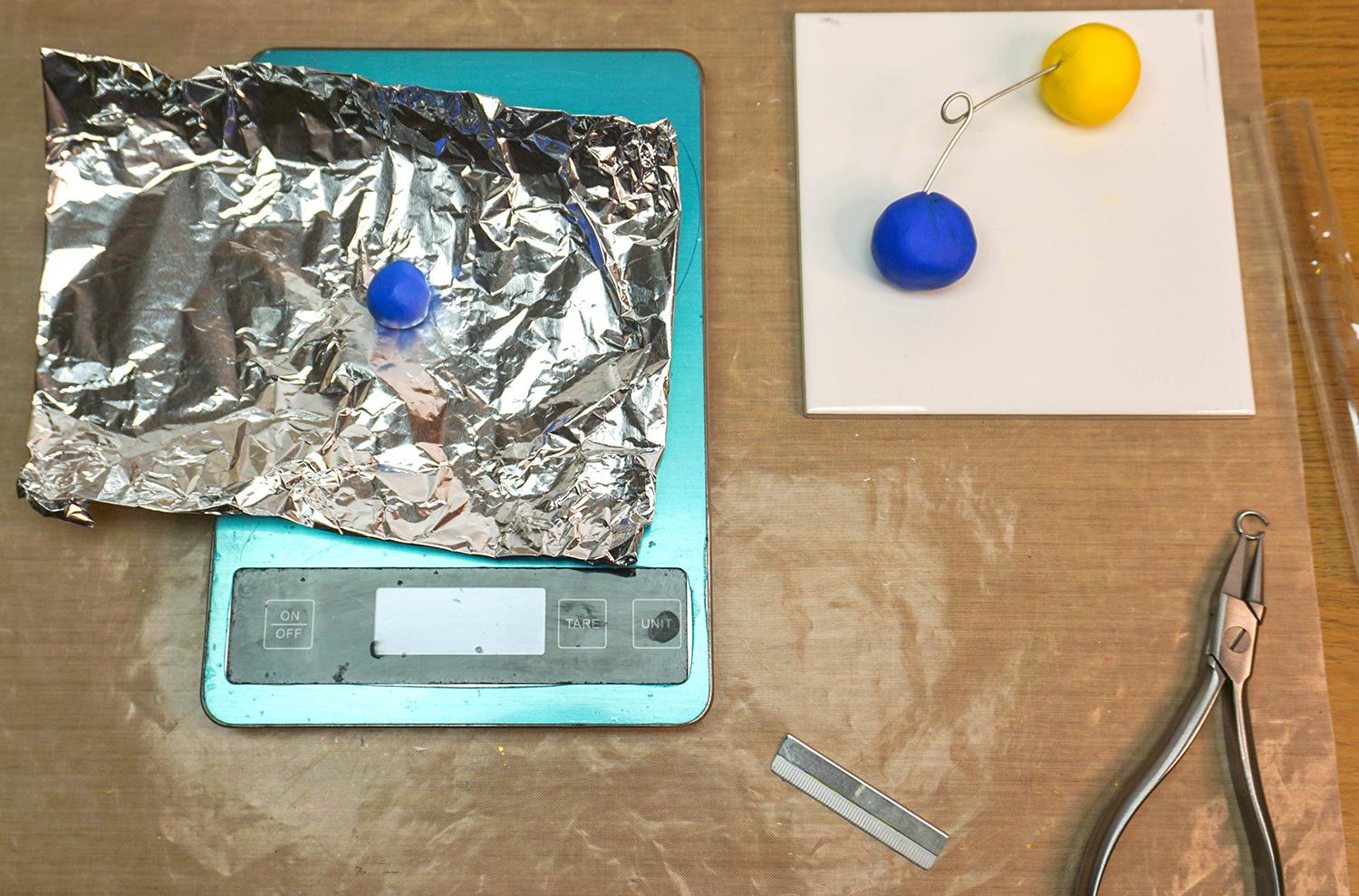


You’ll need scales to weigh your clay, but make sure you use foil under the clay because you don’t want anything that you use for food to come into contact with the clay.
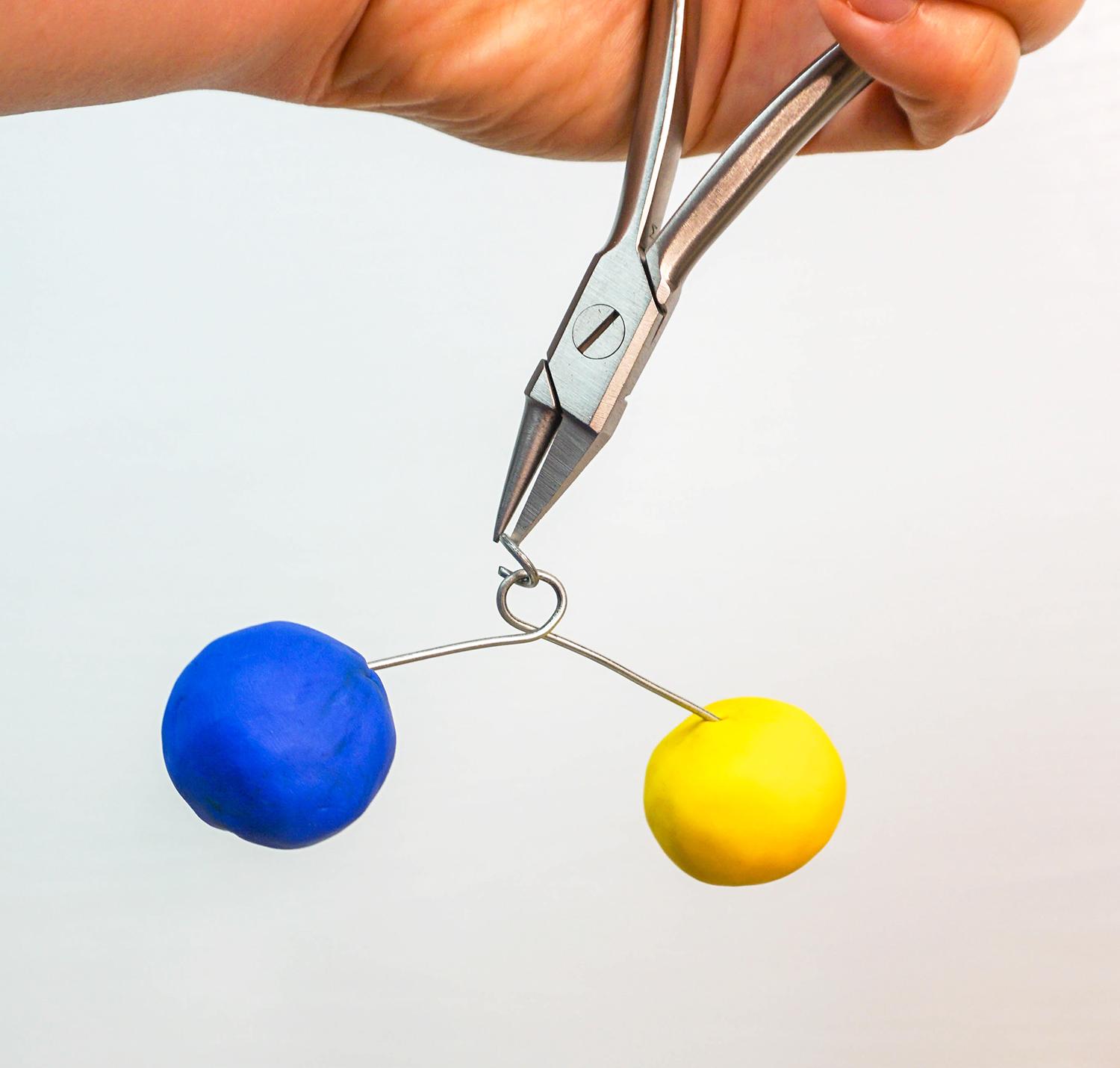
The yellow clay plus the wire weighed in at 27g, so I then conditioned a little more clay than that, this time in blue. Once I’d done that, I roughly pushed the other end of the wire into it, and balanced this from a jump ring*, using my pliers. Look at it from eye level to see if it’s balanced, and judge whether you need to take away any clay or add more. I needed to remove a bit.
*You'll need 2 jump rings for this project, so wrap the wire around the round nose of your pliers and cut it to give you a ring shape. Try and make this ring join smoothly and lie flat. Repeat this so you have another ring.
Once you’ve shaped the blue clay how you want it, you’ll need to bake this in an oven, following the instructions on your pack of clay.
If, once the cool has cooled down completely, there’s a gap around the wire where it enters the clay, condition a tiny bit of clay and smooth it onto the baked clay (see photo) - then bake it once again. Try and add a minimal amount because it will affect the weight balance.
Clay Ball #3


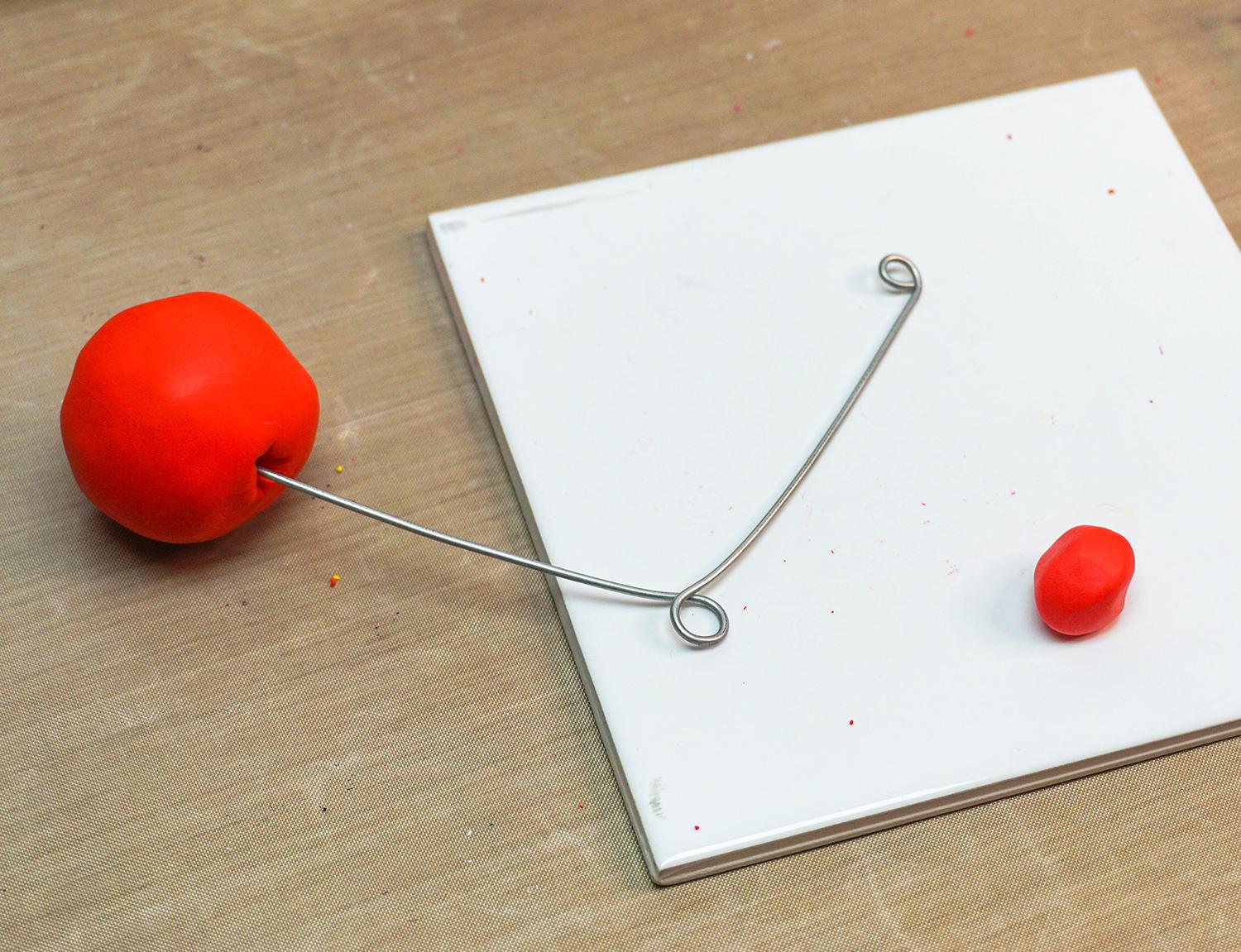

Once cool, weigh the piece you just baked. Mine weighed 51g. I am now, therefore, going to make a ball of red clay that weighs 51g.
Note that I wouldn’t really recommend making the actual mobile section much heavier than this one, as the stand won’t be sturdy enough to hold the weight well… so if you want to add more weight to the mobile, make sure you also make the stand sturdier than my single layer of plastic :)
Once you’ve made that larger ball of clay, press the other piece of wire into it, mould the clay around it, and then bake it. Again, if there's any gap around the wire, fill that in with a bit more clay and bake again.
When that’s fully cooled, I recommend that you sand the clay, particularly the flat shiny area where the clay has rested on the tile. I wouldn’t really go below a grit of a few hundred, and I’d finish with a grit of 800 or finer.
I also used a scrap of woven cotton denim to buff the clay, which gives it a subtle shine. All you do is vigorously rub the clay surface with it. That’s an optional step, though, as I'll be adding varnish later.
Assembly


Shape the wire at the top of the stand into a hanging loop, and cut off any excess.
Open up the 2 jump rings you made earlier by twisting them apart with 2 pairs of pliers.
Next, assemble the pieces of the mobile by using the jump rings to connect the wire levels to each other, and then attach the top level to the hanging loop on the stand.
Varnish


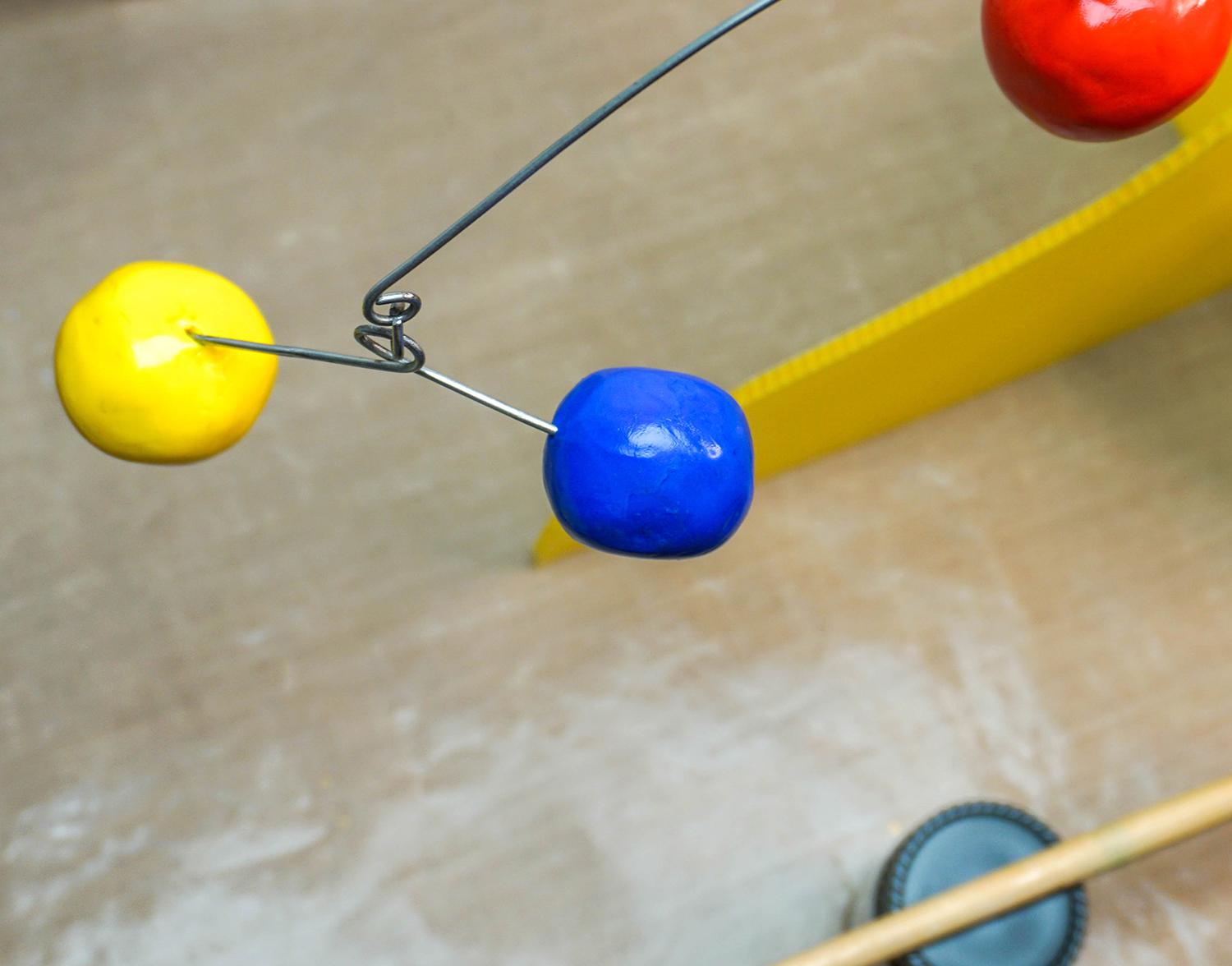
I used an old paintbrush to apply some Fimo gloss varnish to the clay to add some shine, and tried to brush out any bubbles that formed on the surface.
Note: There are various finishes you can add to polymer clay, or you can choose to leave it uncoated.
Once the varnish is dry, your mobile is complete!
Finished!


I really like the result, and I hope it inspires you to give it a go yourself! Feel free to experiment with different materials, colours and shapes too.
Thank you for reading :D