Don’t Be Afraid of the Dark… or Circuits!
by Zorjac Maker in Circuits > LEDs
56 Views, 1 Favorites, 0 Comments
Don’t Be Afraid of the Dark… or Circuits!


Ever since I could remember I have been afraid of the dark. Even in college at UW Madison, when I am alone in the lab, I have a feeling that something is out to get me. It could be monsters, zombies, or EXAMS!!! But anytime I get afraid of the dark I remember Iam going to school for engineering and I can scare away the homework by wiring a simple circuit… or something like that😊. Circuits also have always scared me. Ever since I tried fixing a lamp, that was plugged into the 120V AC, which gave me the shock of my life, I have avoided the invisible menace of electricity. Now that I am in college and have lived and learned from my experiences, I can conquer my fears of electricity by facing it! The best way of exposure therapy is to research, face it, and conquer it! This instructable will first research a basic LED circuit, visualize it in TinkerCAD, build it with Arduino circuit, and walk away with a conquered fear!
Supplies
.jpg)

.jpg)
.jpg)

.jpg)

-1) Use of a computer for an hour or two
-2) Use of TinkerCAD
-3) Access to a power source, 3 Volt DC battery or even DC buck converter
-4) One 220 Ohm Resistor
-5) One LED, any color
-6) An assortment of wires
-7) An electrical bread board is optional
-8) A parental guide and a great attitude!
Researching the Fear
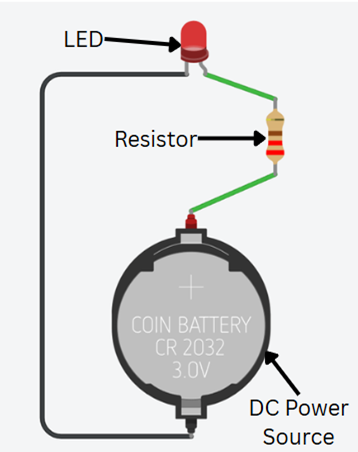
First, we are going to cover the basics of electricity, and then simulate a simple DC circuit to power an LED to conquer the dark. Don’t be scared! We are going to start by just simulating a simple circuit. It has just three parts: a DC power source, a resistor, and an LED. Simple, right? But together, they are about to become your team of heroes! So let us see this circuit in action by opening a computer. I used my student account through Autodesk to access TinkerCAD and opened a default simple LED circuit. Hit "Start Simulation" and the LED will turn on, now we are ready to do this in real life!
Building Our DC Circuit
.jpg)
.jpg)

Now that we have a proper understanding of the circuit, let build this! Instead of soldering wires, which can be scary, we can use an electrical bread board. An electrical bread board is a way to connect wires easily, each row is connected and each "-" and "+" column is energized with whatever power source we connect. I have a 9volt battery which is too much power so I will use a pre-built circuit called a DC buck converter. All this does is reduce the voltage to 3V, where most LEDs are happy to run at.
Getting Power Connected
.jpg)
Whatever power source you have, you can connect it to the "-" and "+" column on the left side. Now electricity is waiting to do something awesome! But since we need to wire the LED and resistor, you should disconnect the power when installing the other circuit components. Don't be worried now, we are halfway there!
Getting Our LED Connected
.jpg)


Recall what we learned in the simulation, the circuit is just a simple series loop, or a loop that has no branches. Wire from the "+" column to a row of your choice. Put one side of the resistor in that row and the other side in a different row of your choice. That second row put one side of the LED and put the other side in a different row, That last row you chose, wire that row into the "-" column. Now you can reconnect the power source.
CONQEUR THE DARKNESS! FACE YOUR FEAR!
.jpg)
.jpg)
Once you turn on your power source you may not see the LED turn on, this is probably because the LED can only run the circuit in one direction. A simple fix is to power off the bread board, and switch the rows the LED is connected to. You can switch off the lights and see your defeat of the dark, you did it!
Celebrate and Reflect
Sometimes fear feels like a giant shadow. It sits in the corner of your mind, growing bigger the more you try not to think about it. But here’s the truth: shadows only look huge when you don’t shine a light on them.
One of the best ways to face a fear is to learn about it. Research is like holding up a flashlight, just like when we researched our circuit, every fact you discover makes the unknown a little less mysterious. When you understand how something works, it stops feeling like a monster in the dark.
Then comes exposure—taking small, safe steps toward the thing you’re afraid of. Not all at once, not in a way that overwhelms you, but in tiny pieces you can handle. Each step is like turning up the brightness. Bit by bit, the fear shrinks.
When you combine knowledge with brave little actions, you build confidence. You start to realize:
You are stronger than the darkness. You just needed the right tools to see it clearly.
And once you've faced a fear—really looked at it, learned about it, and taken steps toward it—you discover something amazing: the thing that once felt huge suddenly isn’t so scary anymore.