Graves County Relief Pavilion
by johntsampson in Design > Architecture
83 Views, 0 Favorites, 0 Comments
Graves County Relief Pavilion

When disaster hits, communities are thrust into rapidly changing and unpredictable times. Even after homes are rebuilt and safety is restored, the community must heal. Communities need spaces that help people feel safe again, bring neighbors back together, and restore a sense of home. Responding to these challenges is the Graves County Relief Pavilion: an adaptable system of disaster relief designed to function differently in the initial relief efforts, rebuilding, and post disaster healing.
Architecture, by nature, tries to predict the actions of its user and fulfill their needs. Disasters, however, create times of unpredictability that force buildings to adapt to fulfill the changing needs. The program of the relief pavilion's spaces is fully fluid. Movable partition walls assembled onsite are easily rearranged to make the space into whatever it needs to be. In early days of relief the pavilion can be a base of operation for rescue efforts, and when needs change it can become a temporary shelter or a distribution center. After those needs pass, all of the materials have been intentionally chosen to be reused in the rebuilding of lost houses. After the disassembly, the site transforms into a public green-space, with the structural concrete columns becoming a memorial to the strength of the community and to those lost in the disaster.
Designed in Revit, this pavilion pursues an identity that is more than just Architecture; it is a system of sustainable and modular disaster relief that adapts as the community it serves heals.
Supplies
Software
- Autodesk Revit - Program used for modeling, documentation, and diagrammatic views including sections, floor plans, detail drawings, and parti diagrams.
- Chaos Enscape - A plugin to revit used for all renderings
- Bambu Studio - Slicing software for 3d printing
- Google earth - Site analysis and research
- Canva - Used for documentation
Tools
- Dell T2 Tower
- Bambu Lab X1-Carbon
Materials
- Pla filament
- Paper
Community Needs

On the night of December 10th 2021, a high level EF4 tornado ripped through Western Kentucky. The morning sun rose to reveal the devastation: 57 dead, hundreds injured, thousands left homeless, and tens of thousands without food, water, or electricity. Damage was vast, so skilled labor was stretched far past its breaking point. With many people missing and more with nowhere to go, the community was in desperate need of relief.
Dynamic Building Function

The nature of architecture is to predict the actions of its user and fulfill their needs. Disasters, however, are unpredictable, forcing buildings to adapt to fulfill communities’ changing needs. During the Covid pandemic, we saw stadiums become hospitals, and in the case of these tornadoes, schools became distribution centers and churches became shelters. Recognizing this, how does the architect respond? Should an architect assign a use to a building in disaster conditions? It seems that a disaster opens the door to explore fully fluid plan and programming in architecture.
The image above shows Madisonville First United Methodist Church used as a distribution center for the Dec. 10 tornado in Hopkins County KY.
Site Research
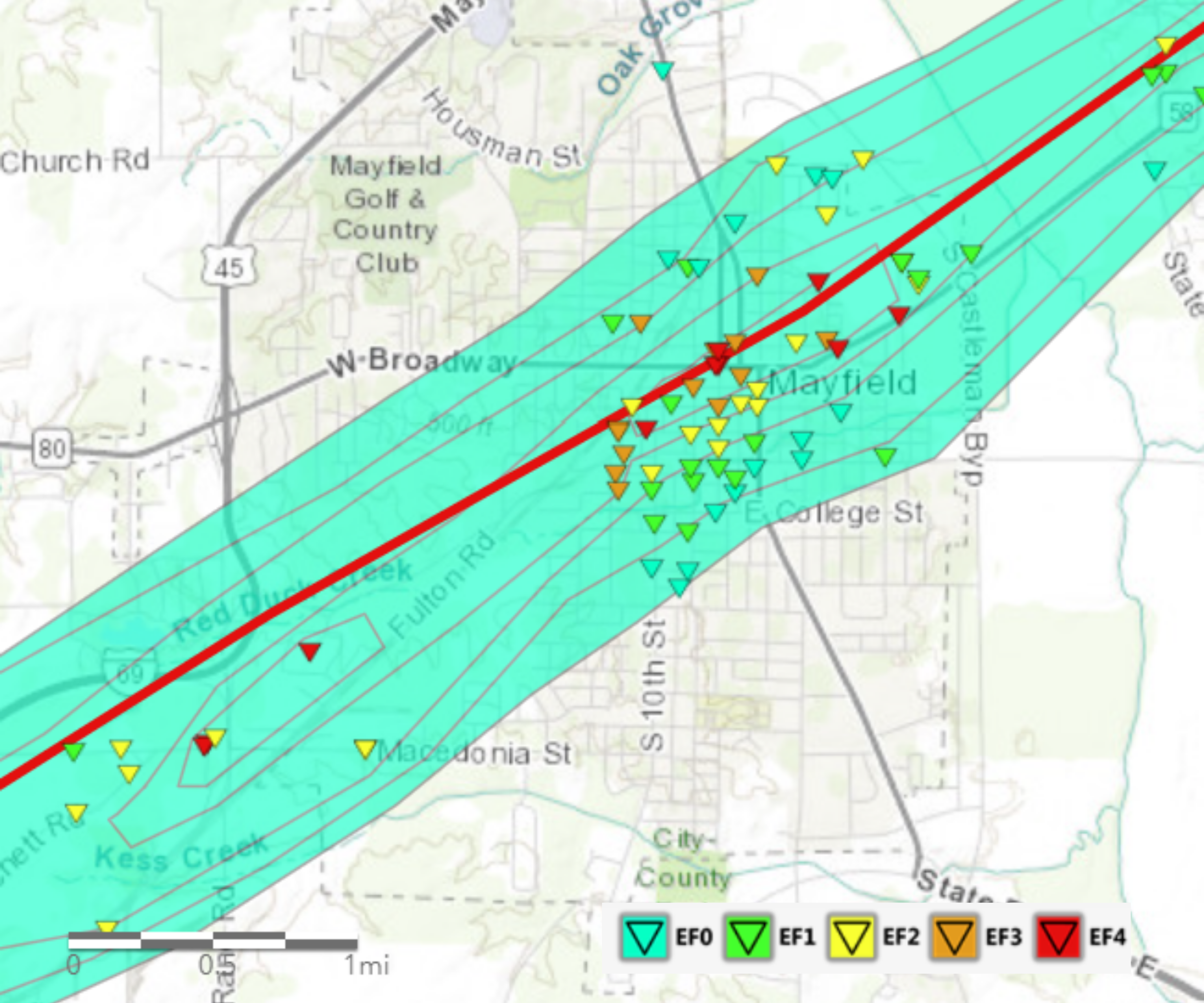
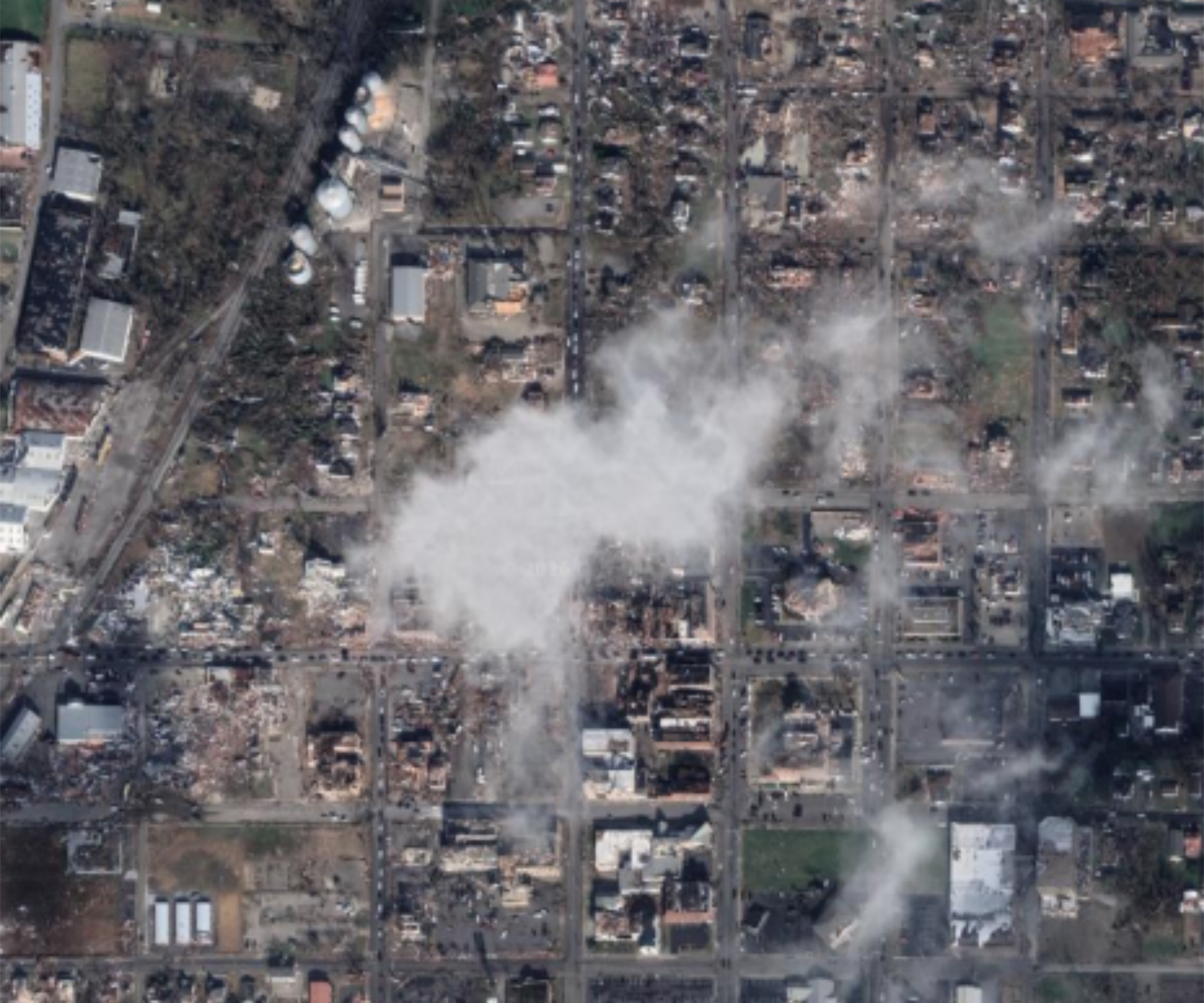
Graves County was hit especially hard by this tornado and Mayfield, a city within Graves County, was flattened. The tornado was recorded at the EF4 level multiple times throughout its direct path through the city. Very few buildings downtown survived, and surrounding suburbs faced extensive damage. Mayfield was chosen as the host for this project, informing the specific response.
Moodboard
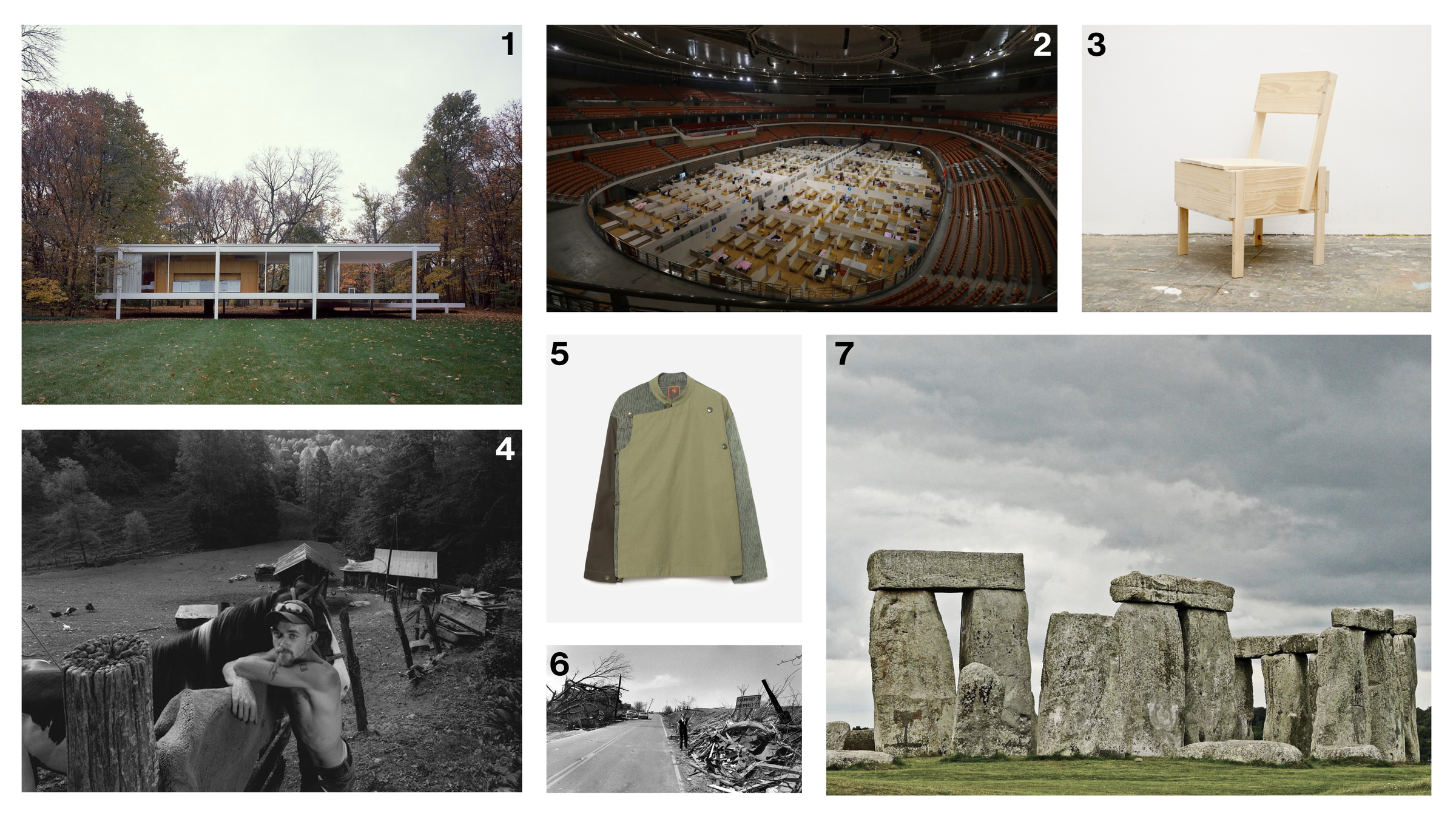
As inspiration and precedents were gathered for this project, recurring themes were identified in the images. These images serve as a mood board for aesthetic and conceptual purposes.
1) Structural purism
Originally coined in the days of early modernism, purism is a design philosophy of fully stripping down objects to their most basic, tectonic states. Here, there are modern and ancient examples in the Farnsworth house (1), Enzo Mari Chair (3), and Stonehenge (7).
2) Adaptive reuse
Important for sustainability and for better serving its user, adaptive reuse overhauls objects, sometimes by form, and always by function. Stadium (2), garment (5).
Sketchbook and Project Goals
.png)
During the ideation process, multiple concepts and goals took form. Early development was rooted in the idea that building is a response to conflict. Multiple conflicts were identified. One is the lack of skilled labor available when homes and infrastructure need to be rebuilt. Another is the need for tangible relief competing with the need for emotional healing. The goals of the response are as follows:
- The project must be adaptable to respond to the community's needs.
- The final form will be a space for the community to heal.
- The construction must be simple and modular.
- All materials must be circular, with their end of life planned for.
Parti
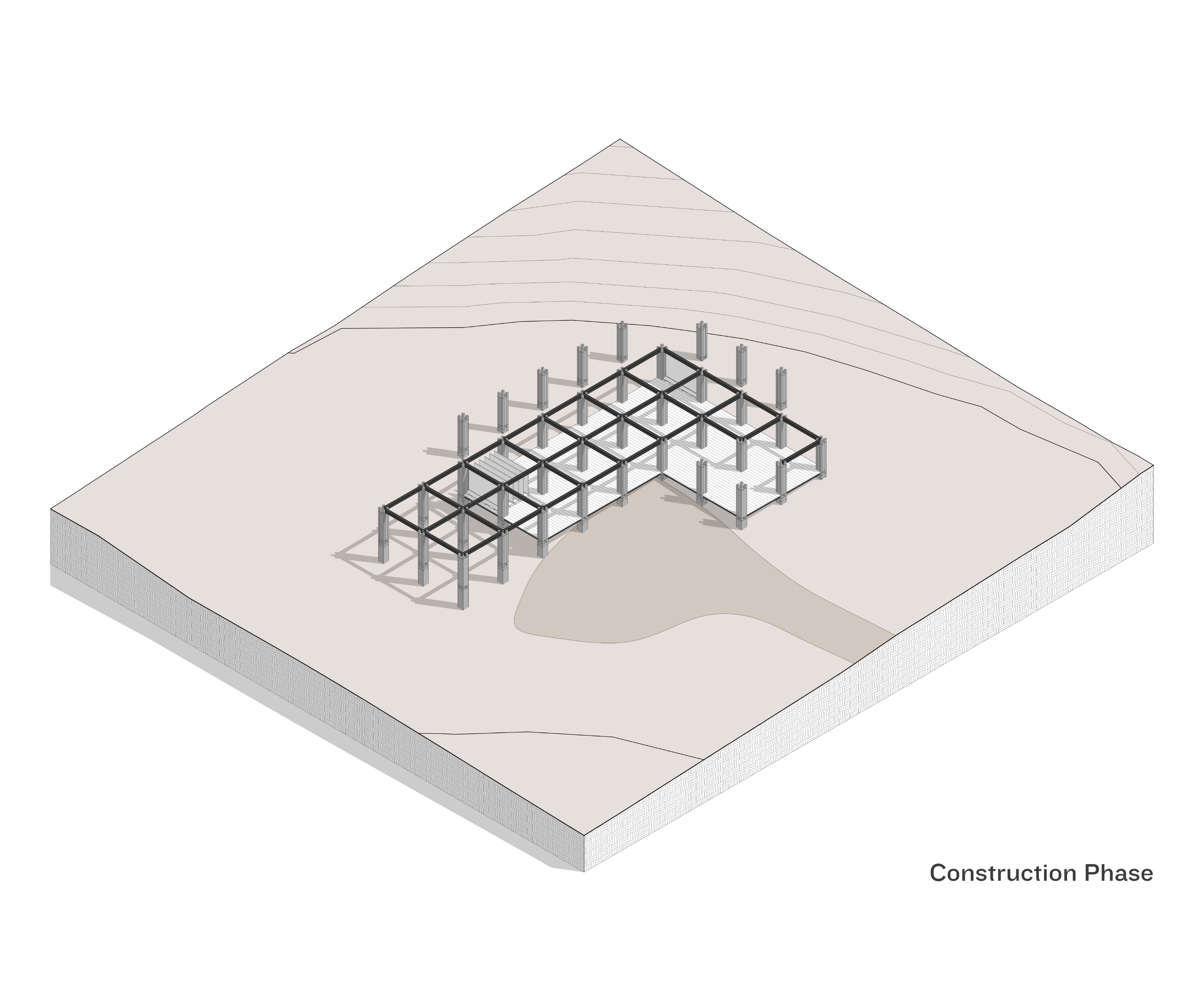
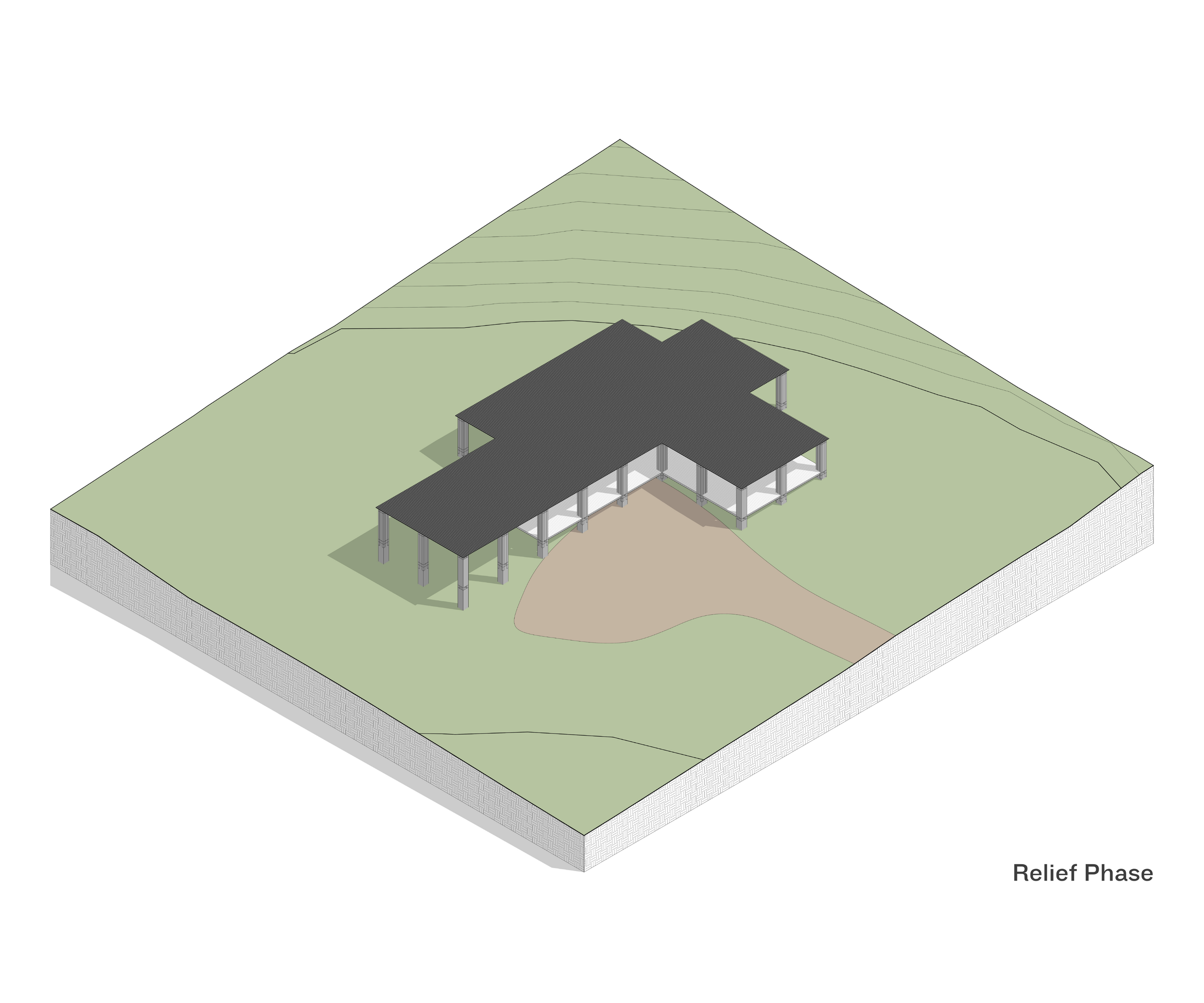
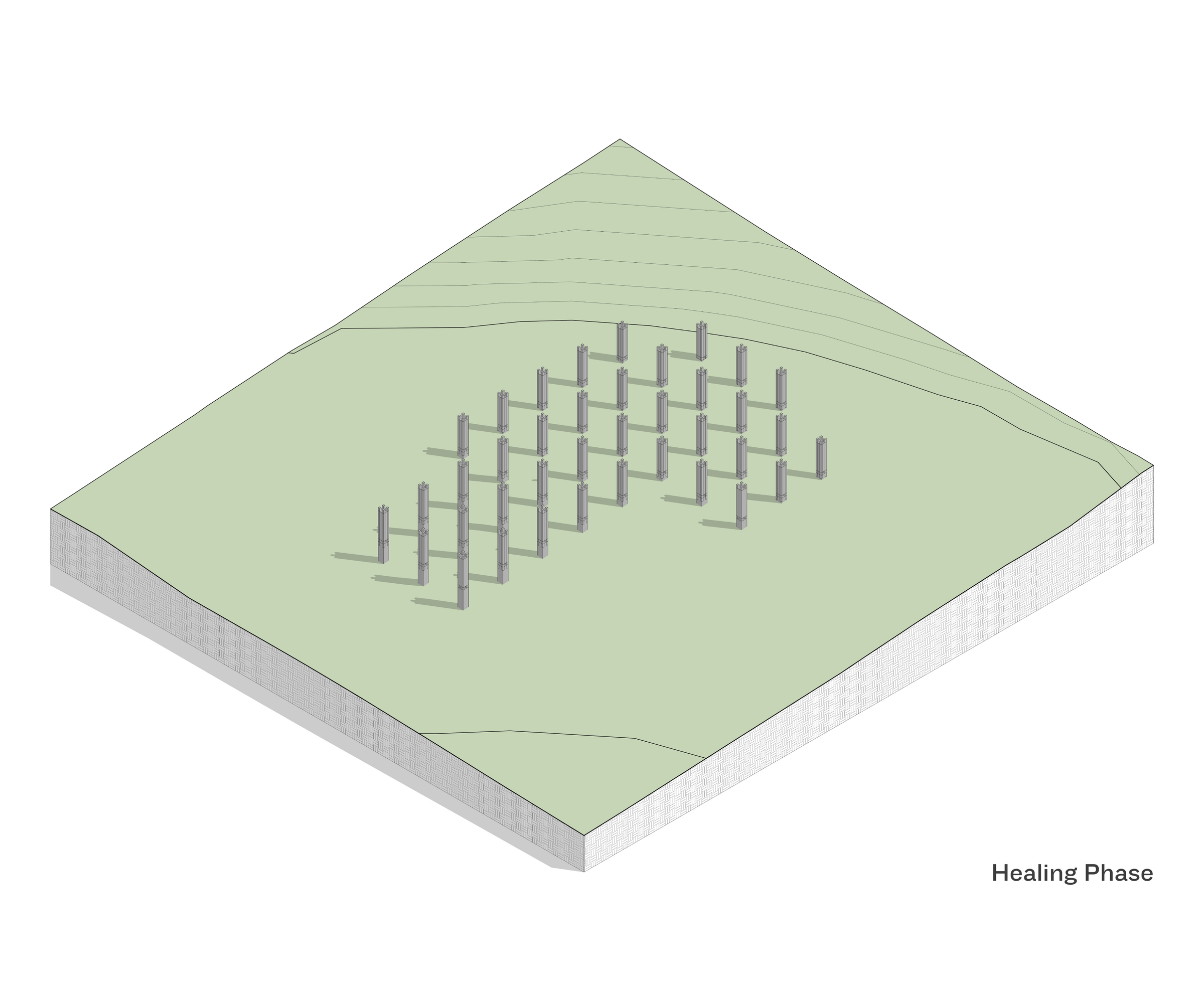
The parti of the Graves County Relief Pavilion was informed by the human healing process. When a human is wounded, the body sends blood cells called platelets to the site of the wound. Those platelets work to create a temporary scab that aids in the healing process. Once the healing process is completed, the scab falls away leaving only a scar.
In the case of this relief pavilion, after a disaster happens, people come together to the site to construct the pavilion. The pavilion is intentionally designed to be constructed by volunteers and some skilled workers. After it is constructed, the pavilion acts as a temporary structure for direct aid and relief. This could include functions like shelter, distribution, or emergency medical facilities. After the relief, the pavilion is deconstructed and recycled leaving only concrete columns. The columns become a public space, fostering community events like farmers markets, art fairs, or other recreational uses. These columns also act like a scar, a memorial to the lives lost and to those who aided in the relief.
Site Analysis

The pavilion is proposed to sit on an already empty site, right in the center of the city. It is adjacent to the destroyed courthouse, giving the structure a central placement in the city, strengthening its function as a relief structure. This placement also benefits the structure’s final use. The courthouse is a public building, and when the relief pavilion becomes a public park/monument it begins to build the area into an active city center.
Efficient Construction
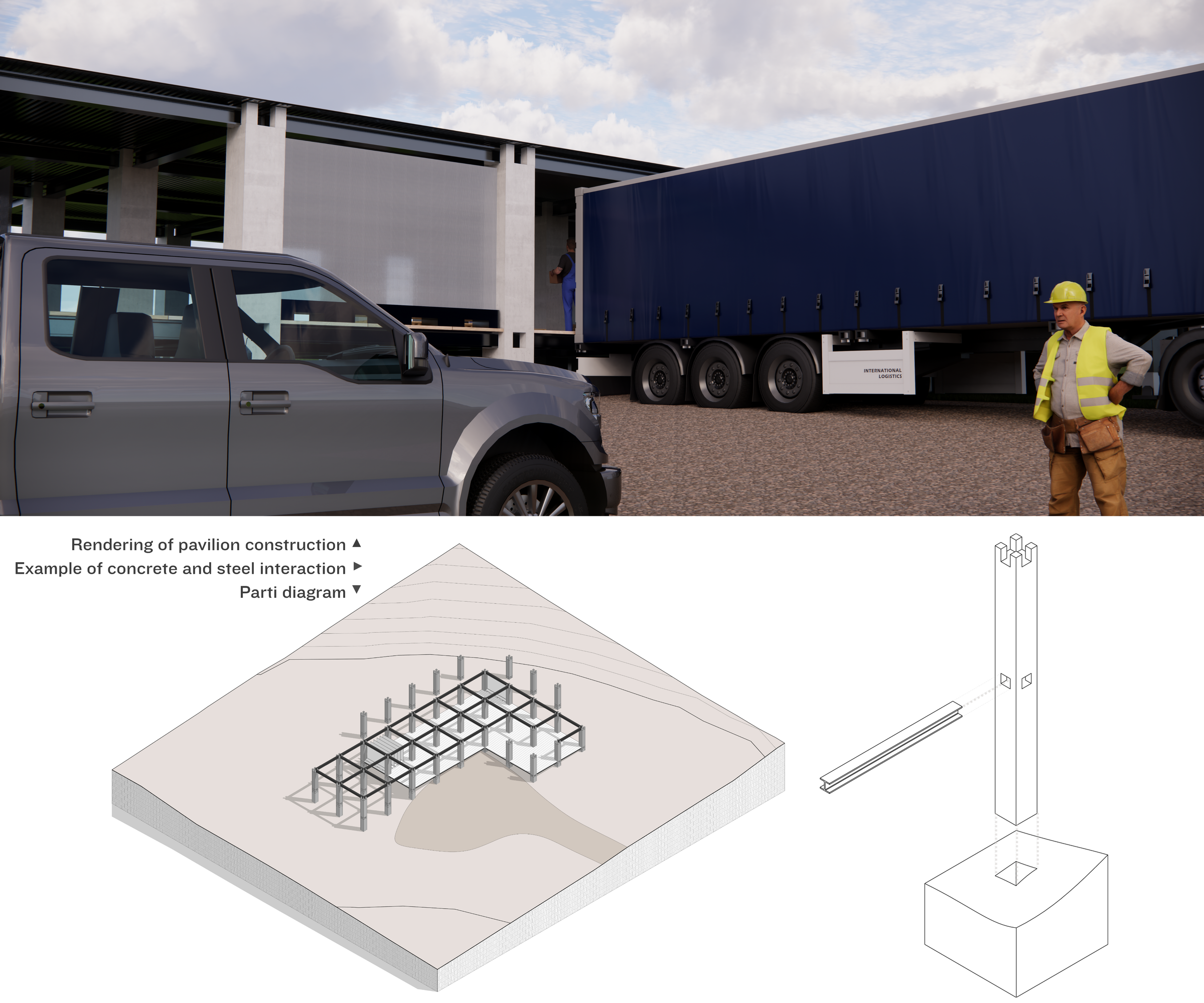
In the case of a disaster like the tornadoes, skilled labor is stretched past its breaking point. The need for skilled laborers could delay the construction of the pavilion, and strain the relief effort further.
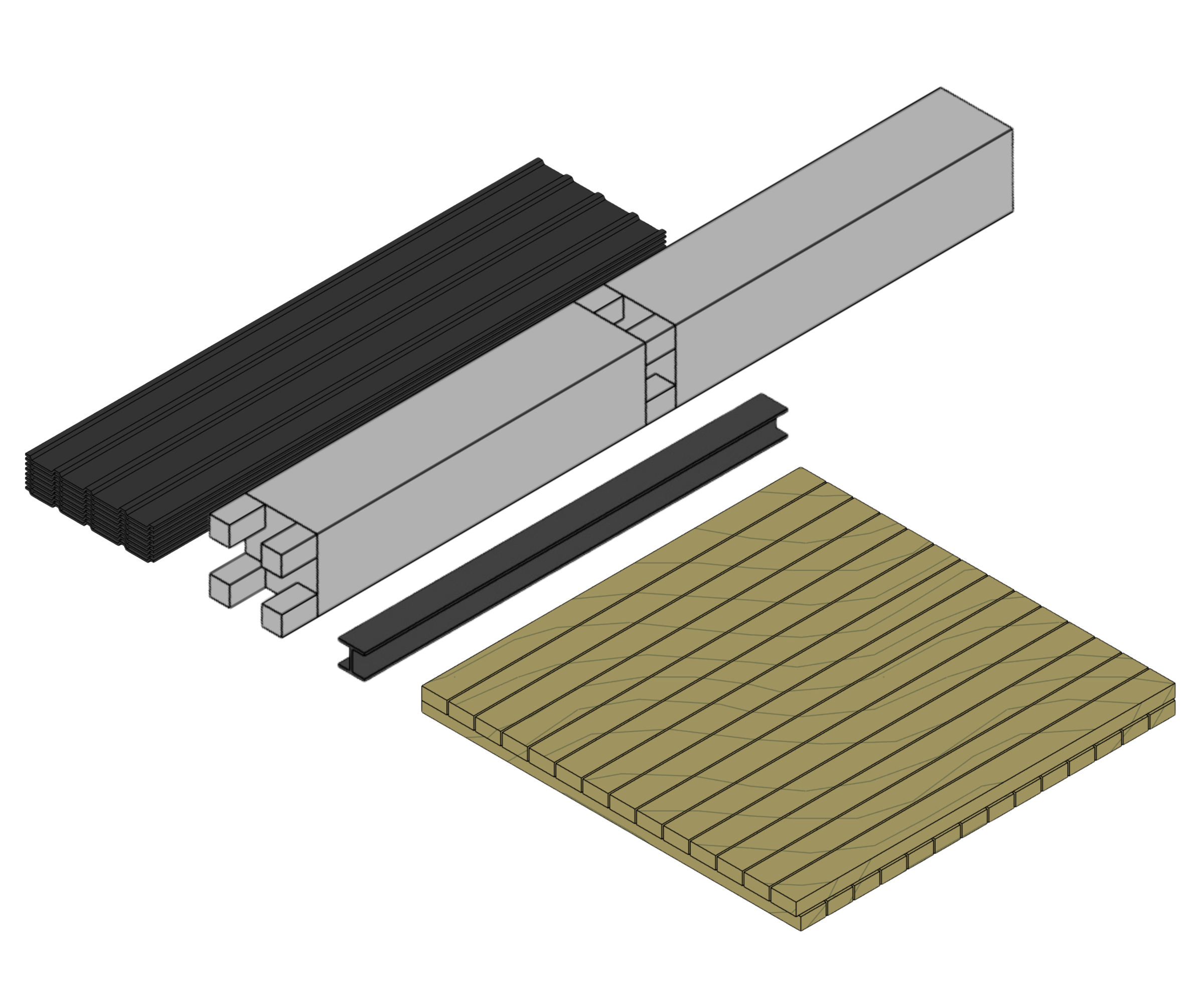
Because of this, the pavilion was designed to be constructed from modular components by a team of volunteers with little previous experience led by only a couple of experienced laborers. Concrete columns would be cast off site and shipped via truck or train. All other materials (standing seam roofing, steel beams, and softwood lumber) can be sourced from commercial hardware stores. These smaller materials could also easily be donated in the disaster.
After all materials are on site, an excavator would be used to dig holes at 15' intervals for the concrete columns to be set in poured concrete footings. From there, steel beams are slotted into each column so that flooring and roofing can be bolted in place. The floor and roof systems use heavy-duty structural bolting to withstand high wind loads during the relief phase, but allow clean unbolting during deconstruction.
Modularity and Site Specific Layout
.png)
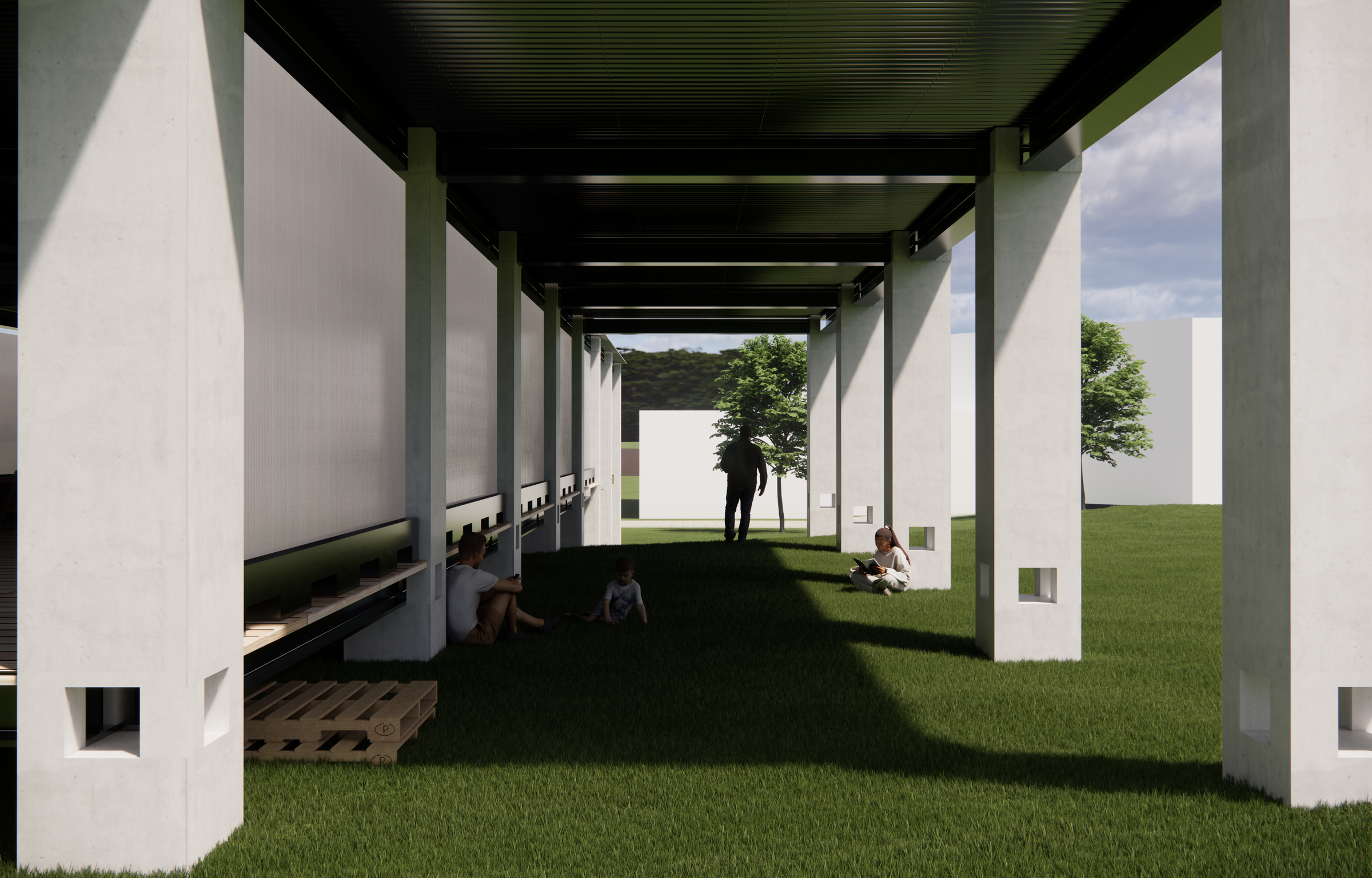
The simplicity of the construction process allows the pavilion to adapt to any site. The pavilion can be as large or small as the relief efforts need it to be. The floor sits above grade, bypassing the issue of rough terrain. It is accessed by a series of prefabricated steel stairs and ramps, ensuring accessibility for injured or elderly users. The floor can also be removed, creating a covered green-space. These covered sections can provide cover for people, space for cars to be parked, and open air space for generators to run.
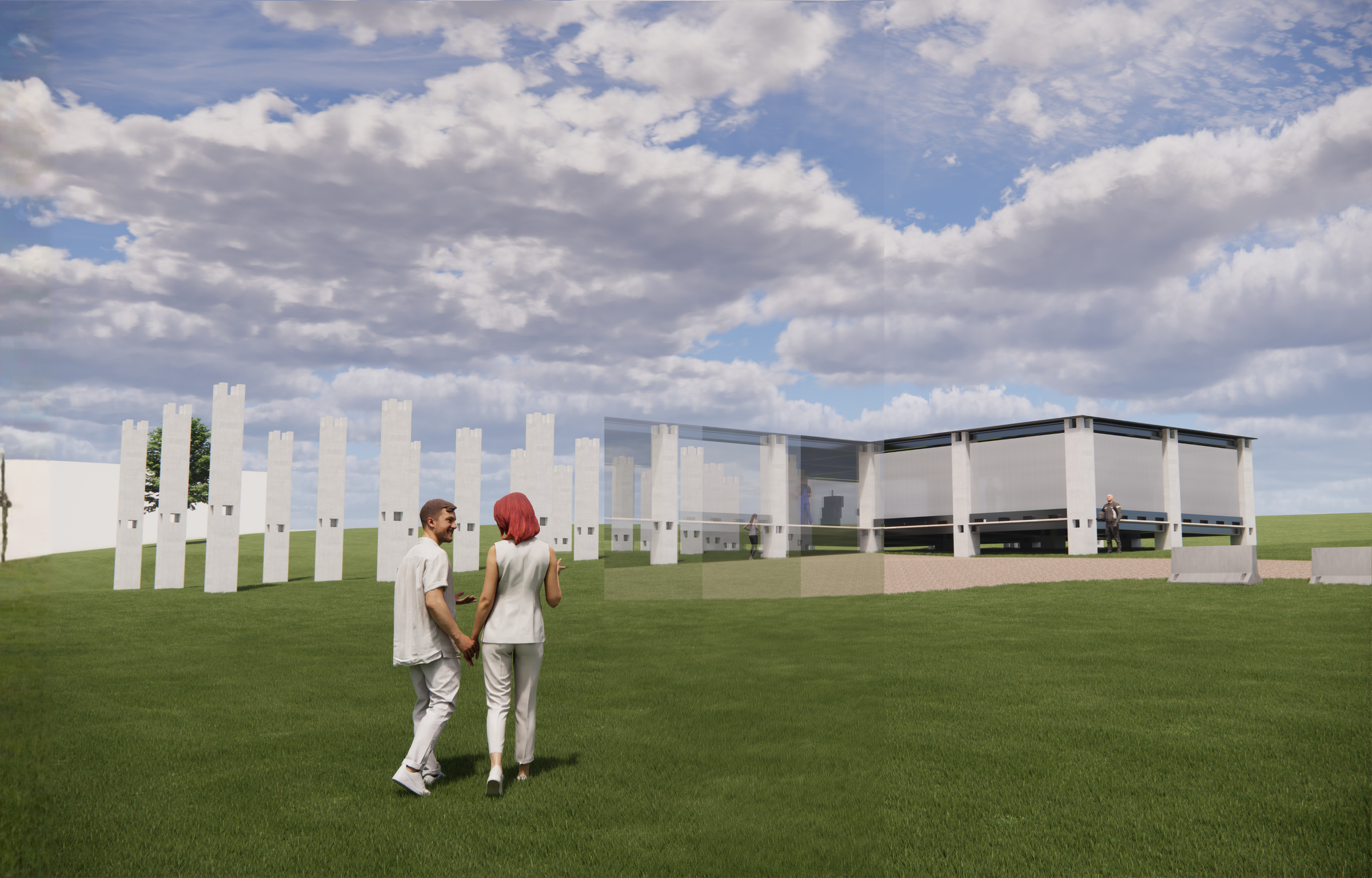
For the tornadoes in Western Kentucky, the pavilion was configured with one floored section and three non-floored sections. The L shape allows for trucks to easily load and unload, and implies a larger uncovered space.
Humanism

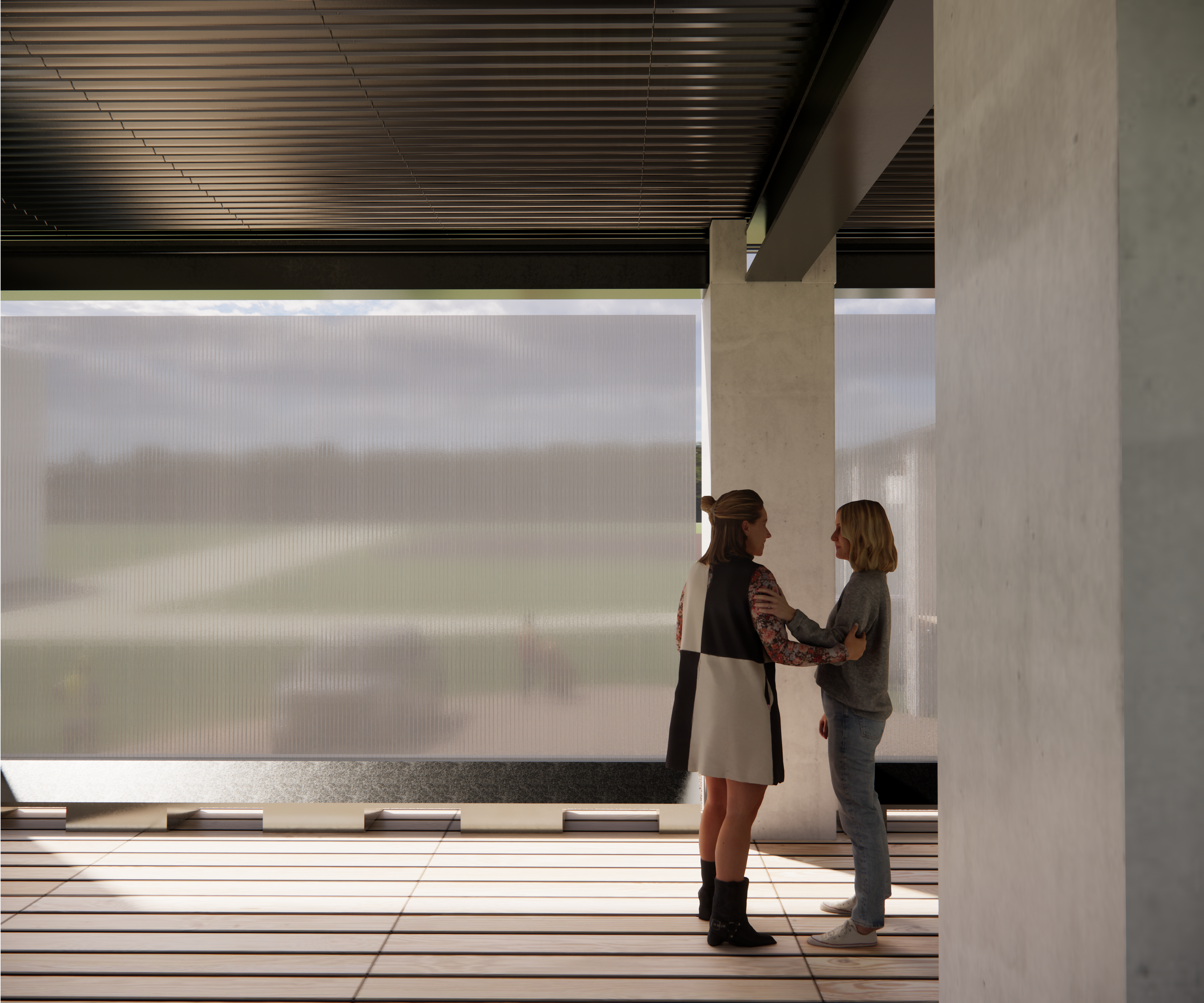
Even in the least extreme scenarios, disaster relief is unpredictable, and forces architectural programs to adapt. Stadiums might become hospitals, schools become shelters, and churches become distribution centers. A humanist approach to disaster relief is one of abandoning defined function. This system of relief pavilions can become exactly what the community needs it to be, before and after construction.
After construction, the pavilion uses a system of partitions assembled on site from three prefabricated components: two steel parts for the base, and a sheet of multiwall polycarbonate for the wall. The polycarbonate is translucent, allowing light in without sacrificing privacy. This allows spaces created in the center of the pavilion to borrow light from the outer spaces.
The steel base gives the partition most of its weight, making it sturdy while defining space. When it needs to be moved, the base is designed to interface with standard pallet jacks. With just one or two people, the layout of the pavilion can change in a matter of hours, adapting with the ever-changing relief.
Humanism Continued
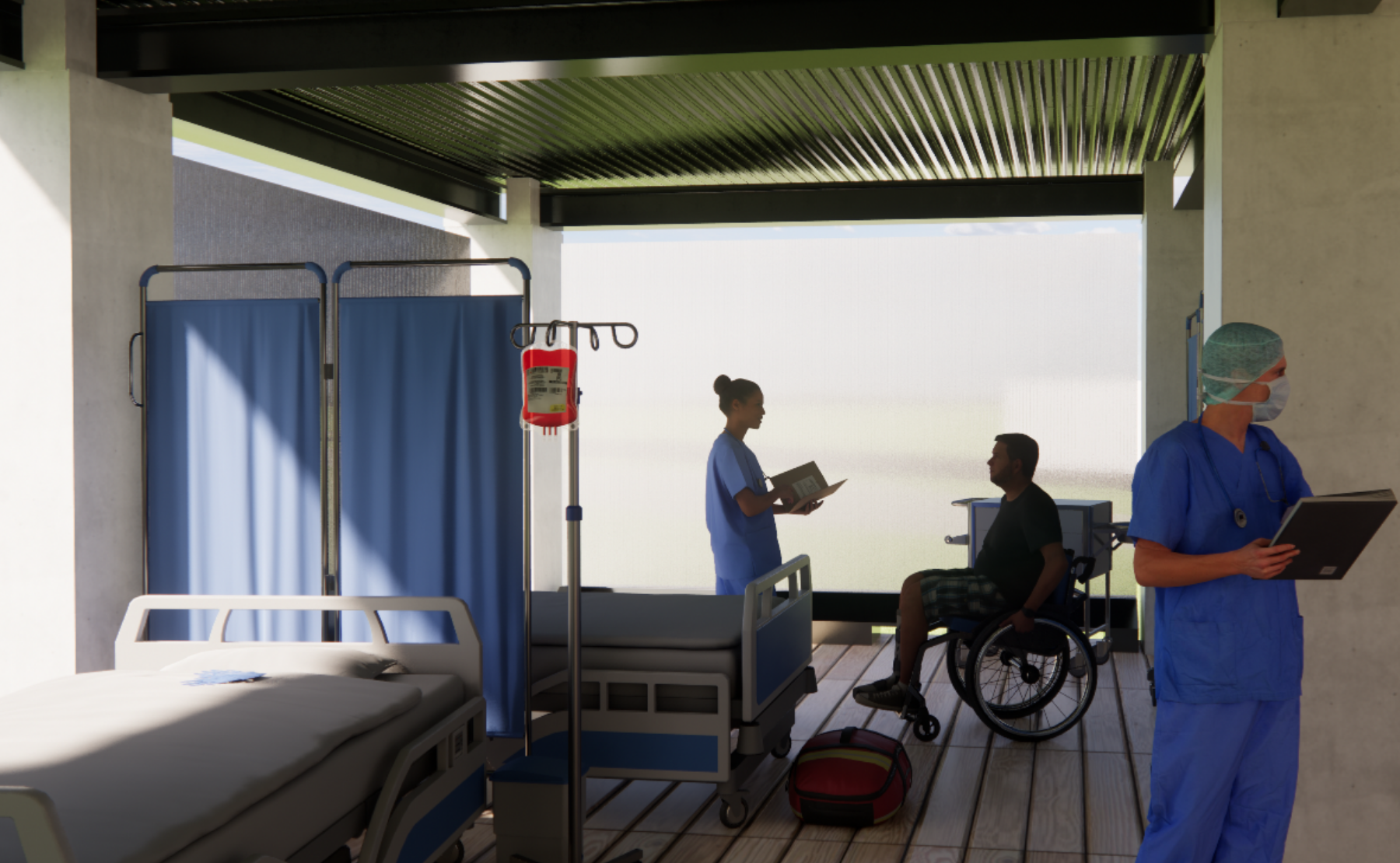
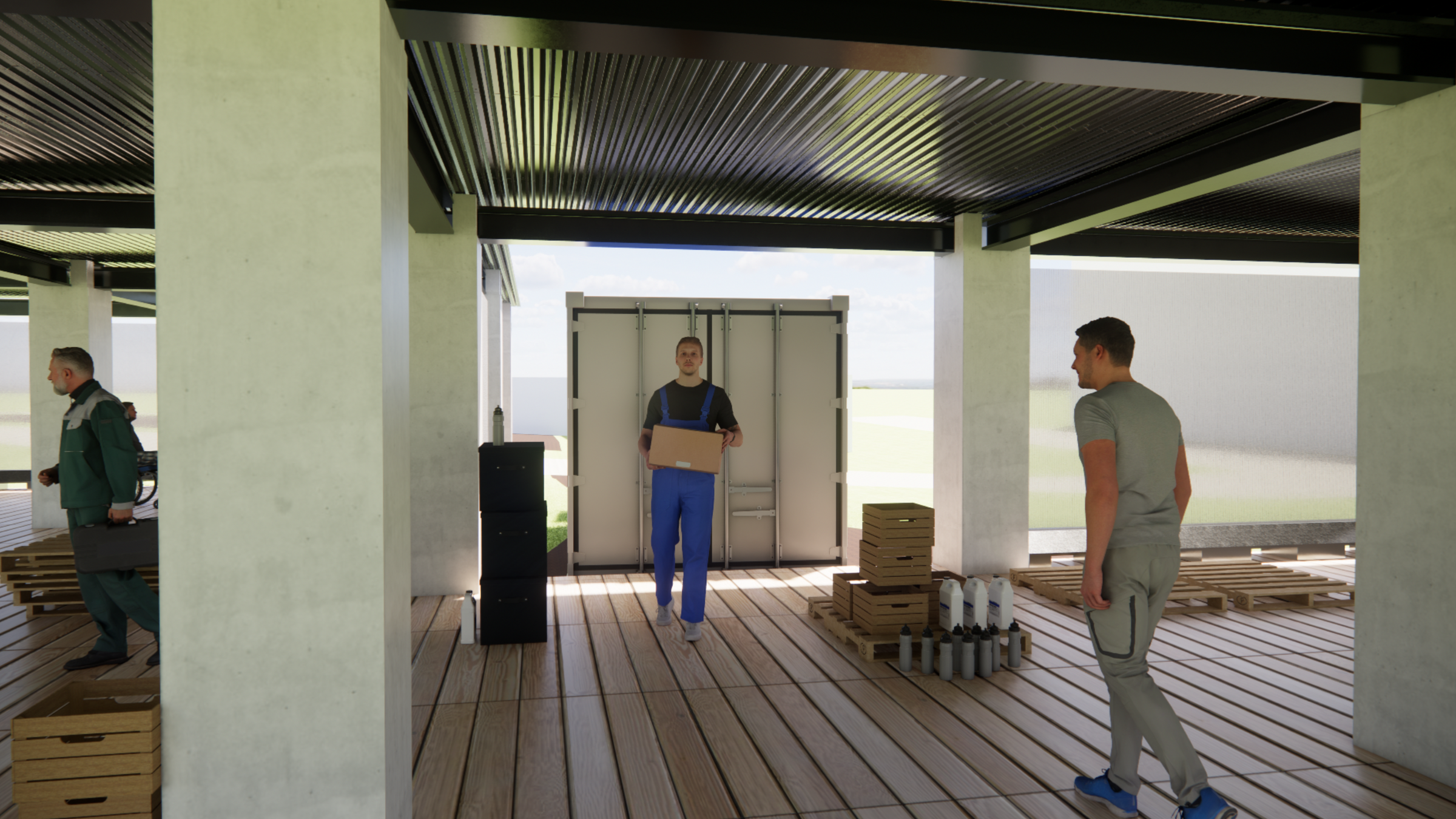
The images above show the pavilion used as an emergency medical structure and distribution center.
A Note on Sustainability
Sustainability has two definitions
- the quality of being able to continue over a period of time
- the quality of causing little or no damage to the environment
Just as relief not continue indefinitely, this pavilion is not meant to exist forever. With the first definition of sustainability not applying here, sustainability now becomes just as important at the end of the pavilion's life as it is at the beginning. If 30 percent of all global solid waste comes from the construction industry, how does this pavilion respond?
To reduce waste almost fully, the materials and construction methods used have been chosen with recycling in mind. All connections would be bolts and friction joints instead of adhesives or caulk. Everything could be disassembled afterward and used in the reconstruction of what was lost.
Steel, as used in the beams and partitions, is infinitely recyclable; it can be melted and reforged without losing any strength. The pine used in the floor and the standing seam aluminum in the roof would be used in the construction of new homes, being more sustainable, cost effective, and less reliant on a post disaster supply chain. The polycarbonate used in the partitions can be recycled into agricultural structures.
When the pavilion has been fully cannibalized, only the precast concrete columns remain. The columns become a public space and stand as monuments to everyone who lost their lives in the disaster.
The image above combines a rendering of the project as a park and a rendering of the active relief pavilion.
Post Disaster Healing
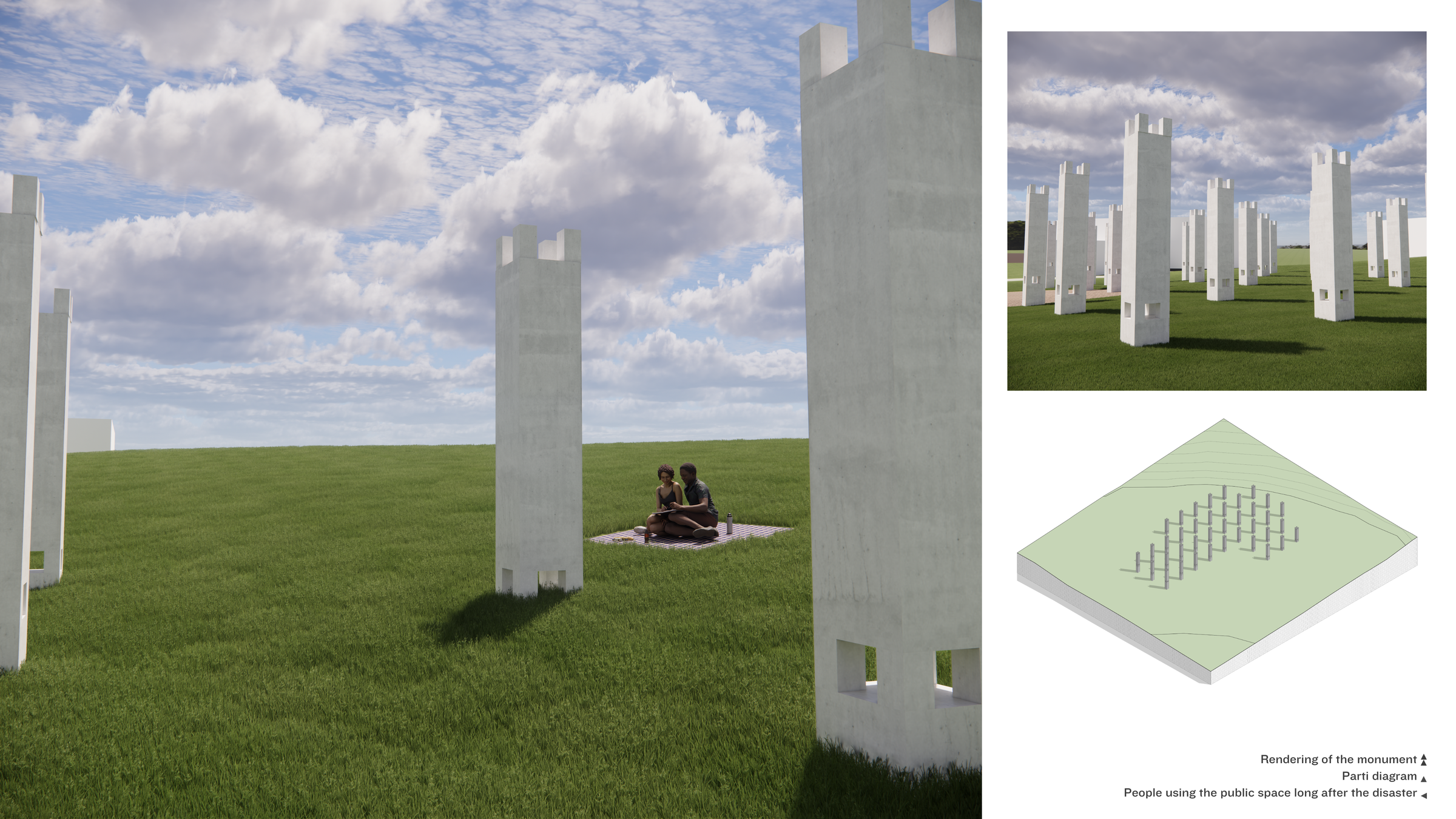
As the physical scars of the disaster heal, the community is still left hurting. After its deconstruction, the pavilion, now a park, can fully focus on the emotional side of disaster relief.
These columns stand not only as a reminder to the lives lost, but also as a sign of the community’s strength and resilience.
The new public space is located adjacent to the county courthouse, a public building, making the area into a more active city center. The park is a blank canvas to be used however the community wants. It can foster events like art fairs, farmers markets, etc, and all of these events become seamlessly woven into the monument: canopies hang from the tops, friends set up hammocks, and children run between.
When the anniversary of the disaster comes around, reopening old wounds, families can gather in memorial, where you might see expressions of healing like wreaths, photos, and candles. The monument will stand for as long as is needed, a space fully for the healing of the community.
Physical Model
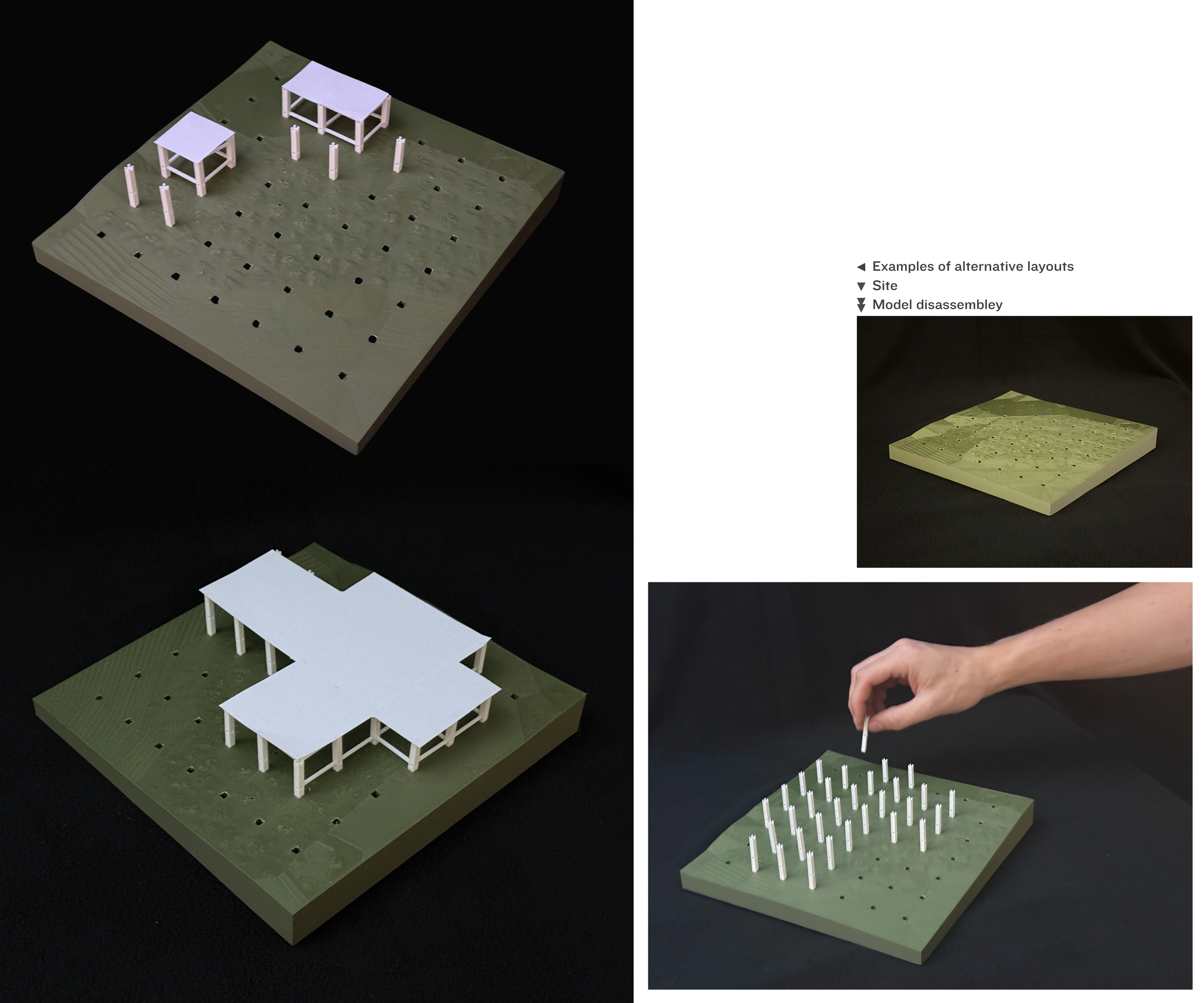
The model of the Graves County Relief Pavilion was designed to show the modular potential of the project. Holes are put at equal distances across the site where the column pieces can slot in. After the columns are put in place, the beams are put in to the columns, and the roof is cut out of paper to fit the chosen configuration. All pieces, except for the roof, are 3d printed with PLA plastic. Modeling in this manner allows for rapid ideation when determining the pavilion layout for a specific site.
Physical Model Continued

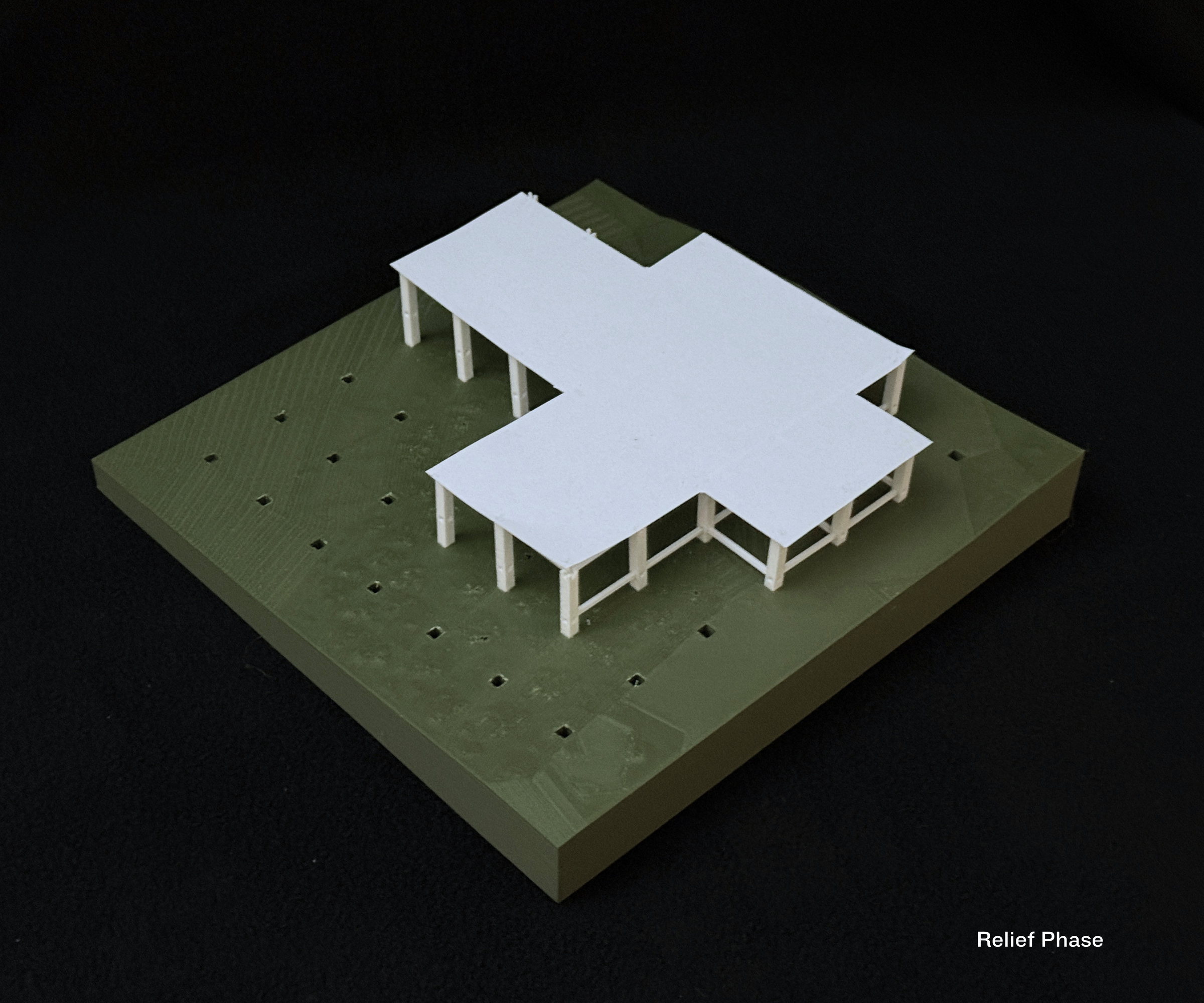
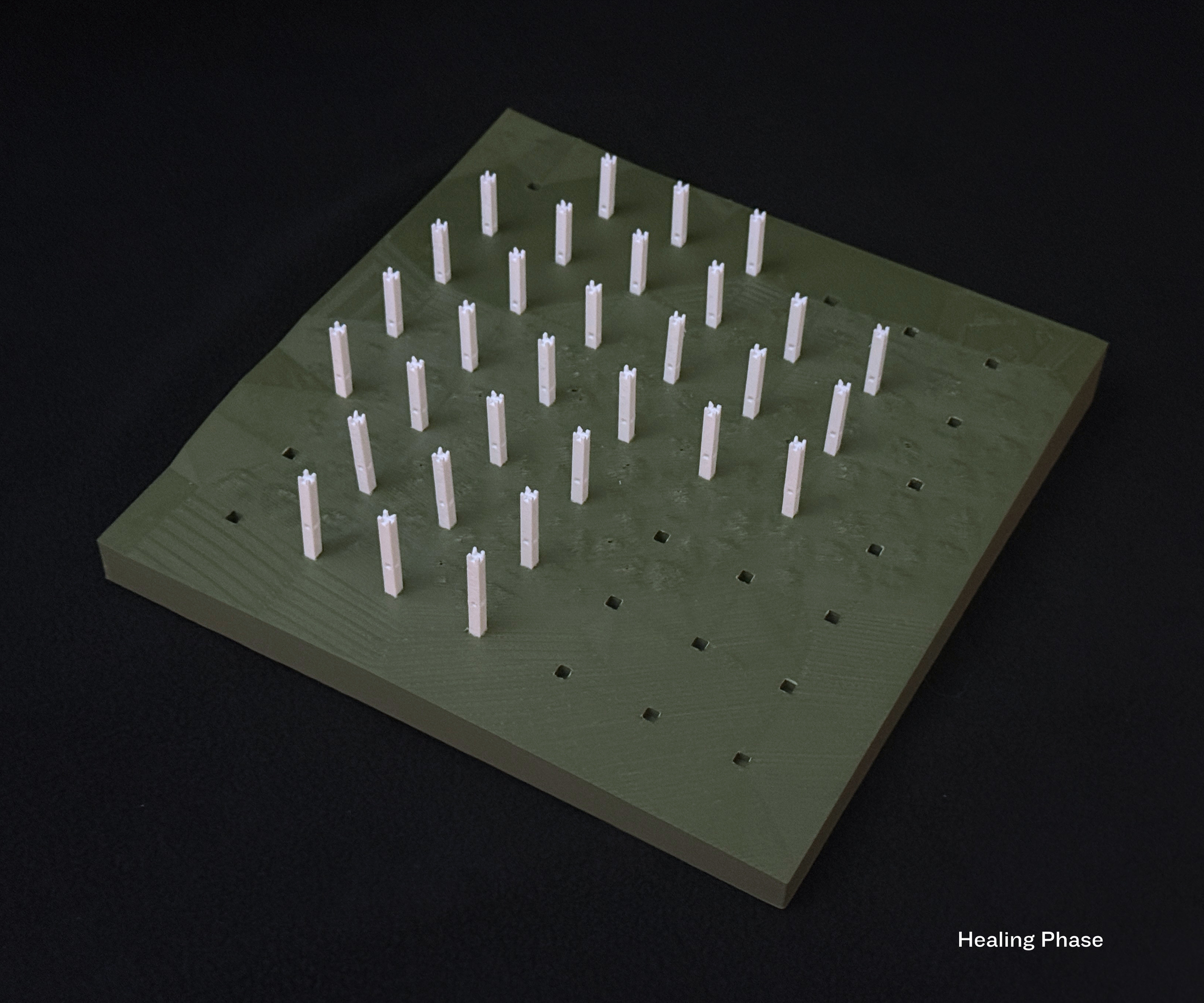
The images above show the original parti diagram represented by the model.
A Community Restored

After a disaster, as life returns to normal, people need to heal. Here, by the means of architecture, the community gathers in remembrance and in unity, growing stronger together.
Thank You
My name is Ty, and I am an aspiring architect living in Lexington, Kentucky. Currently, I am a student at Lafayette High School and participate in my school's chapter of the ACE Mentor Program. I love to read architectural theory, and my own work is heavily inspired by the socially critical works of Rem Koolhaas and Reinier De Graaf. I have competed previously in the TSA architectural design and CAD architecture competitions at the state and national levels.
Thank you for reviewing my work. I thoroughly enjoyed getting to explore new ideas with this design, and hope to continue exploring these further in the future.