How to Make a Foam Snowboat
by TsunamiScrum in Workshop > Electric Vehicles
79 Views, 1 Favorites, 0 Comments
How to Make a Foam Snowboat


It doesn't snow very much where I live but when it does, I make the most of it. I made these showboats with my dad when I was younger and wanted to make my own interpretation. They are swamp boat style RC snow boats made out of foam board and minimal electronics. They go surprisingly fast, are really fun to drive around and race, and are easy to build.
Downloads
Supplies


Materials:
- 2, 20 in/30 in Foam Boards (can be bought at Dollar Tree, these should have the paper on both sides)
- 2, 12 in Long Wood Skewers
- Hot Glue Gun with lots of Glue Sticks
- Ruler
- Brightly Colored Pencil
- Razor/Exacto Knife
- Pliers
- Duct Tape (a must for any project)
- Scotch Tape
- Velcro (to easily attach and secure electronics)
Electronics:
- Small Outrunner Brushless Motor (mine are from RC airplanes)
- RC airplane propeller (it might help to get a few)
- ESC (Electronic Speed Controller)
- 1-2, Servos
- Servo horns & other attachments
- Electronic Wires
- A Receiver that connects to your controller
- A Small 3 Cell Battery
- Metal Wire (can be taken from a wire clothes hanger)
Measure


I encourage you to experiment with the measurements but if here are mine to start you off: (Y)
- Full length when flattened = 20 in
- Full width when flattened = 14 in
- Length of side panels = 20 in
- Width of side panels = 2 in
- Length of front panel = 3 in
- Width of front panel = 10 in
- Length of main panel = 17 in
- Width of main panel = 10 in
This should all be on one piece of foam and none of it will be completely cut away.
I highly suggest you do the next part after completing the basic frame with the measurements above so come back after assembling the main frame.
Measure out 2 trapezoids that are the height measured from the bottom panel, up to the top of the side panels (when already positioned at their end angles). The side angles of the trapezoids should match the angles of the side panels on the frame. (A)
Do this after attaching the supports above:
Use a ruler and your propellor to decide how high you want your engine mount. I prefer at least 1/2" of clearance. Measure out two small squares, large enough to attach to the back of the motor (I will refer to one side's measurements as x). Then measure out 2 pieces for the engine mount (they are in an image above). The long end should be the sum of the distance from the bottom panel to the center of your propellor, including clearance, and half of x. The top should go back the length of x and straight down x. Then there should be a line going at an angle from the bottom of that line to where the supports end above the open side of the base. The base should be the distance from the inside edge of the first support to the outside edge of the second. (B)
Lastly, look at where you want your propellor. Find a height that encapsulates the majority of the propellor's positioned height and measure out 2 pieces with that height and a width that will give you enough stability (C). Then, measure out two pieces with the same width but an inch less height to be your rudders (D). Finally, measure out a piece with the same width and the length should span the distance between the two C pieces (E).
Personal Choice:
You can choose to make a top/cover but it id dependent on your boat's specifics so you just need to measure the outline of you boat and find where your cutouts should be.
Cut Out

For the Y piece of foam, all pieces should be cut on the lines most of the way through but make sure not to cut through the bottom paper. Once you cut the initial line pick a side of it and cut a similar line parallel to it so that it's the width of your foam's thickness. For pieces that are set at a slant like the side and front panels, you can do cut them the standard way but if you're more experienced, it's better to make that second cut at an angle facing inward. I'm going to refer to these as partial cuts.
On the side panels, for the length of the front panels, fully cut a right angle where the hypotenuse is aimed inward and the right angle is on the outside. Then, partially cut the line where the front panel starts.
On the sides of the front panel, you should cut similar angles so that the base is wider and the top is narrower.
For the B pieces, on the long vertical side, cut out basically a cross section of the A pieces so it should go in about 1/4 in and up from the bottom the same height of the A pieces.
The rest of the pieces can use be fully cut out.
Assemble Frame
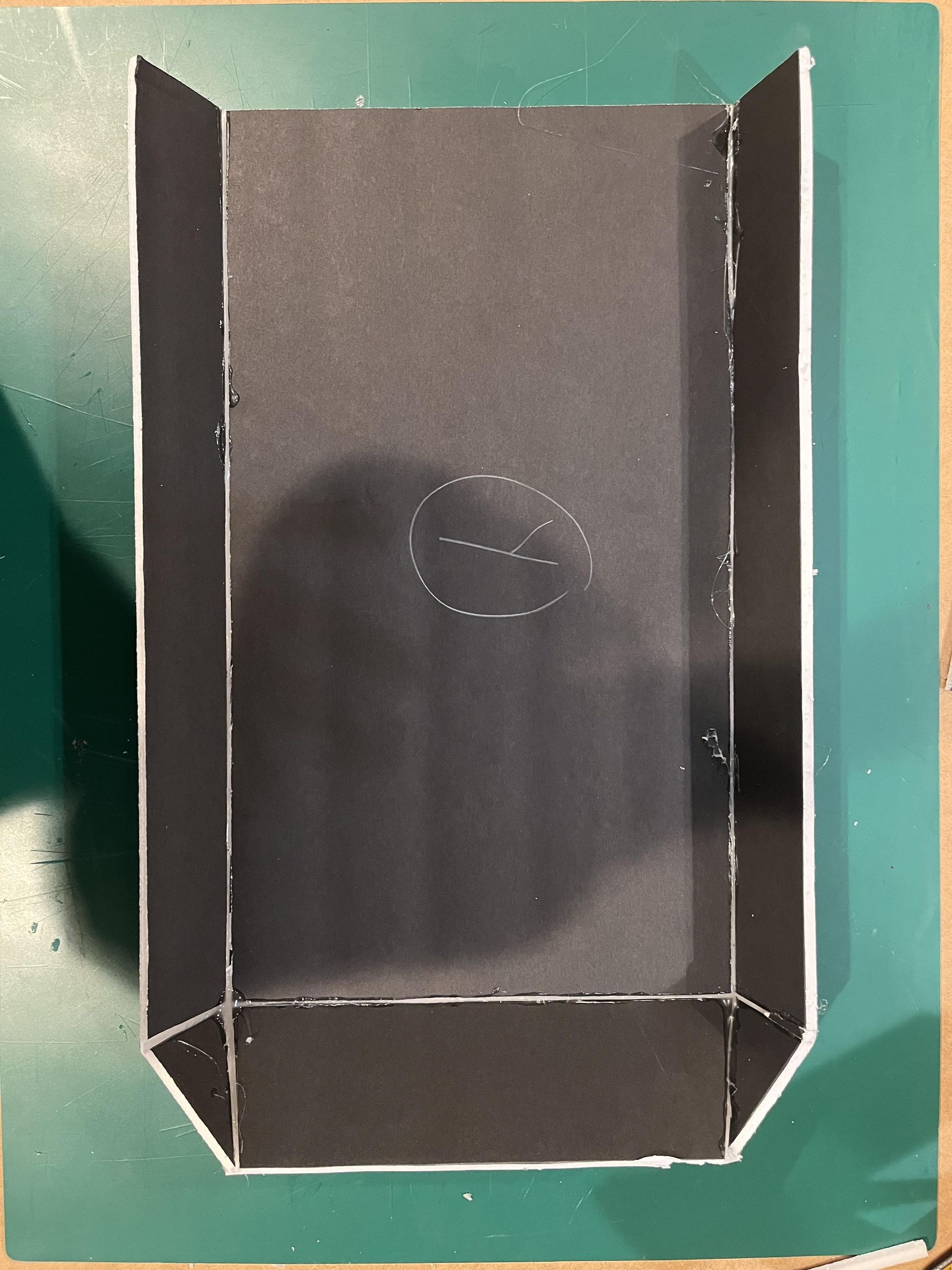

First, fold the side panels so that they lean outwards and hot glue them there. Then do the same with the front panel and connect the triangles on the side panels to the sides of the front panel.
Next, add the supports (A). One should be 6 in from the back of the boat and the other should be 4.5 in from that support or 10.5 in from the back of the boat. Make sure when you glue them, they are full connected to both side panels and the main panel.
Add Motor & Rudder Supports


Then, center the B pieces and arrange them so that they're 2 in apart and the notches (straight edge) go over the A piece closest to the back of the boat.
After, attach one square to the top of the motor support (B) and another to the back edges at the top of B.
Subsequently, glue the C pieces to the inside edges of the back of the boat with about 1/3 hanging off. (This can be adjusted based on how much distance you need from your propellor to the rudders).
Attach piece E later once you've decided the positioning of your servo and rudders and cut out appropriate sections.
Lastly, if you wish to add extra stability to your rudder frame, you can attach pieces going from the top of the side panels up the sides of the rudder frame and any other support you find necessary.
Assemble Rudders


Take the D pieces (the rudders) glue your tall wooden skewers to a long edge of each rudder (only on one side of each).
I like to stack up a few small scraps of cardboard on the bottom to give the skewers more height. Carve a hole through the top few scraps and the top of the E piece so that the rudders can rotate freely but are also secure.
Cut a piece of wire and bend about 1 in of each end 90 degrees down. Insert the ends into the outer portion of the top side of the rudders.
This last part can be done in many ways including using servo horns but this is how I do it:
Cut another piece of wire and attach it to the servo arm. Get a small piece of scotch tape and make a small loop on the side of the rudder that the servo is nearest. The hole should be lengthways and in line with the servo wire. The servo wire will go into this hole and be able to move slightly freely while still controlling the rudder.
Add Electronics


1) Attach the servo to piece E and set it up as described in Step 5 or however you want.
2) Connect the servo to the receiver
3) Connect the receiver to the ESC
4) Connect the ESC to the motor and to the battery
5) Secure each piece with tape or velcro as you see fit
6) Attach the back of the motor to the square on the back side of the motor support
Test
Once the entire boat is built (or at least the main components), test the motor runs, attach the propellor, make sure the rudders turn an appropriate amount left and right, and make sure you have full control of every component.
If all of it works well, go outside and take it for a spin. It doesn't have to be snowing but that is when it works best. If you're reading this in the summer, don't worry, it works well on grass too (maybe even sand if you're at the beach).
See what works and what doesn't and adjust accordingly.
Happy driving!