Investigating Methods of Improving Home Insulation
by leenkalzamil79 in Workshop > Science
159 Views, 0 Favorites, 0 Comments
Investigating Methods of Improving Home Insulation

Done by:
LEEN ALZAMIL
MISHAEL ALOLAYAN
LAMA ALAFALIQ
REEM ALALWAN
PROBLEM OR PURPOSE
How is the cost of an insulator dependent on the effectiveness?
Purpose: Insulation in your home gives resistance to heat flow and brings down your heating and cooling costs. Properly insulating your home, not only diminishes warming and cooling costs but makes strides in the comfort of your own home. Finding alternate ways to improve home insulation makes a difference in tackling the worldwide warming crisis by lessening the discharge of natural gas leading to greenhouse gasses within the environment. We moreover need to discover cheap alternatives for provincial nations to insulate their homes securely and proficiently since global warming caused an increment in temperature.
HYPOTHESIS
If the insulator is made out of aluminum foil, then, it would be the cheapest and most efficient insulator, that is due to its lightweight yet strong build, and it also prevents the radiation of heat by reflecting it back at the source. this will all contribute into it being a very and cheap insulator.
VARIABLES
Independent:
Insulating materials used (Cardboard, Bubble Wrap, Aluminum Foil, Foam Board) Dependent: Amount of heat insulated from the materials given. Controlled: Size of the beakers used Amount of time recorded for each insulating materials Amount of material used for the insulating process Amount of water used Temperature of water Brand of thermometer used Cardboard used to cover the beaker and act as a lid
BACKGROUND RESEARCH
The majority of traditional insulation materials work by slowing both conductive and convective heat flow. Reflective insulation and radiant barriers operate by reducing radiant heat gain. By providing an efficient resistance to the flow of heat, properly insulating your home will reduce this heat flow.
MATERIALS
Beaker (two sizes: large and small)
Cardboard
Foam Board
Aluminum foil
Bubble Wrap
Thermometer
Water
Stopwatch
Graph paper
Pen
PROCEDURE
lace a small beaker into a larger beaker.
Fill the small beaker with hot water from a kettle.
Put a piece of cardboard over the beakers as a lid.
The lid should have a hole suitable for a thermometer.
Place a thermometer into the smaller beaker through the hole.
Record the temperature of the water in the small beaker and start the stopwatch.
Record the temperature of the water every 2 minutes for 20 minutes.
Repeat steps 1-6, each time packing the space between the large beaker and the small beaker with the chosen insulating material.
Plot a graph of the temperature (y- axis) against time (x-asis).
DATA
DATA ANALYSIS
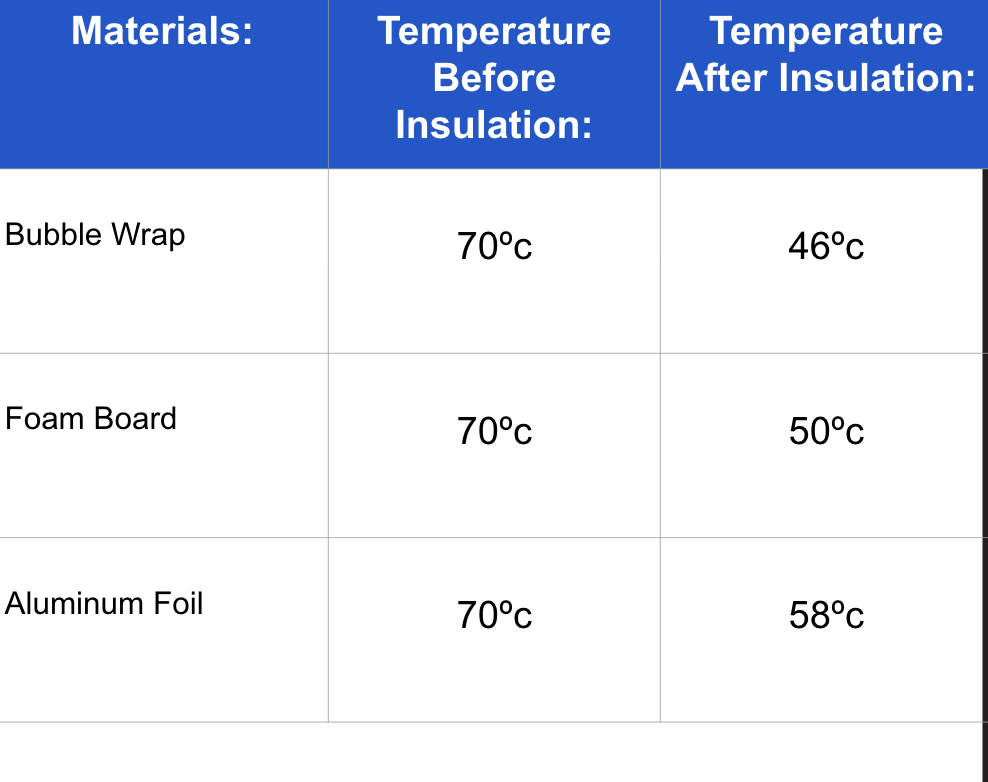
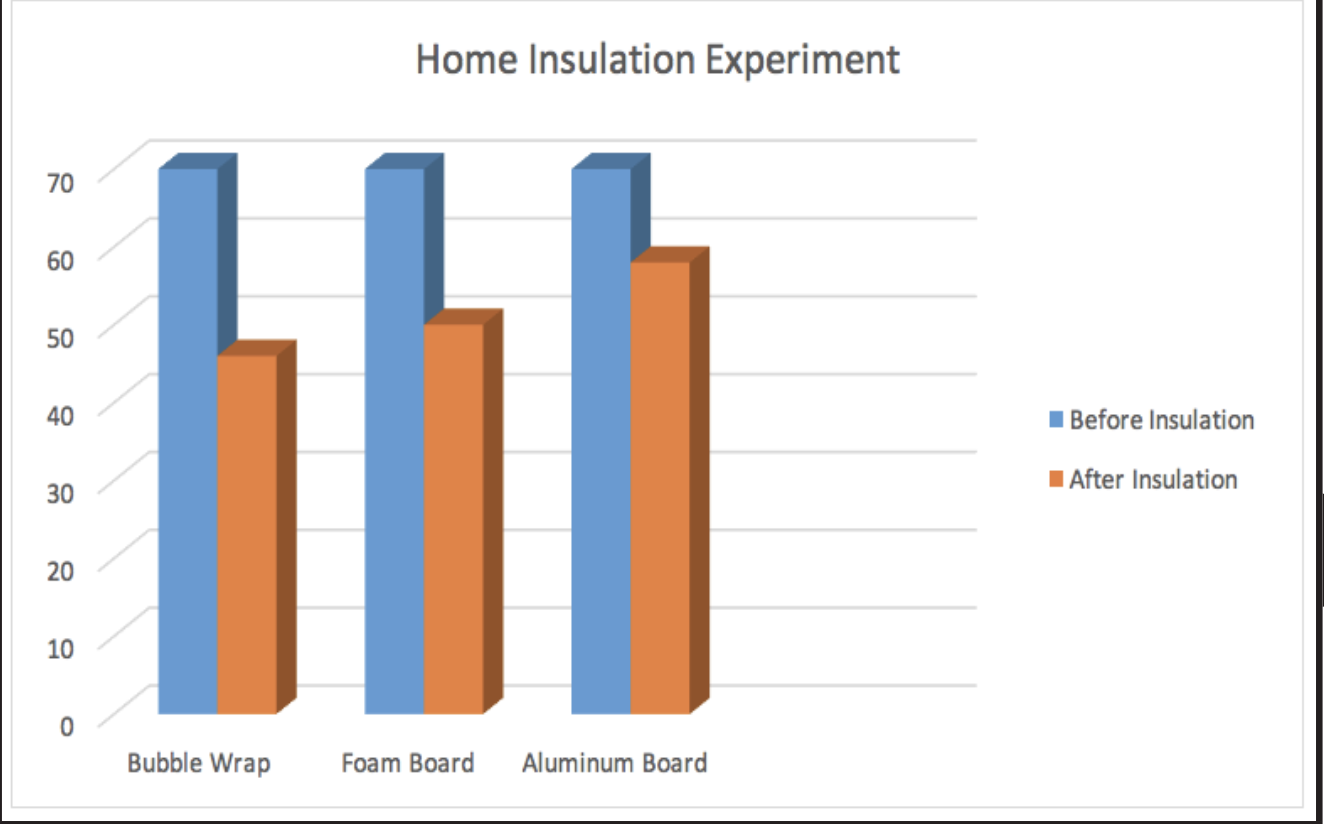
After performing the experiment, we noticed that the best insulator was indeed and by far aluminium foil, where the temperature decreased by 12 degrees celsius in 20 minutes. What followed was foam board, which had a decrease of 20 degrees celsius in a matter of 20 minutes. However, the worst insulator was bubble wrap, which was closer to foam board, with a decrease of 24 degrees celsius in 20 minutes.
RESULTS
After completing the experiment, we concluded that after each insulation material, the water temperature varied based on the material used, we noticed that:
When the beaker is at a high temperature, there is a big difference between the temperature of the beaker and the temperature of the surrounding air. This means there is a high rate of transfer. When the beaker is at a lower temperature, there is less difference between the temperature of the beaker and the temperature of the surrounding air. This means there is a lower rate of transfer.
CONCLUSION
In conclusion, and due to aluminium foils reflection of thermal radiation coming off of the boiling water back onto the boiling water. It was by far the best insulator used, with a decrease of only 12 degrees celsius. Aluminum foil also traps pockets of hot air, so that they cannot convect away heat, which also increases its insulation.
APPLICATION
Aluminum foil can be a successful insulating material since it doesn't emanate heat out into the environment. That's what makes it viable specifically beneath a roof: in spite of the fact that it'll warm up through conduction from the shingles, it won't transmit that heat out into the space. This makes aluminum foil one of the foremost versatile yet cost-effective materials within the insulation of houses. Foil insulation also aids in the decrease energy costs by blocking the warmth that transmits from the sun, into your living space. It is that characteristic exchange of heat from the outdoors that causes your systems to work harder and be less energy effective. By blocking that heat gain in your attic specifically (which is where the aluminum foil is most recommended to use), is an excellent way to make your home more energy-efficient. Which means you use less energy, and reduce your carbon footprint.
PHOTOS & VIDEO