Making Your Own Slide Rule
by Phil B in Living > Office Supply Hacks
76627 Views, 110 Favorites, 0 Comments
Making Your Own Slide Rule
Download a File

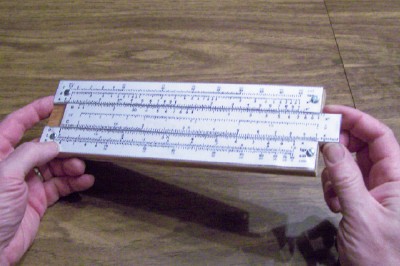
Back in 2008 Instructables member legionlabs published "How to use a slide rule." In the comment section Instructables member Mr ross made reference to a May 2006 article in Scientific American magazine titled "When Slide Rules Ruled." Once that article was available on-line in PDF, but has since been removed. Scientific American still makes it available, but at a cost of about $7 US. The article included a downloadable PDF file pictured in the graphic for this step. It is a printout for a fold-up paper slide rule. I decided I wanted to make one of these just for fun, but mount it on wood and Plexiglass. After printing the PDF file, I enlarged it with a copy machine to about 150%. The idea was that the scales would be larger, easier to read, and more precise.
Construction

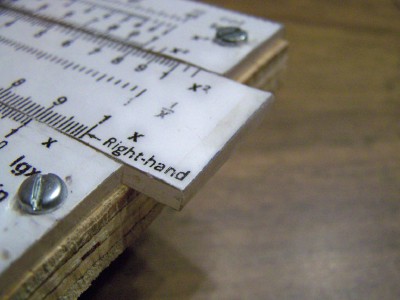
I used Plexiglass screwed to 1/2 inch plywood. In order to hold the slider (center movable piece) in place and still allow it lateral movement, I used a dovetail router bit to shape the edges of the Plexiglass pieces. This slight bevel holds the slider down, but allows it movement.
I covered the Plexiglass pieces with double stick cellophane tape. Then I pressed the paper scales to the tape. I covered the paper scales with cellophane packing tape about 2 inches wide. I trimmed the edges with a very sharp knife.
Adjustment
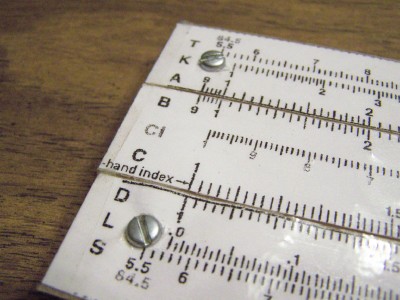
The selection of scales available is basically those found on a "trig" rule. These are the scales found on the Nestler 23 rule favored by Albert Einstein, Werner von Braun, and Sergei Korolev (chief designer for the Russian space program). This link includes a photo of von Braun's Nestler 23 rule. Most of the scales were not labeled on the Nestler 23.
A First Problem
Cursor?
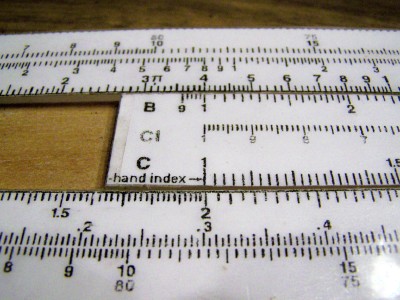
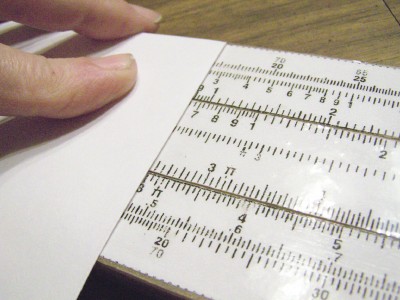
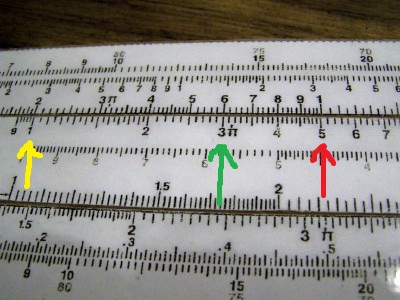
Notice one inherent problem with the PDF file that serves as a pattern for this slide rule. See the first photo again. The left index for the B scale is aligned with 4 on the left half of the A scale. The left index on the C scale below it should very accurately indicate 2 because the C scale gives the square roots of numbers on the A or B scales, but the left index of the C scale is a full line width to the left of the 2 indicating 1.99 as the square root of 2. Calculations done on the C and D scales of this rule are quite accurate, but I found several problems on the A and B scales that are not due to my printer or my construction methods.
Further Problems
What to Do?
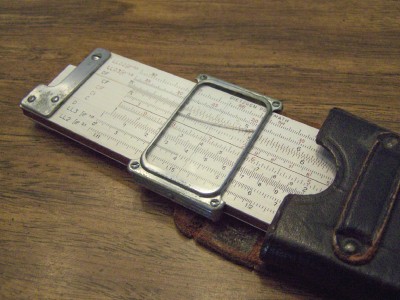
Right now I am talking with a friend who studied electronics just a couple of years after electronic calculators unceremoniously drove slide rules from the engineering scene. He wants to learn to use a slide rule out of personal interest and curiosity. I may give him the slide rule I built so he can practice. Otherwise, for someone like him, I would suggest watching the auctions at eBay and buying a favorably priced rule. An aluminum Pickett 10 inch rule similar to the one used for the virtual rule linked above can often be had for $25 or less plus shipping, even on a "Buy It Now" sale. Recently I posted an Instructable on how I bought a nice old Dietzgen slide rule for $2.50 plus shipping and replaced the defective/missing cursor glasses myself. If you have not seen that Instructable, there are some useful links there. If you saw it when I first posted it, I have since added some links and information. The photo for this step is my new old rule before I repaired the cursor glasses.
Other Downloadable Slide Rule Scales.
If you want to download copies of just about every slide rule scale ever devised so you can make your own custom rule, this site is what you need.
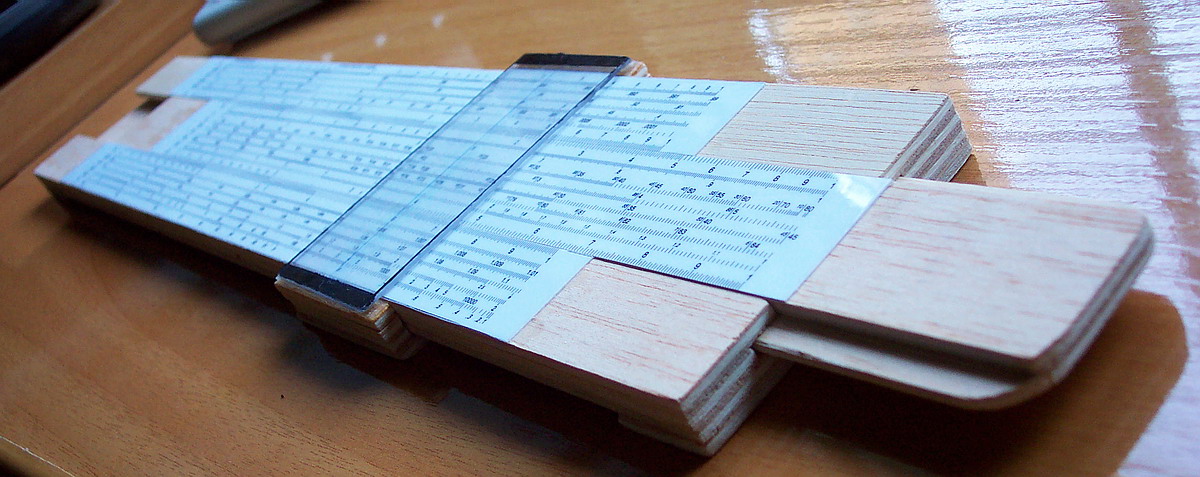
If you would like to download PDFs of various classic slide rules and transfer them to your own base construction materials, this is the site you want. There are even some circular slide rules you can build. Scroll down about 2/3 of the page to see a nice wooden slide rule built by a man from Spain. (See the photo with this step.)
Here is a basic circular slide rule design you can build.
In summary, my experience is that you can spend a couple of hours making a slide rule that may not be accurate or work as smoothly as a vintage slide rule you can pick up at an on-line auction. If your time is worth anything, the slide rule you purchase at an auction site may actually cost less than the one you attempted to build.