Microscope Slide With Integrated Electrodes
by SciencExpert in Teachers > University+
70 Views, 1 Favorites, 0 Comments
Microscope Slide With Integrated Electrodes

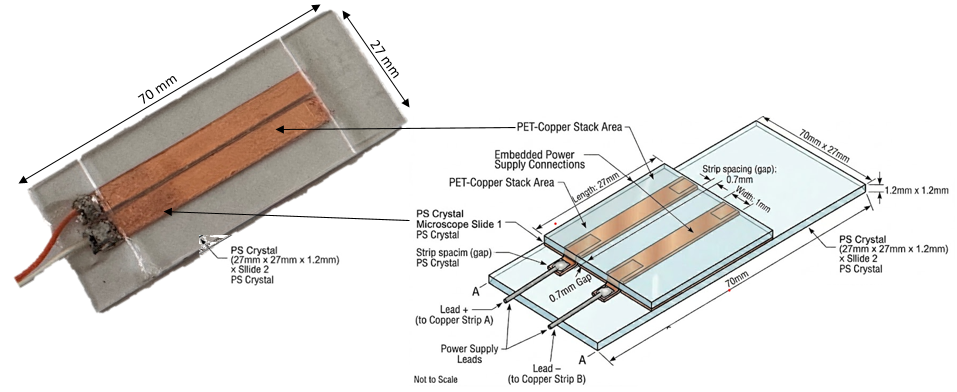
This project demonstrates how to build a flat microscopy cell with integrated electrodes, allowing you to apply an electric field while observing a sample in real time under a microscope (a home made and modified OpenFlexure in our case).
This setup is extremely useful for studying:
- Electro-optical phenomena
- Microfluidics
- Interfacial chemistry
- Biological responses to electric fields
The device consists of two conductive tracks separated by a small gap, creating a controlled electric field in a thin observation chamber.
Supplies
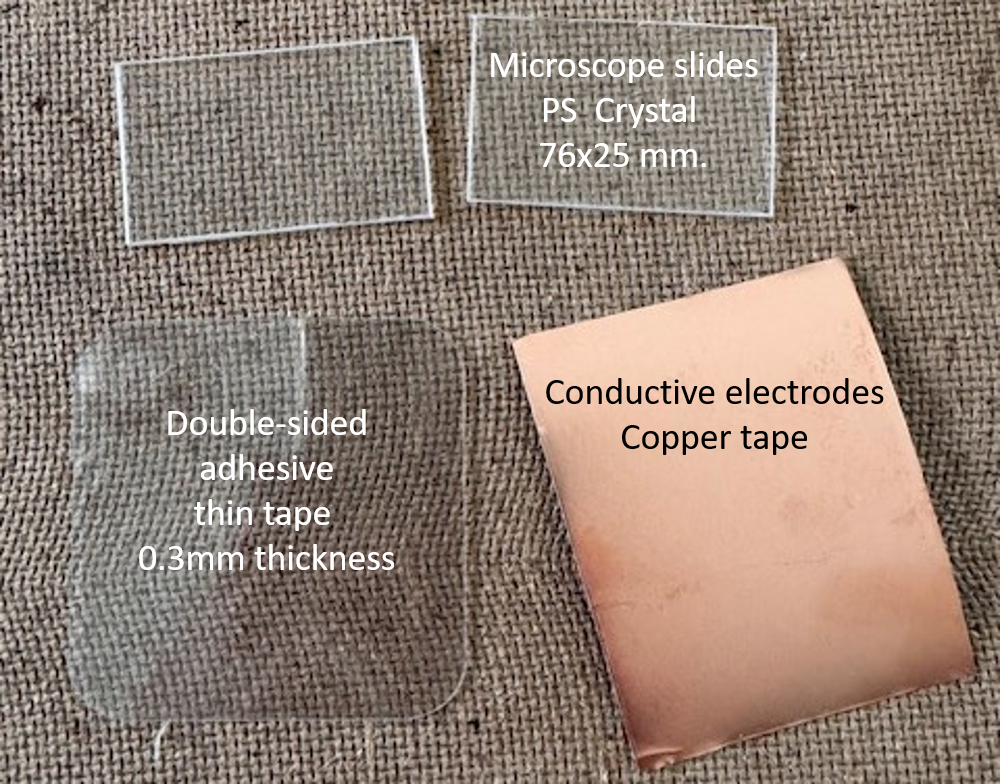 To build the electrode microscope slide, you will need:
Core Components
- Glass microscope slides or alternative PS Crystal 76x25 mm. The PS Crystal is housed in a CD case.
- Conductive electrodes (thin metal strips, ITO coating, or copper tape)
- Double-sided adhesive thin tape (0.3mm thickness)
Electrical Setup
- Low-voltage power supply (DC or AC depending on application)
- 2 Connecting wires
Optional for experiments
- function generator (see SciencExpert Book "Electronic for Chemists - Wave Generator")
Preparation Tools
- Isopropyl alcohol (for cleaning)
- Tweezers
- Gloves and lint-free wipes
Optional
- 2 Polarizers(highly recommended for optical studies)
- Camera for recording experiments
Microscope
We use a homemade and modified open flexure microscope.
Assembly Procedure
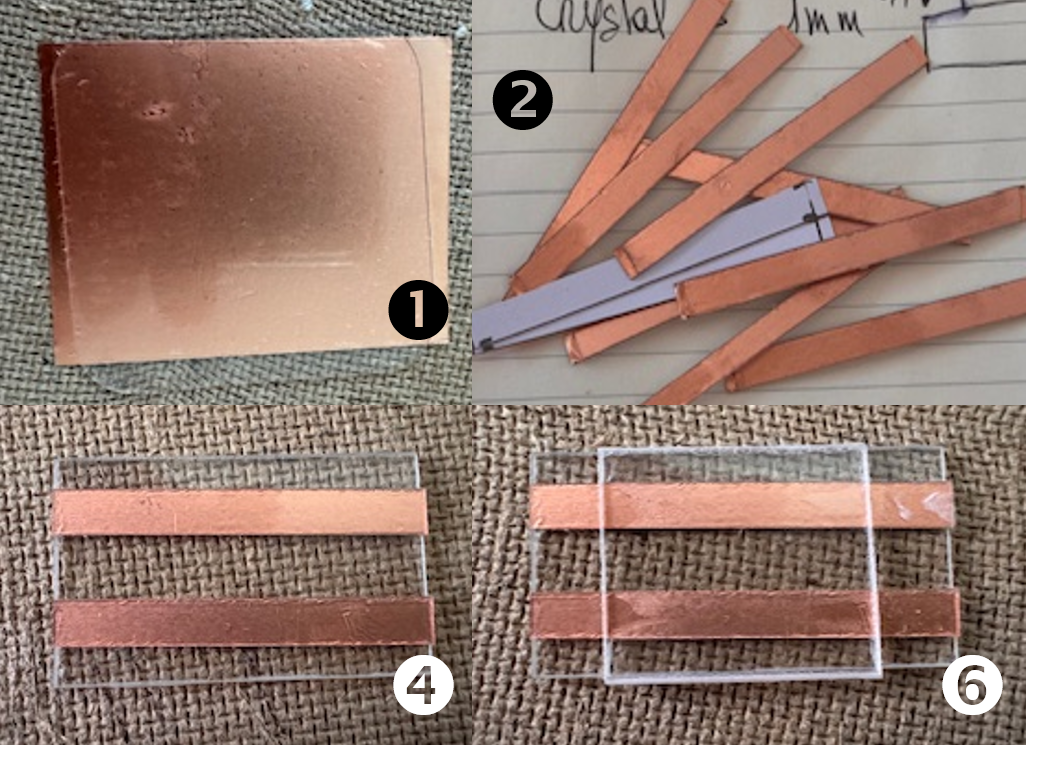
Preamble : Prepare the Substrate
- Thoroughly clean the glass slides and electrodes using isopropyl alcohol.
- Ensure there is no dust or grease contamination.
1. Prepare the Adhesive Electrode Layer
- Take a sheet of double-sided adhesive film.
- Remove the protective liner from one side.
- Carefully laminate this exposed adhesive surface onto the copper tape (copper-clad film).
- Press firmly to ensure uniform adhesion and avoid trapped air.
2. Cut the Electrodes
- Using a precision cutter, cut two strips approximately 1 mm wide from the copper-clad adhesive sheet.
- These strips will serve as your electrodes.
3. Place the First Electrode
- Remove the protective layer from the adhesive side of the first copper strip.
- Place it onto the PS crystal microscope slide (plastic microscope substrate).
- Ensure it is straight and well adhered.
4. Place the Second Electrode
- Repeat the same process for the second strip.
- Position it parallel to the first electrode, leaving a gap between 0.1 mm and 0.5 mm.
- This gap defines the active electric field region.
5. Expose the Top Adhesive Layer
- Once both electrodes are correctly positioned, remove the remaining protective layer from the double-sided adhesive.
- This will expose the bonding surface for the top slide.
6. Seal the Cell
- Place a second PS crystal slide on top of the assembly.
- Apply gentle, uniform pressure to ensure proper sealing and consistent thickness of the chamber.
7. (Optional) Electrical Connections
- For more reliable electrical contact:
- Apply a small amount of rosin (flux) onto the copper electrodes to improve wettability.
- Add a small layer of solder (tin)
- Solder thin electrical wires onto each electrode.
- Ensure connections are solid but avoid overheating, which could damage the plastic slide.
- Reinforce the connexion with epoxy glue
Applications

This setup enables a wide range of experiments across multiple disciplines:
1. Liquid Crystals
- Molecular alignment under electric field
- Phase transitions (nematic ↔ isotropic)
- Defect dynamics and texture evolution
2. Biology & Biophysics
- Cell motion via dielectrophoresis
- Alignment of microorganisms
- Membrane response to electric stimulation
- Cell viability testing
3. Interfacial Chemistry
- Crystal nucleation and growth
- Localized precipitation
- Surfactant behavior and wetting effects
4. Electrochemistry
- Local electrodeposition
- Corrosion processes
- Redox reactions at interfaces
- Micro-electrolysis
5. Materials Science
- Conductive film testing
- Percolation in composites
- Thin film deformation
- Coating inspection
6. Colloids and Suspensions
- Particle aggregation
- Chain formation under electric field
- Controlled flocculation
7. Microfluidics
- Droplet manipulation
- Interface dynamics
- Confined flow behavior
8. Photonics & Optical Materials
- Electro-optical modulation
- Birefringence changes
- Light transmission variation
9. Corrosion & Degradation Studies
- Initiation of corrosion
- Localized attack visualization
- Passive layer breakdown
10. Education & Demonstration
- Visual demonstration of electric field effects
- Laboratory teaching experiments
- Real-time physics visualization
Best Practices and Tips
- Always start with low voltage and increase gradually
- Avoid highly conductive solutions unless required
- Record experiments (video preferred for dynamic processes)
- Keep a control sample without electric field
- Monitor temperature and avoid overheating
- For biological samples, ensure medium compatibility
References
- Bard, A. J., Mirkin, M. V. — Scanning Electrochemical Microscopy, CRC Press, 2022
- Kanoufi, F. — Electrochemical Microscopy, L’Actualité Chimique, 2007
- Hapiot, P. — Scanning Electrochemical Microscopy, L’Actualité Chimique, 2007
- Liu, H. Y. et al. — Scanning Electrochemical and Tunneling Ultramicroelectrode Microscopy, JACS, 1986
- Techniques de l’Ingénieur — Electrochemical Microscopy Dossier, 2026
- Evident Scientific — Electrode Fabrication and Microscopy Applications
- Société Chimique de France — Electrochemical and Interface Studies
SciencExpert Ed - Electronic for Chemists - Hacking Recycling 3D Printing