Changing the Way Communities Endure and Heal From Natural Disasters
by Nadav Hakak in Design > Architecture
29 Views, 0 Favorites, 0 Comments
Changing the Way Communities Endure and Heal From Natural Disasters
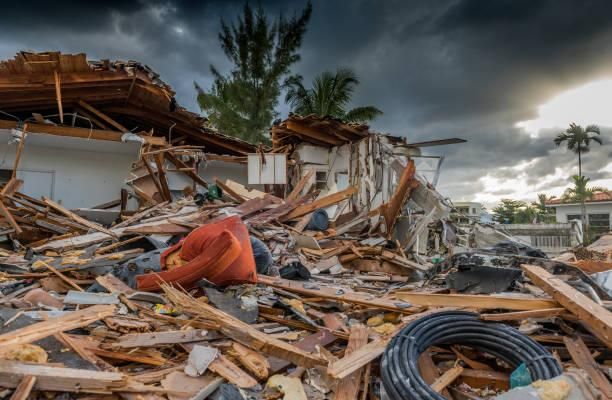
A universal problem across the globe is natural disasters. Floods, storms, earthquakes, and fires cause harm in every country. No matter the region, these hazards affect people by disrupting the economy, causing supply shortages, and even forcing people to leave their homes behind. Every year, roughly 100 million people are impacted by natural disasters, disrupting their lives and causing them to suffer. This leads to over $100 billion a year being lost, mainly due to those affected being unable to work. Being out of the workforce and having to look for a new home can make it hard to pick back up when the dust settles, which can cause a permanent strain not only on them but also on the economy as well. While immediate shelter during the disaster can be easy to find, temporary housing after is very difficult to find. This is because most shelters fill up quickly, don't have the proper amenities, are far away, and lack proper FEMA paperwork (stating that the Individuals and Households Program can provide money and limited direct housing services to those affected after a presidentially declared disaster), and insurance delays.
As someone who's been affected by a natural disaster, I've seen firsthand how devastating they can be and realized there's a solution. Community centers are the heart of a local community. They're close, host events, and foster bonds between community members. I realized that this small, yet important building can be used not only to better relationships in the community, but also to help one recover from a natural disaster.
Fully equipped for any natural disaster, allowing people to continue being in the workforce, and ensuring that they're getting the emotional help they need, my design is the solution to these issues. It combines immediate shelter, temporary housing, and gives residents a way to recover.
Supplies
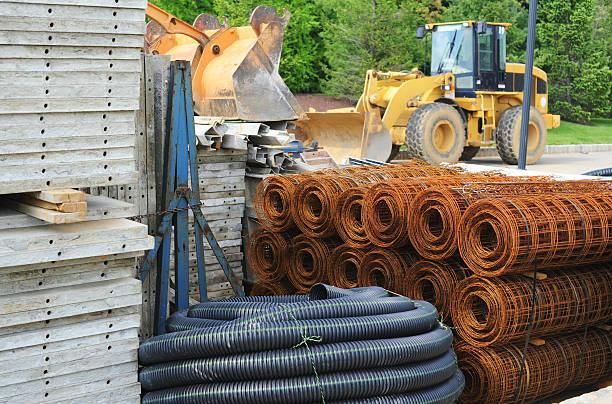
While the building is relatively simple in design, its many features require lots of materials. The general list of supplies is as followed:
Foundation
- 350-500 cubic yards of reinforced concrete
- 35-55 tons of rebar
- 150-200 anchor points
Main Frame
- 160 tons of structural steel
- 600 cubic yards of concrete flooring
- 70 braced steel frames
Main Disaster Shelter
- 5000 sq ft reinforced concrete
- Steel shelter doors
- Emergency supply cabinets
Exterior
- 20000 sq ft of noncombustible exterior cladding
- 12000 sq ft of reinforced CMU
- 12000 sq of fire-resistant insulation
- 500 ft of metal flashing
- 4000 sq ft impact-rated laminated glass
- An adequate amount of steel curtain wall framing
Roof
- 2000 sq ft of Class A fire-rated membrane
- 10 solar panels
- 2000 sq ft of concrete rooftop pavers
- 400 ft of steel guardrails
- Foldable steel roof panel
Ideation Process/Foundation for the Project
In 2025, there were 358 natural disasters recorded, which led to 16,607 deaths and affected 110,200,000 people worldwide, resulting in $169,680,000,000 lost. The year before that, there were 393 disasters, and 167.2 million people were displaced, with $241.95 billion lost. In the last 5 years, disasters have cost the U.S. $149.3 billion. In recent years, millions of residents have been displaced for either long or short periods, with an average of 1 million a year losing their homes.
Furthermore, over 4 million of those Americans struggled to find temporary housing. Most of the time, there's not enough housing available, either causing people to leave or be without shelter. Even if there is enough emergency shelter, most of it isn't set up to be temporary housing. Most importantly, temporary housing separates people from their community, causing people to be cut off from their careers, education, proper counseling, and healthcare.
Overall, the strong impact of natural disasters, along with the difficulty of dealing with them, are some of the more prominent problems I've noticed. When seeing all these problems, I knew my design had to address all of them, while also making a community center that can be used normally throughout the rest of the year.
Picking a Location

Out of all the states, California has suffered the most from natural disasters. Storms, flooding, wildfires, and earthquakes have destroyed billions of dollars of industry and property in the last century. The Los Angeles Wildfires, the San Bernardino fault line, and rare tropical storms like Hurricane Hillary are recent examples. Additionally, California's population is the biggest of all the states, meaning the most people are impacted by disasters.
Knowing this, I saw California as the perfect location for my community center. Because the majority of people live closer to the coast (west half of the state), I designed the building to be built in those areas. However, the building can be built anywhere (especially the Central Valley, where flooding is more frequent).
Criteria
For this building, I wanted to follow three strict requirements: To account for most natural disasters, supply adequate shelter, and supply proper healing.
To start, to make the building account for most natural disasters, I started by researching all of the current shelter engineering to ensure that the building had all of the necessary civil engineering aspects, as well as having the materials necessary to withstand disasters. This went together with my second requirement, as I designated one room to be the emergency shelter, which was designed with materials that make it secure during disasters. Finally, for the third requirement, I made sure that there were multiple rooms (which will be shown soon) that helped foster growth, whether that was supporting careers, giving temporary housing, or giving proper therapy.
For the Make it Heal competition, there were some criteria that I worked to meet. For digital literacy and design, I used my previous experience to use Tinkercad, Revit, and Twinmotion to plan and bring my idea to life. When designing my building, I made sure to use problem-solving to incorporate my requirements and apply my engineering mindset to integrate them. I made sure to use real architecture and civil engineering principles to design my building. Finally, this Instructable will go over everything about my design, including writing and renders, to present it.
Software
For this project, I utilized a multitude of CAD, BIM, and rendering tools to create it. To start, I used Tinkercad, which helped me visualize my initial design. After planning my design, I then used Revit to create it. This was where I did the majority of the work for the project, as here I designed the interior and had to properly scale everything. Despite already having experience with Revit, I still had to learn a lot. Both YouTube and the Autodesk Forums were extremely helpful for improving my workflow. Finally, I used Twinmotion to render my design. This software, made by Epic Games, uses Unreal Engine to do very realistic renders. This software was really useful, as it gave me assets and materials to use, which allowed me to show my design more accurately. The main feature I used was the "synchronize" feature, whihc allowed me to update my design in Revit, and have it also update in Twinmotion, rather than having to import the design again.
TinkerCad Prototype
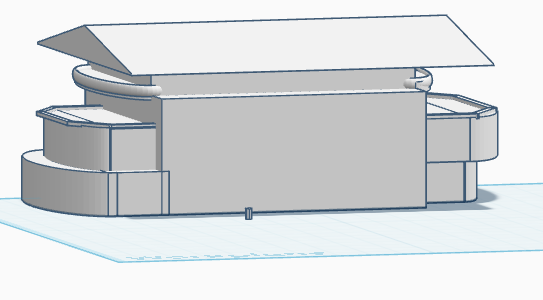
Before starting my Revit design, I used Tinkercad to visualize my initial design. To do this, I used a combination of already existing assets, as well as using all the hole-assets and grouping to make what I needed. Compared to my final version, my initial design had some major differences. For example, the left and right wings were much bigger, while the main building was closer to a cube rather than a rectangular prism. I changed the proportions in my final design by using more space for the bigger buildings, which was more space-efficient, given the total area of the building. Additionally, I made the third floor have much more space, and kept the indoor portion and roof smaller, as it allowed for residents to experience the outdoors more, which can reduce stress. Additionally, the larger roof would have led to more architectural issues, making the building more expensive, harder to build, and sometimes more susceptible to storm damage from wind. Finally, the small hexagonal prism at the bottom is supposed to represent a person in scale with the building. When making the Revit model, I decided to scale the building up, making it so there's more space for temporary housing available.
First Floor
The main goal of the first floor is to get people who come in acquainted with the community center. This floor has a mix of both normal community center amenities, as well as some designed to help people heal from natural disasters.
Main Entrance
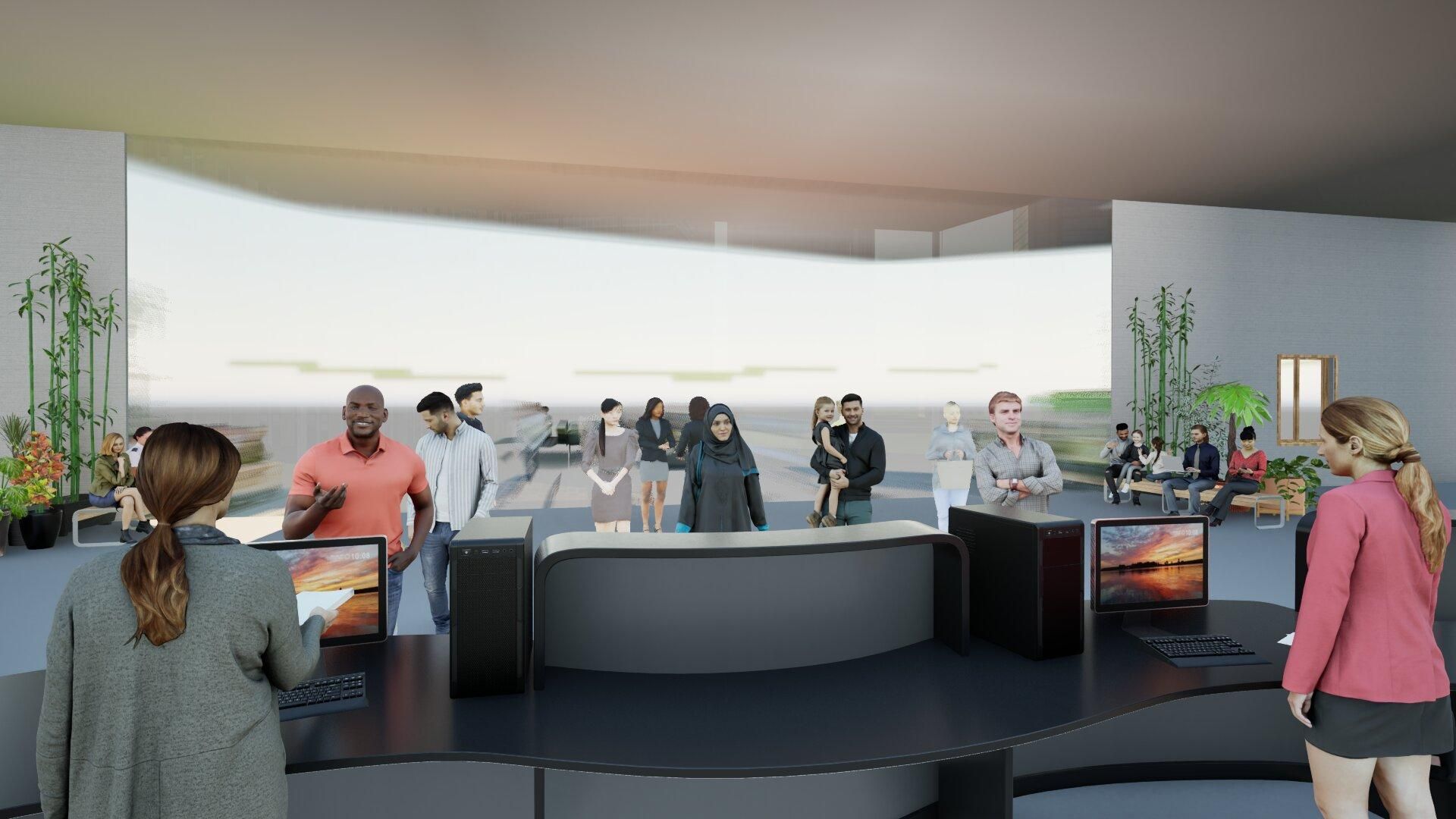
When entering the building, the first thing people are greeted with is a receptionist's stand. Whether it's to take shelter, find housing, or just to use the community center, there's always a receptionist to help. Located right past the entrance, this desk helps newcomers get situated, no matter what they need. Front desk agents assist in getting people to shelter, signing them up for temporary housing, finding them proper counseling, or just guiding them throughout the community center. These agents can help schedule counseling appointments, maintain headcount records, and provide toiletries as needed. Behind them to the right is the storage closet, where all of the necessary resources can be accessed. During and after natural disasters, people can be left panicked and confused. A guiding figure, such as the front desk agent, can not only guide them to safety, but also mentally aid them, as a voice of reason in tragic times can give confidence and endurance.
Waiting Area/Common Area
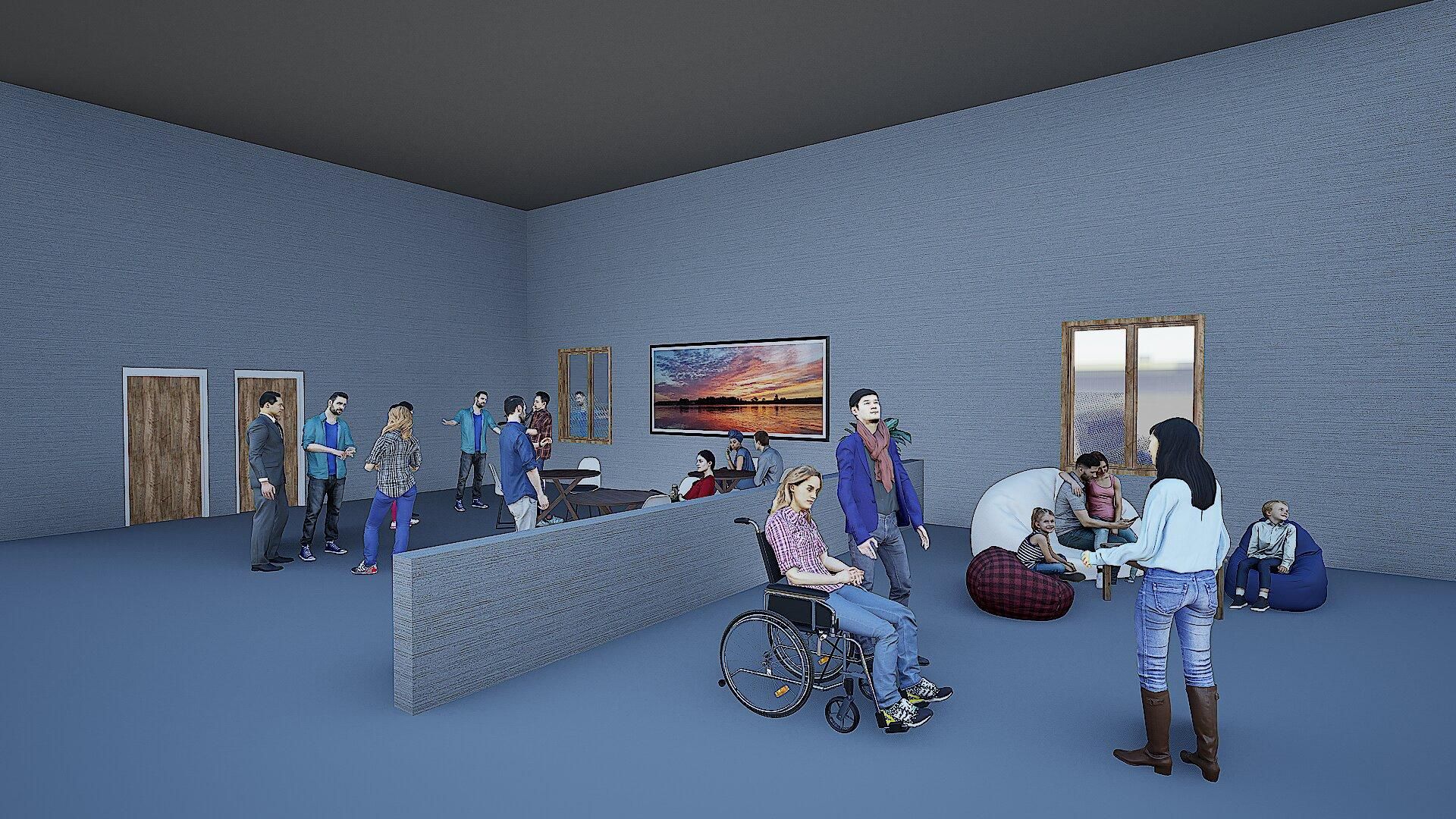
To the right of the entrance, community members can find the waiting area. This is a cozy corner of the main building, meant for people to socialize, relax, and meet others. Paintings in this area are specifically selected to calm temporary residents who have gone through natural disasters based on the vibrant colors and calm weather. Additionally, the concrete finish of the wall can give a feeling of safety to the residents, as concrete is commonly associated with strong, enduring buildings that keep their residents safe.
Counseling Services

Losing a home, job, or, at its worst, family, can put a lot of mental stress on those affected. SAMHSA reports that communities impacted by disaster can experience stress disorders, PTSD, depression, anxiety, and increased alcohol/substance use. Roughly 22% of those affected develop an anxiety disorder, while 50% can experience depressive symptoms (as seen by the Maui wildfires).
To help, past the common area, temporary residents can find two counseling offices. Each of these offices has two specialists with counseling licenses to give therapy to residents upon request. Both of these rooms are quiet and cozy, making therapy sessions feel private and comfortable. Working through mental trauma is a big step towards healing from disasters, but with effort, residents can bounce back, even stronger than before.
Pharmacy/doctor's Office
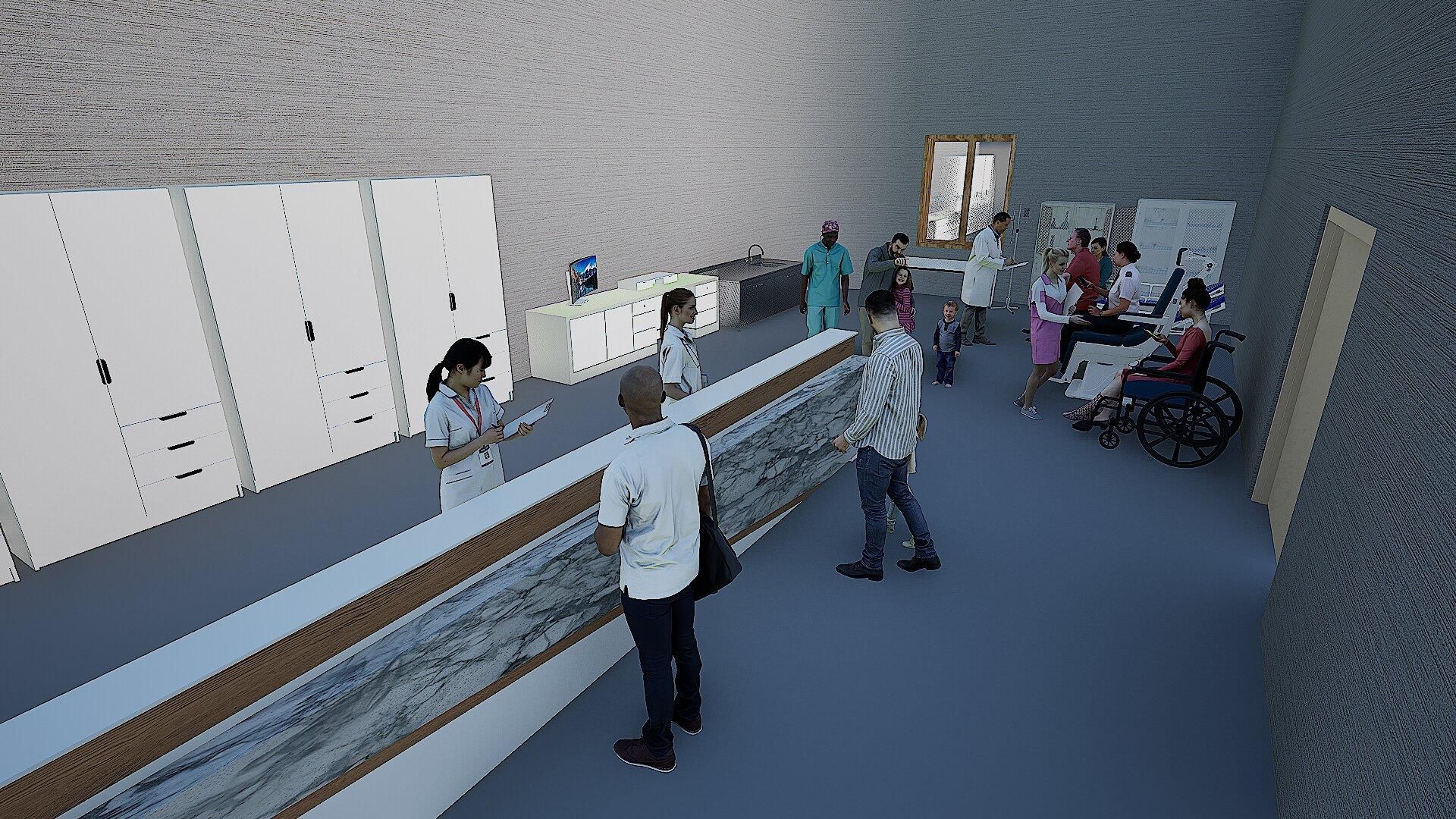
During natural disasters, pharmacies close when people need them the most. The CDC reported that due to Hurricane Mina, only 29% of local pharmacies were able to stay open in affected areas. Additionally, power outages cause medication with special storage requirements (like insulin, which requires refrigeration) to spoil and can't be used. The FDA warns that fire, flooding, and power outages can heavily impact the effectiveness of medicine. Additionally, people who rely on practitioners can be cut off from them in these disasters, causing pre-existing conditions to worsen. On top of that, hospitals for emergency services can be unreachable, causing injuries to get worse.
To combat this, the community center has an in-house pharmacy and doctor's office. Emergency generators keep this room going through power outages and any kind of disaster. The building is registered as an LLC to ensure the pharmacy is up to standard, maintains DEA registration and HIPAA compliance, and holds a State Board Pharmacy license. Temporary residents can get over-the-counter medicine, as well as prescription medicine if necessary. The clinic portion of this room has workers with doctor/nursing licenses and, if used as a formal clinic, would obtain a license from the California Department of Public Health. These doctors can perform basic procedures to either help those injured by the disaster or continue pre-existing treatment. This helps heal the community both physically and mentally
Business Center
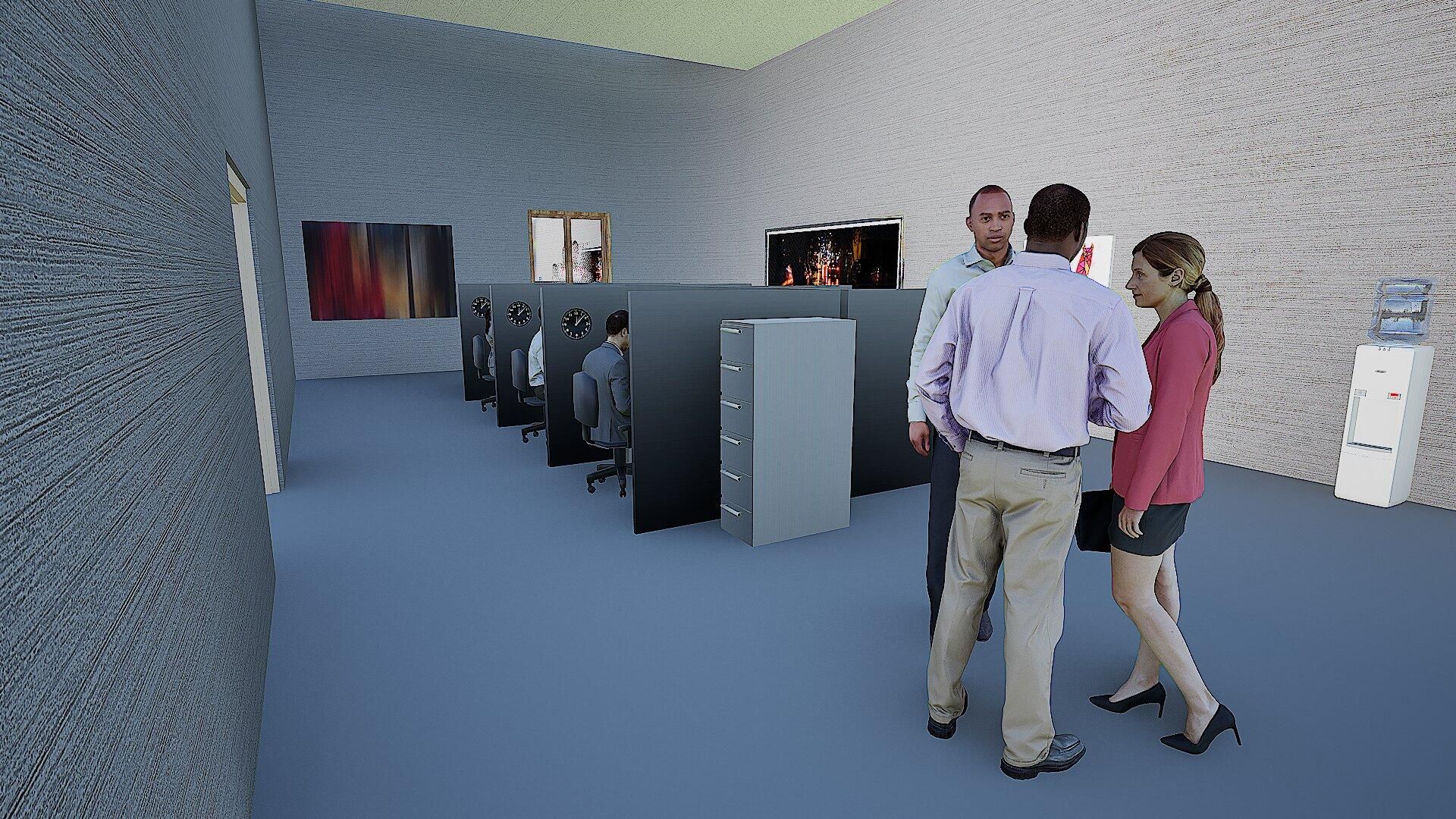
One of the biggest strains on those impacted by disasters is being unable to do their job. Having to move or not being able to reach work can cause a massive financial strain on people in temporary housing. To combat this, to the left of the entrance lies the Business Center. This room is a quiet place for people to get their work done. Cubicles and computers give people the resources and focus that they need to continue doing their work after disasters.
Shelter Core/Auditorium

The auditorium is designed to serve two important purposes: A place for daily gatherings and events, as well as a disaster shelter core during emergencies. Usually, the auditorium is used for events, presentations, or community programs. During a disaster, however, this place is the safest in the entire building. Steel emergency doors prevent fire, water, and debris from getting in, keeping the people inside safe. Internal heating, cooling, and ventilation systems ensure that the room has a safe atmosphere, while steel shutters can block the windows. The main safety feature of the room, though, is its reinforced concrete shell. This special material is what makes the shelter core as strong as it needs to be. It can resist winds/pressure from storms, take on flying debris, uses its proper rebar and shear walls to withstand earthquakes, uses its noncombustible shell to handle extreme heat, can resist water pressure, and can handle heavy roof/floor loads. This room is located on the first floor and towards the center of the building for maximum stability.
If it's too dangerous to leave the shelter, multiple cabinets carry emergency medical supplies, sleeping bags, toiletries, and plenty of food to last 2 weeks in the shelter. In normal scenarios, the shelter can hold up to 100 people comfortably, but almost 300 standing if necessary. Of course, the step before healing is safety. This shelter achieves just that while also being useful for everyday community needs.
Gym
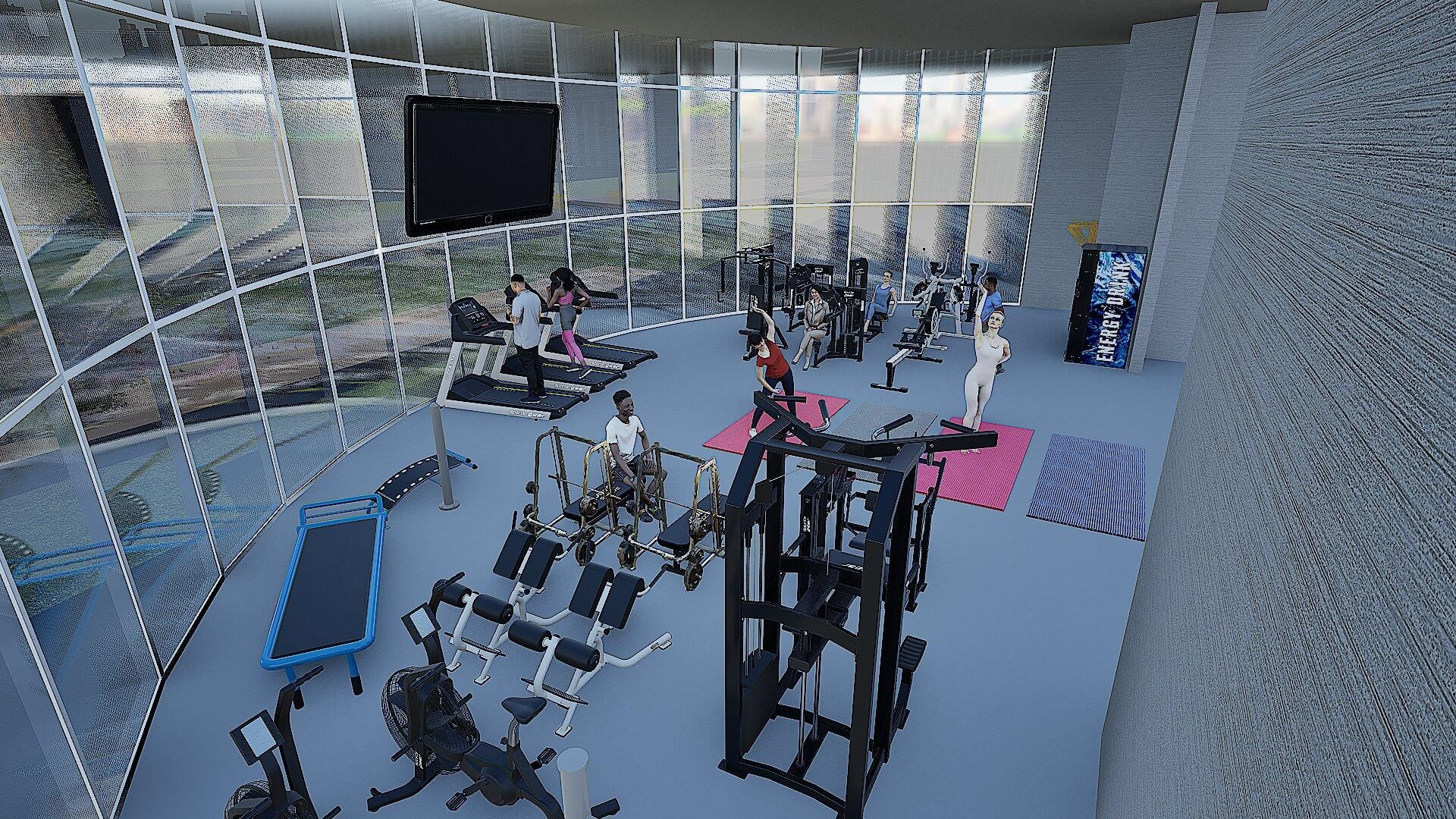
Depending on the type of disaster, leaving the shelter building isn't an option. A lack of exercise can ensue, leading to poor health. However, this community center comes with a full gym, allowing people to maintain their health while staying safe. Exercising has been proven to make people calmer and happier, meaning that this gym can be therapeutic to temporary residents. Additionally, the gym does not have any free weights. This is because during earthquakes, these free objects could fall, roll around, or even hit someone. To make up for this, all the machines selected can be used to exercise every muscle. With this in mind, the gym is a place to improve and heal after a natural disaster.
Community Room/presentation Room
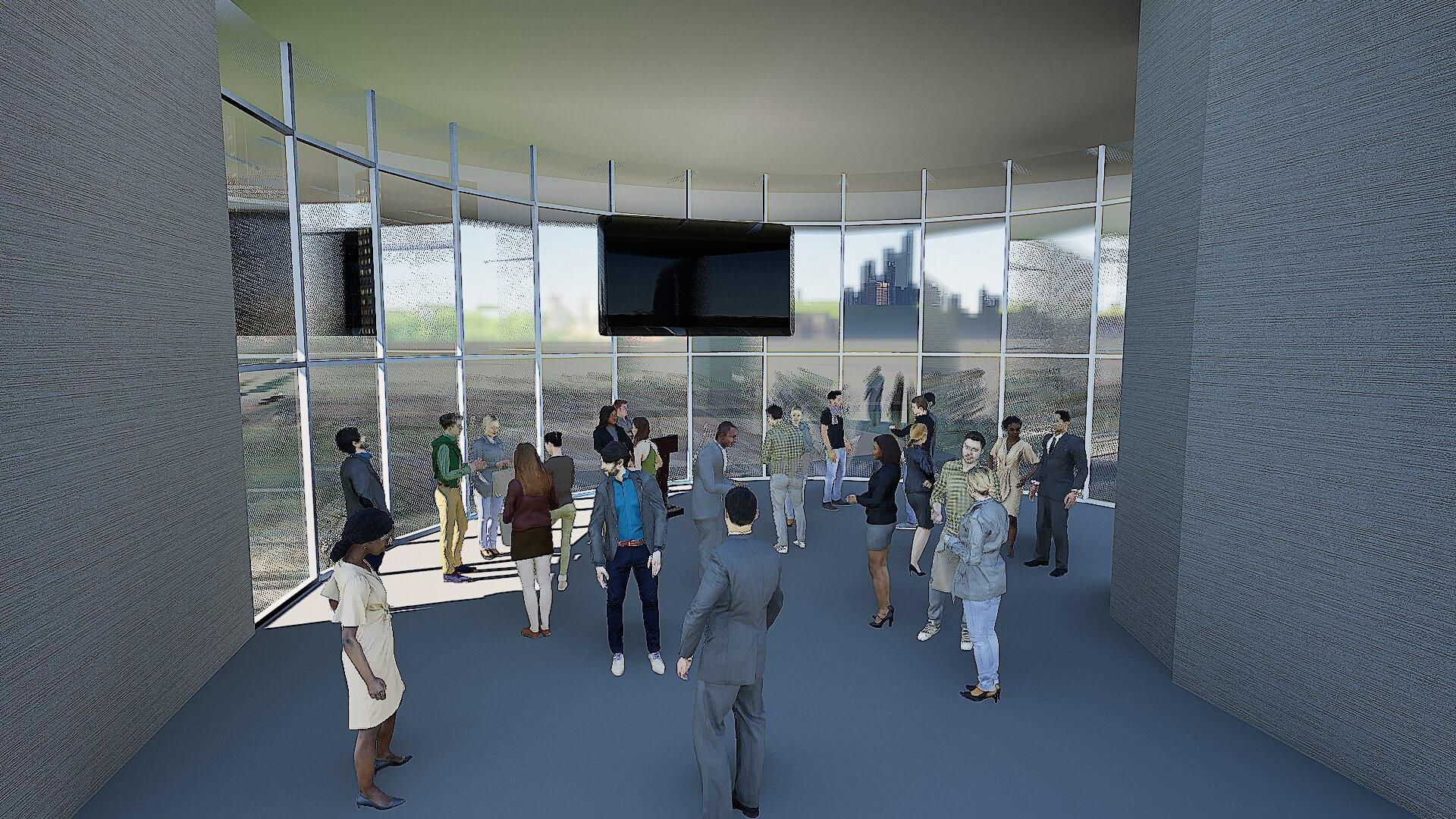
This room, to the right of the entrance, is mainly used for important presentations/social workshops. Here, community members can book time slots to give talks or host important gatherings. These kinds of events are critical to recovering mentally from a natural disaster. They give a safe place to talk, can rebuild community support, and help people connect. Because of this, the community center itself will host social events here after disasters to help people feel better during hard times.
Second Floor
The second floor, while accessible by anyone, is more oriented to temporary residents of the community center. This floor features housing and other daily needs for those displaced by natural disasters.
Temporary Housing
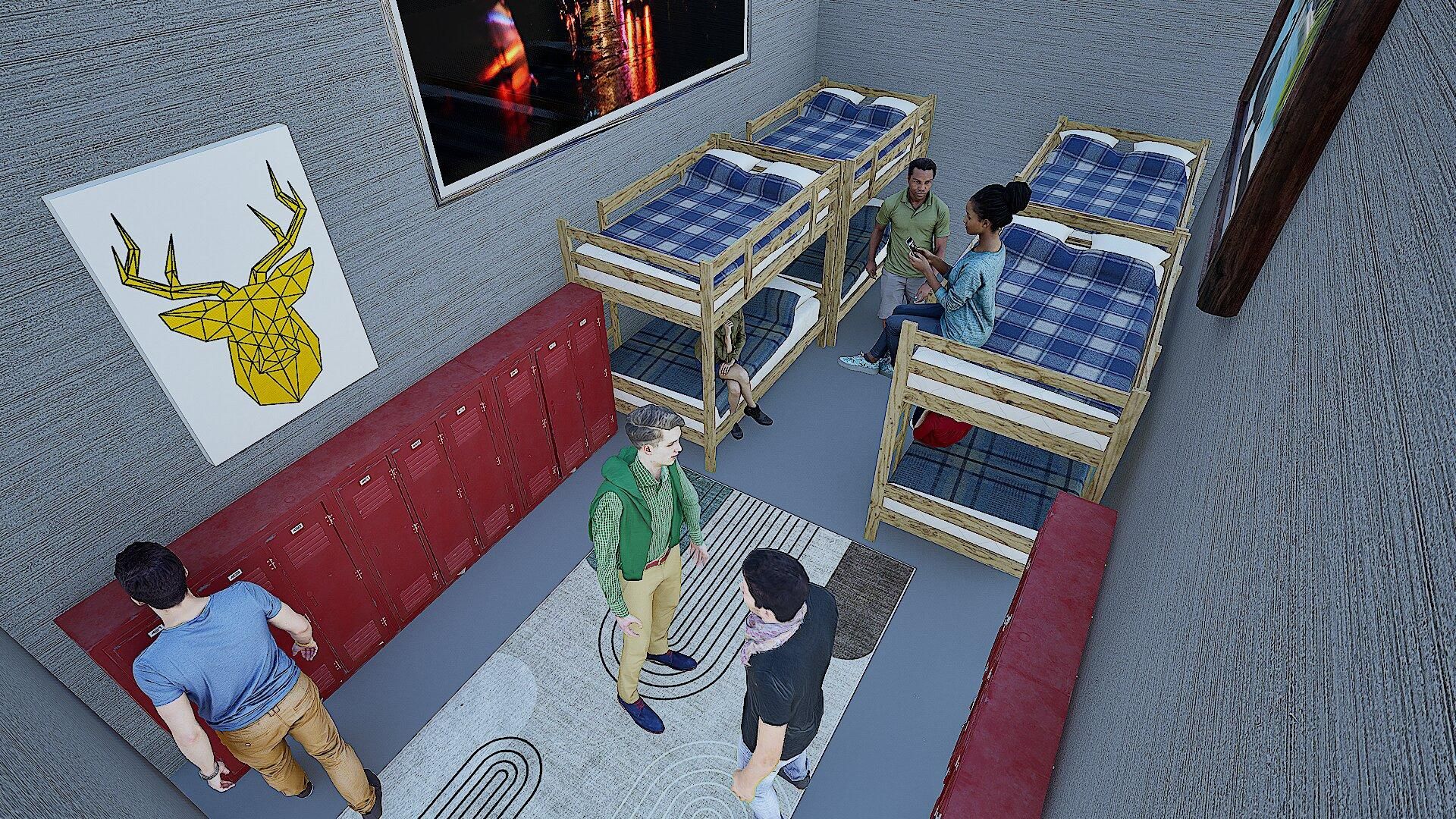
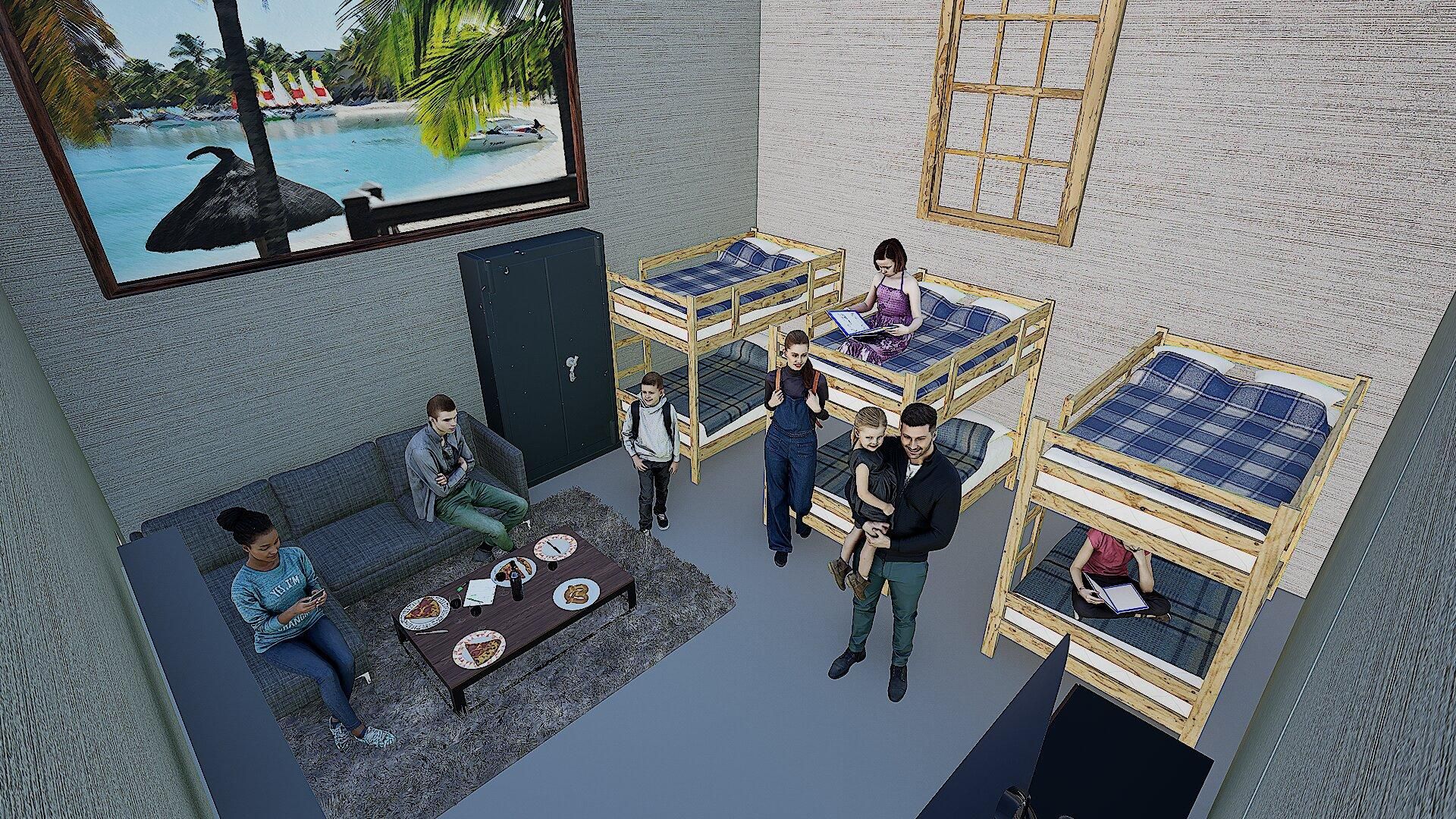
One of the most important features of this building is its temporary housing. As previously stated, one of the most difficult parts of healing from a natural disaster is finding temporary housing. Additionally, most of this temporary housing can lack necessities. To fix this, the community center has free private, temporary housing for residents on the second floor. These rooms have lockers, showers, and sleeping accommodations for both families and individuals. Three rooms can house 6-12 people each, while there are six rooms that can house 8-16 people each.
The bigger rooms have three bunk beds, each of which can hold 4 people. A couch and TV can be found before the door, as well as a locker to hold personal belongings. The furniture and decor was carefully selected to calm residents and make them feel at home. Additionally, a window above (with a steel curtain during storms) allows for natural light to come in, which has been shown to improve mental health. These rooms are meant for bigger families
The smaller rooms have four of the same bunk beds, have more lockers than the other rooms, and are focused around providing a place to sleep. Similar to the previous rooms, the furniture is meant to foster a sense of coziness. Residents here can easily bond with each other and then continue to spend time together when exploring the rest of the second and third floors.
Food and Clothing Store

After natural disasters, people can lose many of their basic needs, mainly food and clothing. During and after disasters, malls and stores are either inaccessible or closed entirely. This makes these goods extremely hard to come across in affected areas. However, the community fixes this by having a food and clothing store on the second floor, to the left of the housing. Here, residents can find dry food, clean water, and clothing racks. The clothes are donated from local charities to reduce waste and maintain environmental sustainability, while food is donated from local food banks' end-of-the-month distribution. Other than clothing and food, people can find other essential supplies
Community Kitchen

Finding a good way to prepare food can be difficult after a natural disaster. Restaurants are closed, people need to leave their homes, and most temporary housing units rely on premade dry food. Residents at the community center get full access to a communal kitchen. Not only does it allow residents to cook to their expectations, but it's also more efficient than smaller, private kitchens. The communal kitchen has less complex plumbing and electrical routing. It also reduces the number of appliances, ventilation, and food pantries. Additionally, this kitchen can be powered with back-up generators in case of power outages, making sure there is always a way to prepare food. Additionally, to the right of the kitchen lies a special, sectioned-off part of the kitchen. This is reserved for those with dietary restrictions or allergies, ensuring that anyone can prepare their food how they need to. Having a good meal can boost someone's mental state, helping them heal after a disaster.
Sitting Area/Dining Area
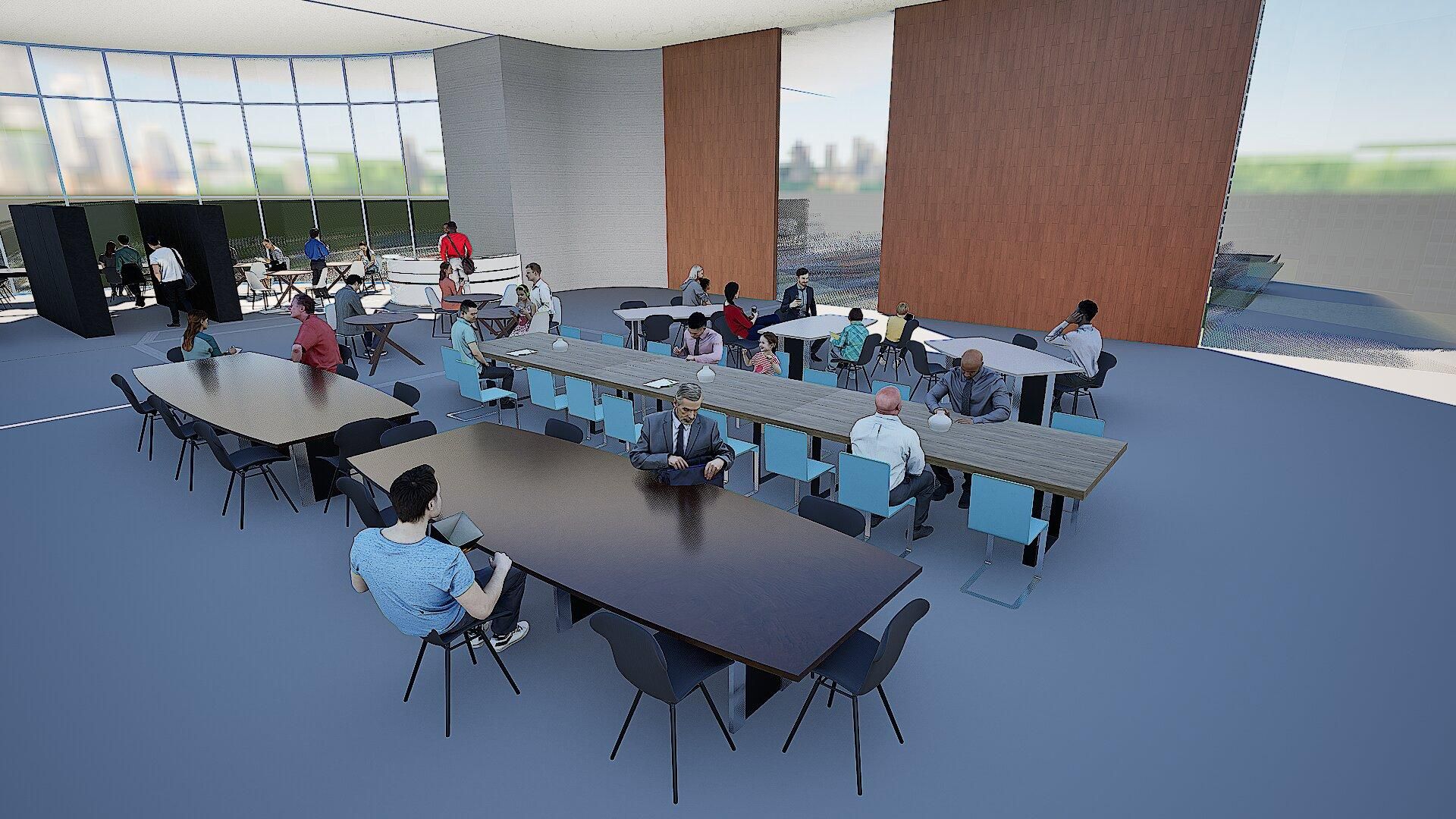
After making something to eat, residents can go to the dining hall, where they can sit with their family and just talk. A shared dining room can support mental health by giving people a way to gather and socialize, while also rebuilding a sense of community and routine after a disaster. This helps the building serve as a place of healing, helping the residents reconnect and build long-term resilience.
Library

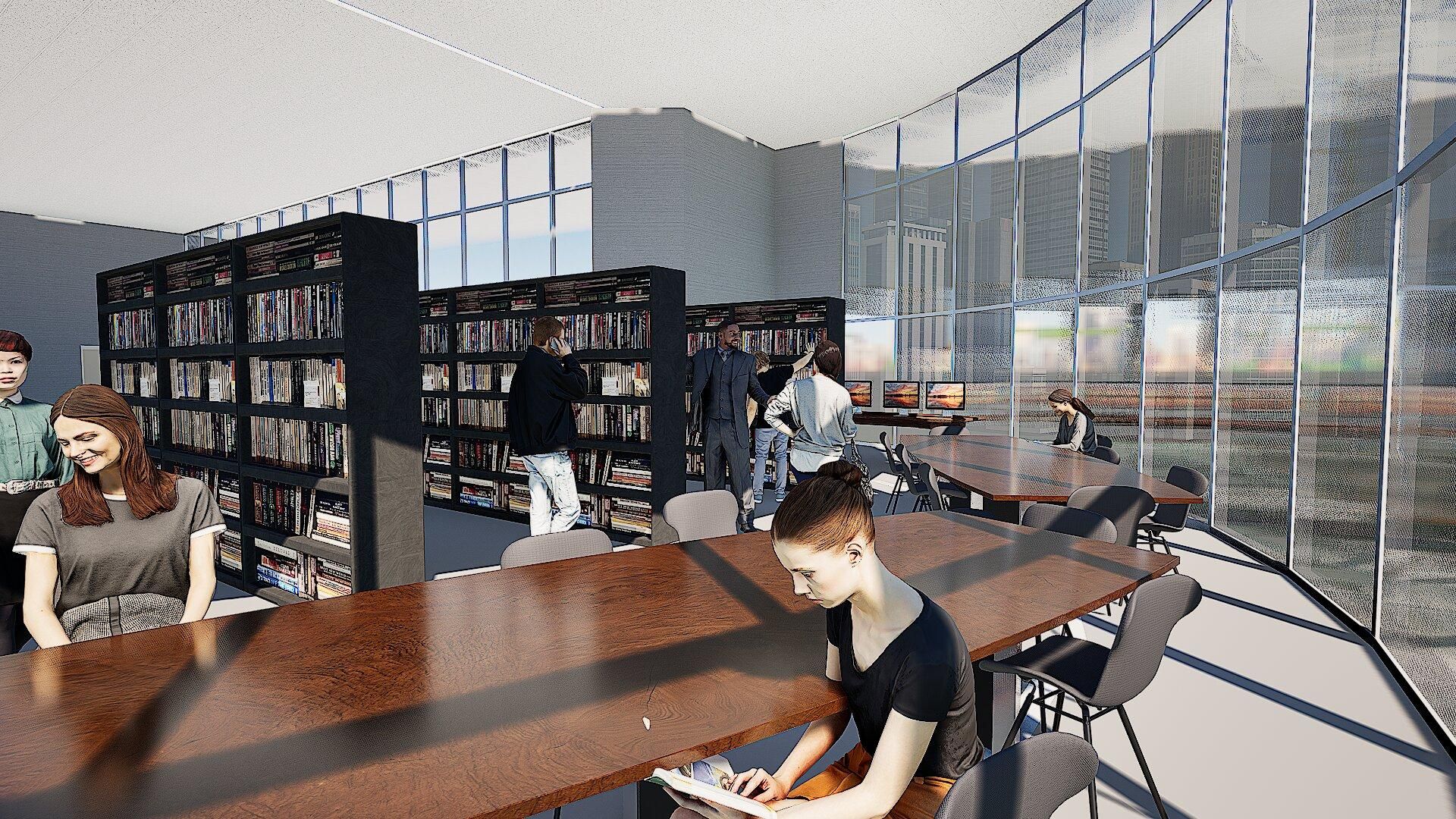
The right side of the second floor hosts the community center's library. Here, students can catch up on missed work, residents can find quiet, or on a normal day, people can come and check out and return books. Reading books has been shown to lower stress, letting residents calm themselves after disasters. Additionally, this is a great place to host meetings, clubs, or other social events. The library is also ADA compliant (proper shelf spacing), allowing everyone to participate.
School

Another unfortunate result of natural disasters is kids missing school. School is important because education is vital for a child's mental development and sometimes even social life. By turning the left wing on the second floor into a classroom, students who've been displaced by disasters can continue their studies. To make sure the students get credit for their work, the classroom meets local education requirements and school facility approval. This ensures that students can heal by getting back into their academics and school social life.
Third Floor
The third floor is a place for downtime. Residents and community members alike can sit outside on the rooftop patio to chat, play games, or just admire the view. This floor includes a gazebo, which can also function as a temporary flood shelter.
Gazebo/Shelter
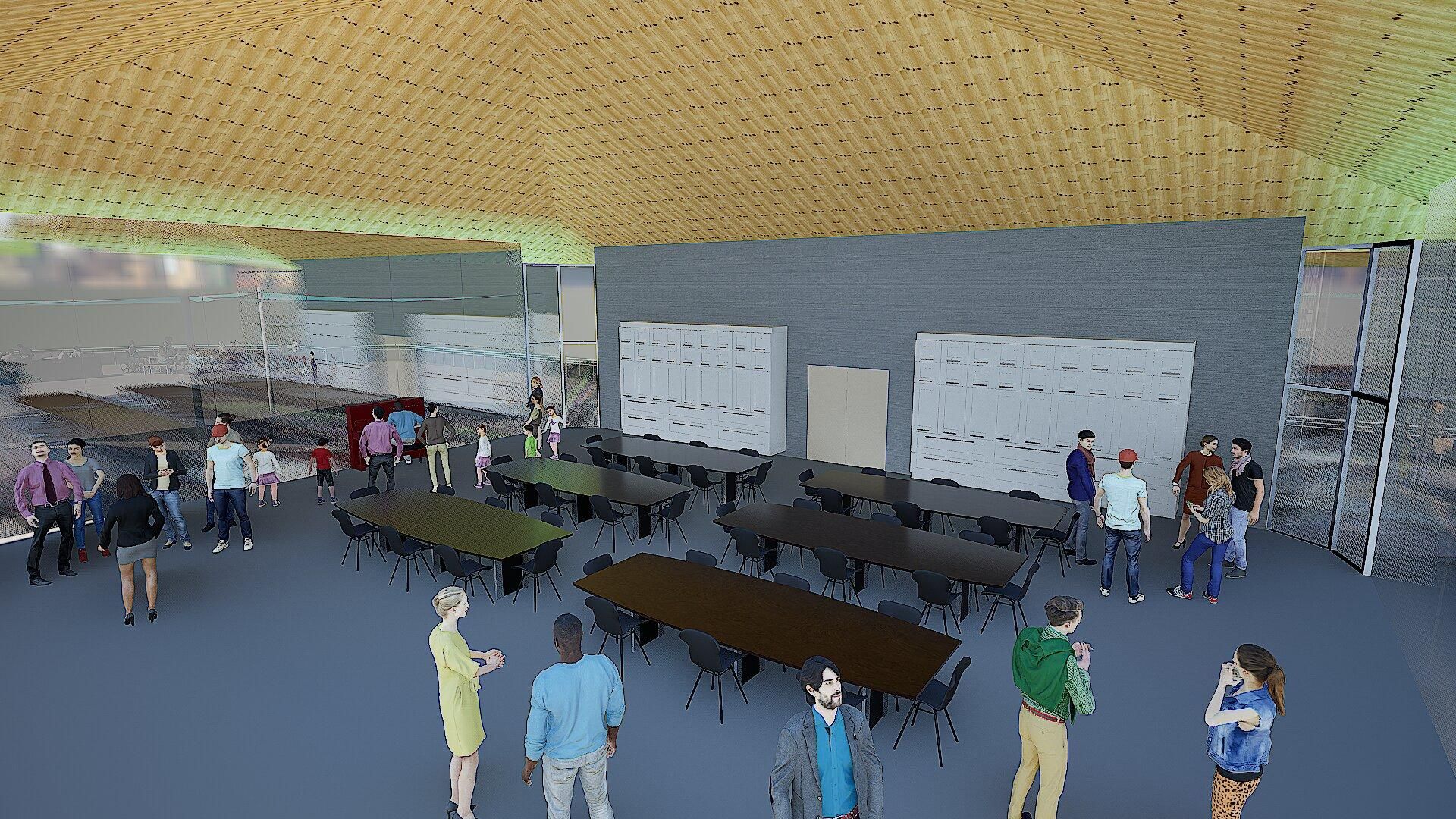
On the top floor, a gazebo lies in the middle of the patio. This room functions as a gazebo/event room for residents/community members. However, it also acts as a shelter during floods, when the main shelter core isn't viable due to rising waters. This room is constructed similarly to the shelter. It has reinforced materials, plenty of room, and rations to last 1-2 weeks. While hundreds of people can take shelter on the roof from flooding, roughly 20-70 people can fit in the roof shelter safely. Additionally, each side of the roof has small gutters so that water won't pool on the patio, causing strain on the building. Just like the main shelter, protection must happen first so that healing can occur.
Patio

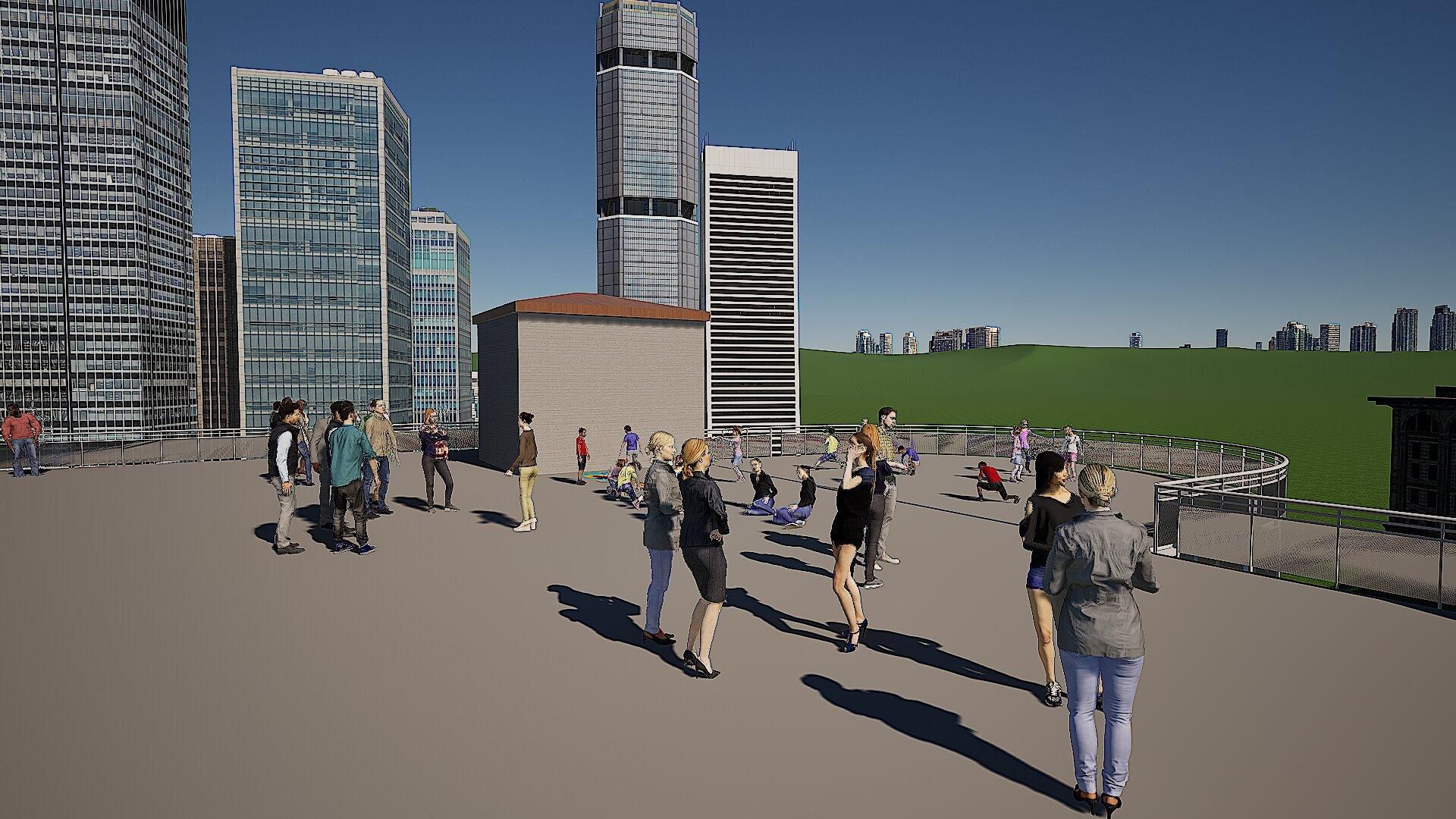

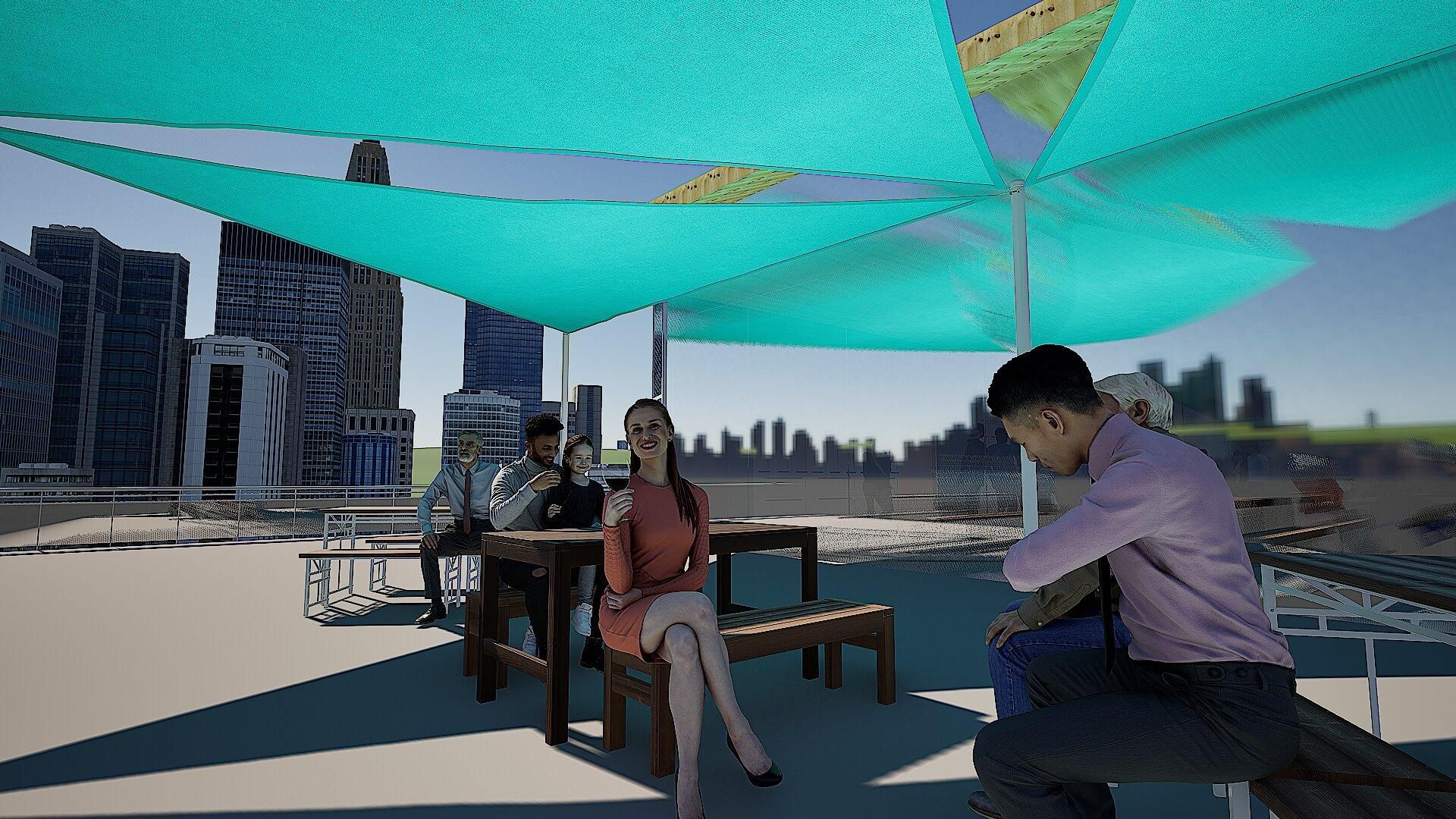
The patio is a place of recreation for both community members and residents alike. Here, residents can spend time outside, getting familiar and okay with being back in nature. Here, people can play, sit under shade sails, or just watch the sunset. All of the furniture is bolted to the ground, while the sails can be easily taken down to avoid flying debris during storms. The floor is slightly slanted towards the gutters so that water doesn't collect and make sure the roof isn't overstrained. Overall, this is the last piece of healing for those affected by natural disasters. Being with family and friends, having a place to stay, and being ready to begin anew.
Construction Plan
Every good building needs a construction plan. To begin, construction of the community center would start with site preparation to ensure the ground is stable. Next, a reinforced concrete foundation would be laid to improve the earthquake and storm resistance. The main frame would then be built with structural steel and shear walls, as well as bracing with connections to resist all kinds of disasters. Then, reinforced concrete would be used to add even more support. The shelter core would then be constructed with its many reinforced materials, as well as its ventilation and temperature systems. As the rest of the building is constructed, drains, solar panels, and guardrails would be installed to add safety and convenience features. Emergency generators, battery/food/water storage, and communication equipment would be prepared in case of emergency. After laying tile and installing impact-resistant glass, the building would acquire permits, fire-safety review, accessibility approval, kitchen health approval, and a Certificate of Occupancy. Finally, once completed, the community center would be used for everyday use as well as a disaster shelter and recovery hub during natural catastrophes.
Safety Feature: Flood
The building is designed to withstand floods by keeping important areas sealed or elevated. For example, housing is on the second floor, while the shelter at the bottom is fully sealed with ventilation systems. Additionally, the main materials on the bottom floor are sealed, so they do not deteriorate, while impact-resistant glass makes sure no drifting debris can break the windows. Then, backup systems and various other necessities are elevated. Finally, drainage systems make sure that nothing floods the patio roof, reducing strain on the building. These safety features work together to make sure the community has a safe place to go during floods.
Safety Feature: Wildfire
The building uses noncombustible materials to withstand fires (all the wood is vinyl). Cement, stone, metal panels, and masonry protect the people inside from harsh fires. Boxed-in vents, gutters, and eaves make it so fire can't spread through weak points. Additionally, there is no foliage present on the building that can catch fire, causing it to spread further. Internal ventilation makes it so smoke can't get through, keeping the air safe. Finally, sprinklers around the building make sure that if fire does somehow get in, it can be immediately put out, which fully protects residents from the harm of fires.
Safety Feature: Storms
The hardened shelter core acts as the safest area in the building during storms. Fully sealed, ventilated, shielded, and equipped with supplies, this room keeps residents safe. Massive steel sheets are used to seal the building so that even if the glass breaks, debris can't hurt community members inside. The reinforced materials for the shelter, as well as for the rest of the building, keep it standing during bad storms. On top of that, the architecture of the building contributes to its resistance. The fact that there are very few overhangs reduces the amount of drag caused by winds, making it so the community center won't get torn apart. Additionally, the numerous anchor points along the foundation ensure that the community center won't be swept away by any strong storms. All these features work to hold both the building and community together during storms.
Safety Feature: Earthquakes
The community center is designed to resist earthquakes through its strong and sturdy structural system. It uses a combination of reinforced materials and civil engineering to not get damaged during earthquakes. While the materials are strong, the real resistance comes from the building's 200 anchor points that keep the building attached to its reinforced foundation, as well as its triangle-shaped frames on the inside of the walls. All heavy objects are fastened to the ground so that they won't move around and hurt a community member. These features help the building stay stable while protecting its occupants during seismic events.
RELi Certification
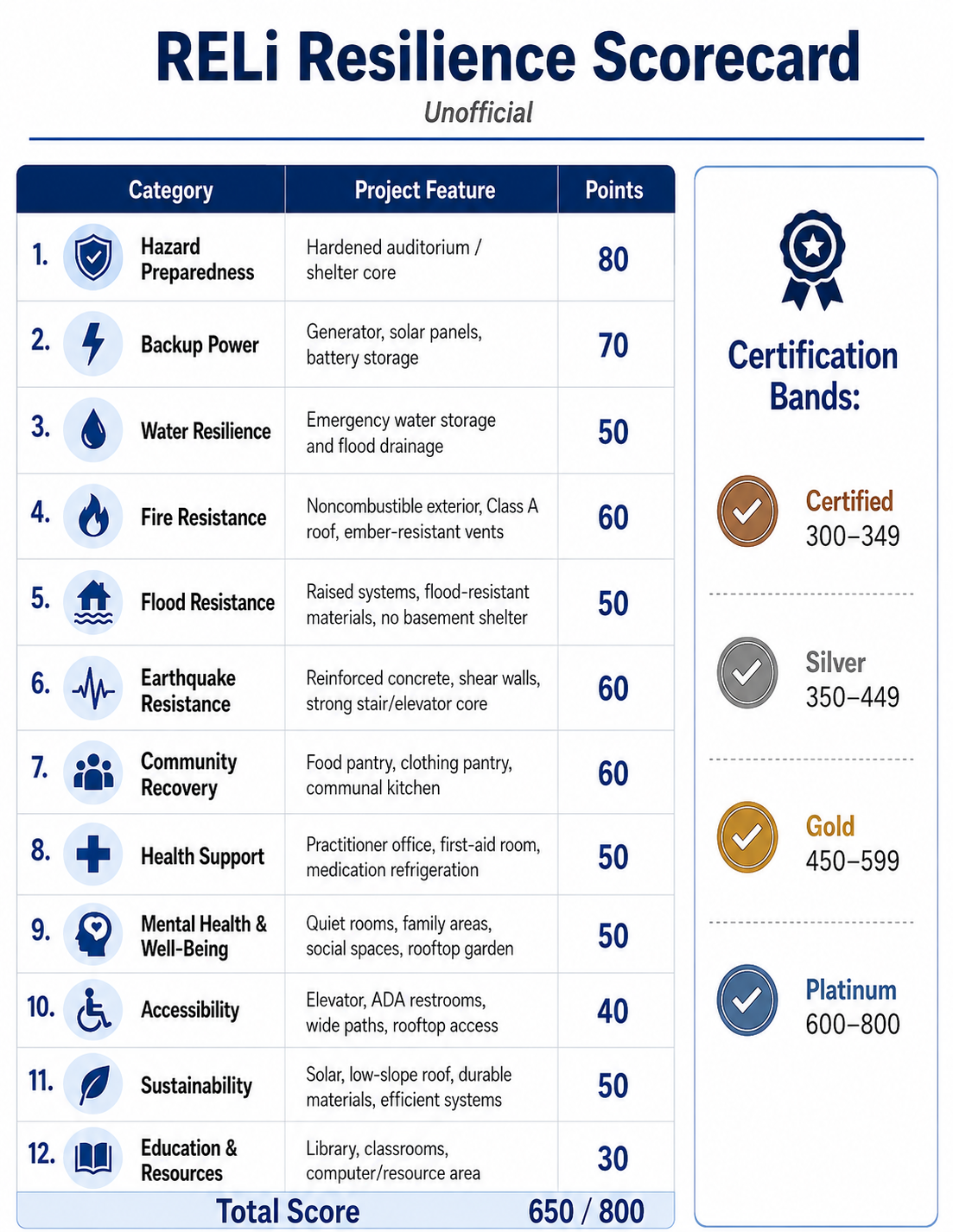
RELi certification rates a building on its resilience in natural disasters. Out of a scoring rubric of 800, the best a building can be rated is platinum. This is based individually on 12 different categories. To rate my building, I compared it to other platinum-certified buildings and unofficially scored a 650/800, making the community center platinum-certified.
Sustainability Factor
While being efficient at protecting and healing community members, this building also has many different features that make it sustainable. It's designed to reduce construction by having communal bathrooms (located at the bottom left of every floor) and kitchens. It also uses a stairwell with an energy-efficient elevator (next to the bathrooms). The solar panels on the roof provide plenty of clean energy, while all of the appliances are specially selected to be power-saving or eco-friendly. Most of the materials used are renewable, and don't require a big carbon footprint to make. Finally, all of the clothes and food are donated from charities and food banks to cut down on waste. Overall, the community center can have a green footprint while also being sustainable.
Sources Used
- FEMA safe room guidance — Used for the hardened shelter core and tornado/hurricane protection ideas.
- ICC storm shelter standards — Used for storm-rated shelter design, exits, ventilation, and safety requirements.
- RELi resilience certification — Used for the resilience scorecard and disaster-readiness certification idea.
- FEMA flood guidance — Used for flood-resistant materials, raised systems, and avoiding basement shelters.
- CAL FIRE home hardening — Used for wildfire-resistant materials, ember-resistant vents, and defensible space.
- NOAA disaster data — Used for statistics about disaster cost and frequency.
- CDC mental health disaster guidance — Used for mental-health impacts after disasters.
- SAMHSA disaster mental health resources — Used for PTSD, anxiety, depression, and recovery support ideas.
- ACF post-disaster housing information — Used for explaining why temporary housing is difficult.
- FDA medication disaster guidance — Used for pharmacy impacts, damaged medicine, and refrigeration concerns.
- ASPR emergency prescription program — Used for explaining emergency medication access.
- California health department food rules — Used for kitchen and food pantry permit/certification requirements.
- California clinic licensing information — Used for practitioner office and medical support space requirements.
- ADA accessibility standards — Used for elevators, ramps, accessible restrooms, and wheelchair access.
- California school building guidance — Used for explaining classroom/school certification issues.
- Revit documentation/tutorial guidance — Used for levels, floors, roofs, stairs, curtain walls, and ceiling plans.
- Community center cost references — Used for normal and disaster-resilient building cost estimates.
- Supermarket/food supply references — Used for explaining food access, pantry needs, and supply disruption after disasters.
- World Health Organization emergency mental health guidance — Used for explaining psychological distress, trauma, and emotional recovery after disasters.
- HUD disaster recovery resources — Used for long-term housing recovery, rebuilding, and community support after disasters.
- USDA disaster food assistance resources — Used for food distribution, emergency meals, and why pantries/kitchens matter after disasters.
- California Office of Emergency Services hazard information — Used for explaining why California needs multi-hazard resilience centers.
- U.S. Surgeon General social connection advisory — Used for explaining why social events, community gathering, and shared spaces support mental health.
Conclusion
Overall, this community center makes the perfect place for healing. California has the biggest population of residents impacted by natural disasters. They can impact anyone and leave them in a dark place. However, by combining the everyday functions of a community center with disaster-response and recovery features, a normal building can become a place to shelter and rebuild from natural disasters as a community. The goal of this project was not just to make a place that can survive natural disasters and house people there, but to make a place where people can recover and flourish.