Pen-based Droplet Generator
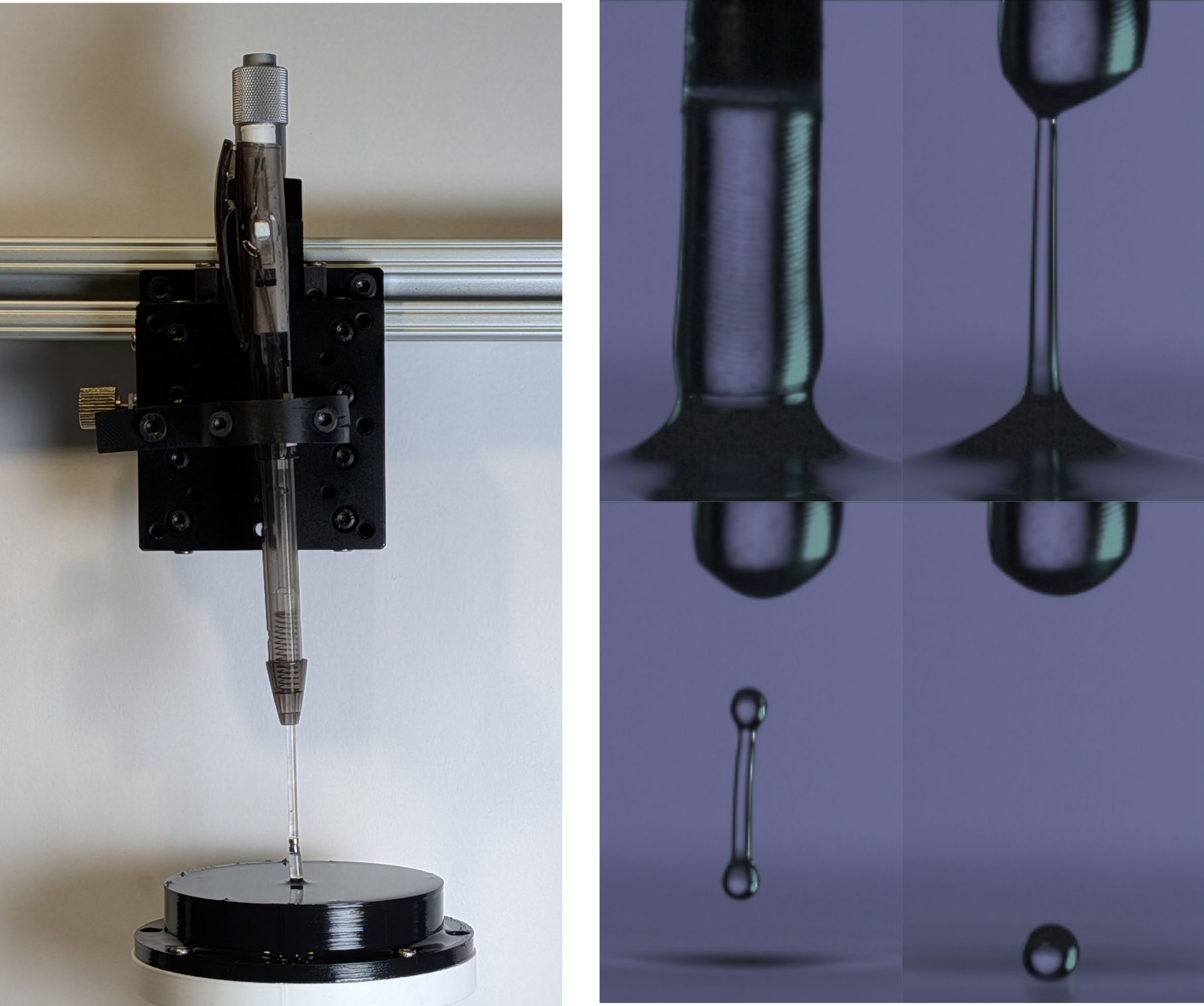
We built a simple latch-mediated, spring-actuated droplet generator based on the mechanism of a standard click pen. The custom components are 3D-printed, while the housing is a commercially available pen.
This device provides a simple, low-cost method for reliably generating droplets on both stationary and vibrating liquid baths, making it well suited for pilot-wave hydrodynamics experiments. In addition to producing single droplets, the tip can be customized to generate lattices of droplets in a single actuation.
Further details on the design and droplet formation physics are provided in the upcoming publication “Drop generation via ligament stretching” by Johnathan Hoggarth, Daniel M. Harris, John W. M. Bush, and Bauyrzhan K. Primkulov.
Supplies
- Compression Spring 1" Long, 0.187" OD, 0.16" ID
- (2x)Neodymium Magnets: Magnetized Through Thickness, 1/16" Thick, 0.08" OD
- Viscoelastic polyurethane 4" x 6", 0.040" Thick cut into 3 x 3 mm sheets
- Pen housing: We used a BIC BU3 Grip.
- UV curable adhesive
- Linear Translation Stage
3D Printed Parts
The pen contains four unique 3D-printed components:
1) Pen Body: The pen body sits inside the pen housing and compresses the internal spring when the mechanism is latched, storing elastic energy for actuation. This component was printed using an SLA printer to achieve higher dimensional accuracy, although FDM printing may also be suitable depending on tolerances.
2) Pen Tip: The pen tip is a cylindrical probe that comes into contact with the liquid bath. Tips can be printed with different radii, which serves as a primary control parameter for the resulting droplet size. The tip attaches magnetically to the pen body, allowing for rapid interchangeability. Due to the small feature size and the sensitivity of droplet formation to the probe radius, this component was fabricated using SLA printing to ensure high dimensional accuracy and smooth surface finish.
3) Pen Button: The button acts as part of the latch mechanism. When pressed, it disengages the latch and releases the stored spring energy, initiating rapid retraction of the pen body.
4) Pen Slider: The slider engages with the latch mechanism and translates during actuation. Pressing the slider compresses the spring and sets the retraction distance, while its release drives the motion of the pen body.
5) Mount: The mount is used to secure the pen to a translation stage, allowing for precise vertical positioning relative to the liquid bath. Accurate positioning is important for consistent droplet generation, so this mount helps ensure repeatability by keeping the pen fixed during operation.
Glue Magnets to Pen Tip and Pen Body
.jpg)
.jpg)
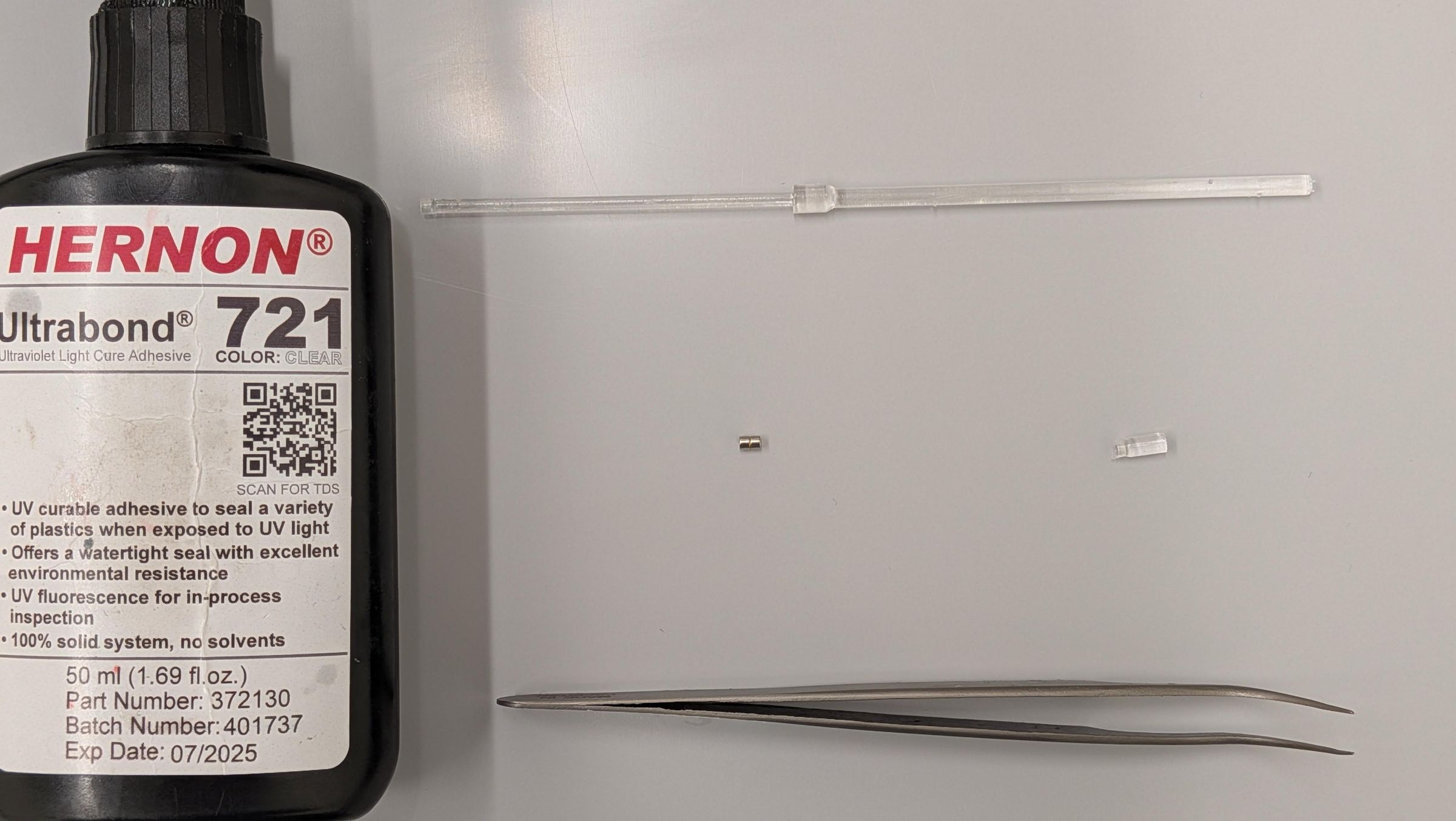
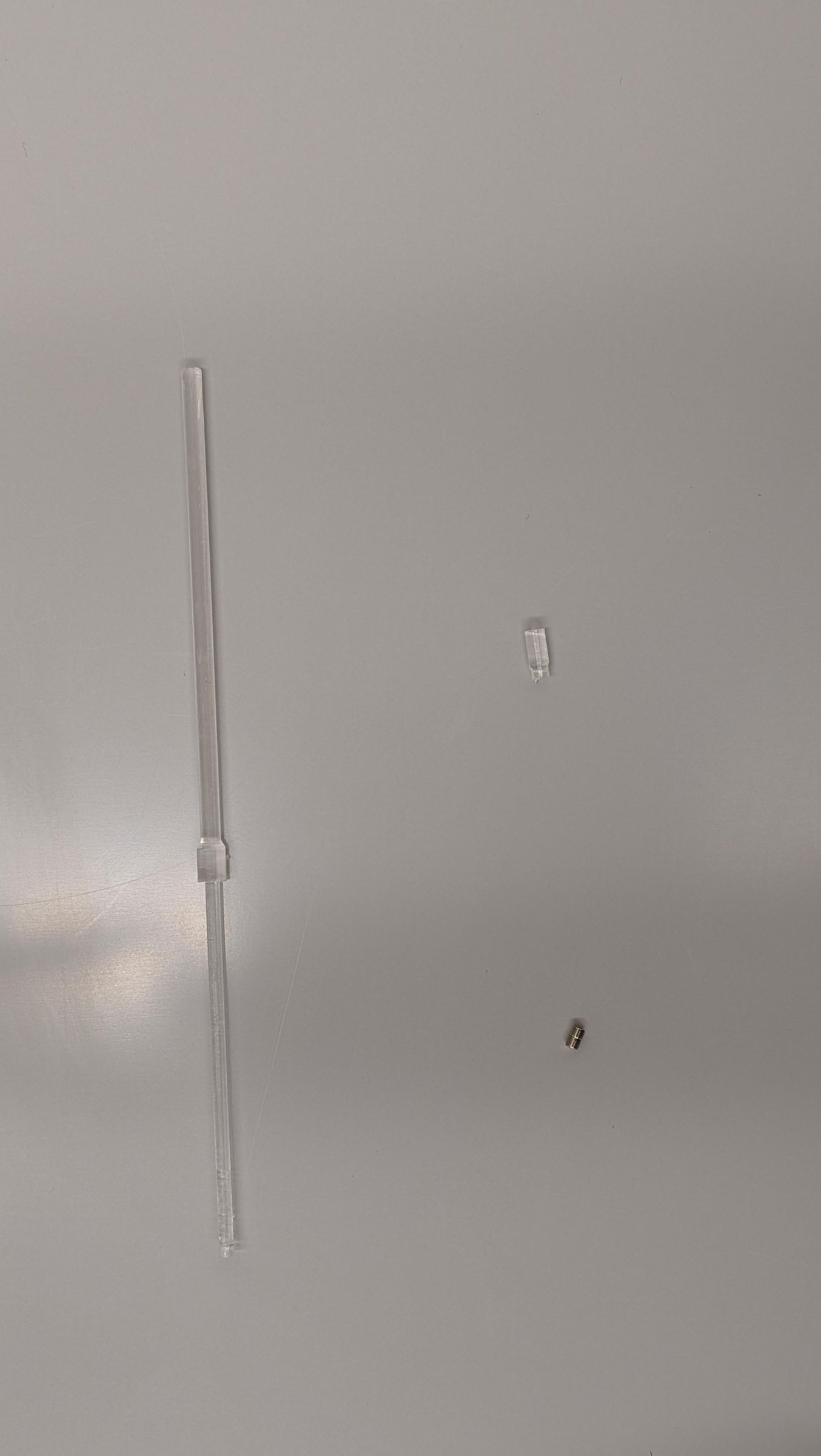
Glue a magnet to both the pen tip and the pen body. We found it easiest to use titanium, or any non-magnetic tweezers, to position the magnets, although this can also be done by hand. WARNING: Ensure the magnet polarity is aligned so that the two components attract each other; if reversed, the tip will not attach.
Add Viscoelatic Polyurethane Material to Pen Slider
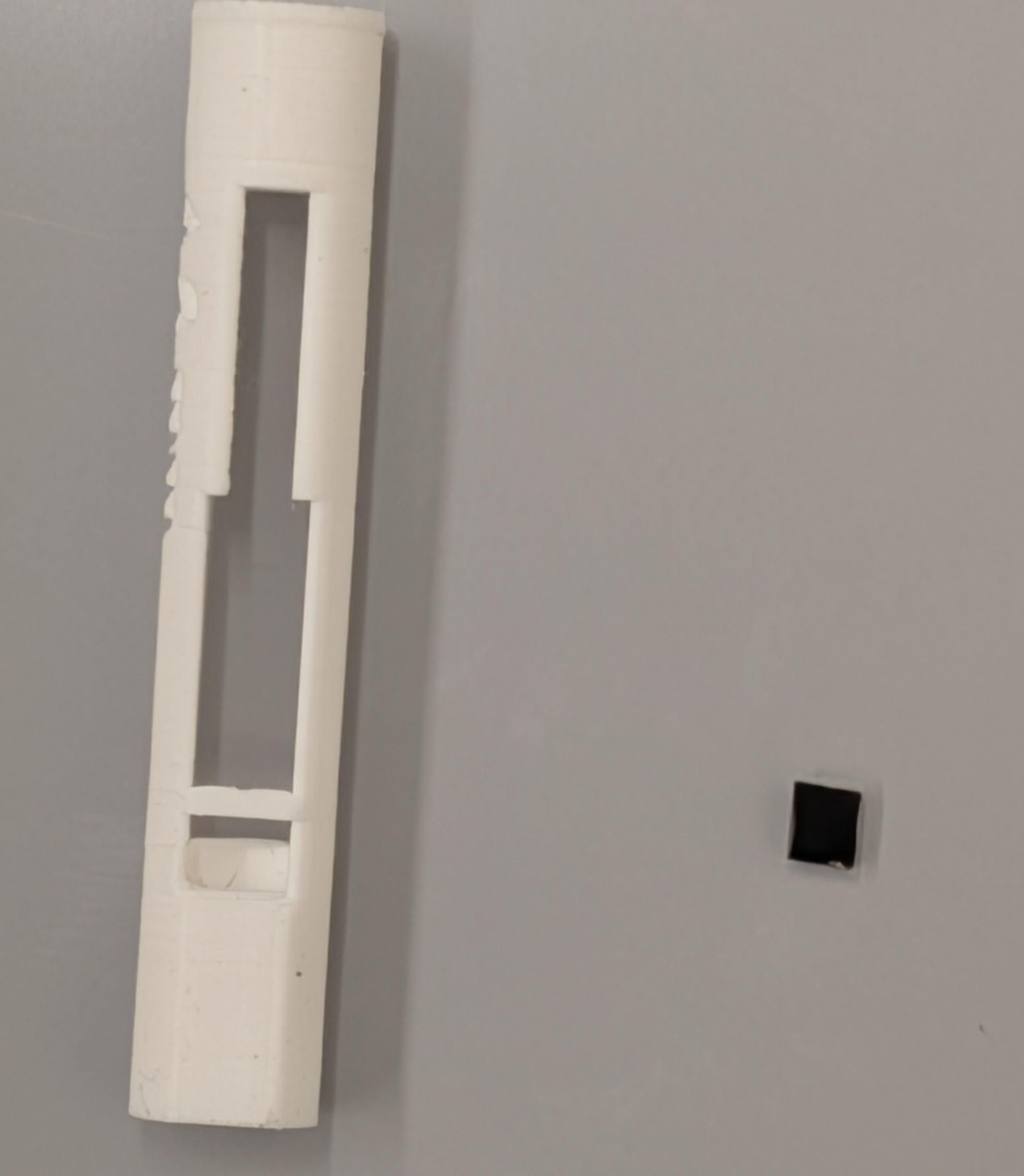
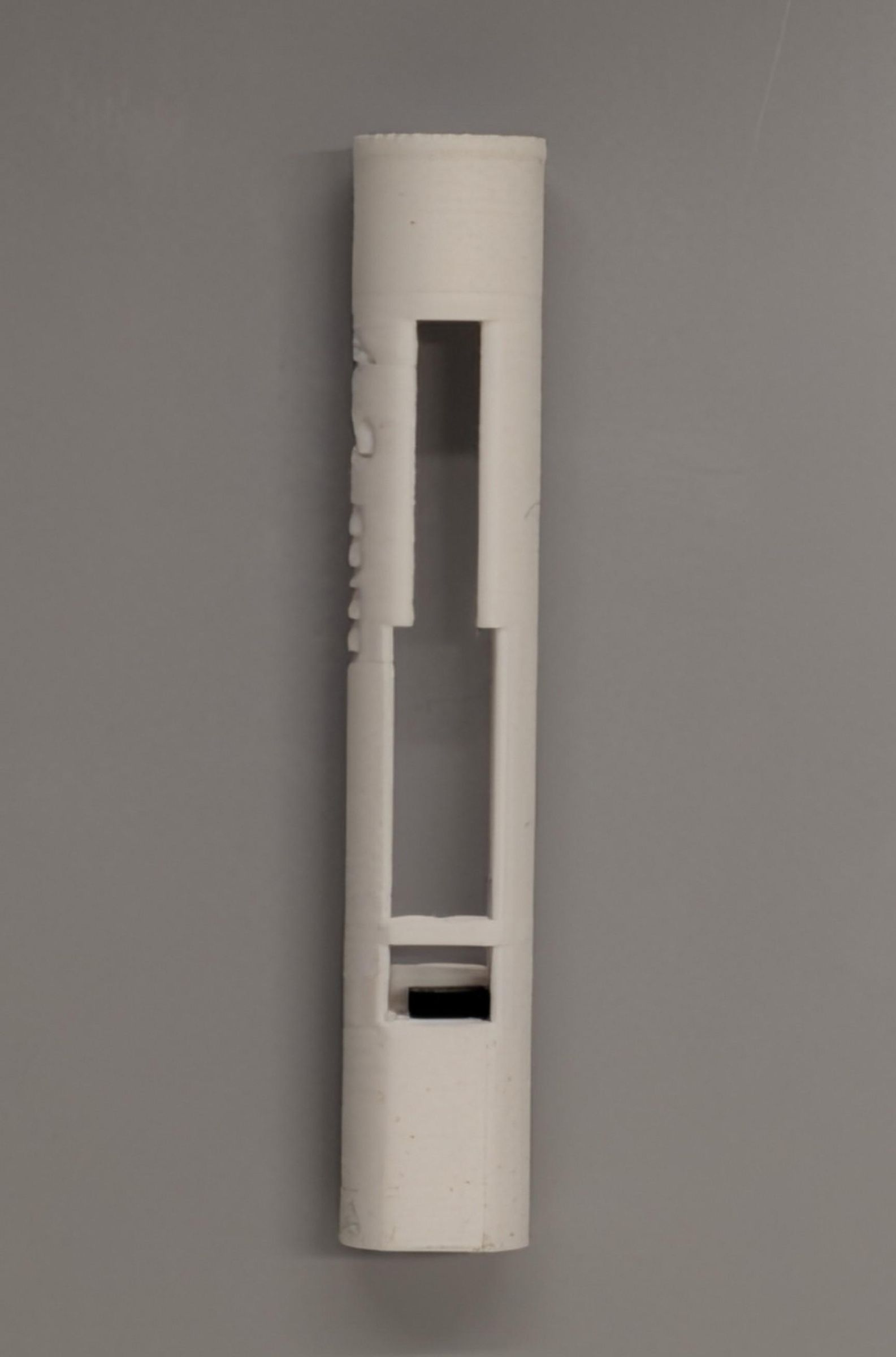
Cut a ~3 × 3 mm piece of the viscoelastic polyurethane and place it inside the pen slider. The exact size is not critical, as long as it fits within the designated cavity. The slider includes a small platform designed to hold this material in place.
Assemble the Pen Parts

Assemble the pen components in the following order (see video for reference). First, press-fit the pen body into the pen slider. Insert the pen button into the slider, then place the spring onto the pen body. Next, insert the assembled components into the pen housing; during this step, the button must be held down to allow the mechanism to fit. Once properly positioned, the button will click into place. Finally, attach the desired pen tip to the pen body using the magnets.
Mount Pen Above Bath
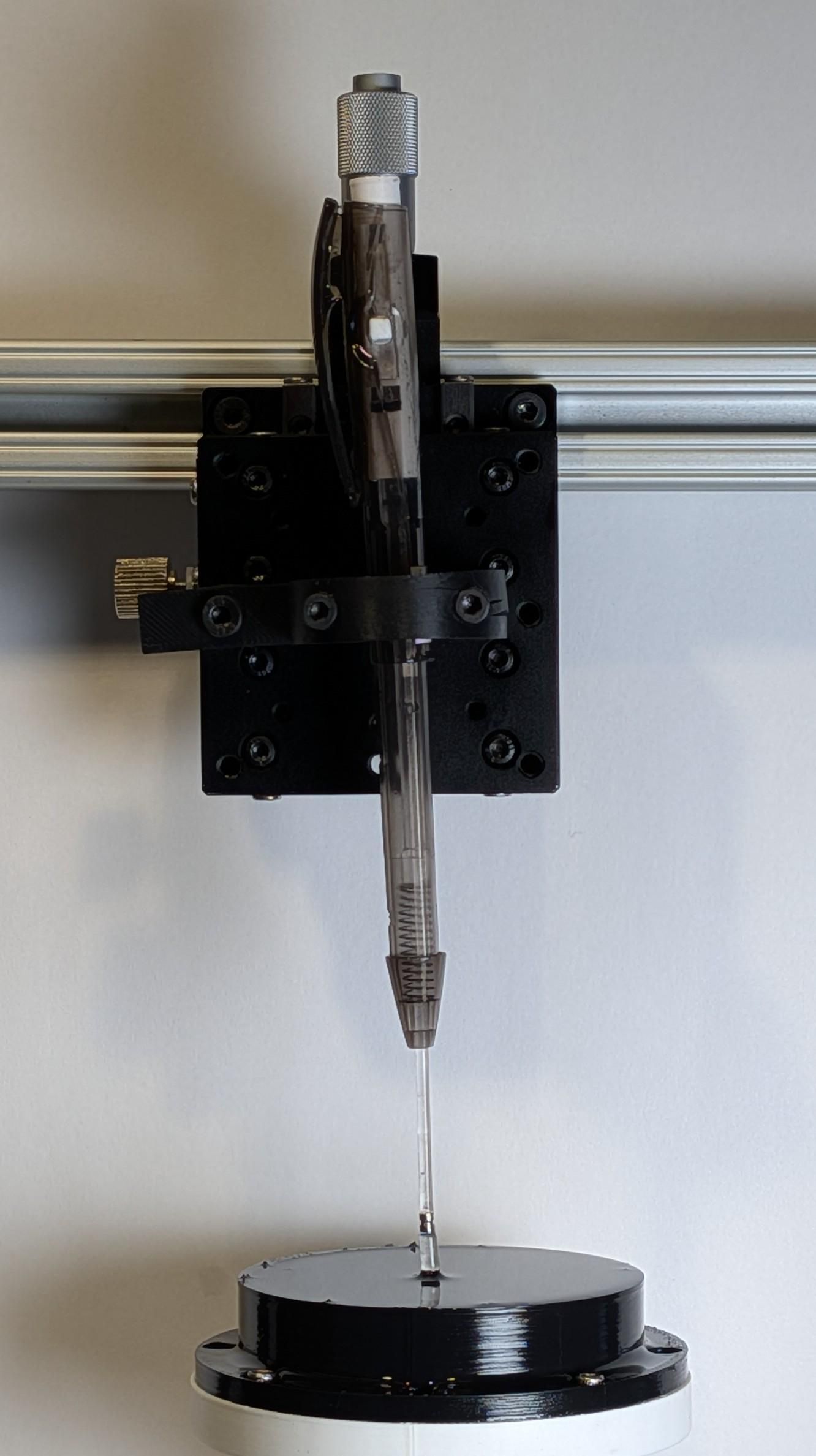
Mount the pen on a translation stage above the liquid bath. Precise vertical positioning is critical for consistent droplet generation. Depress the slider to bring the tip into contact with the bath, then adjust the height using the translation stage so that a stable meniscus forms at the tip. The meniscus should be nearly vertical at the base of the probe.
Click the Pen to Create Droplets
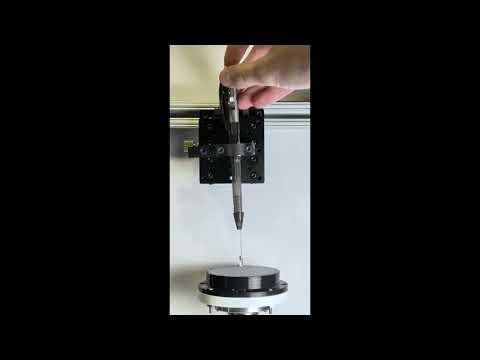
Once the pen is properly positioned, press the button to release the latch. This rapidly retracts the probe and generates a droplet. The device can be actuated repeatedly to produce multiple droplets.
Custom Geometries
The pen tip can be modified to include multiple probes arranged in a desired geometry. This enables the simultaneous generation of multiple droplets.
For pilot-wave experiments, arranging the probes with spacing approximately equal to one Faraday wavelength can produce stable droplet lattices, such as hexagonal configurations.