Pizza Oven Pizza

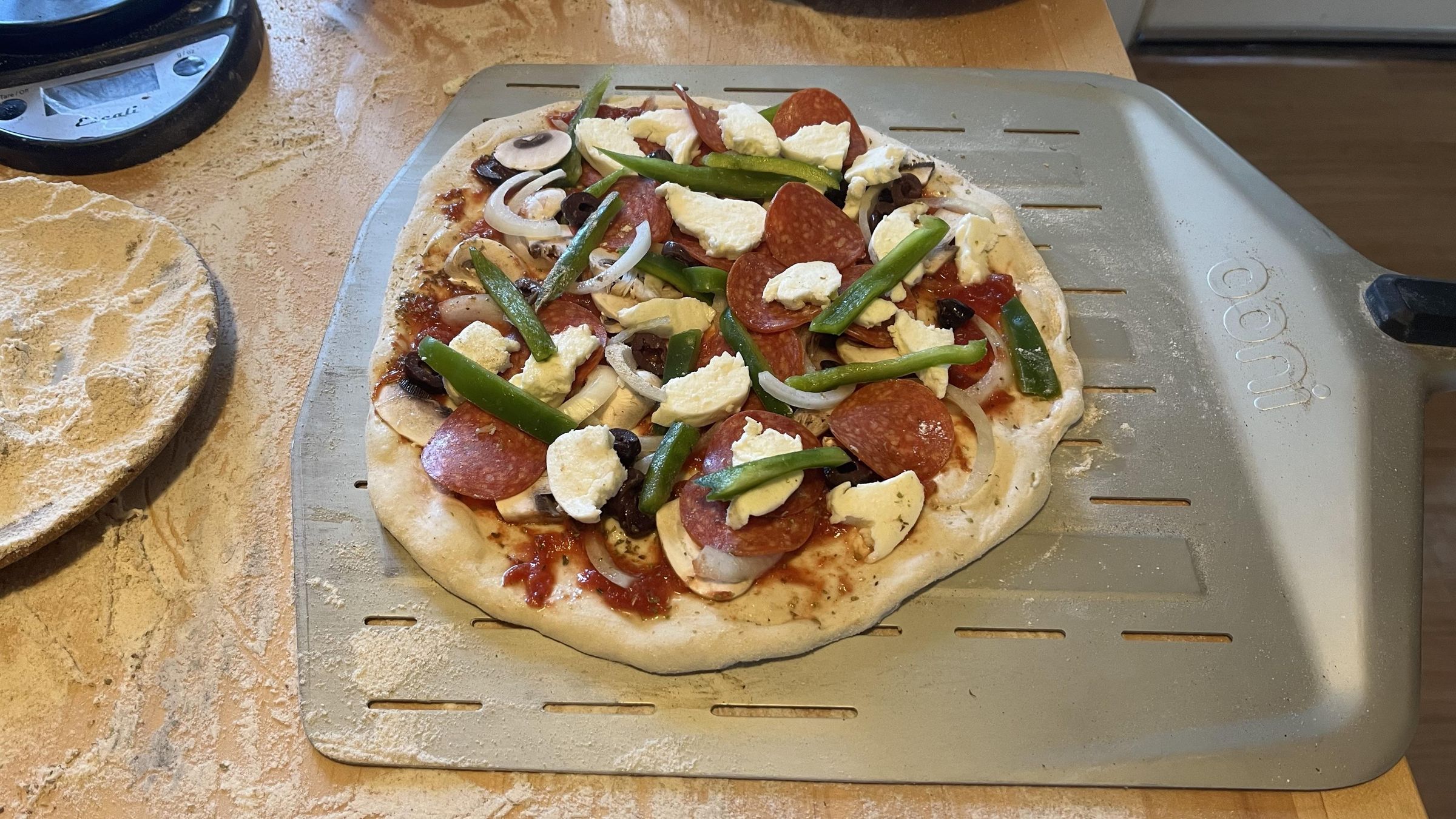

This is the process I go through in making Neapolitan pizza in an Ooni Koda 16 propane fired oven. It works for me; it may not work for you. But at least I hope that there is some useful takeaway in what follows. Before going further, it is worth noting that I have received a tremendous amount of help and inspiration from Vito Iacopelli. Not directly, unfortunately, but through countless viewings of his pizza-making videos on YouTube. He is both knowledgeable and generous and if you haven't watched his videos, you are in for a treat!
If you want the TL;DR version of this Instructable, watch Vito Iacopelli's Next Level Pizza Dough video.
I feel like I watched this video *many* times and still managed to mess things up. It took a while before things came together for me and now that things work, I can see that everything he says is extremely helpful and spot on. It was just that I wasn't ready to understand what he was saying.
Disclaimer -- I am NOT sponsored by Ooni. This is NOT a promotion for Ooni. They did NOT give me my oven. That's the pizza oven I have (and I have room in my life for just one). I would love to have a dozen ovens to play with, but I don't think that is going to happen. My intention is to report on my experience with making pizza in a high temperature oven and all of the learning twists and turns I went through to get where I am. I hope there is a takeaway for people in this.
Keywords: [pizza], [pizza oven], [neapolitan pizza], [dough hydration]
Supplies


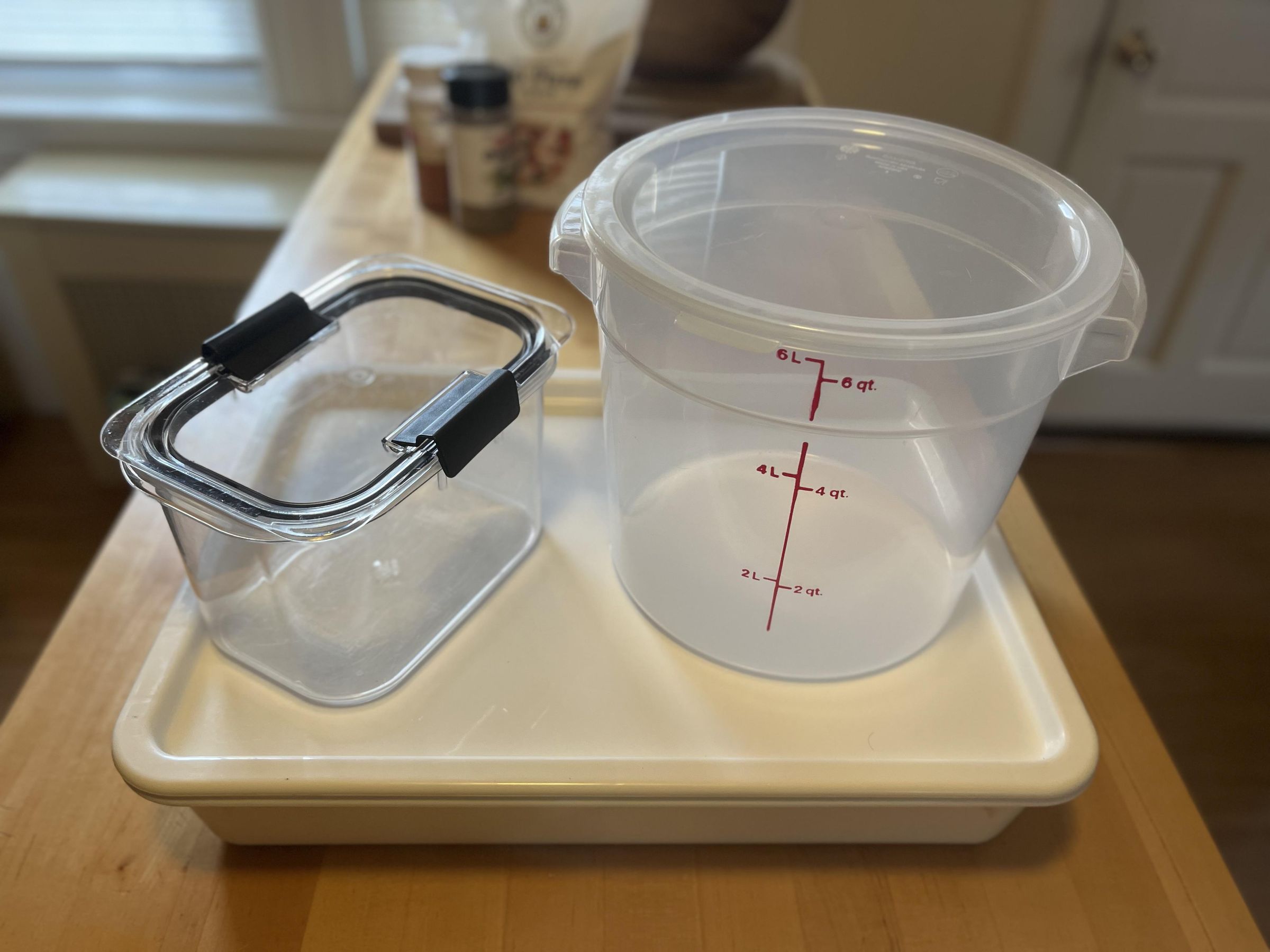

Most of these tools are things that I have accumulated over time and find useful in this process. None, except for a pizza oven, is essential and could not be replaced with something functionally similar.
- pizza oven I have an Ooni Koda 16 propane-fired pizza oven. It's what I have and over time have figured out how to make it work for me. I am not taking sides or reviewing pizza ovens, so if you have a different model, Great! Hope it works for you! Also, I chose propane-fired because I did not particularly like the look of the chimney. Not a great reason. The propane version has a little more flame control, which comes into play later on. Also, cooking pizza in a conventional kitchen oven with a pizza stone or pizza steel is definitely possible. I don't happen to do it and this Instructable is not about that.
- pizza peel You definitely need a metal one of these. Short- or long-handled is a personal preference although you probably want a short-handled one for working in the kitchen and then launching the pizza. I use only a short-handled one both for launching the pizza and pulling it out and checking and turning it.
- infrared thermometer Not essential but useful in lots of settings. Definitely good for checking the temperature of the oven and stone before your first launch.
- proofing containers Three different containers -- one for the poolish, another for proofing the dough overnight in the refrigerator, and a final one for proofing the dough after it has been formed into pizza crust sized dough balls. There are lots of options for this and many things will work.
- drying/cooling racks It took me a while to realize that I needed these and that the organization they allow is much nicer than a bunch of random, non-stacking drying racks. I think it was when my dog pulled a pizza of the table (something she had never done before) that I realized the need.
- digital scale I find a digital scale to be an essential tool in bread baking. And therefore pizza making! Make sure that the scale reads in grams as many cooking recipes use grams.
Dough Preparation


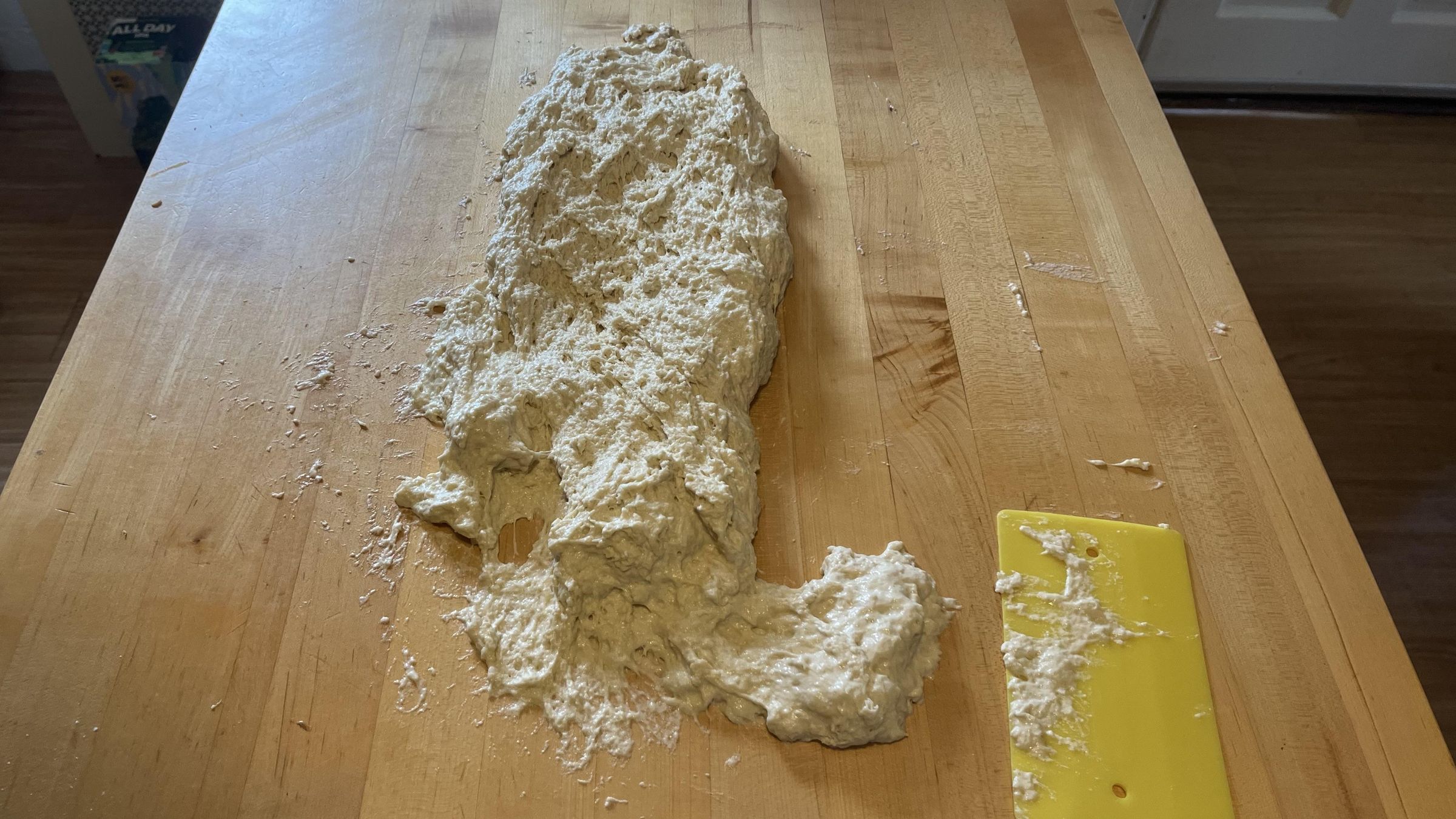


This is the most important step in the entire process. It also is the most technical and mystifying and intimidating. This step lays out what I do. Your favorite recipe or process might be different. That's fine
It is worth saying up front that the dough preparation takes place over three days. Time is flavor! The first day (usually starting in the afternoon) is the poolish. Day two is finalizing the dough. And day three is weighing and shaping the dough balls.
- flour I use either King Arthur or Trader Joe's All-Purpose Flour. I have used bread flour but find that it makes a stronger dough that does not puff up as easily. I have not used 00 Flour but will comment on it when I do.
- water Cold tap water. It's what I have coming out of my taps.
- salt regular Morton's table salt.
- yeast I use a bulk yeast but I imagine any yeast would be fine. Maybe even instant yeast. But the dough recipe calls for 1/4 teaspoon (yup, that's all!) so opening a packet doesn't make sense to me.
Dough Master Pro is a web app I wrote that calculates how much flour, water, salt, and olive oil you need for however many pizzas (and pitas) of a given size you are planning to make. It allows you to create a poolish and set the target hydration for your dough. Besides pizzas, I find it very helpful when making bread when seeking a target hydration for a loaf of a particular size. The app also allows you to save particular settings to your browser storage (like a cookie, but more data).
poolish 300 grams all-purpose flour, 300 grams cold water, 1/4 teaspoon (just a bit!) yeast. mix well, let sit loosely covered for an hour or two, put in refrigerator loosely covered overnight. the yeast will do its magic despite being in the refrigerator. It should smell good in the morning. Day one is in the books!
dough Take the poolish out of the refrigerator a couple of hours before using it (I do this but am not sure it really matters). Then use Dough Master Pro to calculate how much additional flour and water, along with how much salt and olive oil, you need to add to the poolish to hit the target amount of dough. In the image, the DMP is set to calculate amounts for 6 pizzas at 300 grams each, 2 pitas at 133 grams each, with 300 grams each of flour and water contributed by the poolish and a target hydration of 70%. The "fudge factor" is to account for dough lost to the bowls or stuck to your hands. In the bottom panel, it indicates how much additional flour and water to add along with amount of salt and olive oil.
Dough preparation takes a few steps.
- transfer the poolish to a large mixing bowl
- add the measured amounts of water, salt, and olive oil
- mix the poolish in by hand as best you can
- add the measured amount of flour. mix well with your hand and turn out onto the counter. the dough will feel fairly wet. fear not. DO NOT ADD MORE FLOUR. adding more flour will make the dough easier to work but it will change the hydration and therefore the character of the dough. use a dough scraper to help manage the dough while kneading.
- knead the dough until you feel it come together -- probably eight to ten minutes. then shape the dough into a ball. put a little olive oil in your hand and coat the top of the ball. make sure you say, "pat, pat, pat," as you apply the olive oil. let it rest on the counter for twenty minutes or until you are done cleaning up.
- when you come back to the dough, pick it up in the middle and fold it. repeat several times. you will see an amazing transformation!
- shape the dough into a ball and put it smooth side up in an oiled proofing bucket, cover, and put in the refrigerator overnight. the top of the dough in the bucket eventually becomes the top of your pizza so keep track of it.
- day two is in the books!
kneading If you have not worked with a slack dough, it can feel very frightening. Be patient and you will see the dough come together as the gluten network develops!
hydration The hydration of a dough is determined by the amount of water in grams divide by the amount of flour in grams. The higher the hydration, the slacker the dough. My target hydration for pizza dough is 70% although I have found that I can go a bit higher in the winter when the air is drier but need to go a bit lower in the summer when it is humid out.
Dough Balls
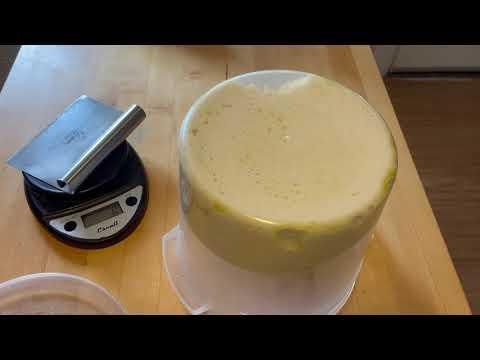
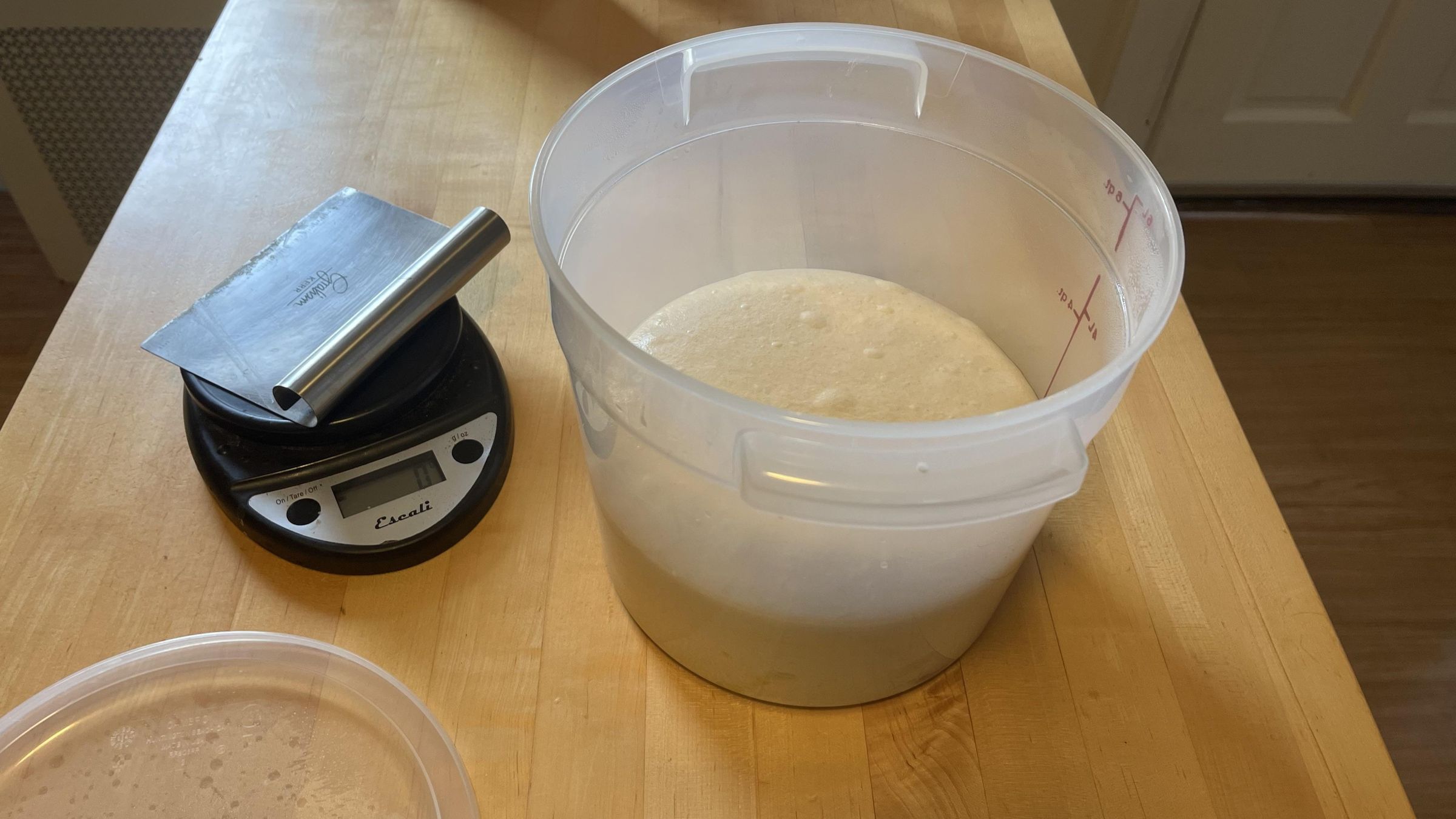

After a good overnight in the refrigerator, the dough is ready to be shaped into balls. The timing here matters and you should work backwards from the time you think you are going to cook.
- take the dough out of the refrigerator for two to three hours before shaping
- shape the balls and put them in a proofing container for two to three hours
- baking time
I am not too fussy about how long the dough sits out before forming the balls. However, if it is a hot day, I check the dough balls in the proofing container to make sure they aren't getting too big.
shaping When you turn the dough out, the top is now on the bottom. Remember this. I cut and weigh my pizza dough into desired sized balls, usually 300 grams for pizza and 133 or 150 for pitas. I keep the top (now the bottom) as the outer part of the dough ball and kind of form the ball by pulling the sides and tightening and moving them to the bottom.
When done shaping put them well-spaced in the proofing container.
Tomato Sauce and Mozzarella Cheese


sauce The tomato sauce is super simple! Not from a jar! One can of San Marzano whole peeled tomatoes (although lots of other ones are certainly fine), a glug-glug of olive oil, one teaspoon of oregano, and salt to taste. I crush each tomato by hand and pull out the tougher end part.
cheese I use thin-sliced fresh mozzarella (but since it comes in a package I cannot tell how fresh it is; fresh frozen, perhaps). Tear the slices into four pieces. It seems better to start with slices and tear them up than to roughly tear up a ball of mozzarella because the pieces end up the same thickness and cook more evenly.
Shredded mozzarella, although convenient, is covered with a starch coating to prevent the shredded pieces from sticking together. This coating burns. Don't use shredded mozzarella.
conundrum The sauce is enough for eight pizzas and the cheese is enough for five (I use three ounces per pizza). What to do with the extra? See below for options that don't use mozzarella!
Toppings
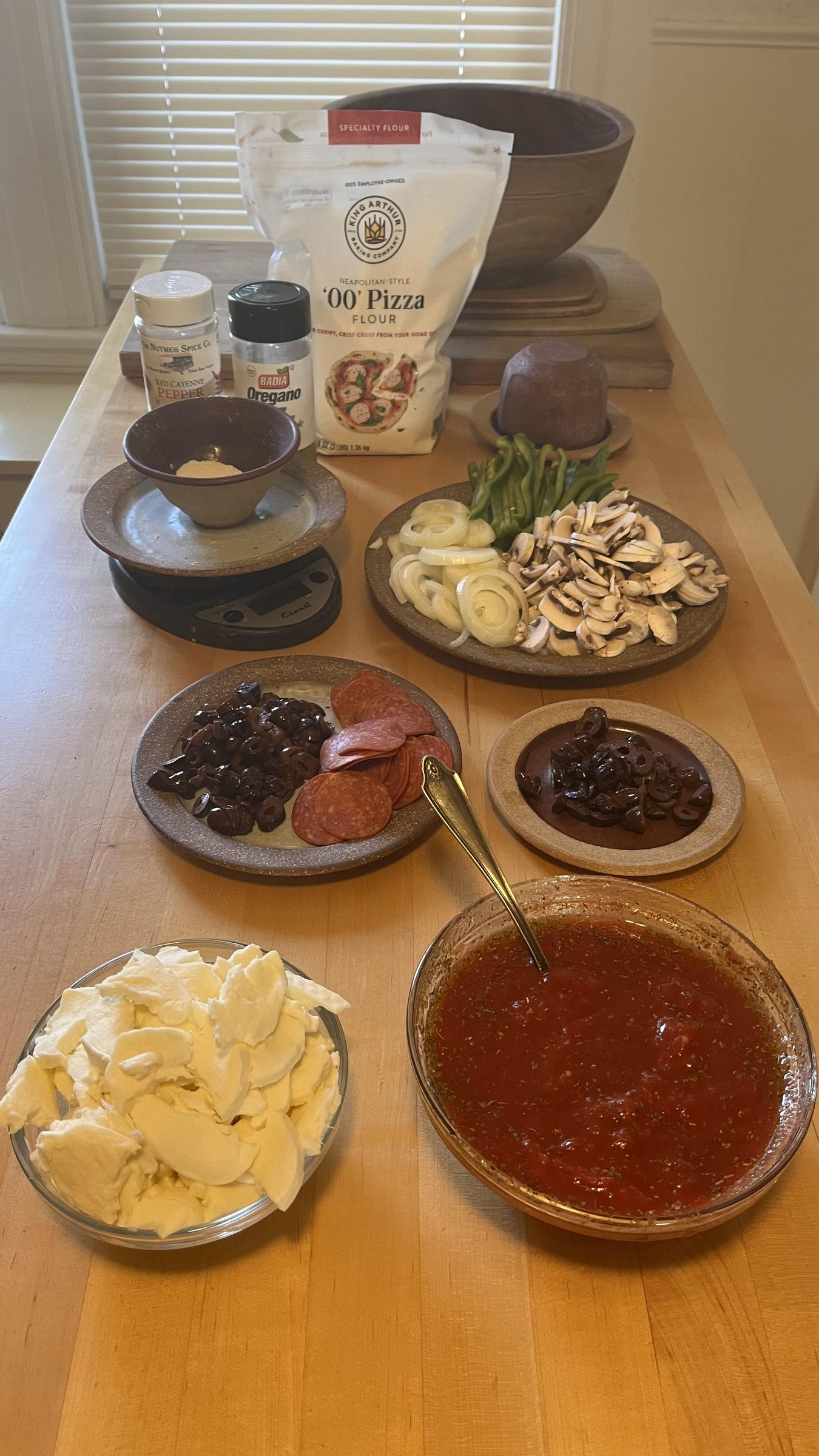



Toppings are really up to you! I use mushrooms, onions, olives, pepperoni, and green peppers (in that order). Sauce on first and cheese on last. And I would use pineapples and ham!? It's all up to you.
overtopping I definitely put a lot of toppings on my pizzas. Maybe not as many as I would if baking on a pizza pan but more than a minimalist amount.
other combinations As you know, lots and lots of combinations are possible! Some of my favorites (also designed to deal with the mismatch in sauce and cheese mentioned in the previous step).
- feta, pesto, olives, pineapples, pepperoni. or, instead of pesto, drizzle dough with a little olive oil and sprinkle with oregano. usually I cook the pizza without the feta cheese on it and add the feta at the very end. This way it gets soft without burning.
- olive oil and oregano, sweet corn kernels, red onion, pepperoni, feta.
- bechamel sauce, lots of vegetables, pepperoni.
Building the Pizza


This is an exciting, in many senses of the word, step! On the one hand, you are building your pizza, forming the dough, adding sauce and toppings, and getting prepared to launch your baby onto its penultimate journey. On the other, it provides and incredible opportunity to make a complete mess of things.
I won't bore you with how to add sauce and toppings since that should be self-evident and really up to you. To create the pizza dough takes surprising precision and care.
- use a dough scraper to get the now proofed dough ball out of the proofing container
- flip it upside down into a plate full of flour (I use whole wheat, others use semolina; not sure I have a preference)
- flip it over to get dough on the underside and place it on your work surface
- push down and outward with your finger tips. flip over, rotate a quarter turn, and repeat on the underside. flip, rotate and repeat one more time. the side that is up should be the same up side that you preserved ever since the overnight proofing and forming of the dough balls!
neapolitan slap But that's not all! Next perform "Neapolitan Slaps" to further stretch the dough and maintain a thick edge/rim/crust. Words are not adequate to describe this process so watch Vito Iacopelli's video Slap Technique. Don't make your dough nervous!
Now add sauce and toppings to your heart's content!
Launching Your Pizza


The first step after building your pizza is to get it from counter to peel. When this works, it's beautiful. When it doesn't, you're making a calzone (at best). It sounds easy -- put a bit of flour around your pizza, grab the edge nearest you, and slide the peel under the pizza in one swift motion.
- understand the stiffness of your dough. if it is fairly strong, this will (should) work.
- if your dough is soft (and I don't know what accounts for this; some days the same hydration doughs are just much softer than others) it becomes tricker. it is easy to pull the crust you are holding too much or snag the dough with the peel. if dough feels too soft, sprinkle the peel with whatever flour you are using and build the pizza on the peel.
- work quickly.
- once the pizza is topped and on the peel (by whatever means) go around the pizza and stretch it a little wider to make it bigger and more circular. you might have to adjust the positioning of the toppings as they tend to get moved about when you do this.
- check that the pizza will slide of the peel without catching. give it a little jiggle so see if any places stick. if they do, lift that area and toss a bit of flour under the pizza and onto the peel. repeat until the pizza moves without sticking anywhere.
- say to yourself, "if it ain't shakin', you ain't bakin'". you won't regret it!
- launch your pizza and move onto the next step.
Launching *should* be straightforward -- slide the pizza and peel into the oven and then in one swift motion pull the peel out and leave the pizza. Sometimes it's not. If it catches, the pizza comes out with the peel. Oops. Or tears and stays in the oven. Double oops. Because then your night is over because you have a pile of pizza burning in your 900° and no way to get it out. If you are really lucky you end up with a pizza bagel. But your cooking night is still over. Bummer.
Baking Your Pizza


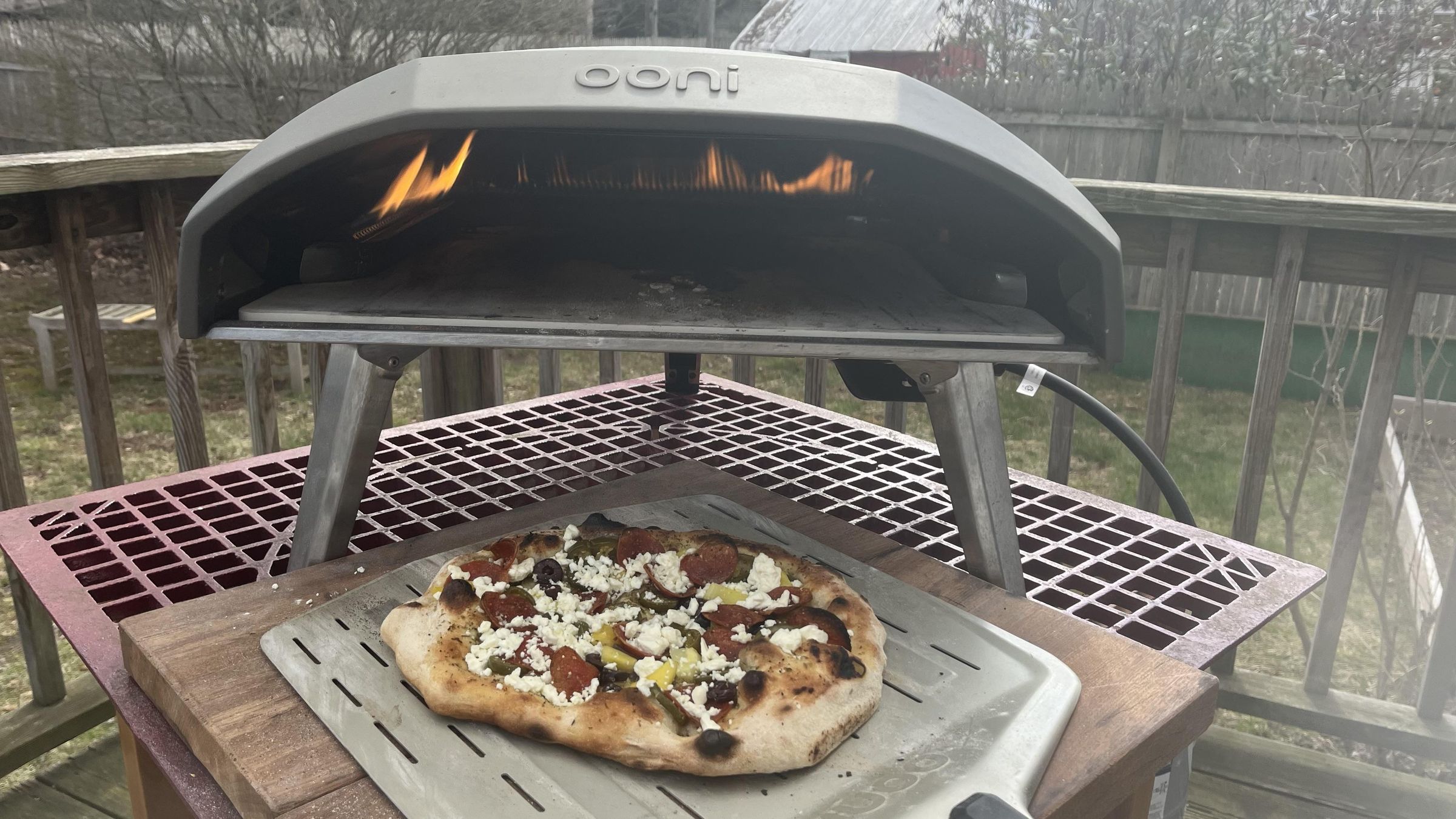
This is what I do. I know there are lots of competing approaches. I also know that my pizzas cook for a bit more than 90 seconds, but not that much longer.
- launch the pizza and immediately turn the heat to it's lowest setting. this is one of the reasons I like the propane fired oven. I think that this allows the pizza stone to do its thing to the crust -- the bottom of the crust hardens and the rim "pitas". the flames do not burn the crust or toppings.
- see the last two pictures to find out what happens if you forget to turn the burner down! outer crust burns and the base may be undercooked. but just cut off most of the burned part and carry on!
- because my oven has burners at the back and on the left (forming an L shape) it is important to turn the pizza at this stage for even cooking.
- once the crust is well-formed and the cheese is beginning to look melty, turn the heat back to it's highest setting and watch your pizza carefully. it can burn in seconds. turn frequently.
- once the pizza has achieve desired char, remove and put on a drying rack!
- leave the oven on high while you make the next pizza. it recharges the stone and brings it to ready for the next pizza.
- best eaten hot out of the oven or gently reheated in an oven (350° for 10-12 minutes). the reheating is convenient depending on your workflow and timing and seems to give just a bit more crunch to the crust (and the bottom of the crust) without compromising it.
When you get the char just right, it sounds like this -- Bruce live!
Enjoy what you have done. And enjoy eating your pizzas!
Storing and Reheating
Usually I make five to ten pizzas of various configurations. That's a lot to eat in one sitting. I find that they freeze and re-heat extremely well. They fit well into a one-gallon Ziploc bag although they might need to be cut in half to fit. They thaw quickly and can be heated up in an oven (350° for 10-12 minutes) or in a toaster oven for just a few minutes. Heck, they can even be microwaved and will still taste great (although not as crunchy).
Pitas and Things

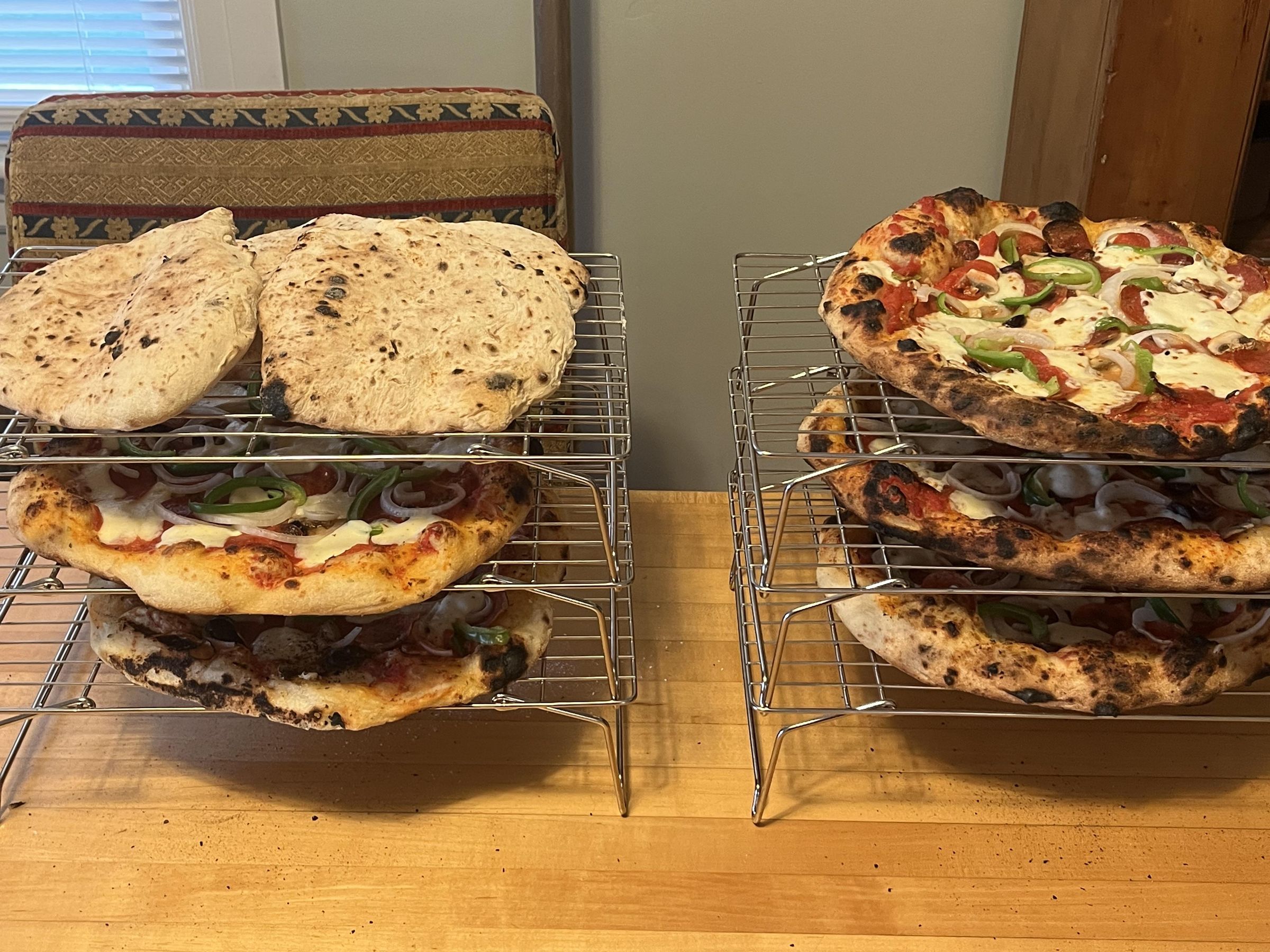


One of the great things about the Ooni (or any pizza oven) is that it generates temperatures of ~900° which is unattainable in a kitchen oven. It creates a whole new cooking environment! I have experimented with various other things (potatoes, steaks, various vegetables, dessert pizzas) with varying degrees (no pun intended) of success. But the one unmitigated success is the not-so-humble pita!
I use the same dough for both pizzas and pitas. See the video above! One interesting thing that I concluded was that the untopped crust of a pizza is basically "pita-ing" as much as it can.
Although I haven't done it often, it is possible to make a gluten-free dough (using gluten-free flour!) that works quite well in the oven. Not as puffy as a yeasted dough, but fine tasting none-the-less.
All Done


The process is a bit messy with flour flying all over the place. A vacuum on hand is curiously nice to have. Clean up is really easy with not much left over. If you have any cheese left over, make a super-mini-pizza by wrapping it in a piece of pepperoni. Payoff for the maker! The final product is delicious. Enjoy! Day three is in the books!