Power Wheelchair Kickball Attachment
by WSUAssistiveTech in Workshop > 3D Printing
1529 Views, 9 Favorites, 0 Comments
Power Wheelchair Kickball Attachment

The objective of this project is to provide a wheelchair user with the independence to join in during gym class and recess. By using a custom-built bumper, the user can navigate a kickball field and "kick" the ball with minimal assistance. This design bridges the gap between sitting on the sidelines and being a key player in the game.
This attachment is engineered specifically for the Permobil M300 UniTrack system. It utilizes 3D-printed PVC clamps that house a sturdy frame made from standard PVC pipes and connectors.
- The Fit: The frame slides into cylindrical 3D-printed supports, extending past the footrests and sitting just above the ground for optimal ball contact.
- The Finish: To ensure the user feels confident and stylish, the entire assembly is painted to match the wheelchair’s original color scheme.
Supplies
1" diameter, 1/8" thick PVC pipe, 10 foot length
Quantity: 2 (Around 13 feet used, extra to account for errors)
Quantity: 4
Quantity: 2
1" 90° side outlet elbow PVC fittings
Quantity: 2
Quantity: 8
Quantity: 8
Spray paint (optional - we used Rust Oleum's Painter's Touch 2X Ultracover Paint + Primer)
ABS 3D printer filament
PVC cutters
Oatey Purple Primer and PVC Cement
Bambu Lab P1S 3D Printer
Jet 48" x 6" Vertical Combination Sanding Machine
10 mm socket wrench
Handheld 80 Grit Sandpaper strip
Consult Physical Therapist
Our group began by consulting the client's physical therapist. We did this so we could not only gain technical information, like the model and dimensions of the wheelchair, but also to gain a more well-rounded perspective of the client's needs, limitations, and lifestyle. We recommend meeting with the client or their physical therapist prior to completing this project to ensure that needs are being met, the correct dimensions are beind used, and the attachment will be beneficial to the client.
During this meeting, we discussed the client's physical disability (which will not be shared for requested confidentiality) and the limitations they experience. This helped us determine which kind of attachment would be most helpful, and which would not be helpful. We also determined the client's model of wheelchair, which was a Permobil M300 PS Jr, specifically designed for pediatric patients. This allowed us to consult the wheelchair's manual, which included dimensions and more information about the features of the wheelchair.
3D Print PVC Supports
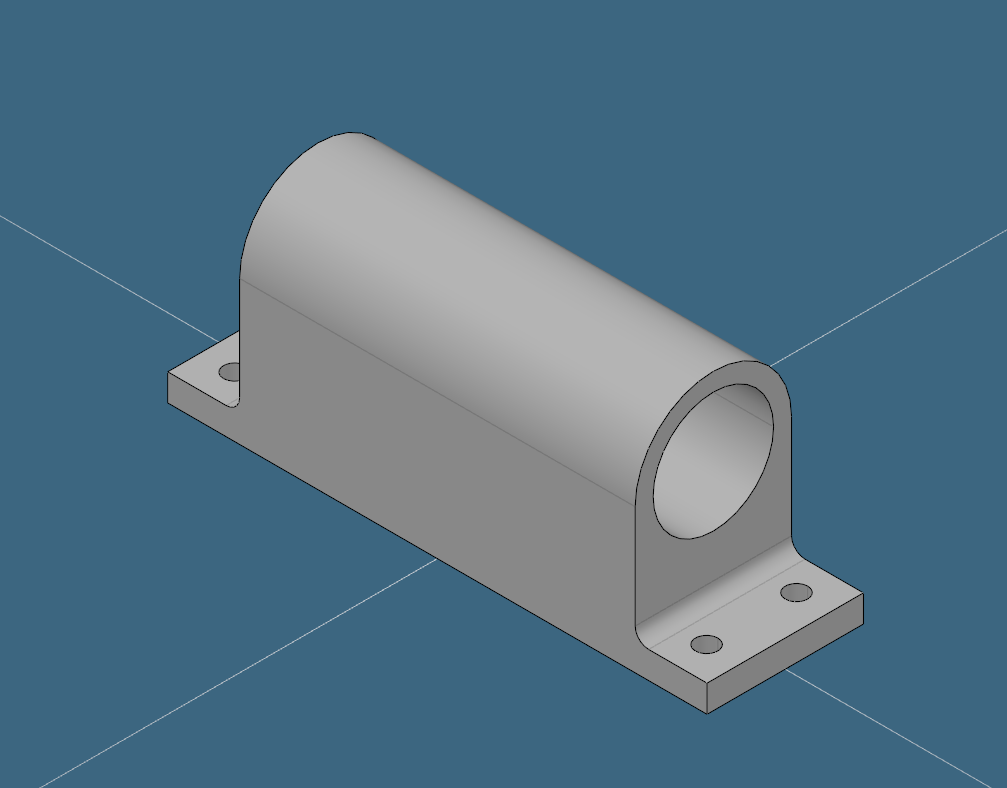
Our primary challenge was determining how to fasten the attachment to the wheelchair. We decided to make use of the built-in UniTrack on the Permobil M300 PS Jr. that the client currently uses. To begin, we designed a partial tube that the PVC would slide into. This tube is open on only one end, so that the attachment can slide in but will not be pushed back when hit with a kickball. It is attached to a flat base with two sets of two holes 1 inch apart from each other, since the UniTrack makes use of two parallel tracks, which are 1 inch apart. These four holes will be used by sliding the heads of the bolts into the UniTrack, putting the supports through the four bolts, and securing them with a nut.
This step required some trial and error to ensure that the dimensions and material would hold the attachment secure, but still allow for easy removal. With our final design, we ended up sanding the interior slightly so that the attachment would fit perfectly. We have attached the 3D-printable file for our two supports below. It may be necessary to trial different dimensions for the perfect fit.
These supports were printed with the following measurements: Length = 6", Width = 1.74", Inner Diameter = 1.34", Outer Diameter = 1.74", Center Hole Height = 1.6" Flange Lengths - .8", Bolt Hole Diameter = .25", Back Wall Thickness = .5". The 6" support was printed vertically on the flange with the enclosed end facing down. We used a Banbu brand 3D printer using autogenerate tree for supports.
Downloads
Design PVC Frame
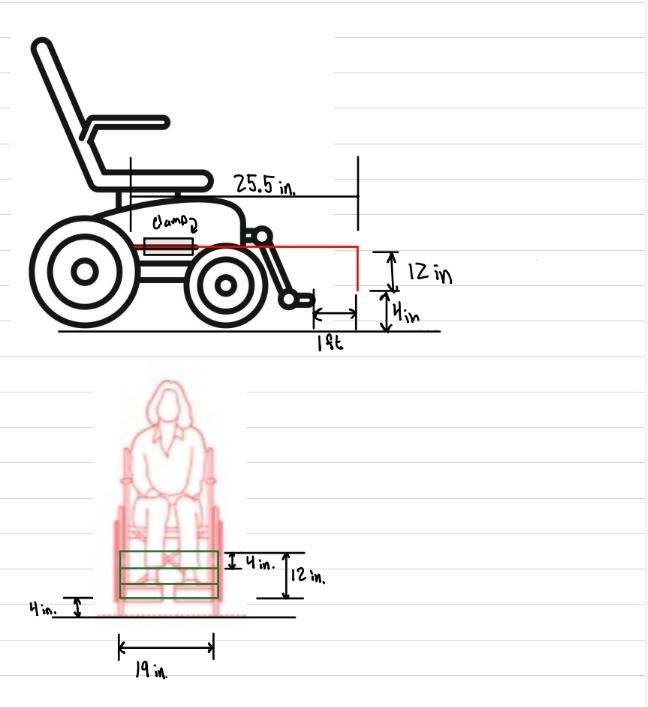
Designing the Frame
Our next step was to design a PVC frame that would slide into the 3D printed supports and act as a bumper for our client to navigate and hit a kickball with. This frame attaches on either side of the wheelchair where the UniTrack sits, extends outward past the client's footrests, and then extends downward to just above the floor. These dimensions may vary slightly based on where the client's footrests attach and what position the wheelchair is in, since the height and tilt are controllable.
Final Dimensions:
- The arms that will slide into the 3D printed supported were cut to 25.5" each. This allowed our supports to be attached directly behind the client's thigh guides, ensuring the supports are fastened at the same place every time with ease, and it also ensured the the attachment did not interfere with the client's footrests.
- The four horizontal bars that will go across the front of the wheelchair and ensure a ball does not go through were cut to 19" each. This accounted for the length between the UniTracks on either side (17.5"), as well as the length added by the height of the supports (1.6" each). Approximately 0.85" in length was added on either side by the PVC connectors.
- Finally, the six vertical bars that will allow the attachment to extend downwards between horizontal bars were cut to 4" each. This ensured that a ball could not get stuck in between horizontal bars or go through, and it also ensured that the attachment was not dragging on the ground.
Cut PVC and Gather Fittings
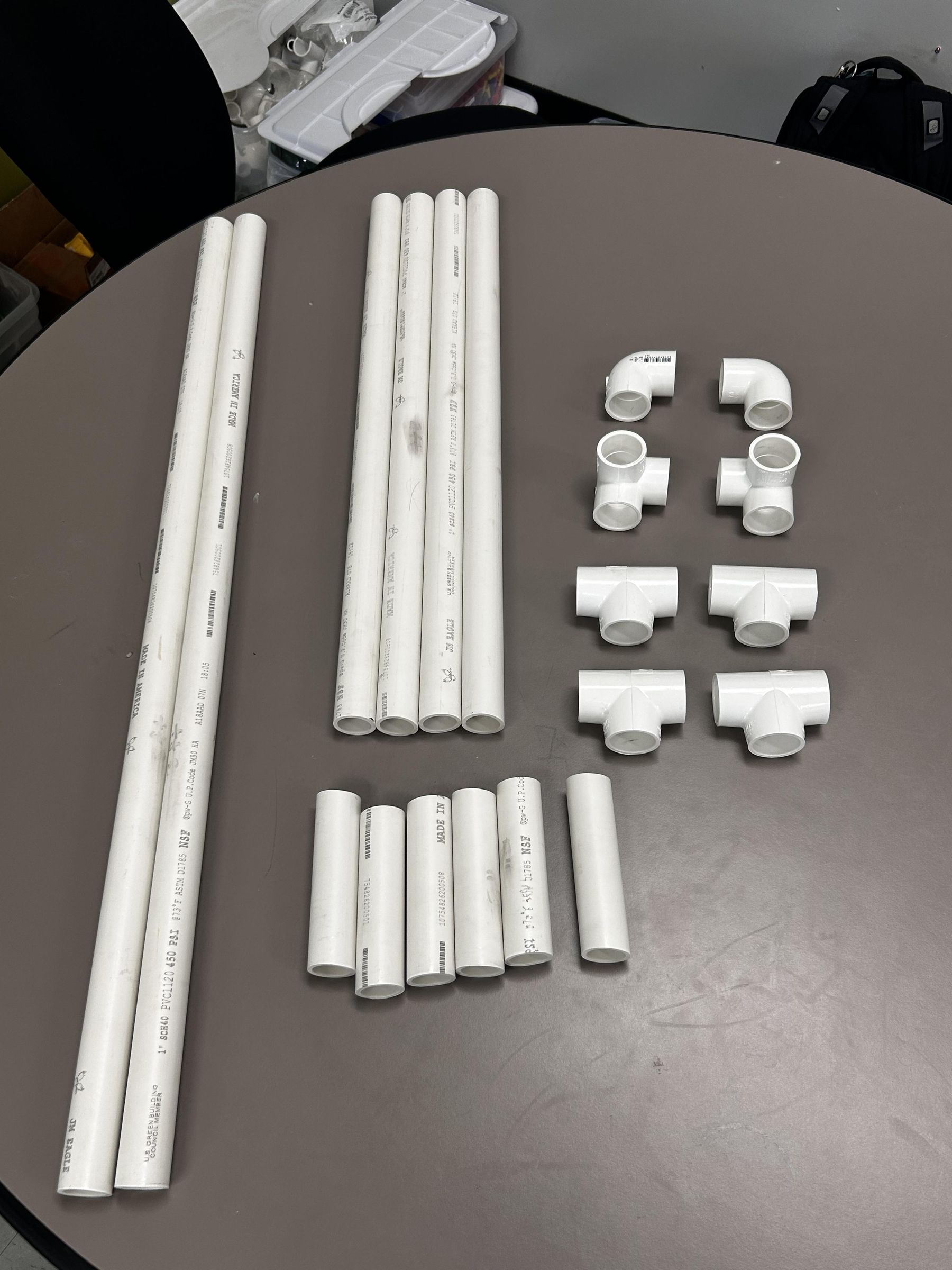
Next, we cut segments of 1" diameter PVC to build the frame. Based on the dimensions in Step 3, we cut two 25.5" segments, four 19" segments, and six 4" segments. We also set aside the PVC fittings: 4 tee fittings, 2 90° fittings, and 2 90° side outlet elbow fittings. Each fitting had an inner diameter of 1" to accommodate the PVC pipe. The attached picture shows the cut PVC pipe (1" diameter, 1/8" thickness) as well as the PVC fittings. A ratcheting PVC pipe cutter was used to cut these segments.
After cutting the PVC, the ends were lightly sanded to ensure an even cut. This step is optional, and should be carefully done to avoid removing excessive length.
Assemble PVC Attachment
.jpg)
To ensure correct dimensions, we assembled the attachment without using PVC cement. We then tested the dimensions on the client's wheelchair and made modifications as necessary The above dimensions reflect our final dimensions after modification. The initial assembled attachment is shown in the attached picture.
This step was crucial for our team, as some of our calculated dimensions were inaccurate and would have made the attachment unusable for our client. Communication with the client or sponsor and check-ins along the way can allow for necessary changes to be made before gluing and finalizing the product.
Glue PVC Attachment
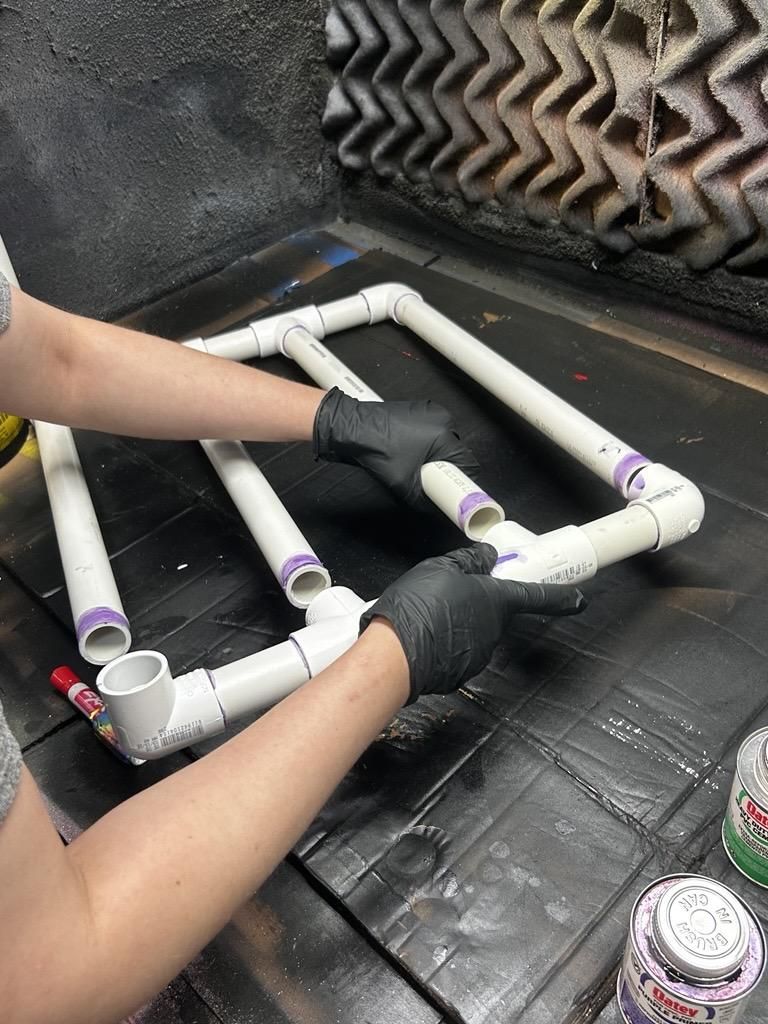
Once our dimensions were finalized and confirmed to work with the client's wheelchair and 3D printed supports, we glued the attachment together using Oatey Purple Primer and PVC Cement. This should be done under a fume hood or in a well-ventilated area (such as outdoors), as the primer and cement are flammable and give off vapors that can lead to undesirable side effects if inhaled. We also used gloves to ensure to avoid skin contact with the primer and cement, which can lead to effects such as skin irritation, dryness, or staining.
It is also important to note that the PVC cement dries extremely quickly. While it takes up to 15 minutes to fully set and up to 2 hours to cure, it took around 30 seconds to be impossible to move and adjust the pipes. Because of this, we set up the pieces of PVC and fittings in the orientation they would be glued in first so we could ensure accuracy. We used the Purple Primer and attached brush to prime the outside of the PVC pipe segment and the inside of the fitting, and then we brushed the PVC cement onto the outside of the PVC pipe segment. We then lined up the pieces to ensure the correct angle and orientation, and slide the PVC pipe into the associated fitting. We made any necessary adjustments and then held the pieces together for approximately 30 seconds. We repeated this process for the whole attachment until it was glued in the correct manner.
Decorate Attachment (Optional)
.jpg)
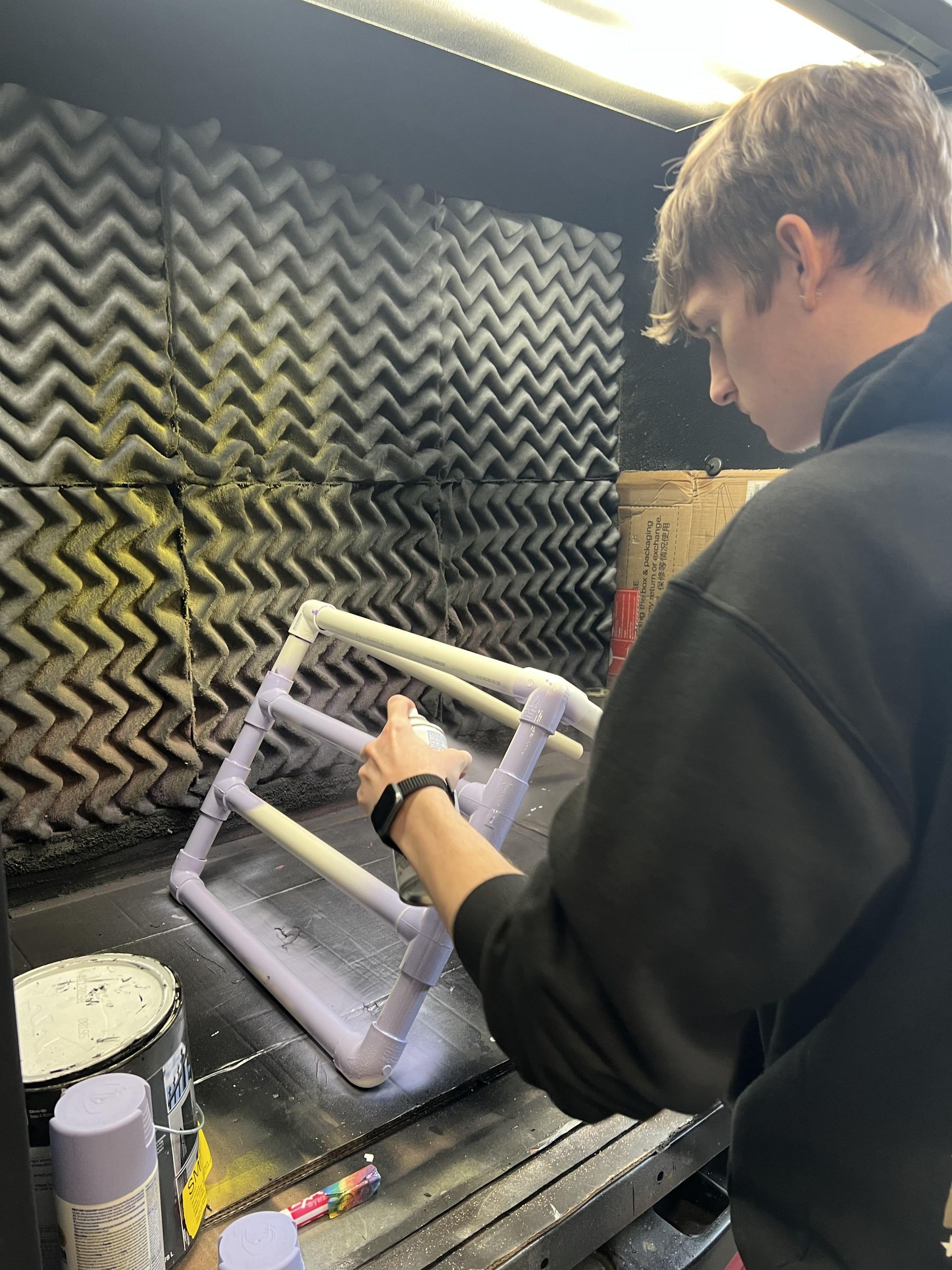
Spray painting the attachment can be a great way to help it look more finalized and professional, and it gives your client a say in how the attachment looks, since they'll be the one utilizing it. This is a fun opportunity to experiment with different colors, finishings, and decals. Keep in mind that spray painting should also be done in a well-ventilated area.
Our client requested a plain purple attachment to match the purple on her wheelchair. The closest color match that we found was Rust Oleum's French Lilac. Once the PVC cement had sufficiently dried (it just needs to be dry, not completely set or cured), we spray painted the entire attachment under a fume hood. After doing so, we allowed the attachment to dry overnight on a piece of cardboard.
Product Delivery

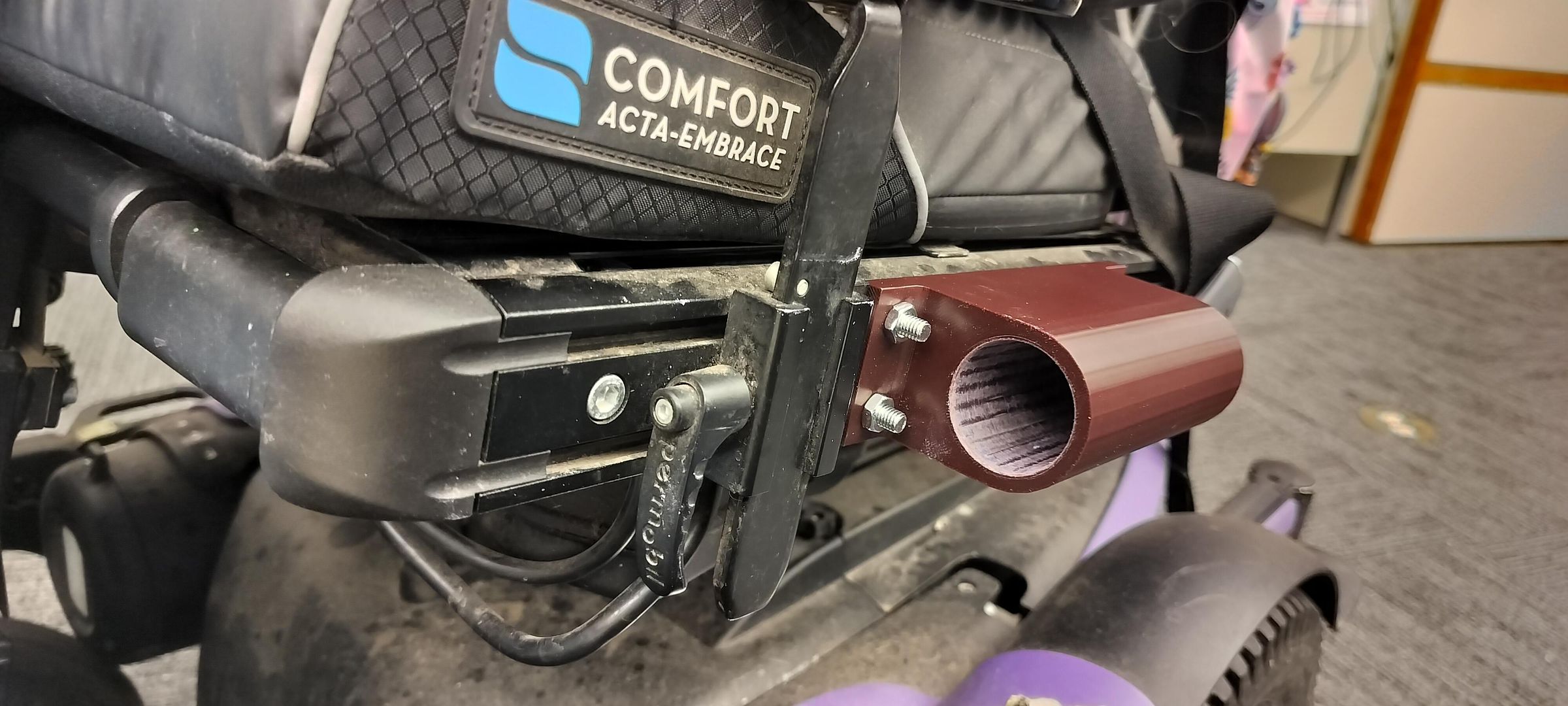

After our attachment was glued and painted and our supports were finalized, it was time to deliver to our client! We set up a meeting to meet with the client, their physical therapist, and their aid. First, we attached the 3D printed supports to the UniTrack, directly behind the client's thigh guides, which are also attached on the UniTrack. To do this, we had to temporarily remove the seatbelt and ensure the client was secure in the meantime.
We used four M6 20mm bolts on each support. The heads of the bolts were slid into the back of the UniTrack, and the supports were attached through the bolts, using an M6 nut on each bolt. A 10mm socket wrench was used to tighten the M6 nuts. The seatbelt was then reattached in its original position. The first and second attached pictures show the supports fastened to the wheelchair's UniTrack.
Next, we simply had to insert the ends of the PVC from our kickball attachment into the supports on either side. This was as easy as lining up the PVC, sliding it in, and making sure it was sufficiently secure. The third attached picture shows our team with our client (face blurred for confidentiality) with their kickball attachment fastened to the wheelchair.
Ensure Client Satisfaction
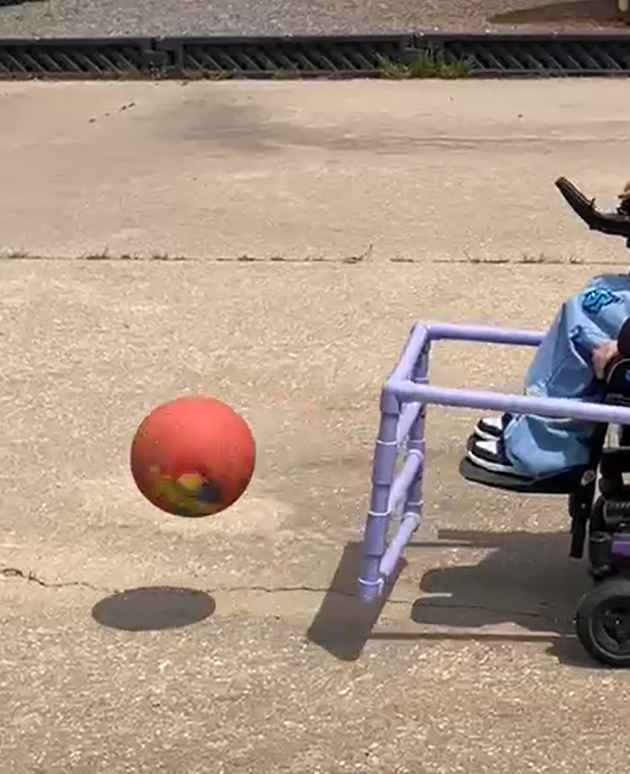
Our final, and most important step, was to ensure the attachment worked for the client and that they were satisfied with the results. We tested the attachment on the client's playground by rolling a kickball toward the wheelchair and having them drive into the ball. The attachment seemed to work, and our sponsor told us they believed that the client was satisfied with the product. It is important to determine if the end product meets a client's needs and be able to reevaluate if it doesn't. The most rewarding part of this project was seeing our client be able to participate in a game of kickball with their peer's at gym class, and we hope we met their needs and wants.
Be sure to listen to your client, persevere through any roadblocks, and have fun!