RP2350 A4 GPIO Input Leakage Current Measurement on Pimoroni Tiny 2350 Using Kitronik Inventor's Kit for Raspberry Pi Pico
by kevinjwalters in Circuits > Microcontrollers
255 Views, 0 Favorites, 0 Comments
RP2350 A4 GPIO Input Leakage Current Measurement on Pimoroni Tiny 2350 Using Kitronik Inventor's Kit for Raspberry Pi Pico

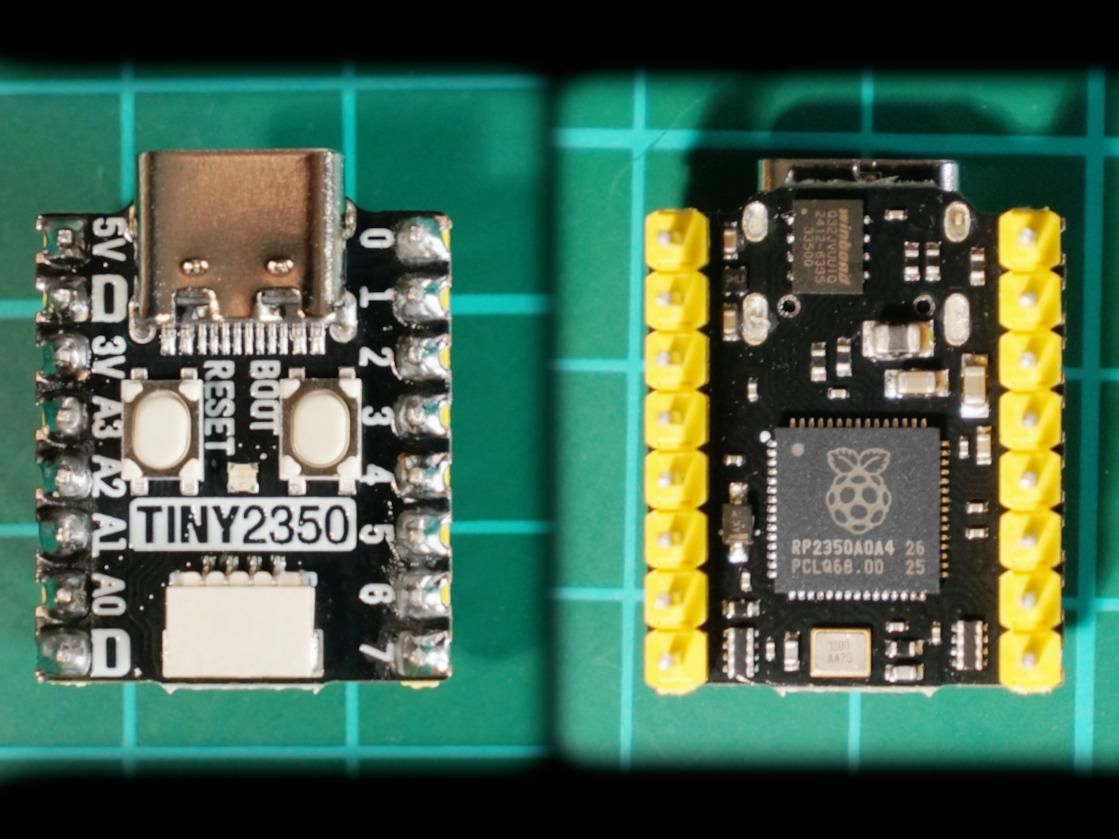
The Pimoroni Tiny 2350 is one of the first boards to feature the A4 revision (stepping) of the RP2350 microcontroller. The A2 revision has a GPIO input flaw described in Errata RP2350-E9 which has been fixed in the A3/A4 revisions.
This article tests this microcontroller to look at the input leakage current on digital inputs as a follow-up to RP2350 GPIO Input Leakage Current Measurement on Pi Pico 2 W Using Kitronik Inventor's Kit for Raspberry Pi Pico. There's also a closer look at the noise on the analogue-to-digital converter (ADC) - the previous tests showed the Pi Pico 2 W's RP2350 suffered from more noise than the Pi Pico W's RP2040. The Tiny 2350 is not directly comparable to the Pi Pico boards for ADC as its 3.3V power is supplied by a linear regulator rather than a simple switch-mode power supply.
This testing involves some very simple soldering as only the headerless Tiny 2350 currently features the RP2350 A4.
Supplies
- Pimoroni Tiny 2350 - this must be the headerless version at the moment (check notes on the shop webpage) and purchased from Pimoroni in April 2026 or later.
- 2x 8 row header pins.
- Solder, soldering iron.
- Optional: a breadboard is useful to align the pins whilst soldering.
- Plus items from RP2350 GPIO Input Leakage Current Measurement on Pi Pico 2 W Using Kitronik Inventor's Kit for Raspberry Pi Pico.
Hardware Setup for Testing
Pimoroni Tiny 2350
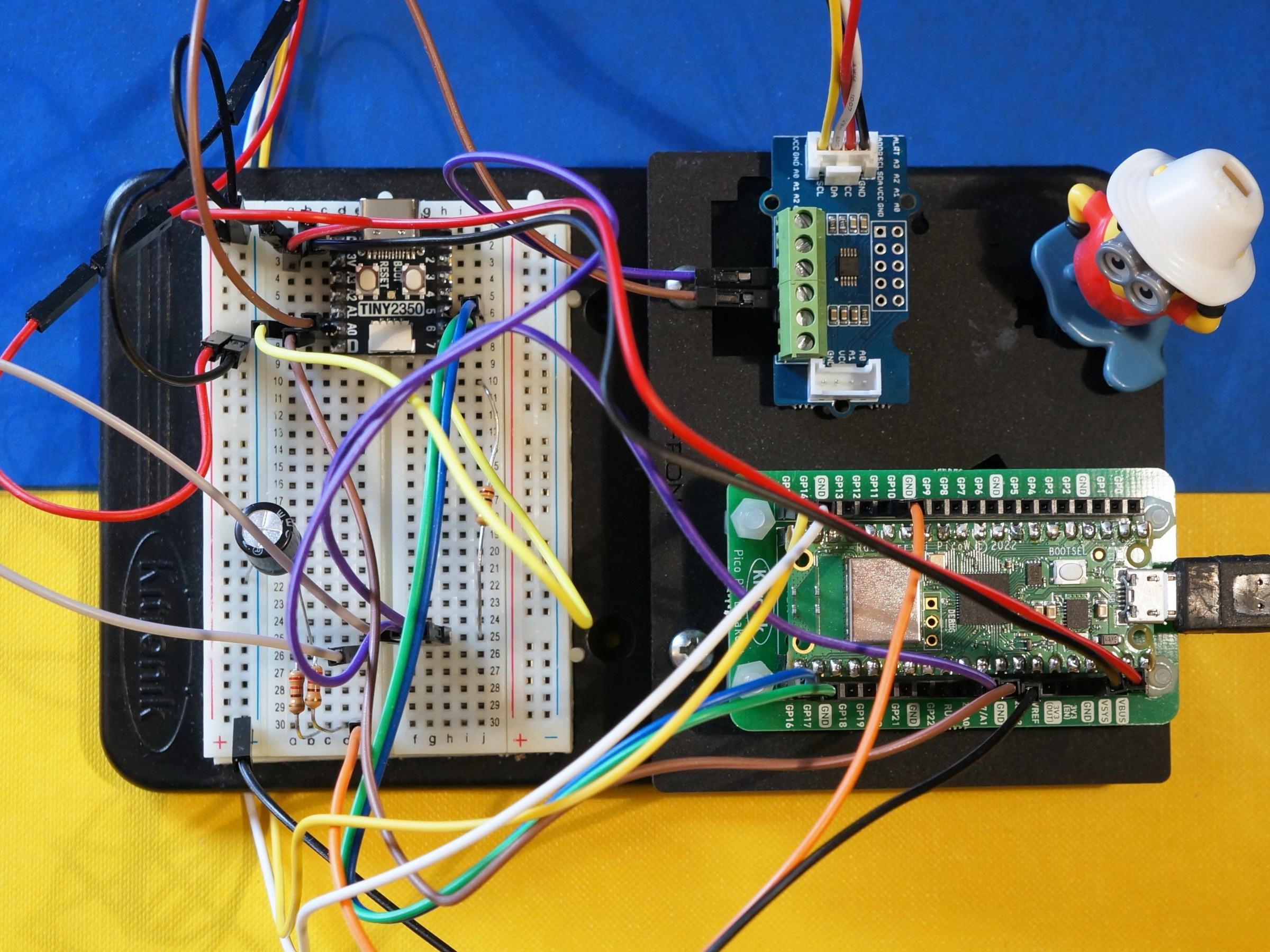
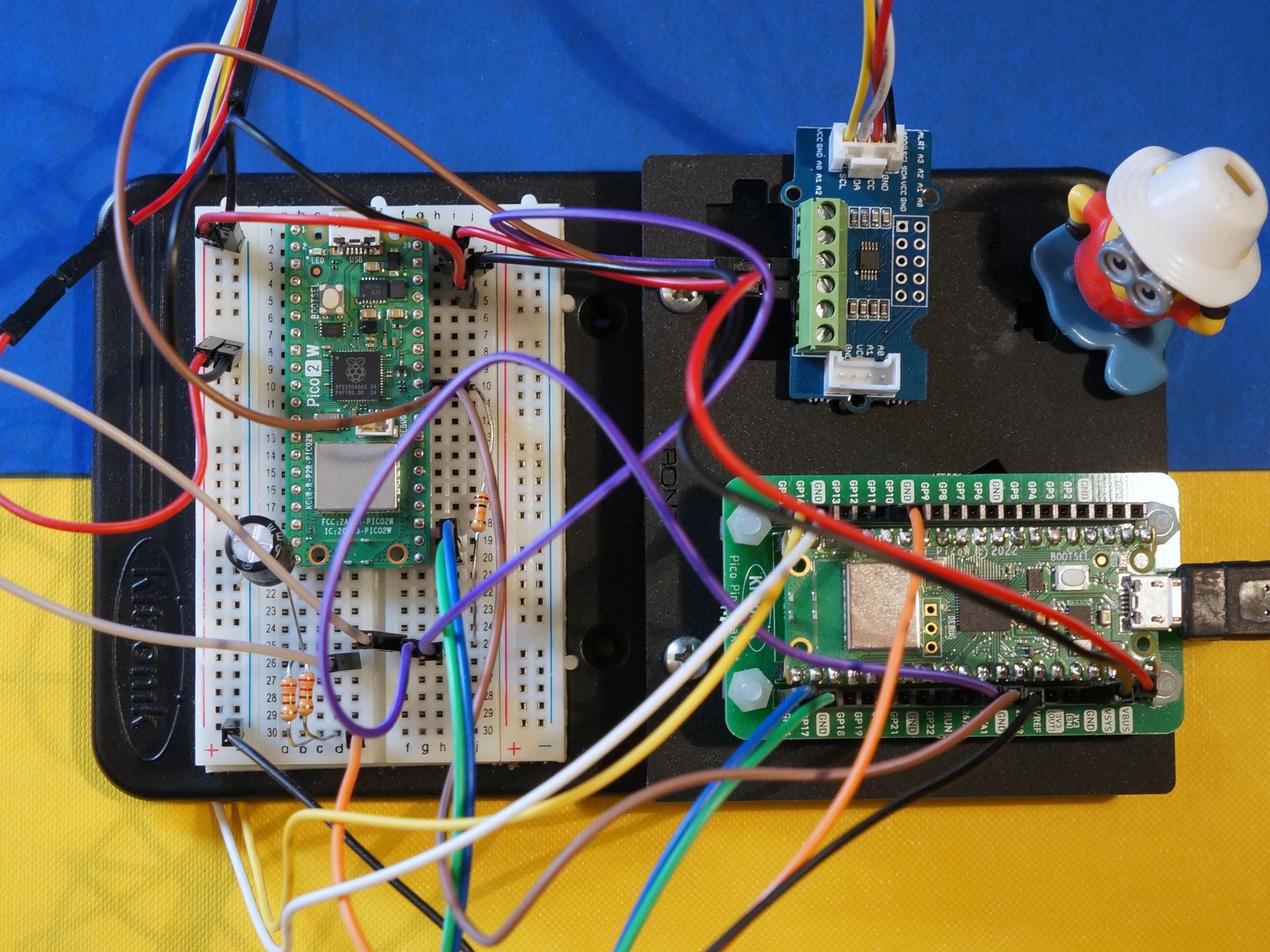
The Tiny 2350 as its name suggests is a much smaller board and clearly isn't going to be pin compatible with the Pi Pico. The connectivity for this "board under test (BUT)" is very similar and is described below.
- SG VBUS (red) and GND (black) to BUT 5V and GND (marked -).
- BUT 3V (red) and GND (marked -) (black) to left rails on breadboard.
- Left breadboard rails to ADS1115 VCC (red) and GND (black).
- SG GP27 ADC1 and ADS1115 A1 (brown) to BUT A0 (GP26) (left row7).
- Breadboard link between right row 10 and left row 7 (yellow). This is the ouput voltage from the "impedance resistor".
- SG GP16 to BUT 5 (blue), SG GP17 to BUT 6 (green). This pair is for the UART serial communication. Note: the crossover between pins here.
- Breadboard link between lower row 26 and upper row 25 (grey).
The power is provided from the USB of the Pi Pico W (the "Signal Generator (SG)"). The USB-C on the Tiny 2350 should not be plugged into a different computer to the Pi Pico W as they need to share a common ground if both are connected.
The previous article, GPIO Input Leakage Current Measurement on Pi Pico 2 W Using Kitronik Inventor's Kit for Raspberry Pi Pico, has more detail and explanation on the hardware and software setup and testing process. There are a few minor changes in the connectivity since the last article. The only significant one is the board under test now powers the TI ADS1115 external ADC.
Testing an RP2350 A4 Digital Input on Pimoroni Tiny 2350
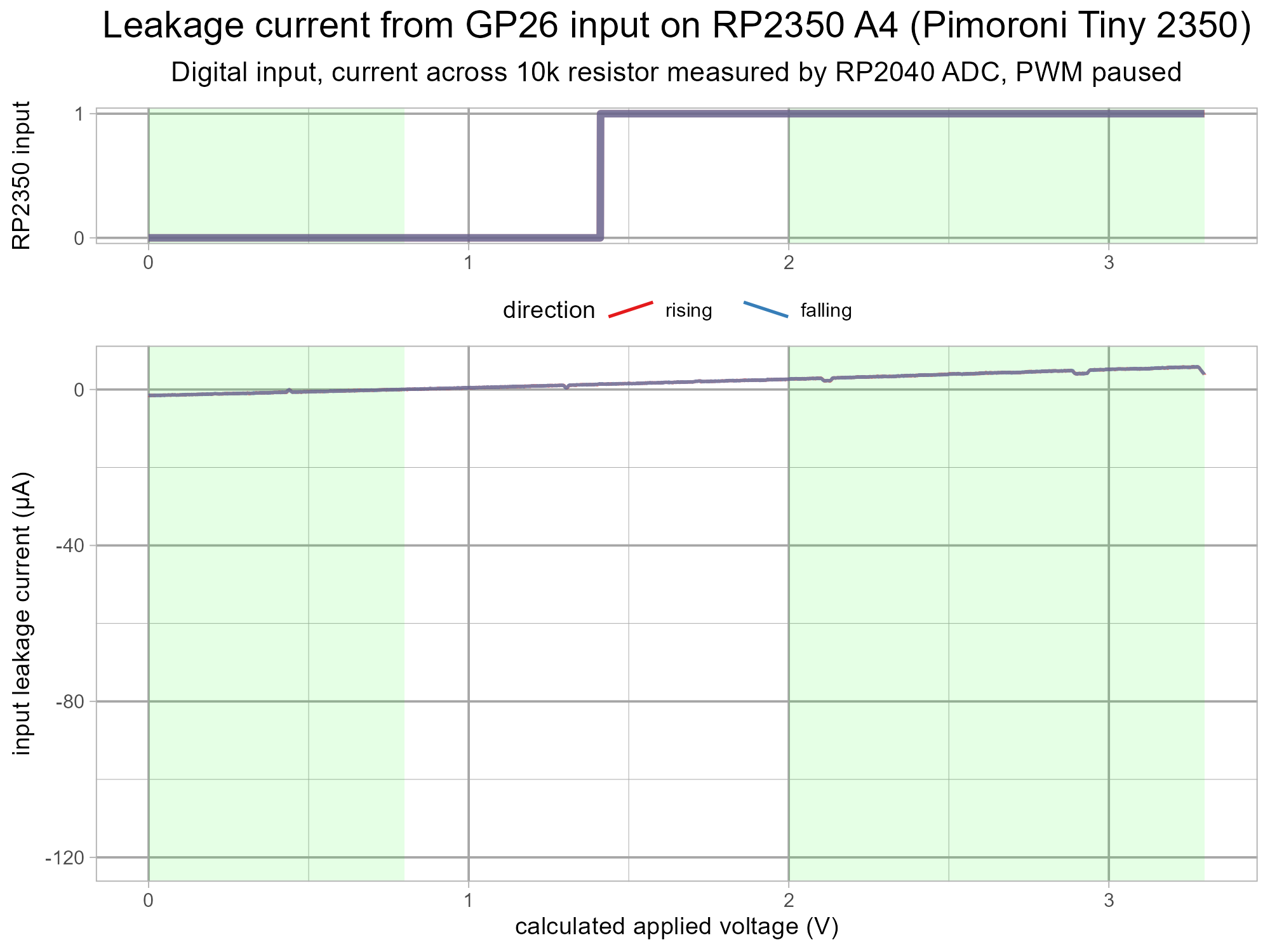
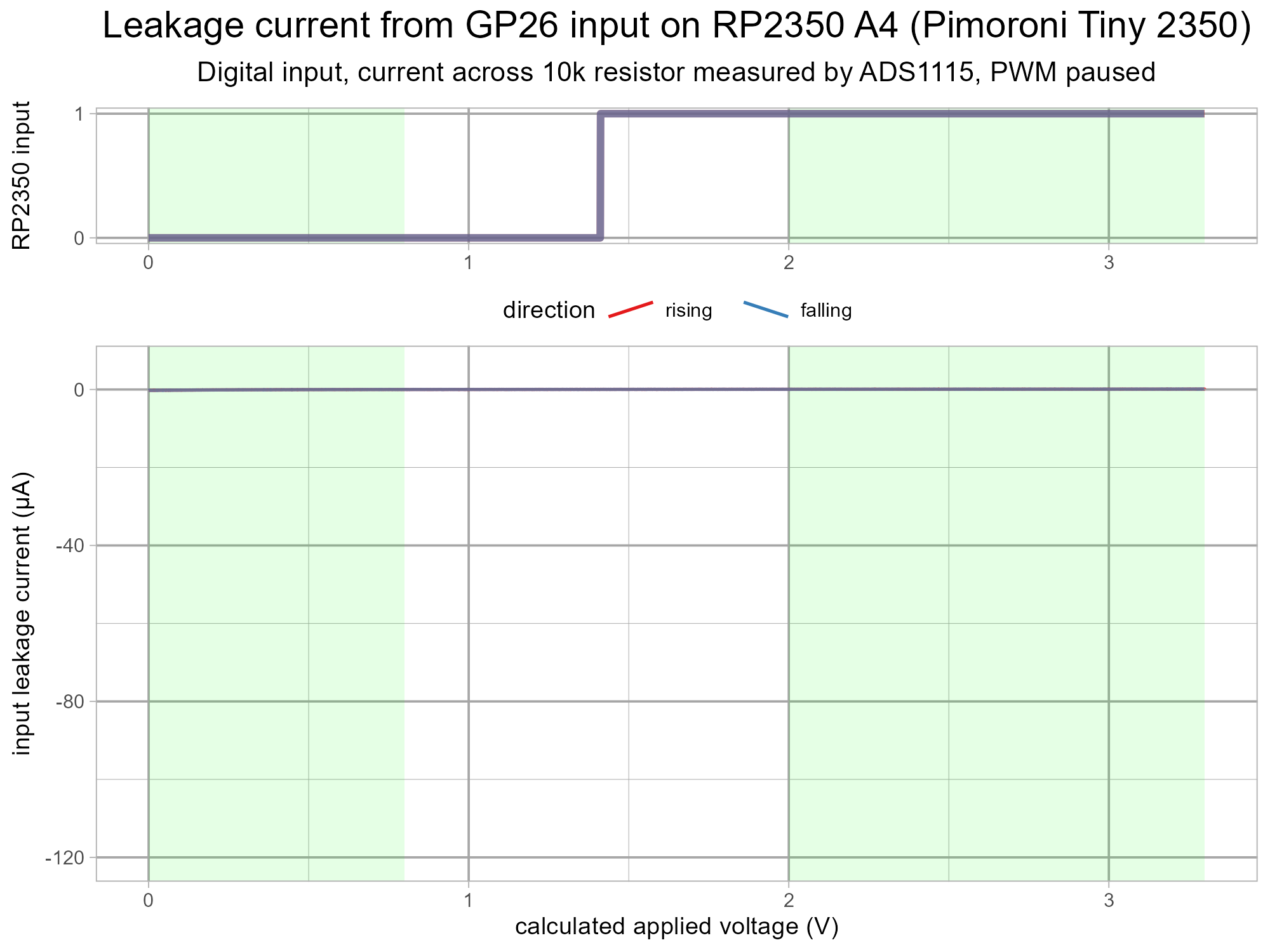
As expected, this shows the input leakage has been fixed. The ADS1115 will provide the more accurate representation of the current, the RP2040 has a slight slope on it probably due to the source being (intentionally) above the maximum impedance. The kinks are due to RP2040's DNL spikes (Errata 11).
The digital input cleanly transitions around 1.4V from low to high and from high to low. This suggests that CircuitPython's DigitalInOut is not using the schmitt trigger feature on the GPIO.
The Pi Pico 2 W was also tested again to ensure the testing setup was okay and the results were reproducible. This retest produced results like the previous article, the plots are not included here.
Testing an RP2350 A4 Analogue Input on Pimoroni Tiny 2350

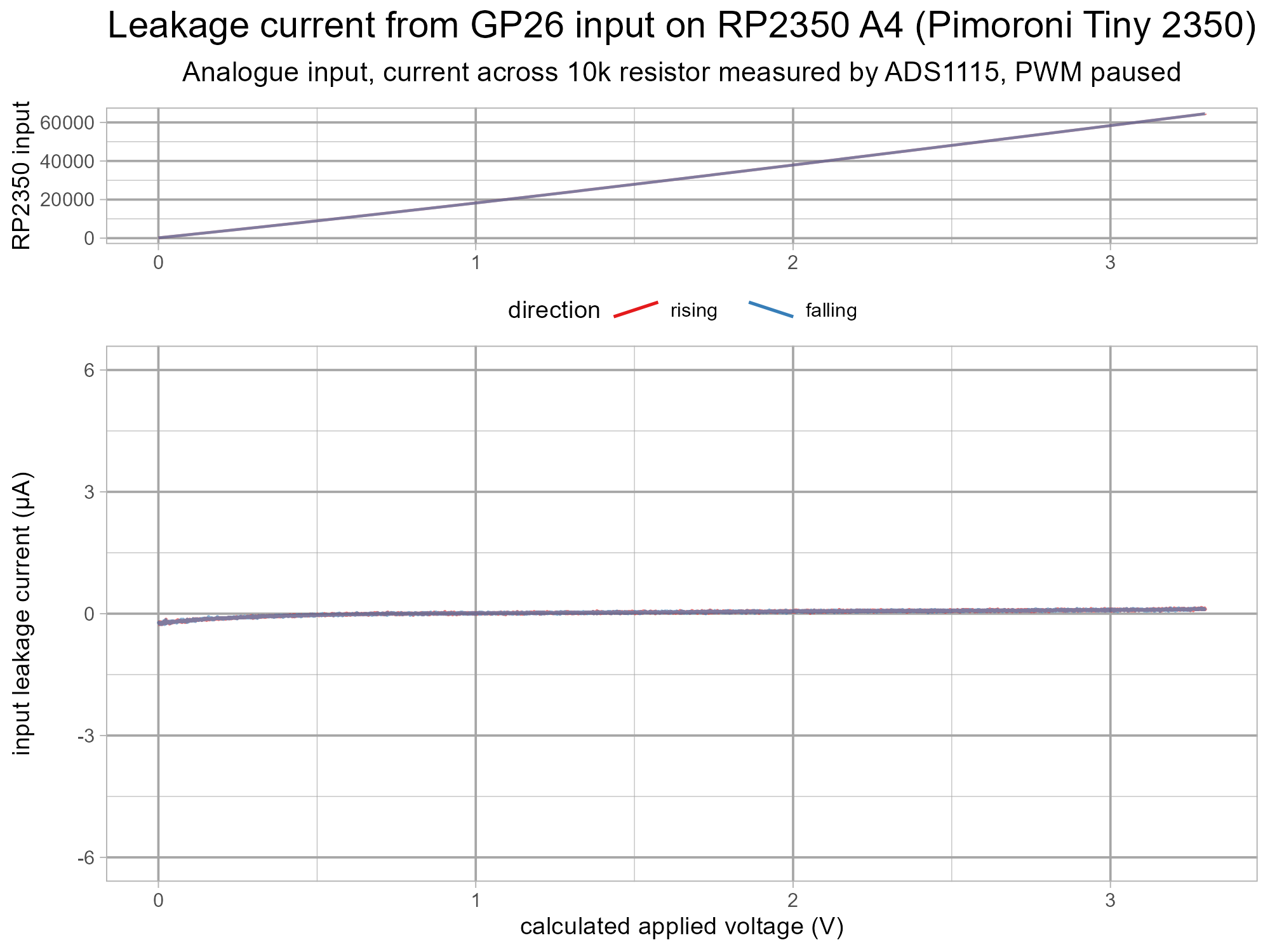
The flaw did not affect GPIO used as analogue inputs. These plots provides a closer look at the input leakage, again the ADS1115 measurements are expected to be the far more accurate ones.
A Closer Look at the ADC Accuracy and Noise

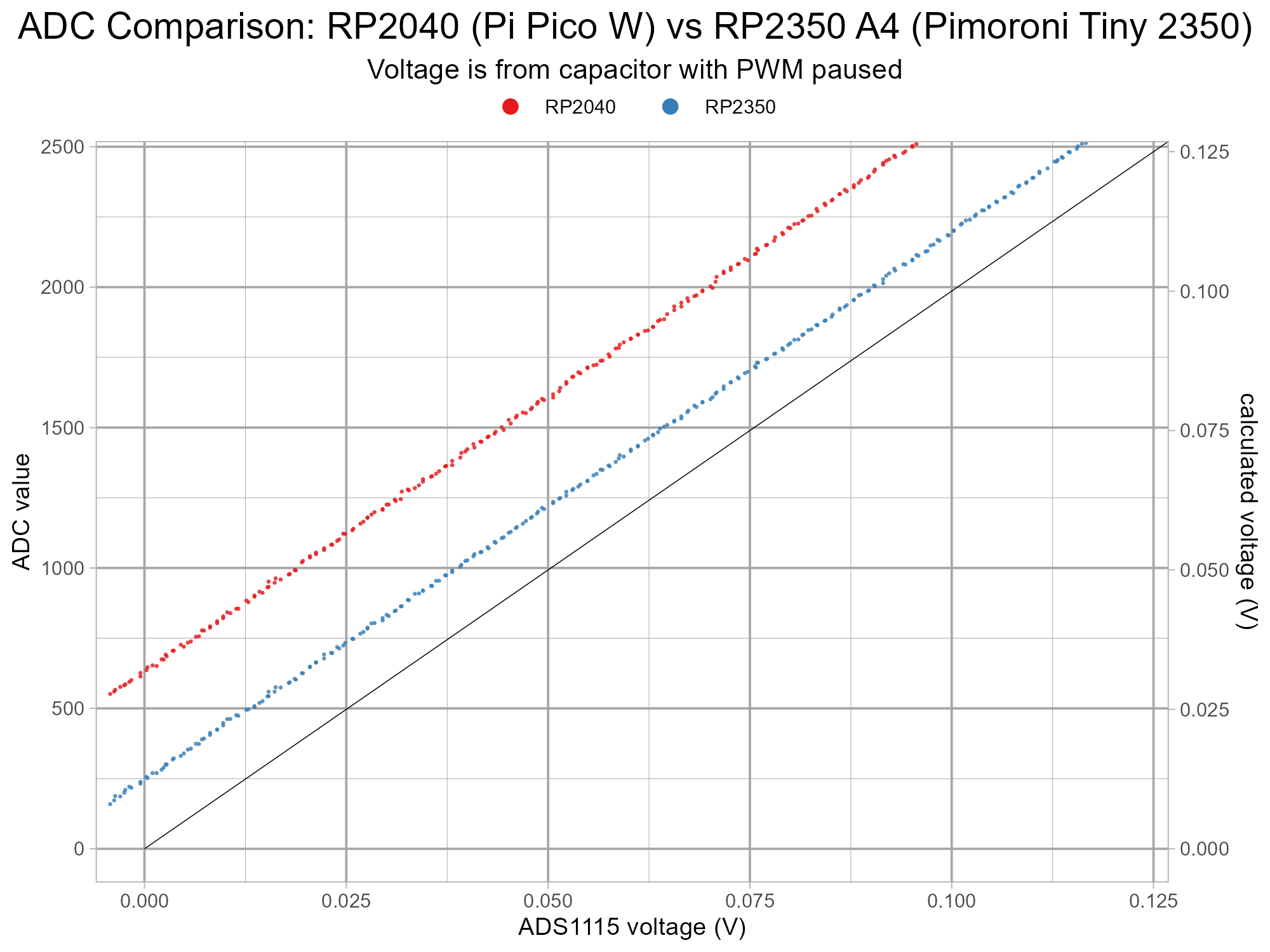
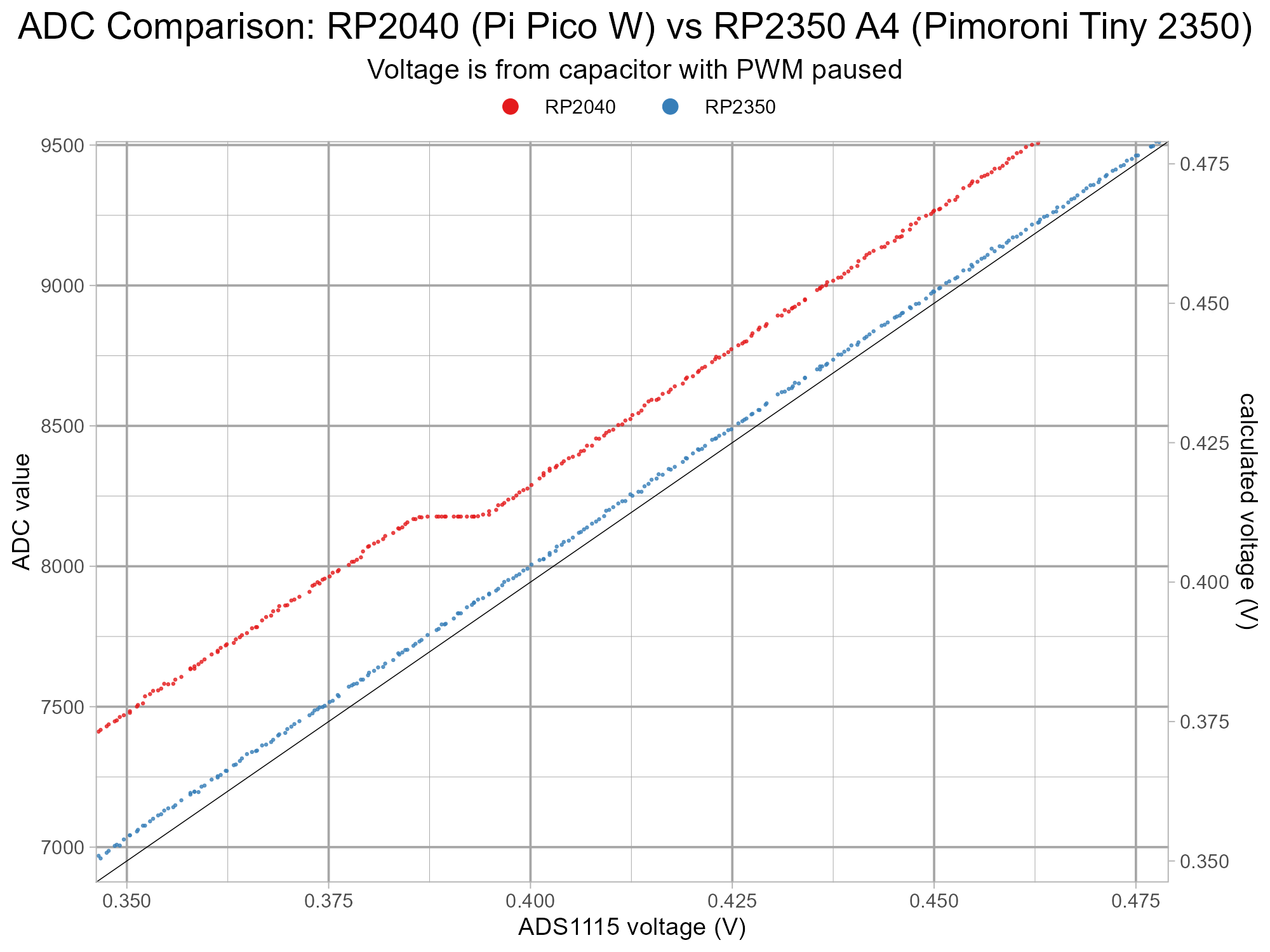

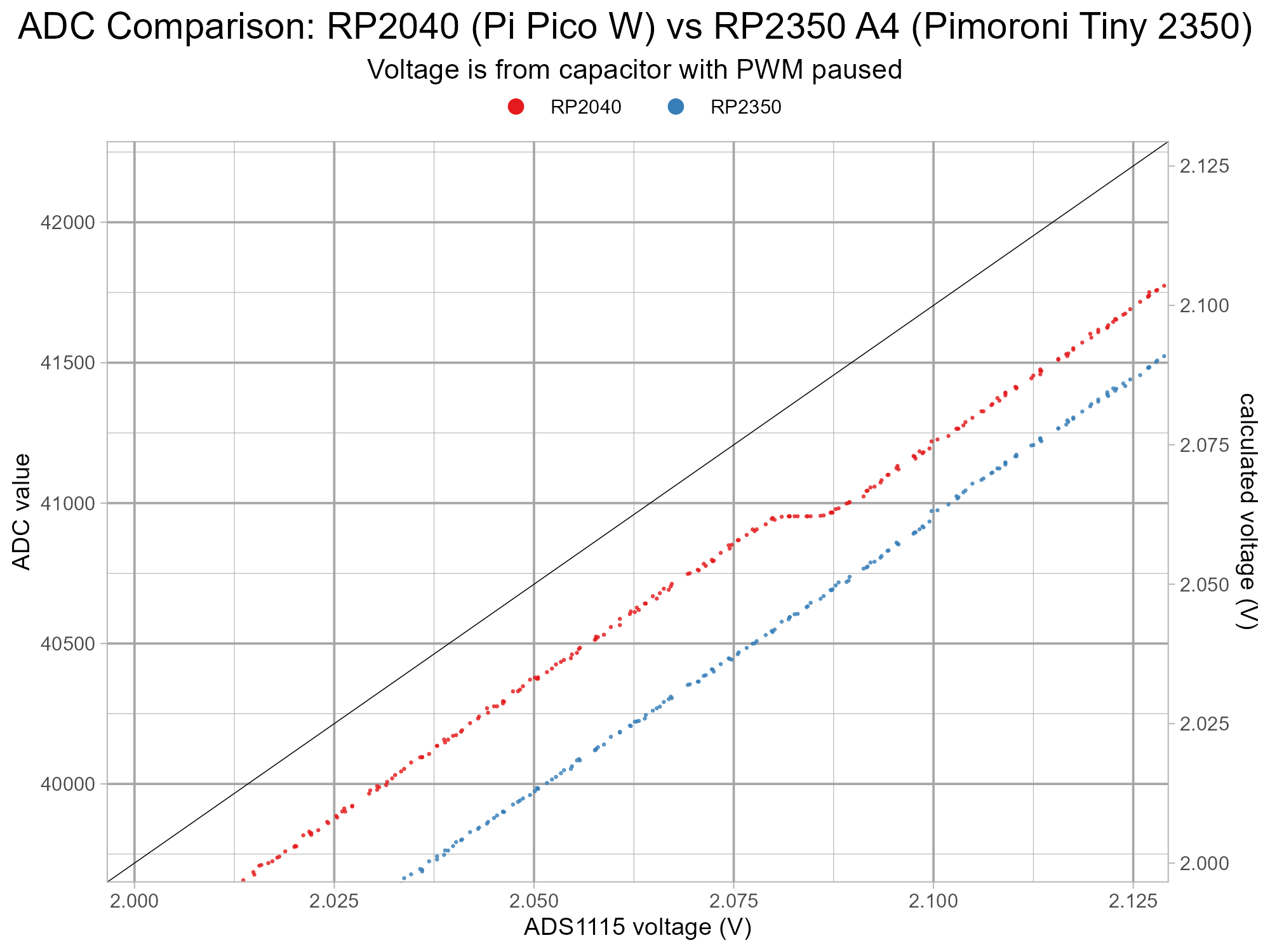
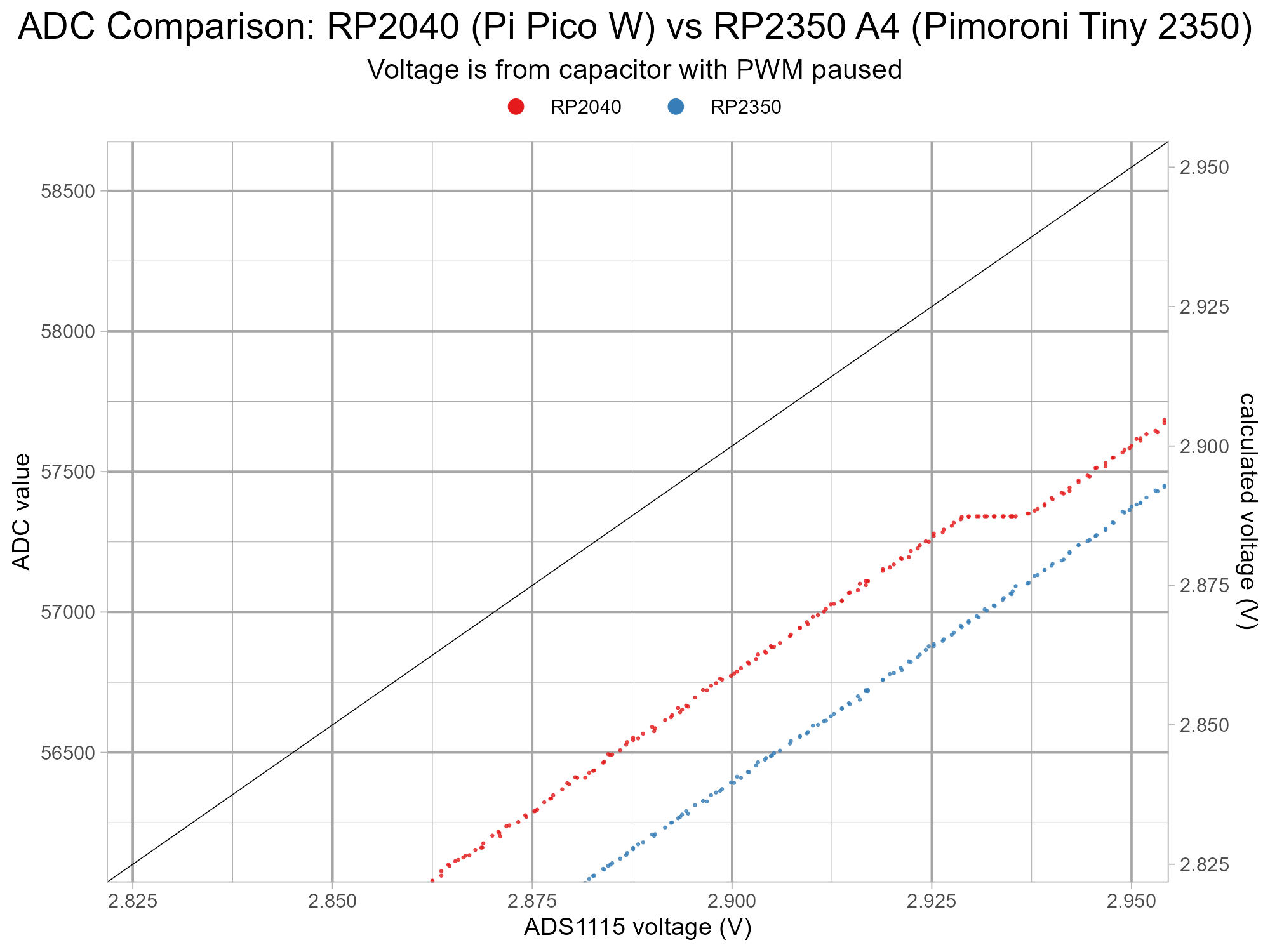
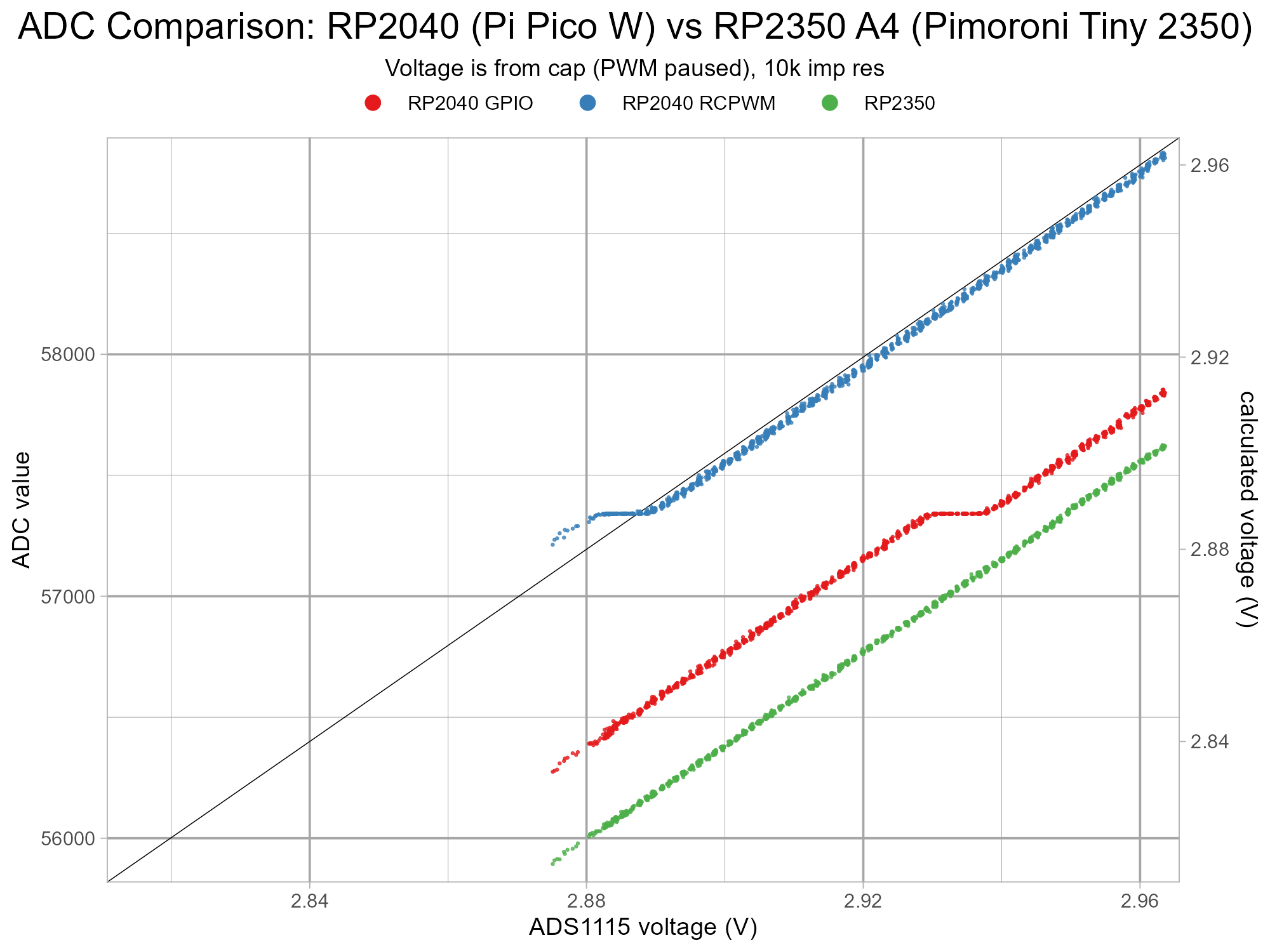
This plot was originally used to look for the RP2040 Errata 11 ADC Issue. The zoomed-in versions are around the voltages where the DNL spikes occur.
In terms of noise, the RP2350 on the Tiny 2350 visually looks very similar to the Pi Pico W's RP2040. This is very different to the previous testing and the retesting of the Pi Pico 2 W's RP2350 (A2). This is compared on the next page.
RP2350 Noise: Pi Pico 2 W (A2) Vs Pimoroni Tiny 2350 (A4) - Noise Proportional to Voltage?
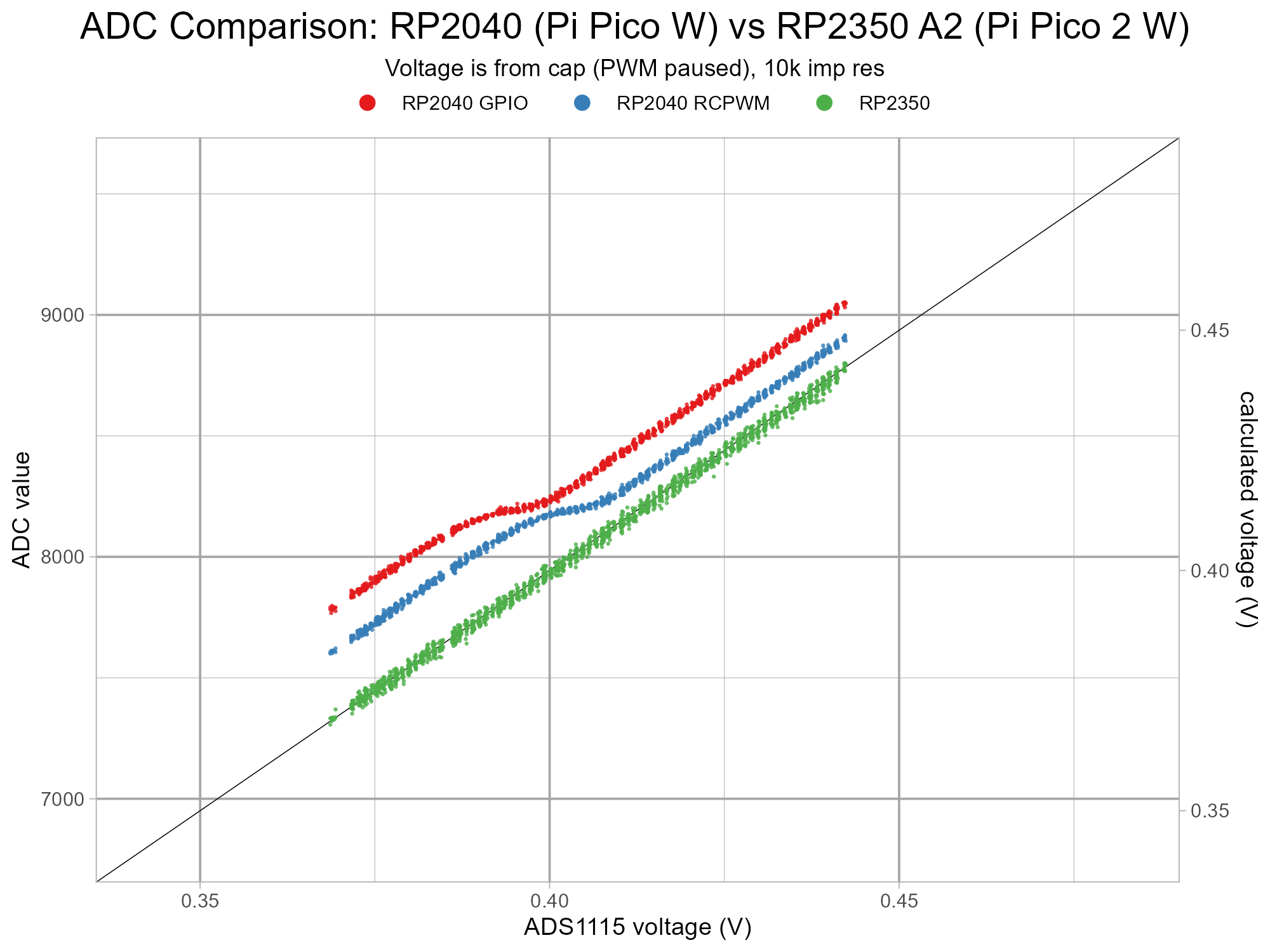
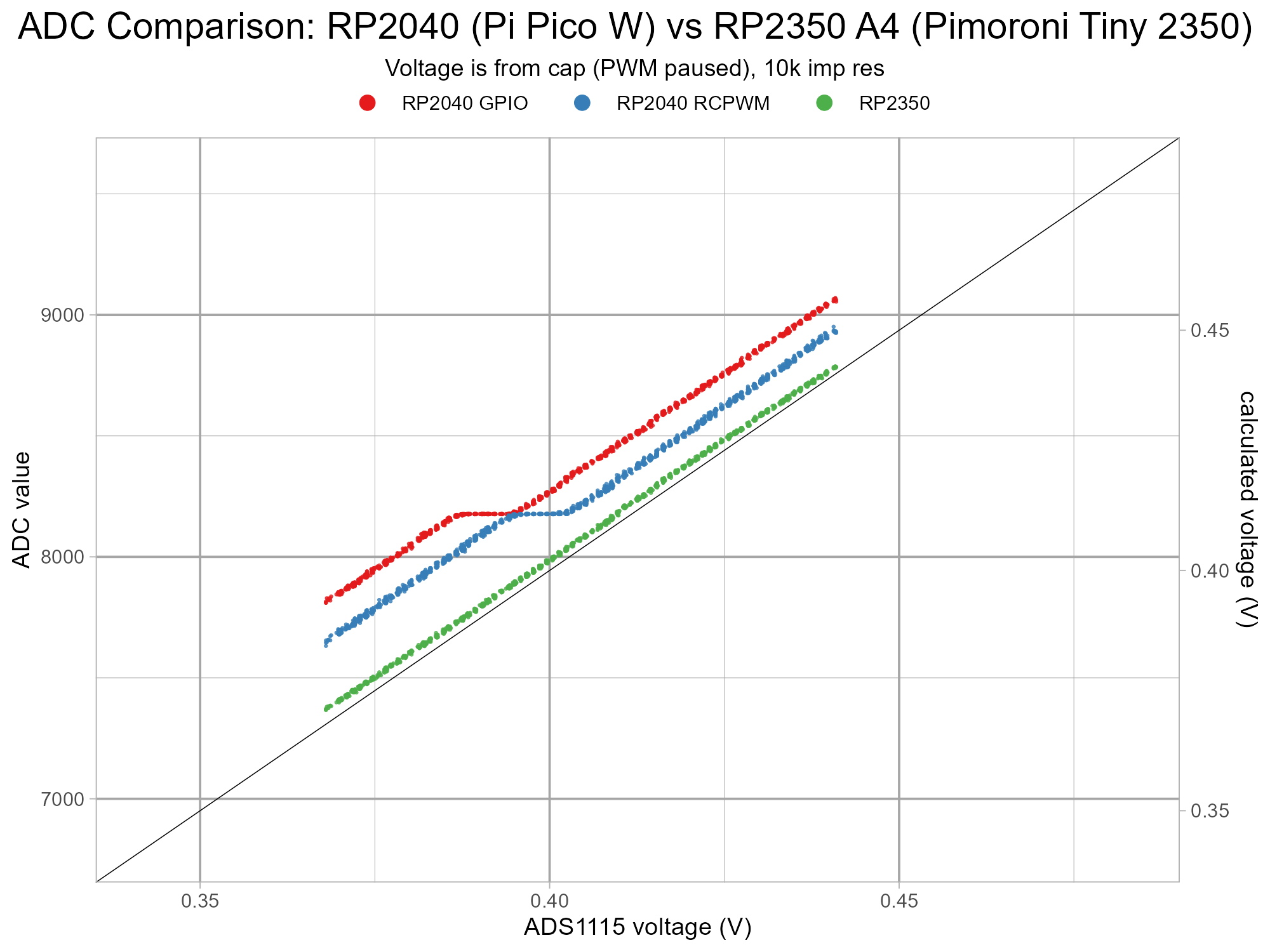
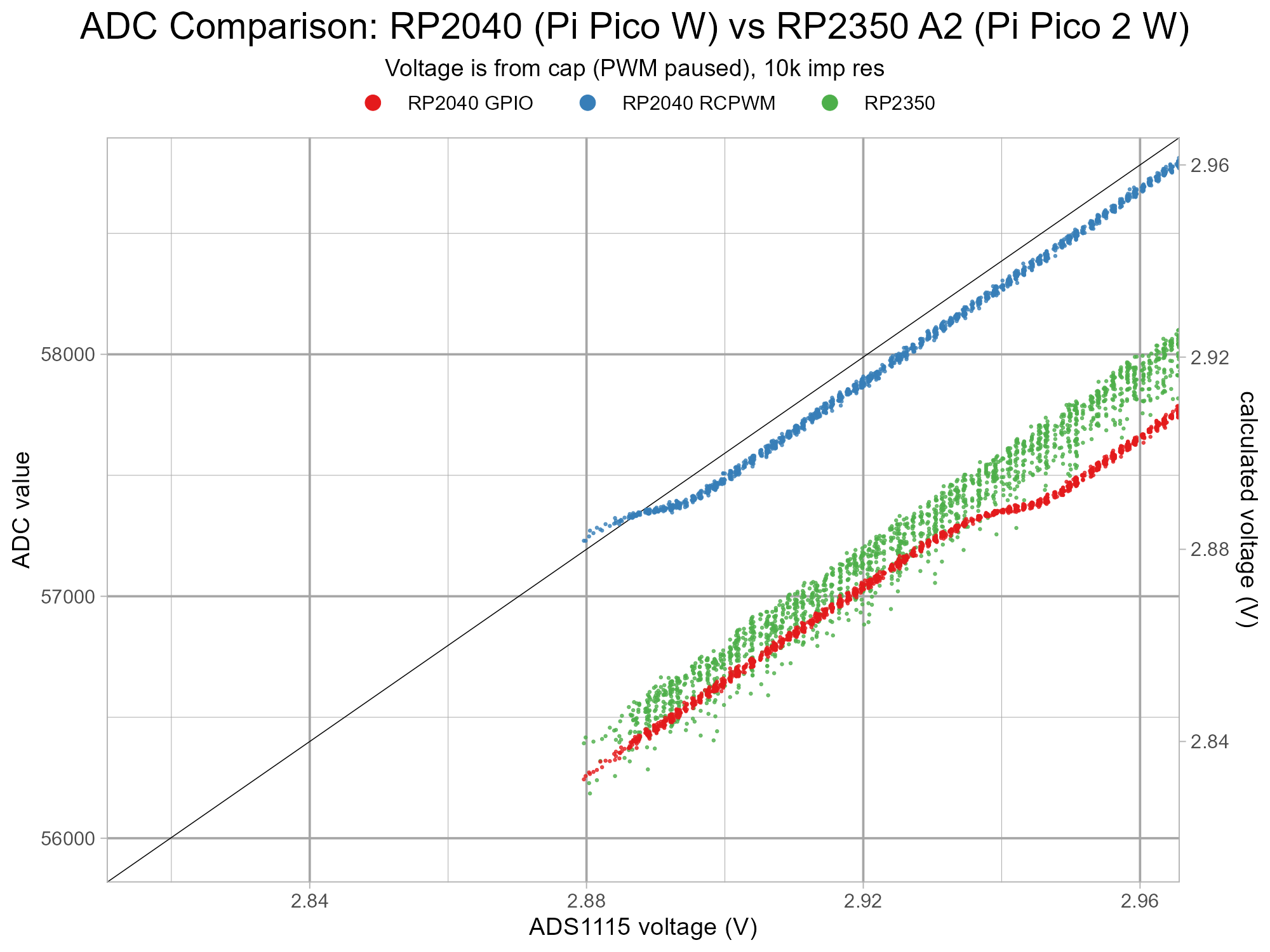
A derivative (copy!) of the the pico-input-tester.py was used to examine the ADC noise. The pico-noise-tester.py has the following relevant features:
- runs the tests with continuous and non-continuous (paused) PWM;
- only tests the analogue input to retrieve the board under test's ADC reading;
- takes five readings using the original semi-parallelised approach and a more sequential one;
- tests a few small voltage ranges** to speed up the testing.
For the RPxxxx microcontroller ADCs, all of the CircuitPython programs here are taking 32 samples, discarding the top two and the bottom two on the assumption they are outliers and taking an arithmetic mean.
The Pi Pico 2 W's RP2350 A2 appears to suffer from more noise (the green dots are spread around rather than tightly clustered) than the Pi Pico W's RP2040 and the Tiny 2350's RP2350 A4. This becomes more prominent as the voltage increases, the deviation of the noise distribution may be proportional to voltage.
It's still not clear if this is an RP2350 A2 issue or a Pi Pico 2 W one or both. The Tiny 2350 isn't the best comparison here as the 3.3V for the microcontroller is provided by a linear regulator rather than a switch-mode power supply - the latter will be noisier. Another difference is the absence of a pin on the Tiny 2350 for the ADC voltage reference. This is being discussed in Adafruit Forums: ADC noise RP2350 vs RP2040 and Raspberry Pi Forum: ADC might be noisier on Pi Pico 2 W compared to Pi Pico W.
** These ranges are mostly around the RP2040 DNL spikes but are also useful here for picking a few different voltages between 0.0 and 3.3V.
RP2350 Noise: Pi Pico 2 W (A2) Vs Pimoroni Tiny 2350 (A4) - Checking Multiple Readings
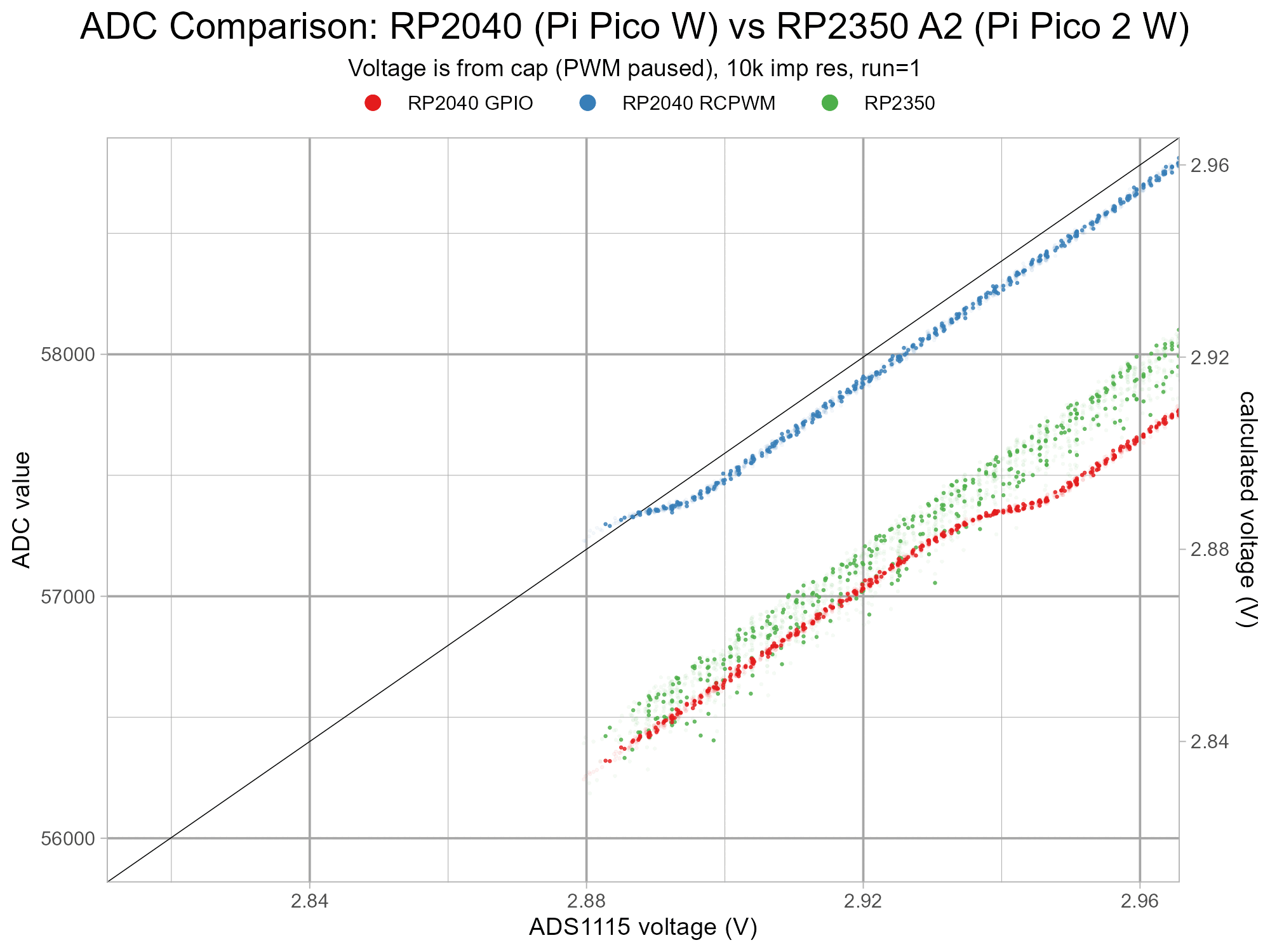
This animation shows the five different readings. These are taken in quick succession. This might show if there was some sort of trend in the readings. They all appear to have a similar random splatter suggesting there's no drifting around over time. A better test would be to look at raw ADC samples and more of them over time.
Going Further

Finding a Raspberry Pi Pico 2 (W) with an RP2350 A3 or A4 would be an intriguing like-for-like test.
There are more ideas and references in RP2350 GPIO Input Leakage Current Measurement on Pi Pico 2 W Using Kitronik Inventor's Kit for Raspberry Pi Pico.