Radially Oriented Biomimetic Elastomeric Resilient Tentacle (ROBERT) Gripper/Actuator
by Aleph Jeremiah Rambie in Circuits > Robots
44 Views, 2 Favorites, 0 Comments
Radially Oriented Biomimetic Elastomeric Resilient Tentacle (ROBERT) Gripper/Actuator


Soft robotics is transforming the world by creating machines that move, adapt, and interact more like living organisms than traditional rigid robots. Unlike conventional robots built from hard metals and fixed joints, soft robots are made from flexible materials such as silicone, rubber, hydrogels, and smart fabrics. This flexibility allows them to safely work alongside humans, handle delicate objects, and operate in environments that were once too dangerous or unpredictable for machines.
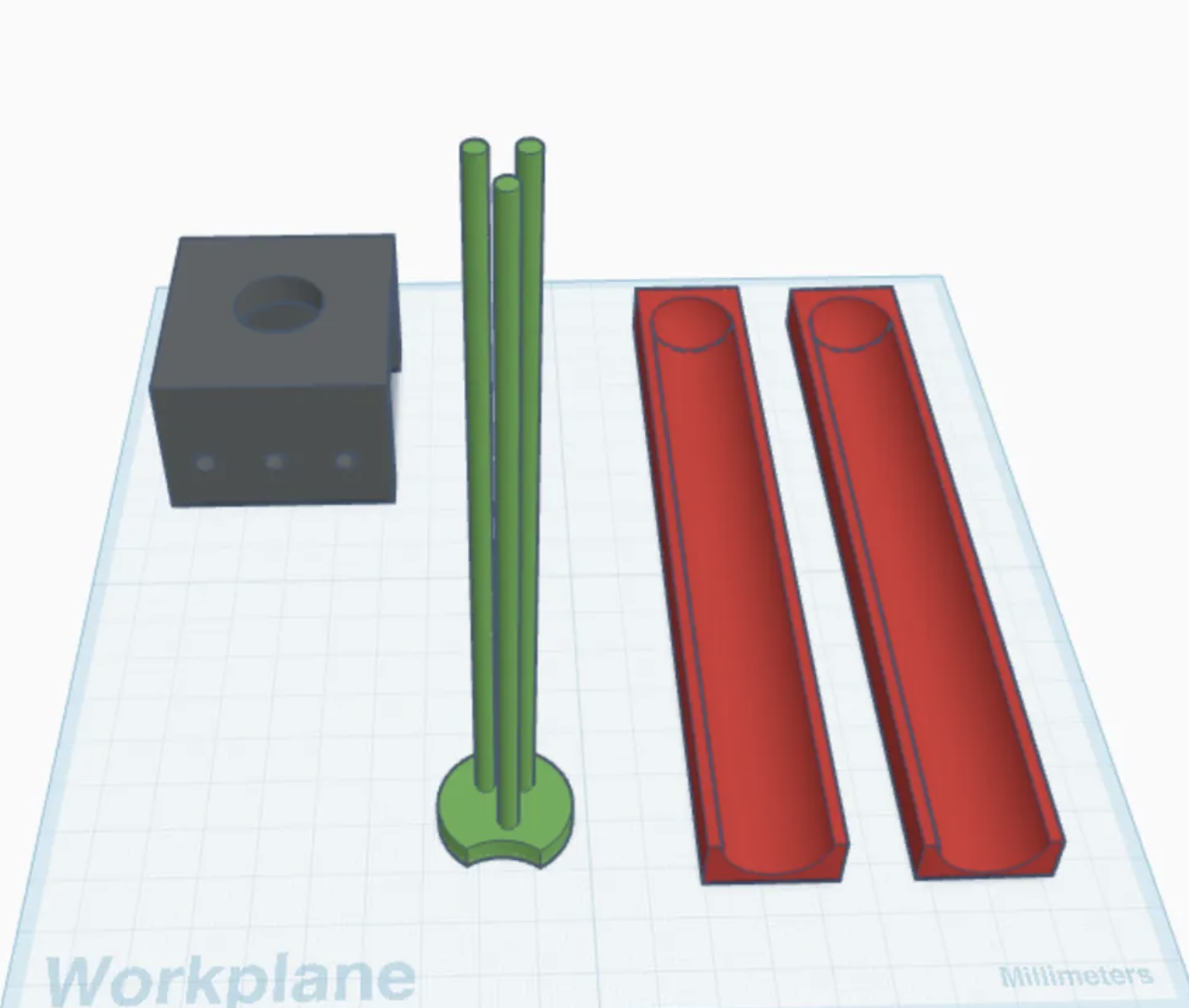
The Radially Oriented Biomimetic Elastomeric Resilient Tentacle (ROBERT) Gripper is a soft robotic tentacle-like gripper inspired by the dexterity of an octopus arm and the flexibility of an elephant’s trunk. Powered by three internal pneumatic chambers, the gripper bends, curls, and twists with smooth, snake-like motion when inflated. Its compliant soft-body design enables natural, adaptive movement, making it ideal for delicate grasping and biomimetic manipulation tasks. The red part is the "clamshell" mold, a two-part mold for the main body, the green mold is the air channel mold (called ORVIN, stands for Omnidirectional Radial Viscoelastic Inflation Network), and the grey part is the base for the tentacle.
Supplies
These are the materials you will need:
- 3D Printer Filament (I suggest a type that is easy to grip for the silicone yet easy to pullout)
- Liquid Silicone (About Shore 10A or Shore 15A, allows for maximum bending) (Any type)
- 2 Clamps (If you do not possess a 2 clamps, you can use a lot of zip ties and tape, but make sure to avoid leakage)
- 3 Aquarium Air Tubes
These are the tools you will need:
- 3D Printer
- Measuring Cup OR a beaker
- 3 Syringes
(the 3D files for all 3 parts are provided below, in .STL format)
Print All 3 Molds
Print all 3 molds using a 3D Printer, it would be best to print them INDIVIDUALLY rather than altogether, it yields better results.
Assemble the "clamshell" Molds


Use your clamp (or tape and zip ties) to attach the 2 ROBERT molds, make sure they are attached SEAMLESSLY, or else you will risk the silicone spilling or the tentacle looking weird.
Mix the Liquid Silicone
To ensure the structural integrity and optimal elastomeric flexibility of the actuator, the liquid silicone must be measured precisely using a digital gram scale. Do not measure by volume (milliliters), as the differing densities of the base and catalyst will disrupt the curing process.
The Chemical Mix Ratio
liquid silicone utilizes a strict 100:2 condensation-cure polymerization ratio by weight:
- Part A (Base Elastomer): 100 Parts (98% of total mass)
- Part B (Catalyst Agent): 2 Parts (2% of total mass)
Mixing Procedure
- Tare the Scale: Place a clean, dry mixing container onto the digital scale and press the tare button to zero out the display (0.0 g).
- Dispense Part A: Slowly pour the viscous liquid silicone Part A base into the container until reaching the calculated target mass for the mold volume.
- Tare and Add Part B: Re-zero the scale. Carefully dispense the liquid silicone Part B catalyst drop by drop until it registers exactly 2% of the initial Part A weight.
- Homogenize the Mixture: Stir the combined liquid silicone thoroughly for a minimum of 3 minutes. Ensure the mixing tool aggressively scrapes the bottom contours and vertical sidewalls of the container to eliminate unmixed chemical pockets.
Note: Inadequate mixing will cause localized curing failure, resulting in structural weak points or tacky spots along the network walls.
Pour the Silicone Into the Mold
Once the liquid silicone is thoroughly mixed and completely homogenized, it must be introduced into the 3D-printed assembly core. Proper pouring technique is crucial to minimize structural vulnerabilities caused by trapped air pockets (voids) inside the elastomer matrix.
Pouring Procedure
- Secure the Assembly: Ensure that the 3D-printed clamshell mold is tightly clamped or rubber-banded together and that the internal structural pins (which form the ORVIN pneumatic channels) are perfectly straight and locked firmly at the base.
- Execute a High-Pour Stream: Tilt your mixing container and pour the liquid silicone into the mold opening in a single, incredibly thin, continuous stream from a height of roughly 30 cm above the entry point.
- The Engineering Principle: A long, thin stream stretches the liquid silicone as it falls, physically popping large air bubbles before they enter the mold cavity.
- Allow Self-Leveling: Pour slowly down one side of the internal wall rather than straight down the center. This encourages the liquid silicone to rise smoothly from the bottom up, pushing internal air upward and displacing it organically out of the mold.
⚠️ NOTE: DO NOT FILL TO THE EXACT TOP BRIM Leave approximately 3 to 5 mm of clearance at the very top of the mold. Do not fill the liquid silicone flush to the upper rim.
When the internal ORVIN core pins are extracted after curing, having this small physical recess prevents the delicate silicone top wall from ripping or delaminating. Additionally, this unfilled top gap provides a clean mechanical landing zone for inserting, sealing, and routing the final pneumatic feedback tubes.
Insert the ORVIN Mold


Insert the ORVIN mold, make sure it is straight, because if it imbalanced, one wall can be too thick or too thing, this can effect the motion of the final tentacle.
Let It Cure
Let the liquid silicone cure for a while, make sure to make it stand VERTICALLY.
Peel of the Mold
Carefully peel off the clamshell mold to reveal the cylindrical tentacle body.
Remove the ORVIN Mold
Carefully pull out the ORVIN mold from the back of the tentacle.
Attach the Tentacle to the Base
Attach the finished tentacle to the base (3D files provided above), use excess liquid silicone to hold it in place (or specialized silicone glue if you happen to have some).
Insert Air Tubes
Insert the air tubes into each of the 3 holes, make sure they are only 1 Centimeter inside, not to short, not too long in.
Connect Air Tubes to Syringe
Connect the each 3 air tubes into all 3 syringes, so you can control the tentacle.
You Choose...
now that you are done, do whatevery you want! replace the syringes with air pumps and solenoids, add sensors, etc, the applications are limitless! And if YOU happen to have any soft robot molds, post them on my open-source soft robotics platform OpenSoft:
https://softrobotics-v9fnm6zv.manus.space