River Stakes: a Push‑Your‑Luck Race Across the River
by FeatherLab in Living > Toys & Games
392 Views, 4 Favorites, 0 Comments
River Stakes: a Push‑Your‑Luck Race Across the River

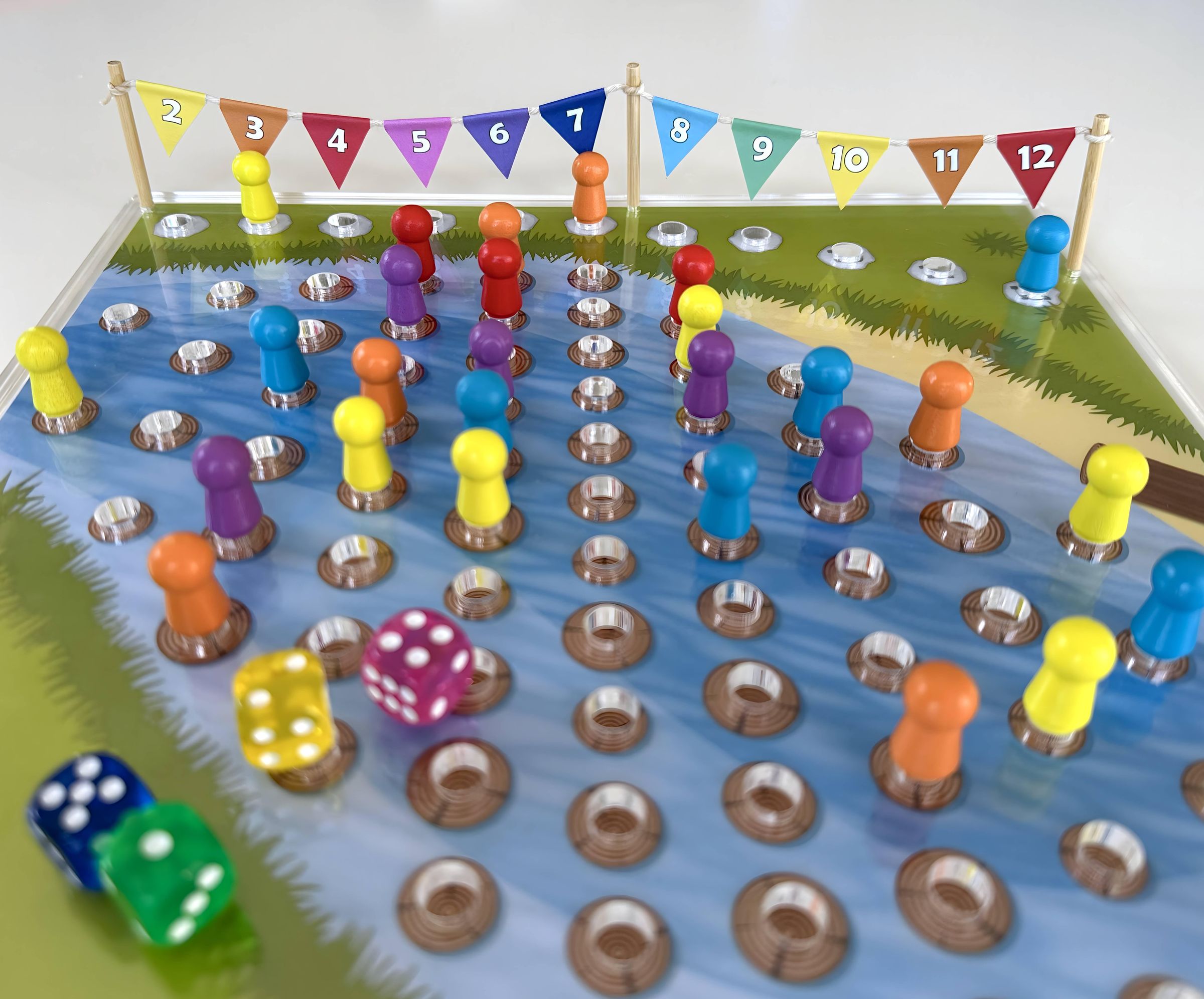


River Stakes is a push‑your‑luck dice game inspired by Can’t Stop. Players race to get their team across a river by rolling dice and choosing how to advance — taking safe routes, grabbing risky shortcuts, or exploiting crowded paths to jump ahead. In this game you control how long your turn lasts, but be careful, push your luck too far and you'll lose all your progress.
In this Instructible, I’ll show you how to build a bold, colourful version of the game. You can simply print the board and start playing or turn it into a fun craft project. For my build, I used a laser cutter to make a clear acrylic overlay that keeps the pieces in place and holds the flag poles. I also made colourful bunting flags to give the finish line a more playful and exciting feel. I have provided all the files so that you can easily make the overlay and the bunting flags, although I encourage you to customise it and make it your own.
What first drew me to this style of game was the clever underlying game mechanics. Both Can’t Stop and River Stakes are built around the probability of rolling different sums with dice, and the board layout reflects those odds. I’ve included an optional section for anyone who wants to dive into the mathematics behind the game. You definitely don’t need this to play, but understanding the probabilities might give you an advantage.
After falling in love with the gameplay, I wanted a physical version I could actually play. The original edition was a single colour and the objective isn't immediately clear. Also it wasn't available in my country. I found a beautiful Korean version online (made by Playte in collaboration with Popcorn Games), but this one was just as hard to get. So naturally, I decided to make my own. I designed River Stakes from the ground up to be more colourful, more intuitive, and more fun.
Before sharing this here, I played River Stakes with my family — and they wanted to play it again… and again… and again. Their excitement convinced me that this game deserved a wider audience. It’s quick to learn, fun for both kids and adults, and surprisingly strategic. I hope you enjoy building and playing River Stakes!
Disclaimer: River Stakes is not affiliated with, endorsed by, or associated with the creators or publishers of Can’t Stop.
Supplies
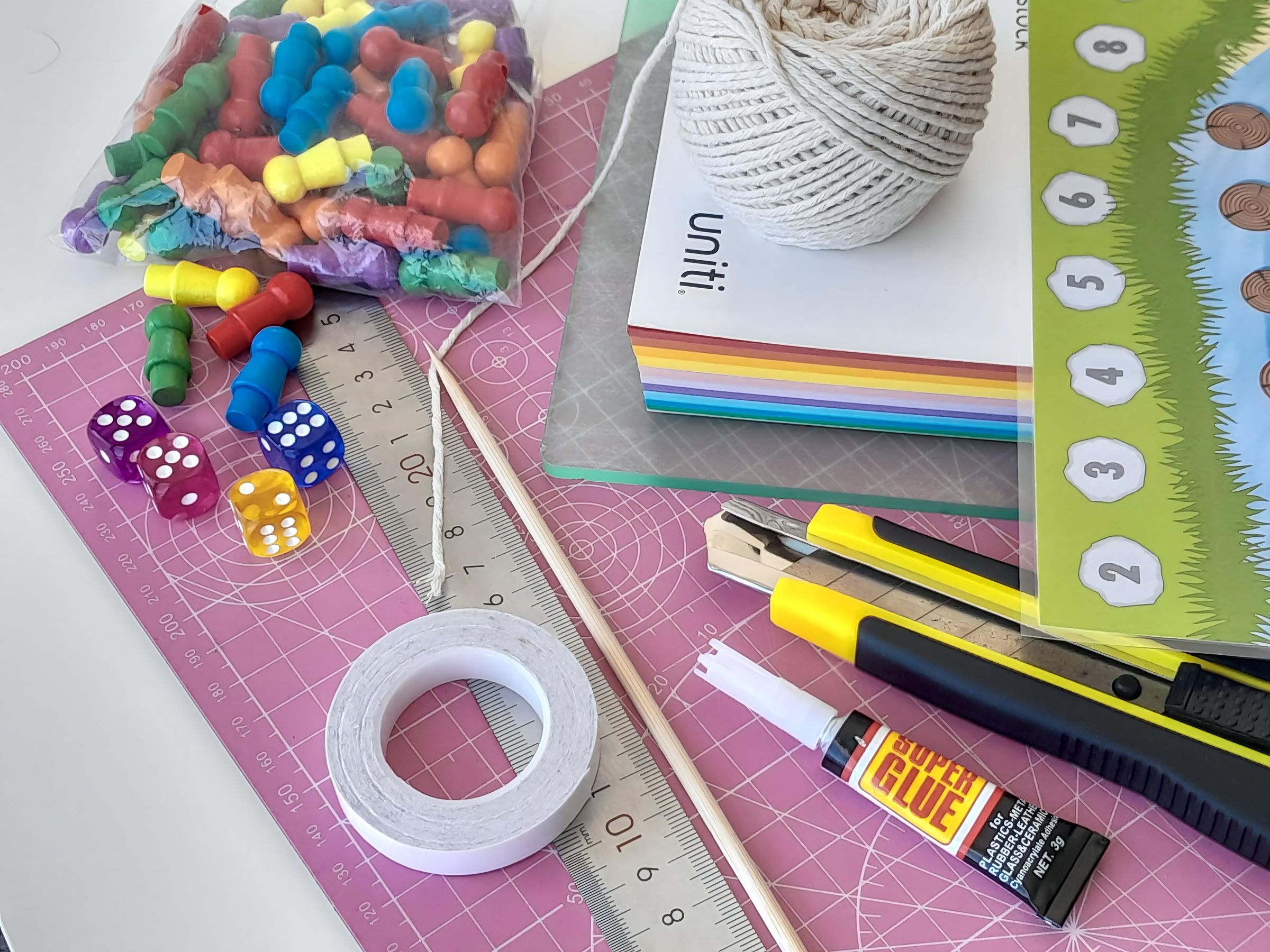
Minimum materials to play
Materials:
- Print out of River Stakes (3 x A3)
- 47 Game pieces (Chinese checkers pieces work well for the deluxe version)
- 11 pieces per player (max 4 players)
- 3 leader pieces
- 4 six-sided dice
Equipment:
- A3 printer
- Scissors
For the deluxe version (acrylic overlay + bunting flags)
Materials:
- Bamboo skewer (less than 4mm diameter)
- Kitchen twine
- Super glue
- Double sided tape (20mm wide)
- Clear Acrylic sheet (290mm x 295mm x 6mm)
- Laminating pouches or clear adhesive book covering
Equipment:
- Cutting mat
- Craft knife
- Ruler
- Laminator
- Laser cutter
- Printer
Print the Board


- Print the River Stakes PDF on an A3 printer for the best results.
- Tip: Print double‑sided if you want the rules on the back of the board.
- To make the board more durable, laminate it or cover it with a clear adhesive sheet.
- Once covered, carefully trim the edges, leaving a 3–4 mm border. This helps prevent the laminate or adhesive from peeling over time.
Downloads
Laser Cut the Clear Acrylic Overlay (Optional)
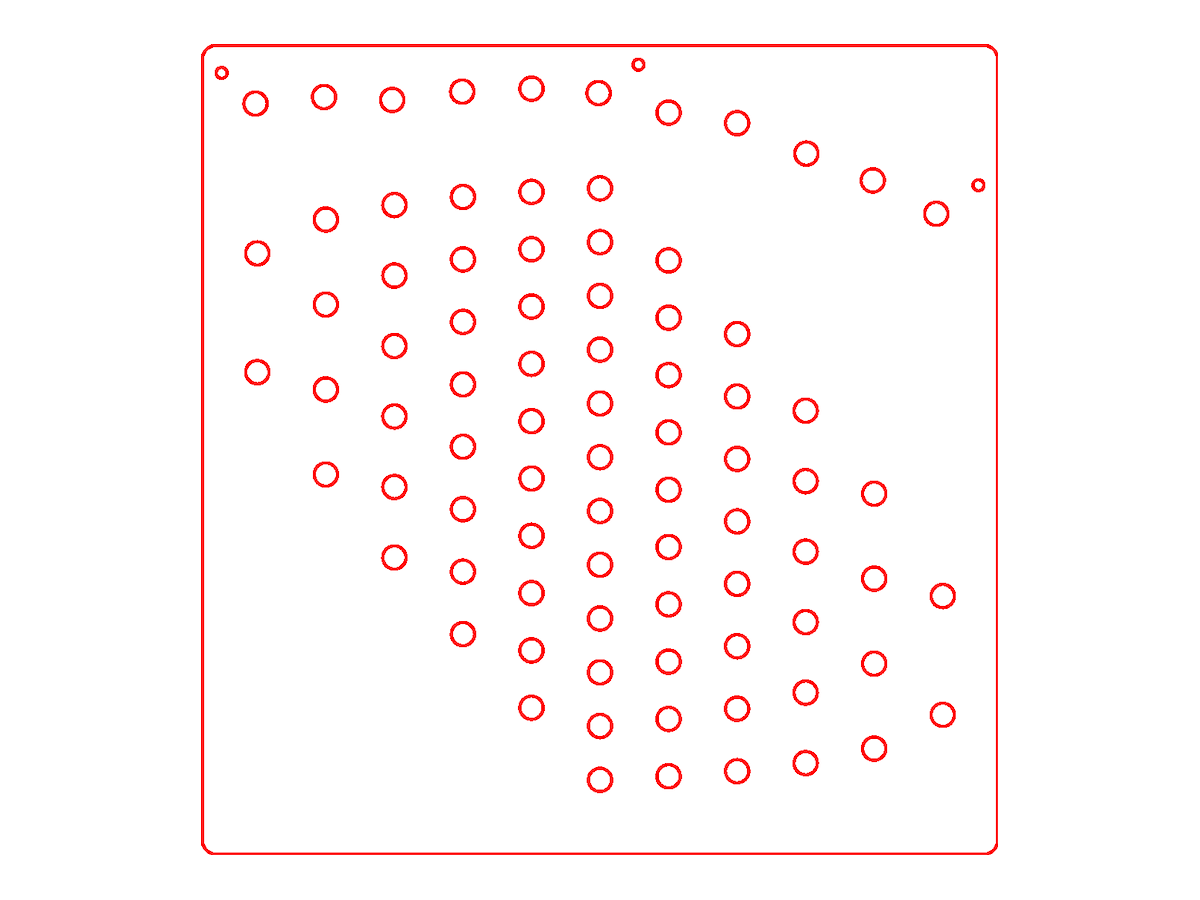
This step is optional, but it adds a nice level of polish to the game. The clear overlay sits on top of the printed board and keeps all the game pieces in place. It prevents pieces from shifting if the table is bumped, making gameplay smoother and less frustrating. It also includes holes for the bunting flags, giving the game a more playful and finished look.
Every laser cutter and software setup is slightly different, but the general process is similar. Here’s a high‑level guide:
- Import PDF or DXF file into your laser cutting application.
- Set material and cutting parameters.
- Place the clear acrylic into the laser cutter.
- Tip: I recommend using 6mm acrylic or thicker so that the Chinese checkers pieces are well supported.
- Focus the laser.
- Align the laser with the workpiece.
- Frame the job to check the alignment.
- Start the cut and monitor the machine while it runs.
- Remove the part from the machine.
- Clean up the edges. I typically scrape a steel rule along the edges to remove the sharp edges.
Note:
The cut files uses 4.25 mm holes for the game pieces and 4 mm holes for the bunting flag poles. Your parts might vary in size, so it’s a good idea to measure your parts and adjust the design if needed. You can easily make these adjustments using open‑source software such as Inkscape.
Make the Rainbow Bunting Flags (Optional)


This step is also optional, but it adds a playful, colourful touch that really brings the board to life. You can use the provided printout, or create your own flags using coloured paper and a marker. The images are in order and correspond to the steps below.
- Cut the printed sheet into long strips using a ruler and craft knife.
- Apply double‑sided tape to the white side of each strip.
- Cut the strips into individual flags.
- Score the skewers so that they are easier to break. Roll a craft knife on the skewer so that the fibres are cut around the whole circumference. Measure and cut them to approximately 5 cm using a cutting mat as a guide.
- Snap the skewers and clean up the ends with a craft knife.
- Tie the twine to the first skewer using a simple overhand knot.
- Once you have secured the twine on the first pole, use the acrylic overlay to secure the twine on the rest of the poles. The twine shouldn't be too slack, but also not too taught. You can always adjust the knots to get it just right.
- Add a small drop of superglue to each knot to prevent it from coming undone.
- Remove the adhesive backing from one of the flags.
- Place it onto the twine adhesive side down. Try to line up the flags with the paths on the board and use the printed crosses to help centre the flags on the twine. Once they are in the right position fold them over.
- Trim each flag into a triangle using a craft knife. A cutting mat with grid lines can help keep the cuts symmetrical.
- Trim off any excess twine. Adding a small drop of superglue to the ends can help prevent fraying.
- Place your colourful bunting flags into the holes on the acrylic overlay.
Play!

Goal
Be the first player to get three of your team members across the river onto the stepping stones.
Players
2–4 players
Components
- 4 × six-sided dice
- 11 × team members per player (same colour)
- 3 × leaders (neutral colour, shared by all players)
Setup
- Each player takes 11 game pieces of the same colour (these are your team members)
- Place the 3 leaders next to the board (shared by all players)
Starting the Game
- Each player rolls 2 dice
- The player with the highest total takes the first turn
On Your Turn
Each turn consists of three steps:
1. Roll and Pair
- Roll all 4 dice
- Split the dice into two pairs
- Add each pair together to determine two path numbers
Example:
Rolling 2, 3, 4, 4 → you could form (2 + 3 = 5) and (4 + 4 = 8)
2. Move the Leaders
Place or move leaders on the matching numbered paths
Rules for leaders:
- You may have up to 3 leaders in play
- If you have fewer than 3 leaders on the board and a valid placement is possible, you must place a leader
- Once all 3 leaders are in play, you may only move those leaders
- Leaders move one space forward each time their number is rolled
- If both dice pairs give the same total, the leader moves two spaces
- Leaders may skip over occupied spaces (they can hop over other pieces)
3. Choose to Continue or Stop
Continue
- Roll again (repeat from Step 1)
- If you cannot make a valid move:
- You lose all progress from this turn
- Remove all leaders from the board
- Pass the leaders to the next player
- Your turn ends
Stop
Convert your progress into permanent positions:
- Replace each leader with one of your team members
- Remove the leaders from the board
- Pass the leaders to the next player
- Your turn ends
Completing a Path
When a leader reaches the other side of the river (stepping stones) they have secured that path.
- Replace the leader with one of your team members
- Remove all game pieces on that path and return them to their owners.
- That path is now closed and cannot be used again
Winning the Game
The first player to secure three paths (get three team members across the river) wins the game.
Game Theory (the Nerdy Bit)
.png)
The logic behind the game
While River Stakes is played by rolling four dice and choosing which ones to add together, it’s easier to understand the logic behind the game by looking at the probability of rolling two dice.
A pair of dice has 36 possible outcomes, and each possible sum appears with a different frequency. The number 7 is the most common, because there are six different ways to make it, giving it a 6‑in‑36 chance. As you move away from 7 in either direction, the number of combinations decreases linearly. At the extremes, 2 and 12 are the rarest, as the sum can only be made with a single roll—1+1 for 2, and 6+6 for 12.
Here is a summary of all the combinations and the probability of that sum occurring.
Sum of 2: (1,1) – Probability: 1/36
Sum of 3: (1,2), (2,1) – Probability: 2/36
Sum of 4: (1,3), (2,2), (3,1) – Probability: 3/36
Sum of 5: (1,4), (2,3), (3,2), (4,1) – Probability: 4/36
Sum of 6: (1,5), (2,4), (3,3), (4,2), (5,1) – Probability: 5/36
Sum of 7: (1,6), (2,5), (3,4), (4,3), (5,2), (6,1) – Probability: 6/36
Sum of 8: (2,6), (3,5), (4,4), (5,3), (6,2) – Probability: 5/36
Sum of 9: (3,6), (4,5), (5,4), (6,3) – Probability: 4/36
Sum of 10: (4,6), (5,5), (6,4) – Probability: 3/36
Sum of 11: (5,6), (6,5) – Probability: 2/36
Sum of 12: (6,6) – Probability: 1/36
The board is designed to reflect this triangular distribution, with longer paths in the centre and shorter ones at the edges. In theory, this means that no matter which path you choose, you should be able to cross the board in roughly the same number of rolls. In practice, however, the additional rules—such as only having three leaders, paths becoming unavailable, and being able to hop over opponents—make this less straightforward. Also, it's important to also take into account your progress and your opponent's progress rather than relying on probability alone.
Early game strategies:
In the early stages of the game, it is best to Focus on the middle paths (6, 7, and 8). They appear most often, so they give you the best chance to extend your turn and make progress.
A useful trick is to keep one leader aside until you must play it. Choose pairings that move your two active leaders. When you can’t move them anymore you must place the third leader. After this, get ready to stop because the risk goes up dramatically as you continue to roll.
Late game strategies
In the later stages of the game, the focus shifts from rolling the most likely numbers to finishing paths. Early on you chase high‑probability sums like 6, 7, and 8, but late game it’s usually better to advance a path that’s nearly complete.
In River Stakes, the ability to hop over other players makes short edge paths (such as 2 and 12) much more valuable in the late game. If another player has already progressed along a path, you may only need a couple of successful hops to complete it. This makes otherwise unlikely paths worth targeting when they offer a quick win.
If the central paths (6, 7, and 8) are already completed, the game becomes riskier because the most common sums are no longer usable. Adjust your risk based on your position:
- If you are ahead → play more cautiously and secure progress
- If you are behind → take more risks to catch up
Note: These strategies aren’t foolproof. Luck and the decisions of other players will always affect how a game unfolds.
Final Remarks

Thanks for checking out River Stakes. I hope you enjoyed building and playing it.
I would love to hear your thoughts and experiences. Comment down below on:
- Winning strategies
- Variations you made to the board or decorations (post an Instructible and send me a link!)
- Suggestions or feedback to improve River Stakes or this Instructible
Open-source tools used to make River Stakes and the Instructable:
Inkscape — for drawing the board and cover image
Darktable — for editing the photos
Copilot - Used to draw the closing image