SOSync: a Multifunctional Off-Grid Communication & Emergency Device
by Mr_Electronaut in Circuits > Assistive Tech
173 Views, 2 Favorites, 0 Comments
SOSync: a Multifunctional Off-Grid Communication & Emergency Device
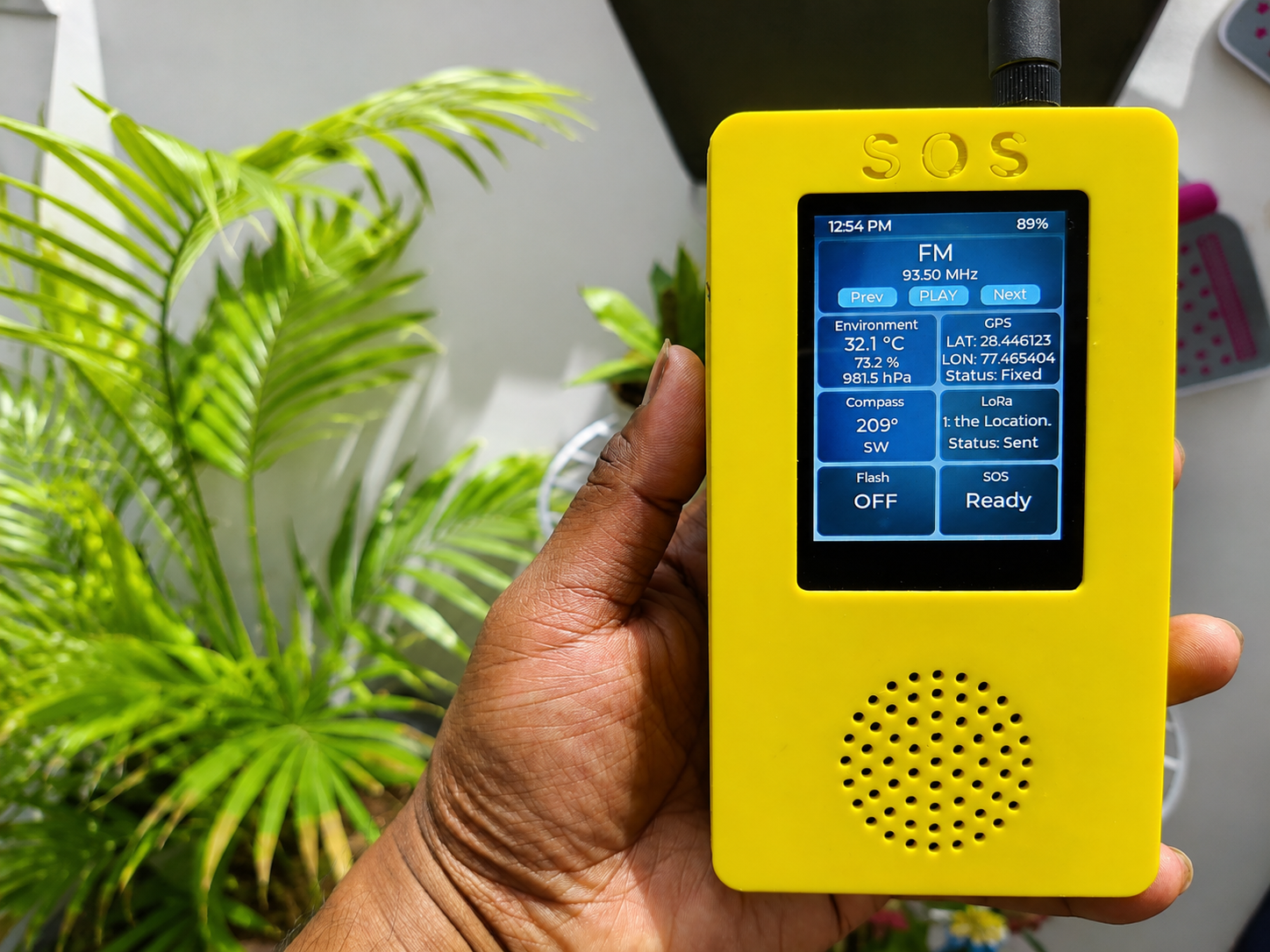
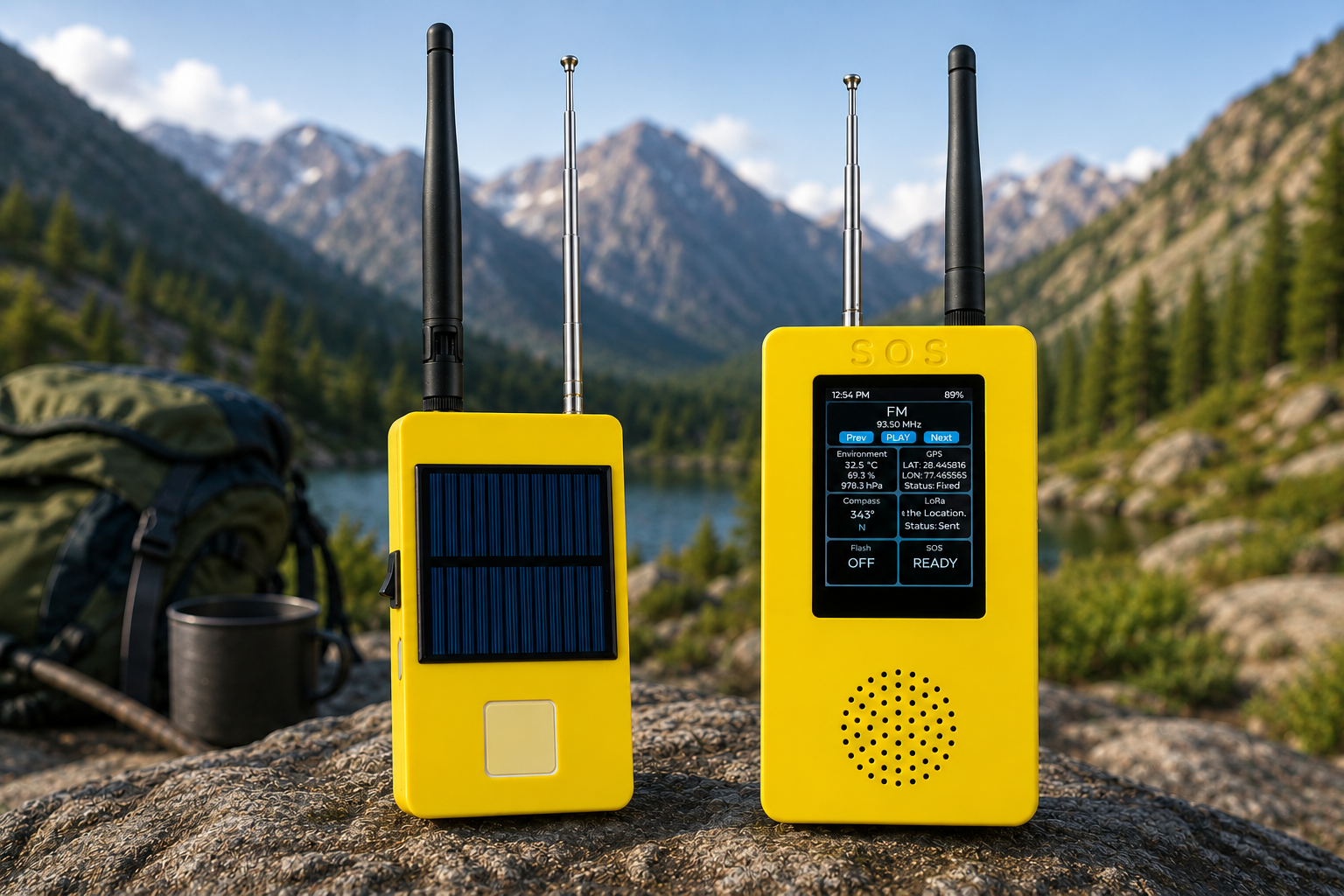
In many remote and emergency situations, cellular networks and internet connectivity cannot be relied upon. Whether it is trekking in remote regions, getting stranded during an outdoor activity, or dealing with a natural disaster or network outage, the inability to communicate or share a location can quickly become a serious problem.
We are building SOSync to provide a self-contained communication and emergency platform that can operate beyond conventional network infrastructure. Instead of depending on a smartphone and multiple separate devices, SOSync brings essential functions such as Solar Powered off-grid LoRa communication, GPS location sharing, digital compass, environmental monitoring, FM radio, emergency lighting, Mobile phone charger and SOS functionality into a single portable device.
The core idea is simple: when conventional connectivity becomes unavailable, a person should still have a way to communicate, determine their location, navigate, access basic information, and call for help. SOSync is designed around this principle, providing a practical off-grid tool for outdoor users, explorers, emergency responders, and situations where reliable communication is critical.
Supplies
.jpeg)
.jpeg)
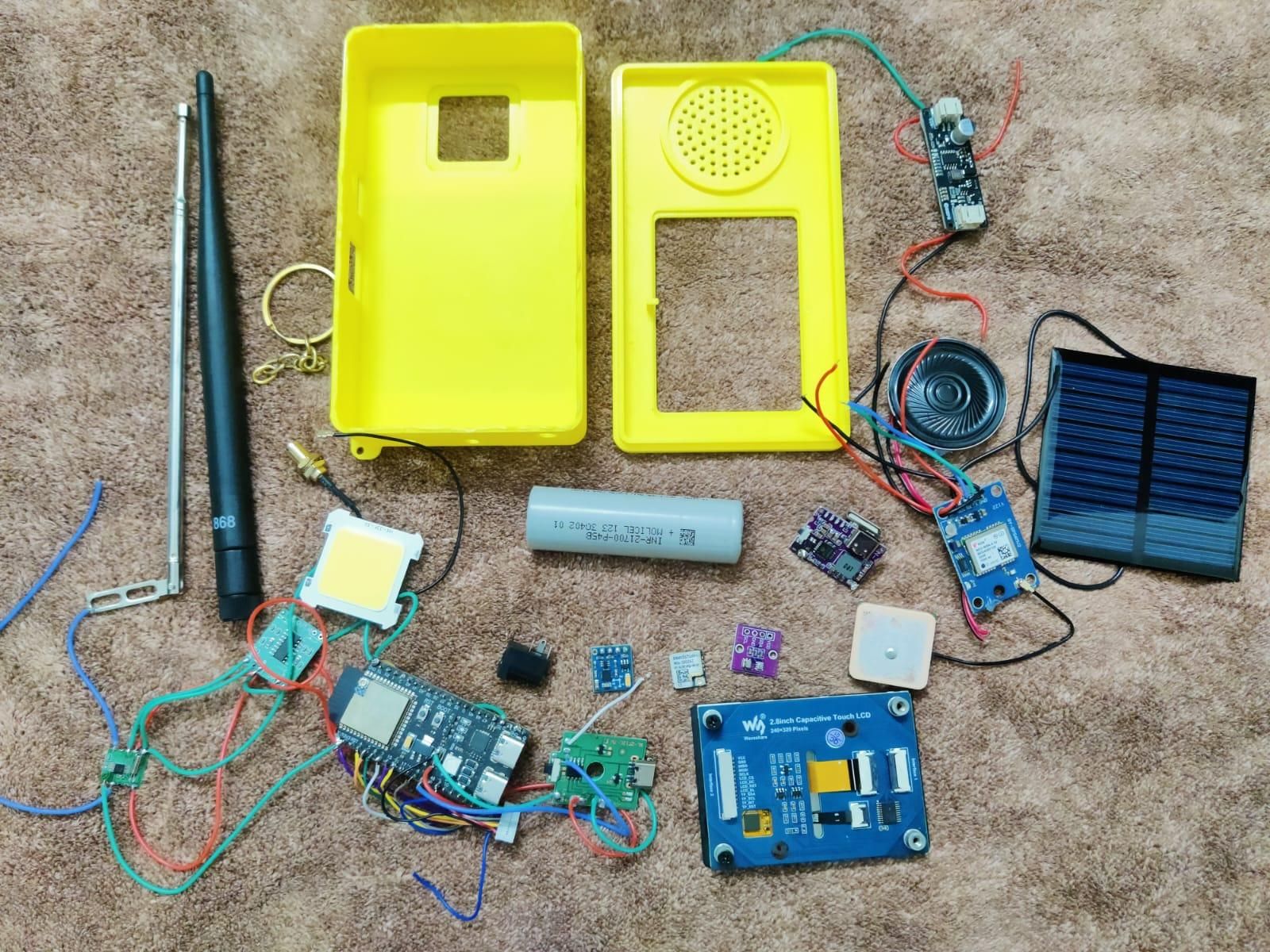
- ESP32-S3 Dev Module x1
- 2.8" Capacitive touch Display x1
- RDA5807M FM Module x1
- PAM8403 Audio Amplifier Module x1
- 2Ohm 40mm Speaker x1
- SX1262 Lora Module x1
- QMC5883 Compass Module x1
- NEO M8N GPS Module with antennax1
- AHT+BMP280 Module x1
- COB Light with Controller PCB x1
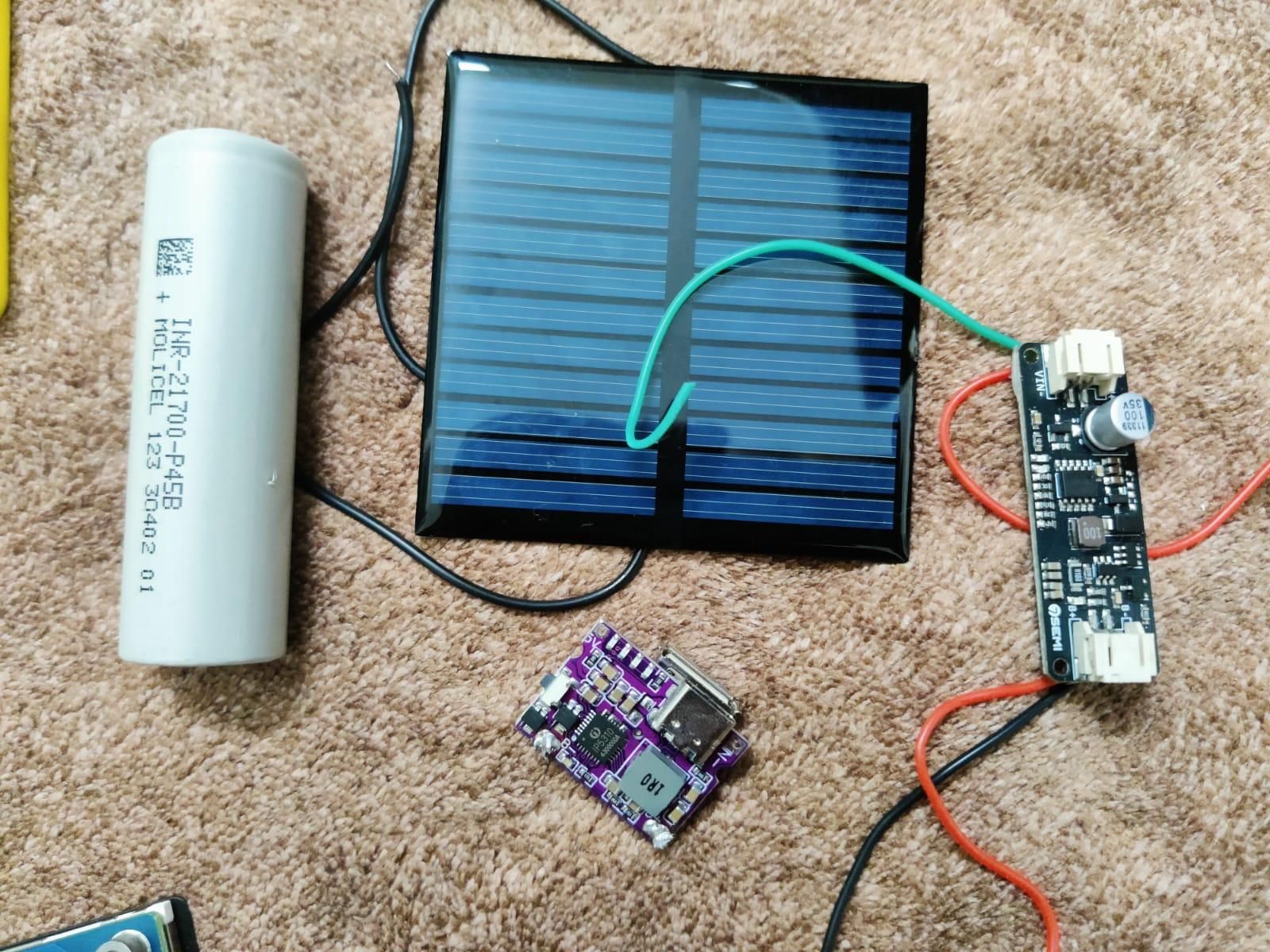
- 18650 Li-Ion Cell x1
- Battery Charging Boost Module x1
- Solar Battery Charging Module x1
- 70x70 mm 6v solar panel x1
- FM Retractable Antenna x1
- LoRa Antenna x1
- DC Jack x1
- Wires
- Soldering Wire & Iron
- Custom Design Enclosure
Note: You can connect a high wattage solar panel through DC Jack to charge the battery faster.
Features
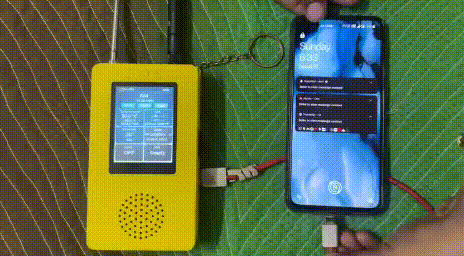
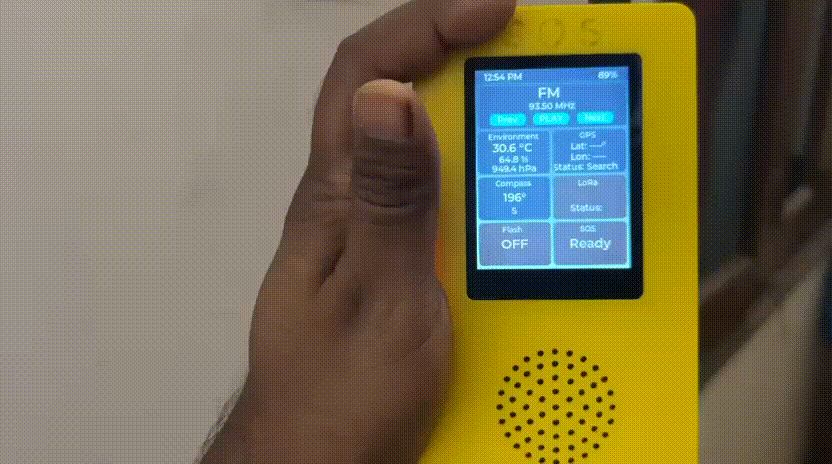
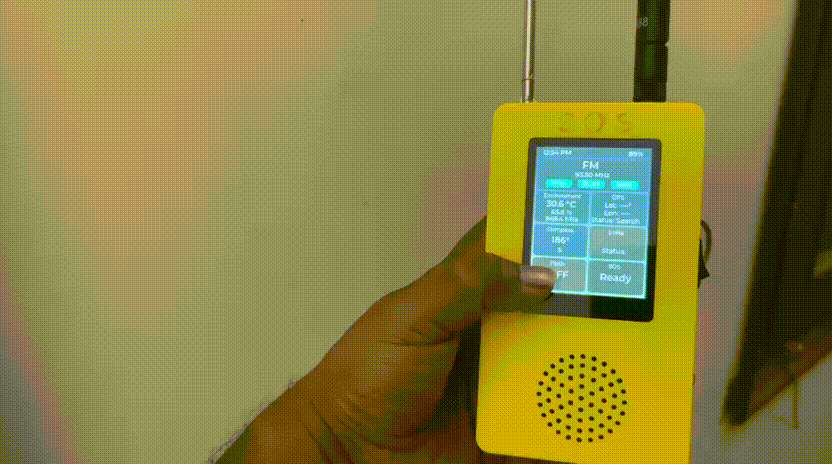
SOSync integrates multiple essential functions into a single compact off-grid device, providing communication, navigation, information, and emergency support without relying entirely on conventional infrastructure.
- LoRa Communication: Enables long-range, low-power wireless communication between SOSync devices without requiring cellular networks or internet connectivity. Users can send and receive predefined messages for communication in remote areas.
- GPS & Digital Compass: The integrated GPS provides real-time latitude, longitude, and fix status, while the QMC5883 magnetometer provides heading information in degrees and directional indications such as N, NE, E, SE, S, SW, W, and NW.
- Environmental Monitoring: The AHT20 and BMP280 sensors provide environmental information including temperature, humidity, and atmospheric pressure, helping users understand surrounding conditions.
- FM Radio: An integrated FM radio provides access to broadcast information and entertainment when internet or cellular connectivity is unavailable. The touchscreen interface allows users to change frequencies and control playback.
- Mobile Charging: SOSync can be used as a portable power source for charging external devices, providing an additional power option during outdoor activities and emergencies.
- Solar Charging: A built-in solar panel provides an additional way to replenish the device's battery, supporting longer operation when conventional charging sources are unavailable.
- Minimal Touchscreen Interface: A compact touchscreen provides a simple interface for accessing the device's major functions while keeping the display focused on essential information such as GPS coordinates, environmental data, compass heading, FM frequency, LoRa messages, and system status.
- Three-Mode Emergency Light: The integrated emergency light provides full brightness, half brightness, and strobe modes, allowing it to serve as both a practical flashlight and a visual signaling device during emergencies.
Custom Enclosure Design
.jpeg)
A custom-designed enclosure was developed for SOSync to provide a compact, rugged, and organized housing for all the electronic components while maintaining easy access to the user interface and external connections. The enclosure is divided into two main sections: the top section and the bottom section.
The top section is designed around the user interface. It houses the touchscreen display for operating the SOSync interface and includes a dedicated speaker grille for the FM radio and other audio functions. The front panel is shaped to provide clear visibility of the display while keeping the controls easily accessible.
The bottom section is dedicated to the electronics and contains the various modules required for SOSync, including the ESP32 controller, LoRa, GPS, FM radio, environmental sensors, compass, power circuitry, and supporting electronics. Dedicated mounting locations and internal spaces were designed to keep the modules securely positioned and simplify wiring and assembly.
Electrical Assembly
.jpeg)
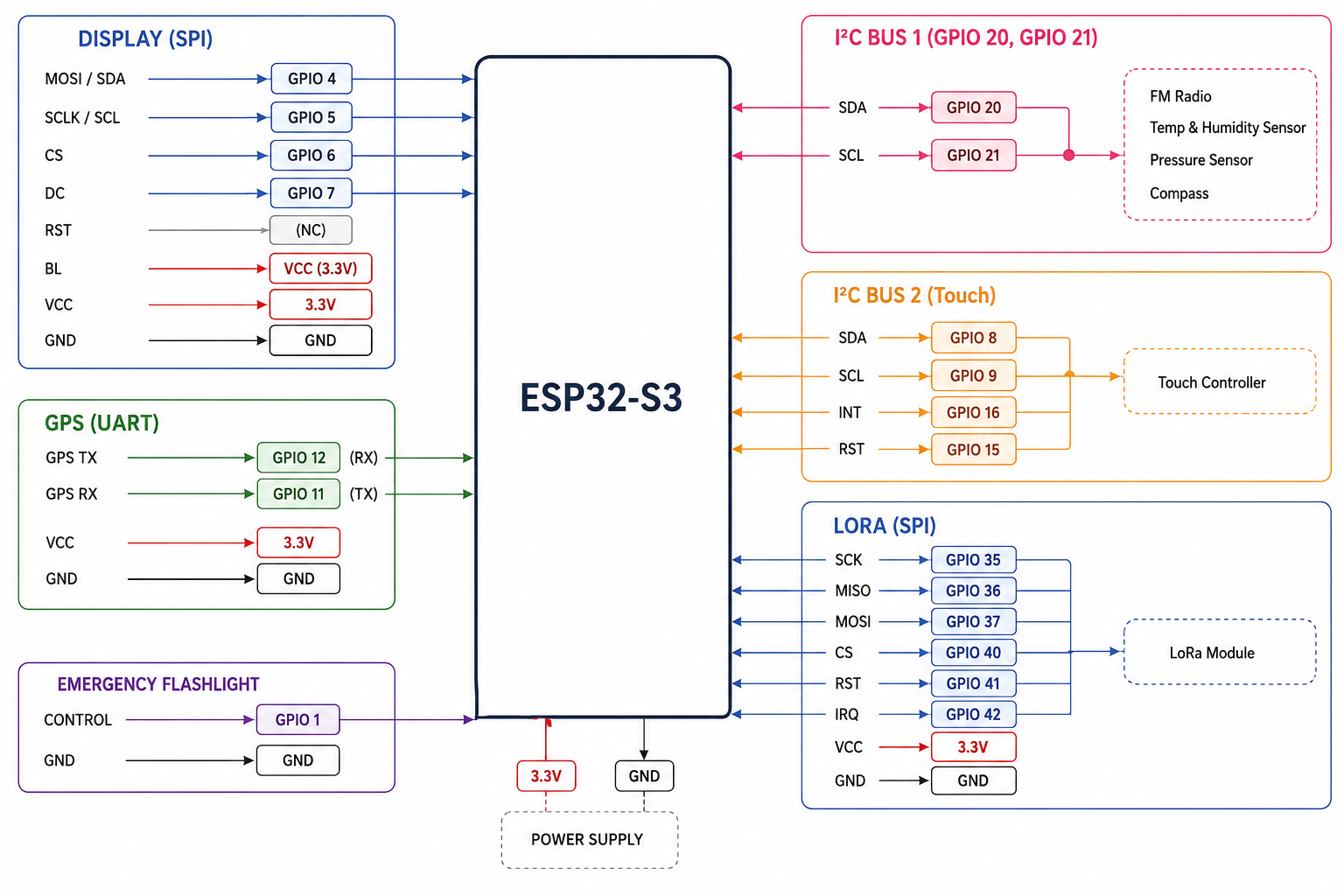
The electrical assembly of SOSync involved integrating all the individual modules into a single compact system and securely installing them inside the custom enclosure. The ESP32-S3 acts as the central controller and is connected to the display, touch controller, GPS, LoRa module, FM radio, QMC5883 compass, AHT20, BMP280, emergency light, and power-management circuitry.
All modules were connected using properly routed wires , following the defined GPIO, UART, SPI, and I²C connections. The modules were then physically fixed inside using hot glue, preventing movement during handling and operation.
After assembly, each module was tested individually and then verified as part of the complete system to ensure reliable communication between the ESP32-S3 and all connected peripherals.
The final electrical assembly results in a compact, organized, and fully integrated hardware system, transforming the individual development modules into a functional SOSync prototype.
System Architecture
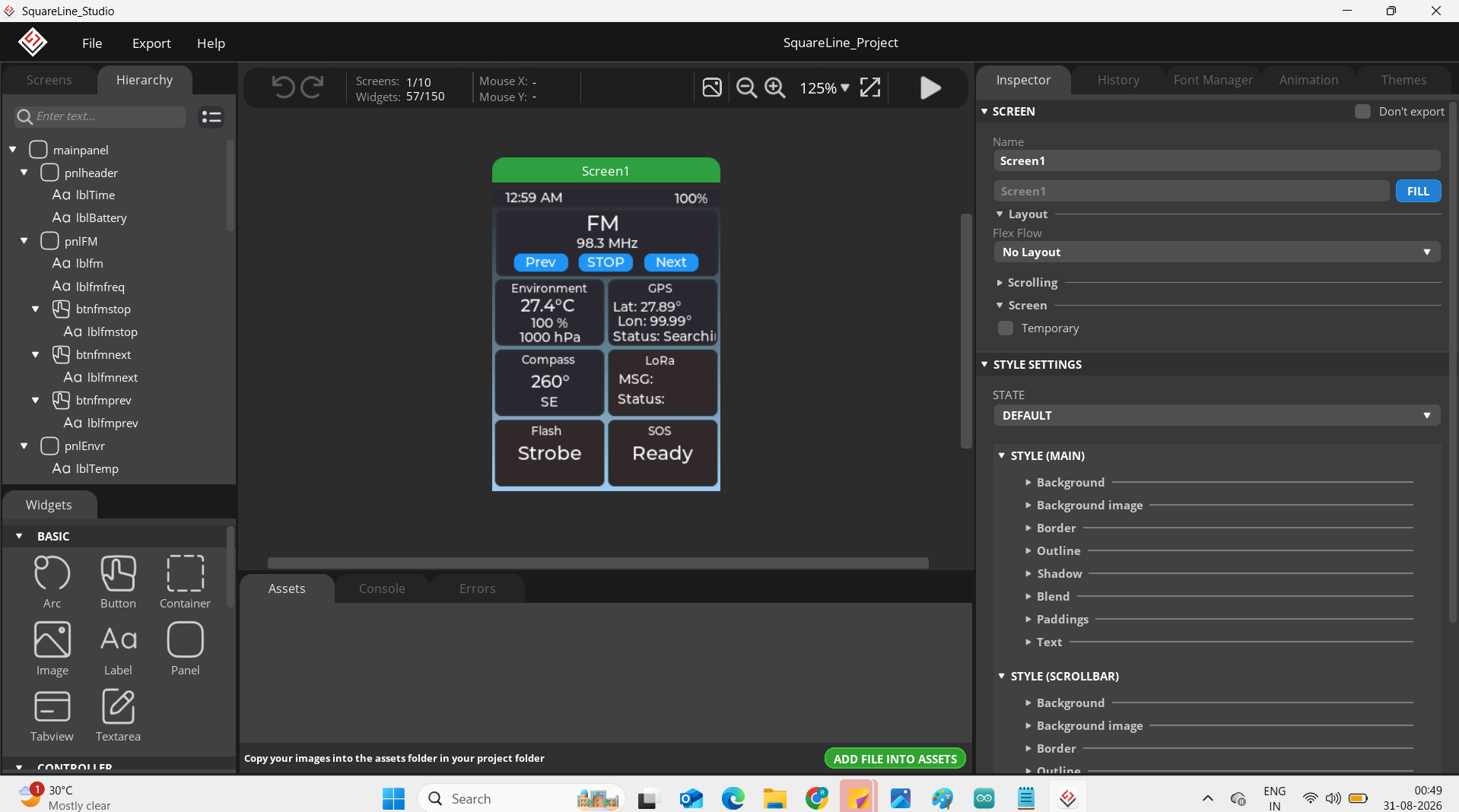
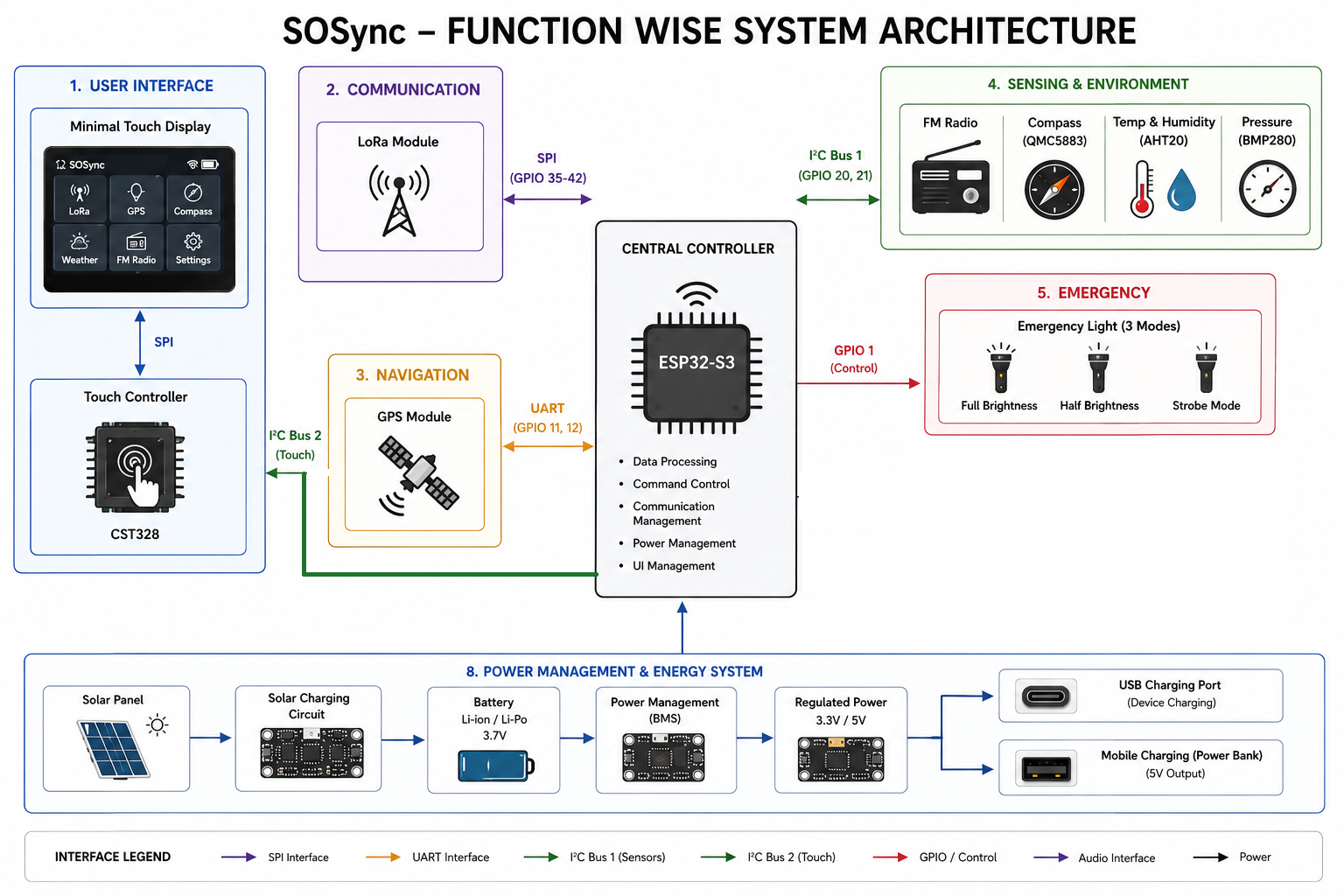
The SOSync system architecture is centered around a minimal touchscreen-based user interface designed in SquareLine Studio, with the ESP32-S3 managing all functions in the background.
- The main screen provides dedicated tabs for FM Radio, Environment, LoRa Communication, GPS, Compass, LED Control, and SOS. The user can navigate between these functions through the touchscreen, while each screen presents only the relevant information and controls.
- The FM tab provides frequency and playback controls, the Environment tab displays temperature, humidity, and pressure, and the LoRa tab allows users to send predefined messages and view received messages.
- The GPS tab displays latitude, longitude, and GPS fix status, while the Compass tab provides heading and directional information. The LED Control tab allows selection of the three emergency-light modes, and the dedicated SOS tab provides a direct emergency function that sends a predefined SOS message along with the current GPS location through LoRa.
- This screen-based architecture keeps the interface simple and organized while allowing the ESP32-S3 to coordinate all sensing, communication, and control functions of SOSync.
Arduino IDE Code
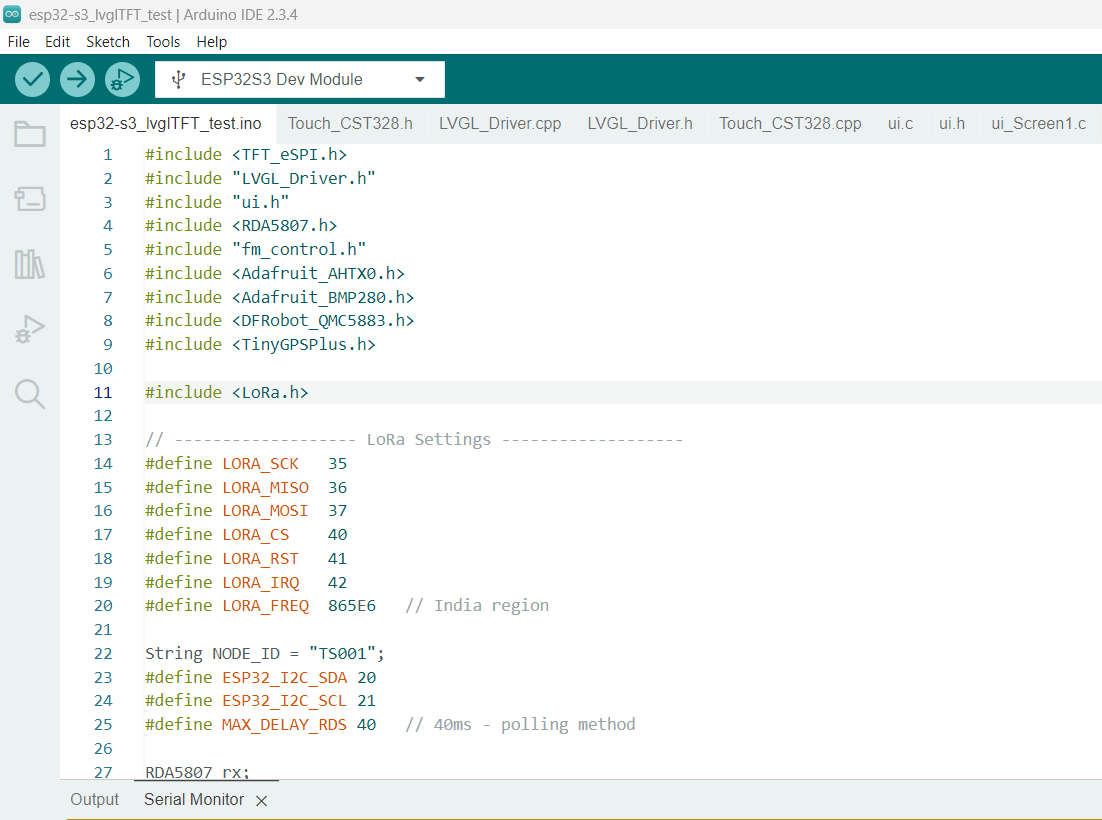
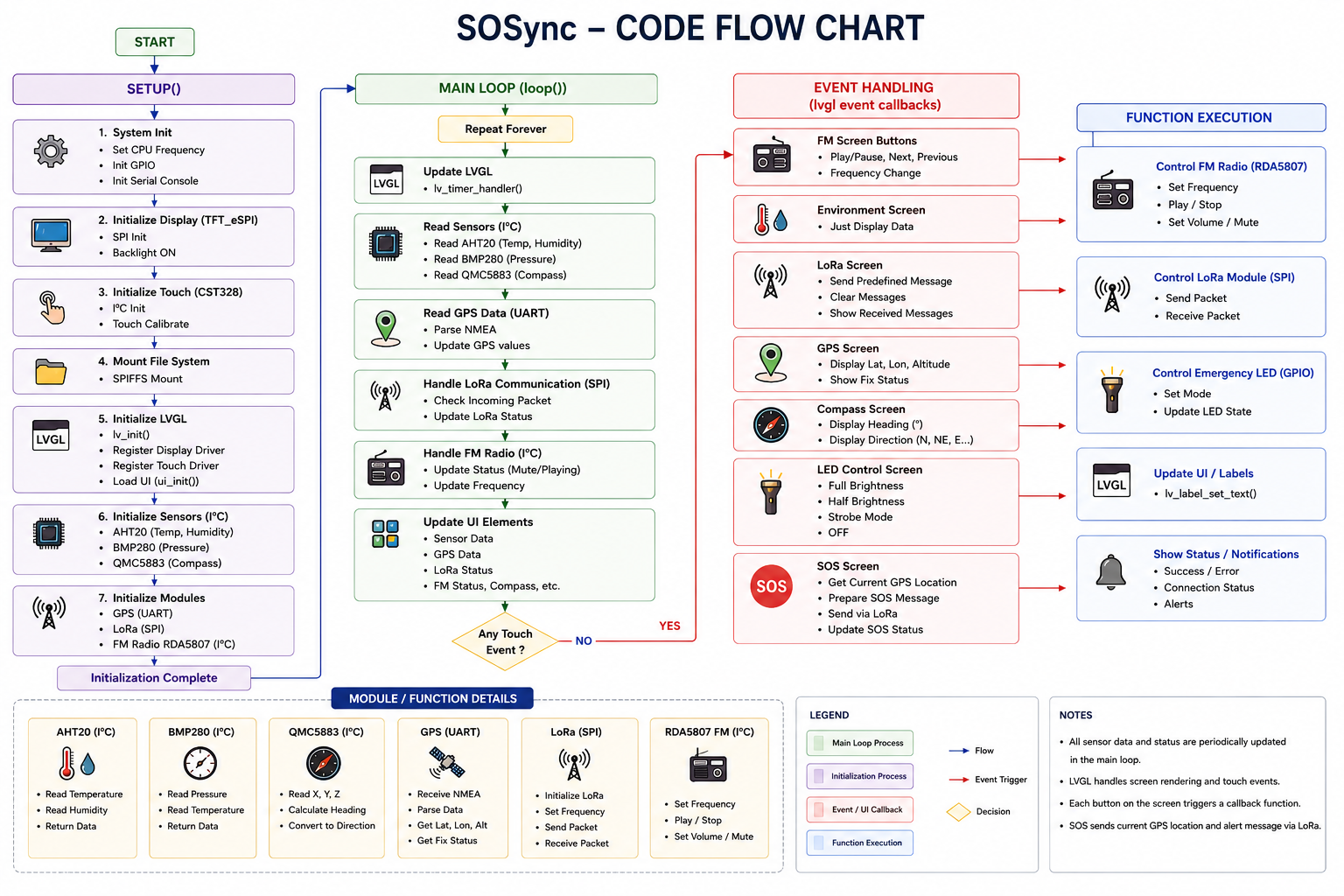
SOSync firmware is developed using the Arduino IDE with the ESP32-S3 as the main controller. The software is structured around a central control program that initializes the hardware peripherals, loads the LVGL user interface generated using SquareLine Studio, and continuously updates sensor data and system status. Different functions are separated into dedicated routines, making the firmware easier to test, maintain, and expand.
The project uses the following Libraries :
TFT_eSPI -- 2.5.34
LVGL -- 8.3.10
esp board files -- v2.0.8
PU2CLR RDRA5807 By ricardo -- v1.1.9
LoRa by Sandeep Mistry -- v0.8.0
TinyGPSPlus by Mikal Hard -- v1.0.3
Adafruit_AHTX0 -- v2.0.6
Adafruit_BMP280 -- v3.0.0
DFRobot_QMC5883 -- v1.0.0
The firmware is divided into several functional layers. Arduino setup() is responsible for initializing the communication interfaces, sensors, display, touch controller, LoRa, GPS, FM radio, and LVGL interface. After initialization, the firmware enters the main loop(), where it handles touchscreen events, updates sensor values, processes GPS data, checks LoRa communication, controls the FM radio, and updates the graphical interface.
TFT_eSPI Configuration
Before compiling the SOSync firmware, the TFT_eSPI library must be configured according to the display hardware. The required pin definitions are set in the library's User_Setup.h (or the selected user setup file). The display is configured for SPI communication with the ESP32-S3 using the following connections:
The display backlight is connected directly to VCC, so no separate ESP32 GPIO is required for backlight control. The appropriate display driver must also be enabled in the TFT_eSPI configuration, while unused display drivers and conflicting configurations should remain disabled. After modifying the TFT_eSPI setup, the Arduino IDE must be restarted/recompiled to ensure the new configuration is applied.
The graphical interface of SOSync is designed using SquareLine Studio with LVGL 8.3.x. The screens, panels, buttons, labels, and their hierarchy are created visually in SquareLine Studio. Each functional section of the device has its own UI elements, including FM controls, environmental data, GPS, compass, LoRa messaging, LED control, and SOS.
Once the interface design is complete, SquareLine Studio generates the required C source and header files, including files such as:
- ui.c
- ui.h
- ui_events.c
- ui_events.h
- Individual screen/UI files such as ui_Screen1.c and ui_Screen1.h
These generated files are placed directly into the Arduino project folder and compiled together with the main .ino firmware. The generated UI handles the graphical structure, while custom hardware functionality is connected through the event callbacks.
For example, a SquareLine button event can call a custom function:
Check Out the Full code on Github.
Working
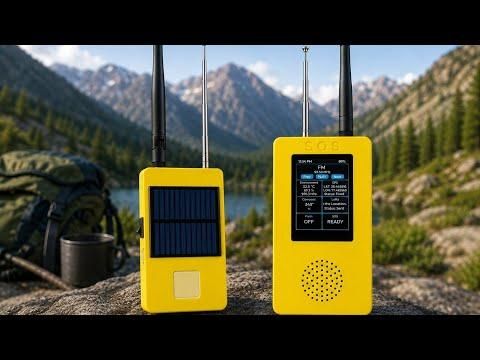
- SOSync operates as an integrated off-grid emergency and communication device, with the ESP32-S3 coordinating all connected modules and the touchscreen providing a simple interface for accessing different functions. When the device is powered on, the ESP32-S3 initializes the display, touch controller, GPS, LoRa, FM radio, compass, and environmental sensors, and loads the main LVGL-based interface.
- During normal operation, the device continuously collects information from the connected sensors and updates the corresponding sections of the display. The GPS module provides latitude, longitude, and fix status, while the QMC5883 compass provides the user's heading and converts it into a simple direction such as N, NE, E, or SW. The AHT20 and BMP280 monitor temperature, humidity, and atmospheric pressure. The user can also access the FM radio to tune frequencies and control playback.
- For communication, SOSync uses LoRa to exchange messages without depending on cellular or internet connectivity. Users can select predefined messages from the LoRa interface and transmit them to another LoRa-enabled device. Received messages are displayed on the touchscreen along with the communication status.
- The device also provides a three-mode emergency light, controlled through the touchscreen. Each press cycles through full brightness, half brightness, strobe, and OFF. In an emergency, the dedicated SOS button provides a direct method of sending the user's location. When pressed, the ESP32-S3 obtains the latest GPS coordinates, creates an emergency message containing the location, and transmits it through LoRa. The interface then updates the SOS status to indicate that the message has been sent.
- The system is powered by its integrated battery and supports USB and solar charging, with the capability to provide power for mobile devices.
Conclusion
SOSync demonstrates how multiple independent technologies can be integrated into a single compact device to provide essential functionality beyond conventional network infrastructure. By combining LoRa communication, GPS, digital compass, environmental sensing, FM radio, emergency lighting, touchscreen control, USB charging, and solar charging, the device provides a versatile platform for outdoor activities and emergency situations.
The most important aspect of SOSync is its ability to provide location sharing and communication through LoRa without depending on cellular or internet connectivity. The dedicated SOS function allows the user to transmit their location along with an emergency message, while the other integrated features support navigation, environmental awareness, information access, and basic power needs.
The project also demonstrates the practical integration of ESP32-S3, SPI, I²C, UART, LVGL, sensors, wireless communication, and custom hardware into a complete working system. With further development in areas such as mesh networking, power optimization, ruggedization, offline mapping, and two-way emergency communication, SOSync has the potential to evolve from a prototype into a more capable off-grid emergency communication platform.