Student Village: Dos Mantos
by cibenoitmaldonado in Design > Architecture
85 Views, 0 Favorites, 0 Comments
Student Village: Dos Mantos


Dos Mantos: A Dual Approach to Housing and Construction Innovation.
1. Dos Mantos as a Microhome Student Housing Solution
Dos Mantos is a compact student housing prototype developed through the inaugural Bachelor of Science in Building Performance program at College of the Canyons in Santa Clarita, California. The project was conceived in response to increasing wildfire activity across Southern California and explores how existing construction methods can be adapted to create more resilient, affordable, and environmentally responsible housing solutions.
The proposal consists of two 200-square-foot microhomes occupying a 50-foot by 33-foot site. One residence is partially earth-sheltered while the second is elevated to meet accessibility requirements. Together, the units form a compact housing ecosystem connected through passive environmental systems and a shared community space.
Rather than treating sustainability, resilience, affordability, and social interaction as separate objectives, Dos Mantos integrates them into a unified architectural strategy.
The design prioritizes:
- Affordable housing solutions for students and emerging professionals
- Efficient use of limited land and resources
- Adaptability to different climates and communities
- High-performance building strategies
- Replicability as a scalable housing model
At its core, the housing component of Dos Mantos seeks to expand access by providing a realistic pathway toward attainable housing while maintaining quality of life and architectural character.
2. Dos Mantos as a Construction System: Terra-Link
Beyond the housing prototype itself, Dos Mantos proposes an alternative approach to wall construction through the development of the Terra-Link System.
The Terra-Link System was envisioned as a method for creating the appearance and environmental benefits of rammed earth construction while significantly reducing labor requirements and construction complexity.
Rather than relying on traditional rammed earth techniques, which can be labor-intensive and difficult to scale, the system separates the wall into two components:
Structural Layer
The structural component is designed to be constructed using either:
- Concrete Masonry Units (CMU)
- Compressed Stabilized Earth Blocks (CSEB)
This layer provides the necessary structural performance, code compliance, and constructability.
Architectural Layer
Attached to the structural wall is the Terra-Link façade system, which recreates the texture, stratification, and visual qualities of traditional rammed earth construction.
- This approach allows projects to:
- Capture the aesthetic and cultural value of earthen architecture
- Reduce labor and specialized construction requirements
- Improve constructability and scalability
- Utilize local materials where appropriate
- Maintain a stronger connection to place and regional identity
The result is a hybrid system that combines the practicality of contemporary construction methods with the environmental and visual qualities traditionally associated with earthen architecture.
Supplies


Dos Mantos was made possible through a combination of digital and analog design tools, each serving a distinct role throughout the development process.
Autodesk Revit served as the primary platform for transforming the concept into a buildable architectural proposal. The project was developed entirely in Revit, including the building design, modeling, visualization, detailing, and much of the presentation material used to communicate the project. The fact that Dos Mantos was conceived, developed, modeled, visualized, and ultimately recognized through award-winning competition submissions using Autodesk Revit reinforces my belief that Revit is not simply a documentation platform. When introduced intentionally and early enough, it can serve as a powerful design tool capable of supporting conceptual exploration.
Procreate was instrumental during the early conceptual stages. It provided a flexible medium to sketch ideas, explore spatial relationships, and visualize how the Terra-Link system could function as a construction methodology. Many of the project's initial concepts and diagrams originated through hand-drawn sketches created in Procreate.
Adobe Illustrator was then used to refine the project's graphic communication. It enabled the development of presentation boards, diagrams, infographics, and visual narratives that helped communicate both the housing proposal and the Terra-Link construction system in a clear and compelling way.
Responding to a Changing California

Dos Mantos began as a response to the growing wildfire challenges affecting Los Angeles and communities throughout Southern California. As neighborhoods continued to face destruction, displacement, and rebuilding efforts, I became interested in how architecture could contribute to recovery through more resilient, affordable, and sustainable forms of housing.
Rather than focusing on inventing a new material, I wanted to explore how existing systems could be improved, combined, and implemented in ways that would make them more practical and accessible.
Establishing a Design Workflow
Before developing the project, I established a workflow that would allow me to move efficiently between conceptual exploration, architectural development, and presentation.
Procreate became the primary tool for sketching ideas and testing concepts during the earliest stages of the project. Autodesk Revit served as the primary design platform due to my familiarity with the software through both academic and professional experience. Adobe Illustrator was later used to refine diagrams and presentation boards.
Together, these tools allowed me to move from concept to final proposal while maintaining a consistent design process.
Exploring Fire-Resistant and Low-Carbon Materials
With resilience serving as a primary design driver, I began researching materials capable of providing durability, thermal performance, fire resistance, and reduced environmental impact.
This investigation led me toward rammed earth, Compressed Stabilized Earth Blocks (CSEB), and Concrete Masonry Units (CMU). Each offered characteristics that felt relevant to California's future. Rammed earth provided thermal mass and a strong connection to place. CSEB offered a modular earthen construction method. CMU provided structural reliability, fire resistance, and widespread industry acceptance.
The challenge became finding a way to leverage the strengths of all three systems together.
Addressing the Limitations of Rammed Earth
Although rammed earth offered many desirable qualities, it also presented significant barriers to adoption. Traditional rammed earth construction often requires specialized labor, extensive formwork, specialized equipment, and longer construction timelines.
For a project concerned with housing accessibility and resilience, those limitations mattered. If a material is environmentally responsible but difficult to implement, its impact remains limited.
Instead of abandoning the material, the project focused on reducing those barriers while preserving its benefits.
Developing the CSEB + RE Strategy

This led to the development of the CSEB + RE strategy, a hybrid approach that combines the practicality of Compressed Stabilized Earth Blocks with the environmental and architectural qualities of rammed earth.
Rather than viewing the two systems as competitors, Dos Mantos explored how they could complement one another. The objective was to preserve the visual and environmental benefits of rammed earth while relying on a more practical and scalable structural system.
Creating the Terra-Link System
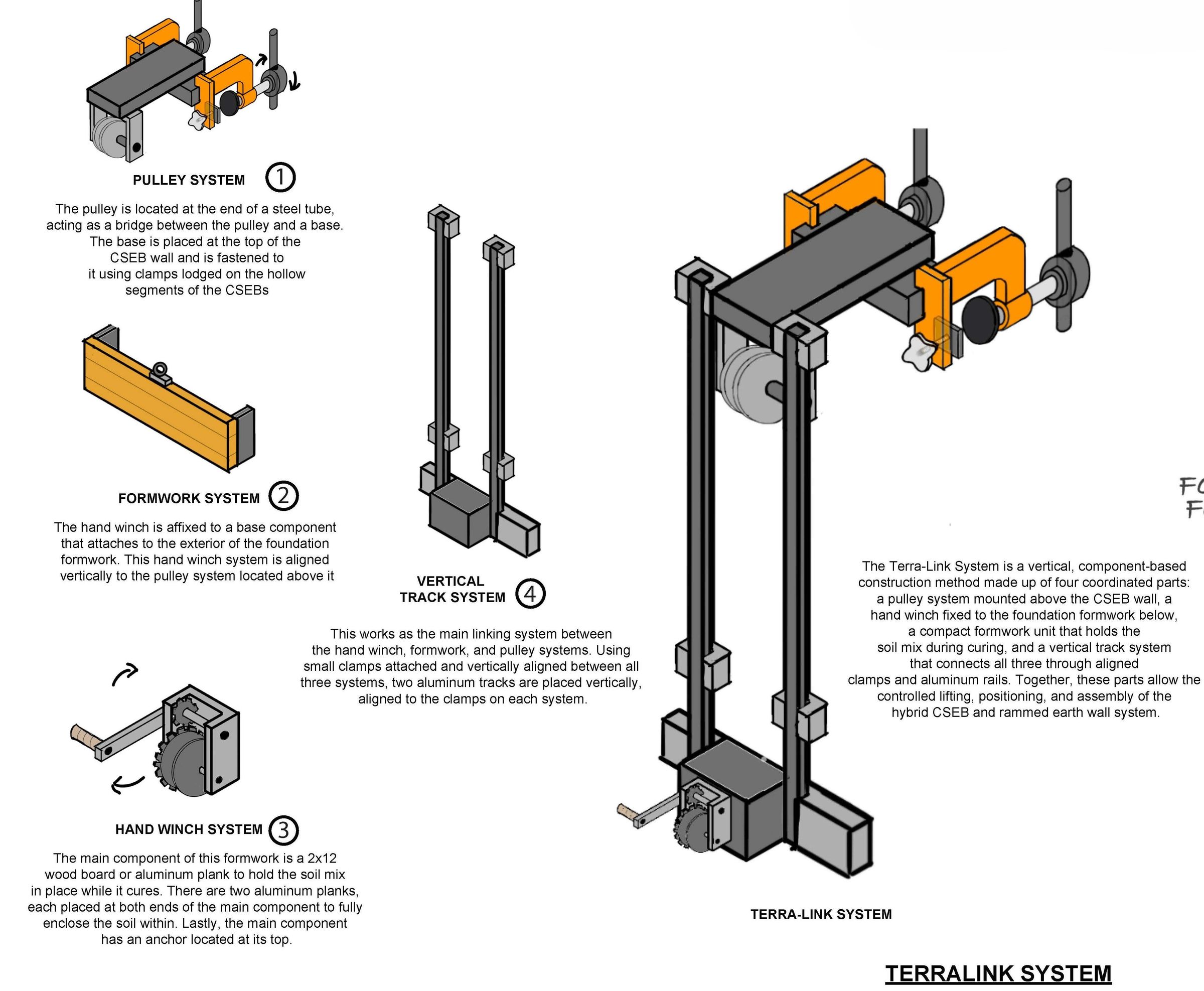
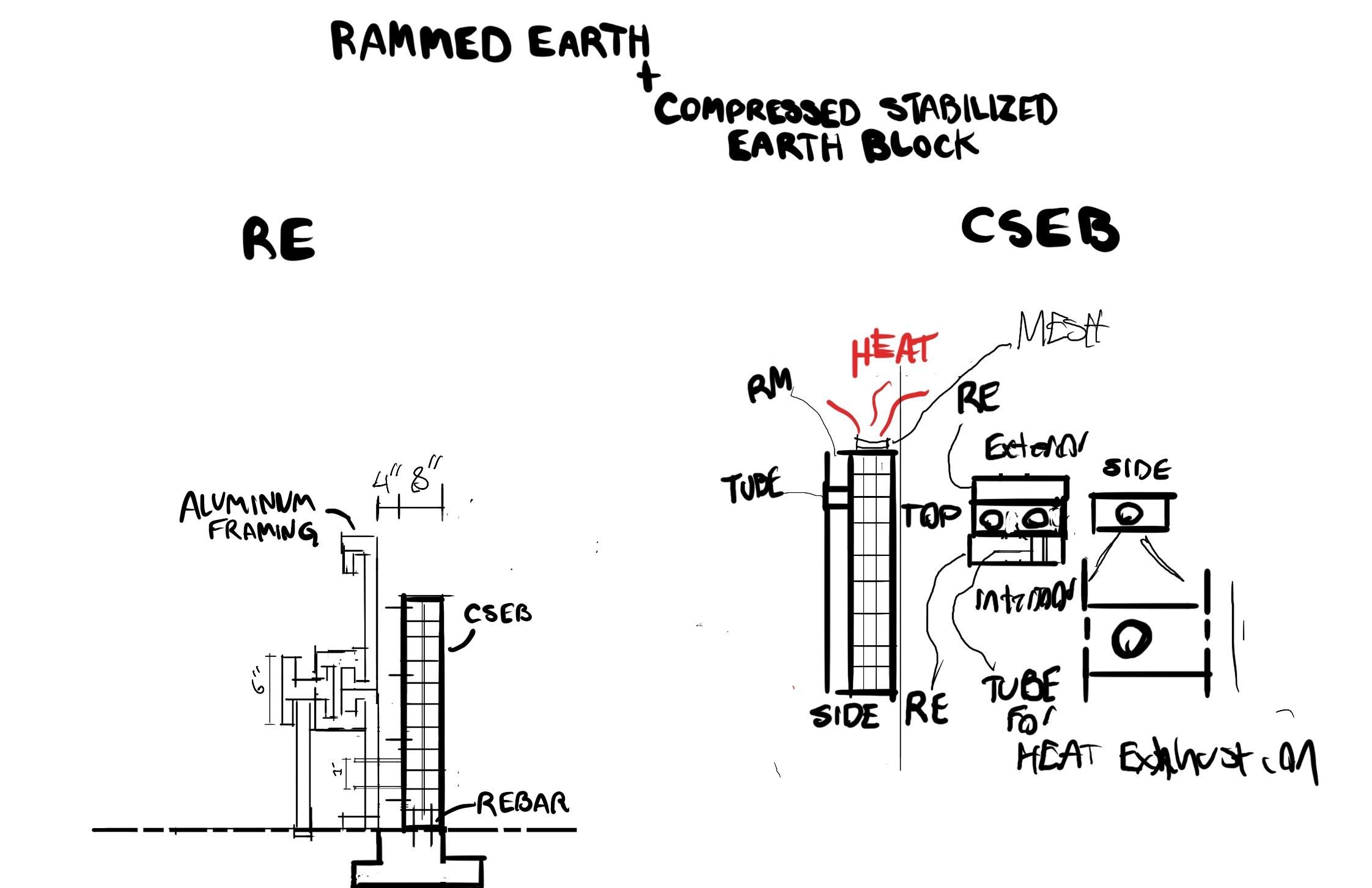


The next challenge was determining how these materials could physically connect and support one another.
This became the Terra-Link System, a construction approach that links rammed earth, CSEB, and potentially CMU into a single strategy. Under this concept, CSEB or CMU provide structural performance and constructability, while rammed earth is used where its environmental and aesthetic benefits are most impactful.
The goal was to create a pathway toward wider adoption by reducing the complexity traditionally associated with earthen construction while preserving its architectural value.
Responding to the Studio Brief


With the material and construction strategy beginning to take shape, the next step was applying those ideas to a real architectural problem.
The studio brief required the design of two 200-square-foot microhomes while addressing accessibility, sustainability, and efficient land use. Rather than viewing these requirements as limitations, I saw them as an opportunity to test whether the material and construction strategies I had been developing could also help solve broader housing challenges.
This transformed the project from a material exploration into a holistic housing proposal.
Rethinking Land Use Through Vertical Stacking

One of the first major design moves was reducing the amount of land required by the project.
Instead of placing both residences side by side, one home was partially recessed into the ground while the second residence was positioned above it. This strategy reduced the project's footprint, preserved more usable site area, and established a relationship between the two homes that would later support passive environmental strategies.
The project began to explore not only housing density, but how density itself could contribute to sustainability.
Reusing Excavated Soil As Building Material
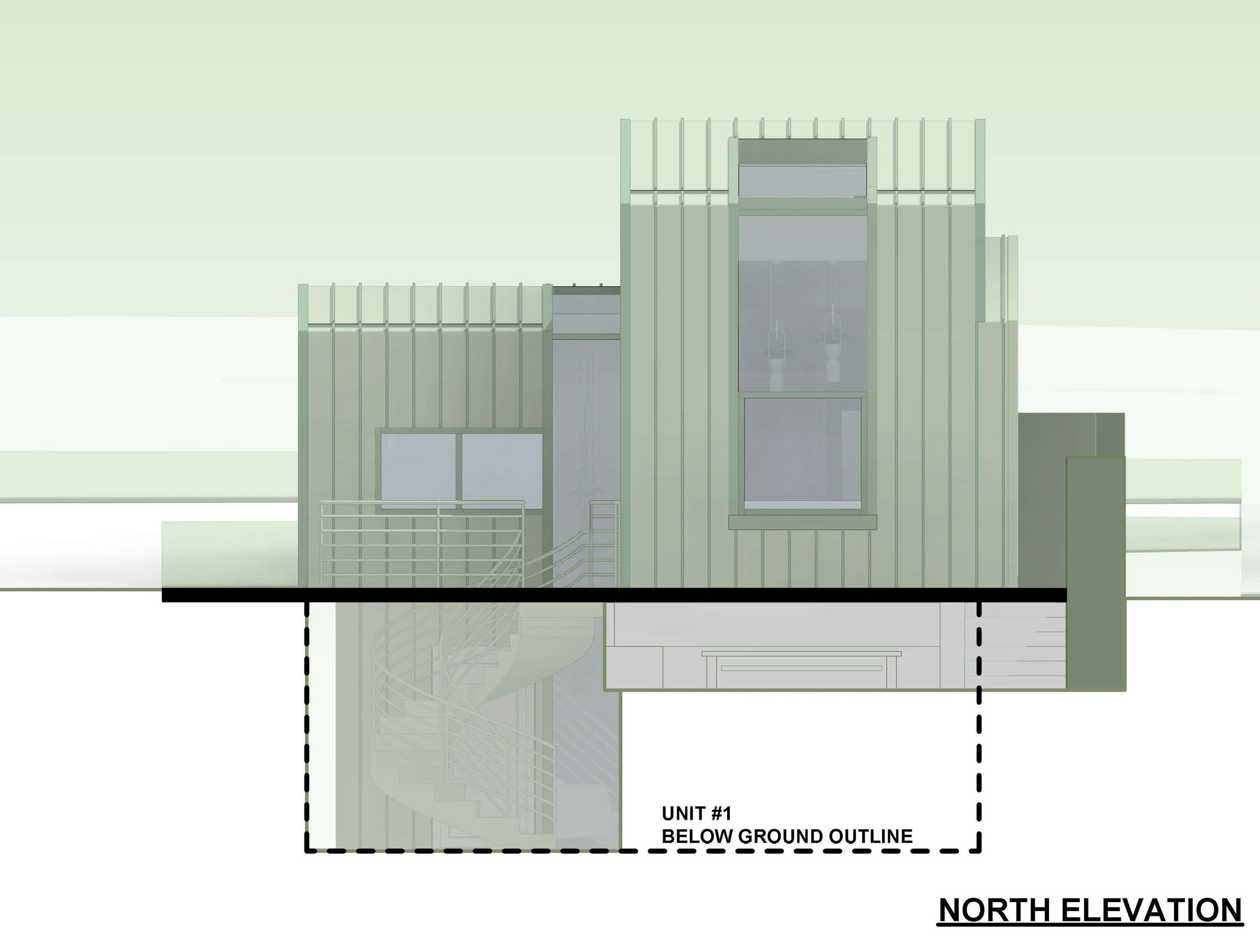


The decision to partially recess one of the residences immediately created another opportunity: the excavated soil.
Instead of treating it as waste, the project explored how that material could become part of the construction process itself. The excavated earth became the source material for the rammed earth walls surrounding the residences and contributed to the production of the CSEB blocks used within the project.
This established a circular relationship between excavation and construction, where the act of shaping the site directly contributed to the architecture being built upon it.
Creating Rammed Earth Privacy and Acoustic Walls


The rammed earth walls evolved into more than a material experiment. They became a way of defining space and improving the experience of living within such a compact footprint.
By surrounding portions of the site with earthen walls, the project creates privacy, improves acoustic separation, and establishes a stronger sense of enclosure. The walls also celebrate the material itself, allowing the layered character of the earth to become an architectural feature rather than something hidden behind finishes.
Using Earth Shelter As a Passive Design Strategy
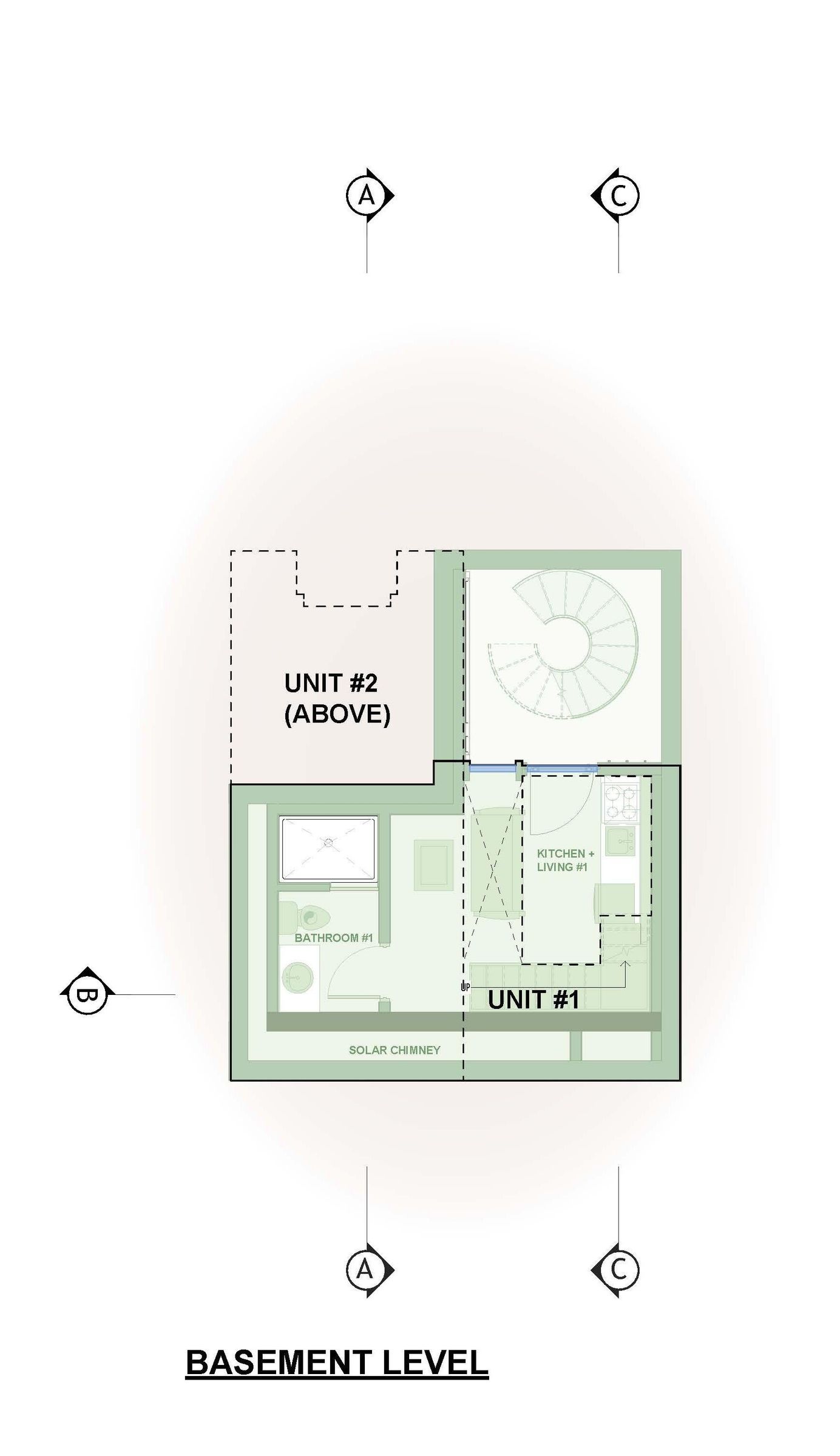

Once one of the residences was embedded into the site, it became clear that the surrounding earth could serve a purpose beyond simply supporting the building.
The partially earth-sheltered unit benefits from the thermal stability of the ground, helping reduce temperature fluctuations throughout the year. Rather than fighting the site's conditions, the project uses them to improve occupant comfort while reducing reliance on mechanical systems.
The lower residence effectively becomes the environmental anchor of the project.
Connecting Both Residences Through a Solar Chimney

With one residence benefiting from the stabilizing effect of the earth, the next challenge was finding a way for both homes to share that advantage.
This led to the development of a solar chimney connecting the two units. The system encourages natural airflow throughout the project while helping transfer and balance temperatures between the residences. The lower earth-sheltered residence acts as the moderating force, while the solar chimney assists in drawing air through the system.
Together, the two residences begin to operate as a single environmental system rather than two independent structures.
Optimizing Solar Orientation

The placement of glazing became another opportunity to improve performance through simple design decisions.
By concentrating most glazing toward northern exposures, the project maximizes access to natural daylight while minimizing excessive heat gain. This allows the homes to remain bright and connected to the outdoors without introducing unnecessary thermal loads.
The strategy reinforces the project's broader goal of using passive solutions whenever possible before relying on technological ones.
Designing Dignified Micro-Living
One of the most important questions throughout the project was whether a 200-square-foot residence could still provide a meaningful living experience.
Rather than treating the limited area as a constraint, the design process focused on maximizing the quality of each space. Careful attention was given to circulation, storage, daylight, privacy, and the relationship between indoor and outdoor areas.
The objective was not simply to fit a program into a small footprint, but to demonstrate that compact living can still be comfortable, functional, and dignified.
Digital Development Through Revit


As the design matured, Autodesk Revit became the primary platform used to develop Dos Mantos.
This was not an intentional effort to showcase the software, but rather a reflection of my familiarity with it after years of academic and professional use. Revit allowed me to move efficiently between design, modeling, visualization, and documentation within a single environment, enabling me to focus on solving design problems rather than managing multiple software platforms.
Much of Dos Mantos, including the architecture, visualizations, diagrams, and presentation materials, was developed directly within Revit.
Refining and Communicating the Design

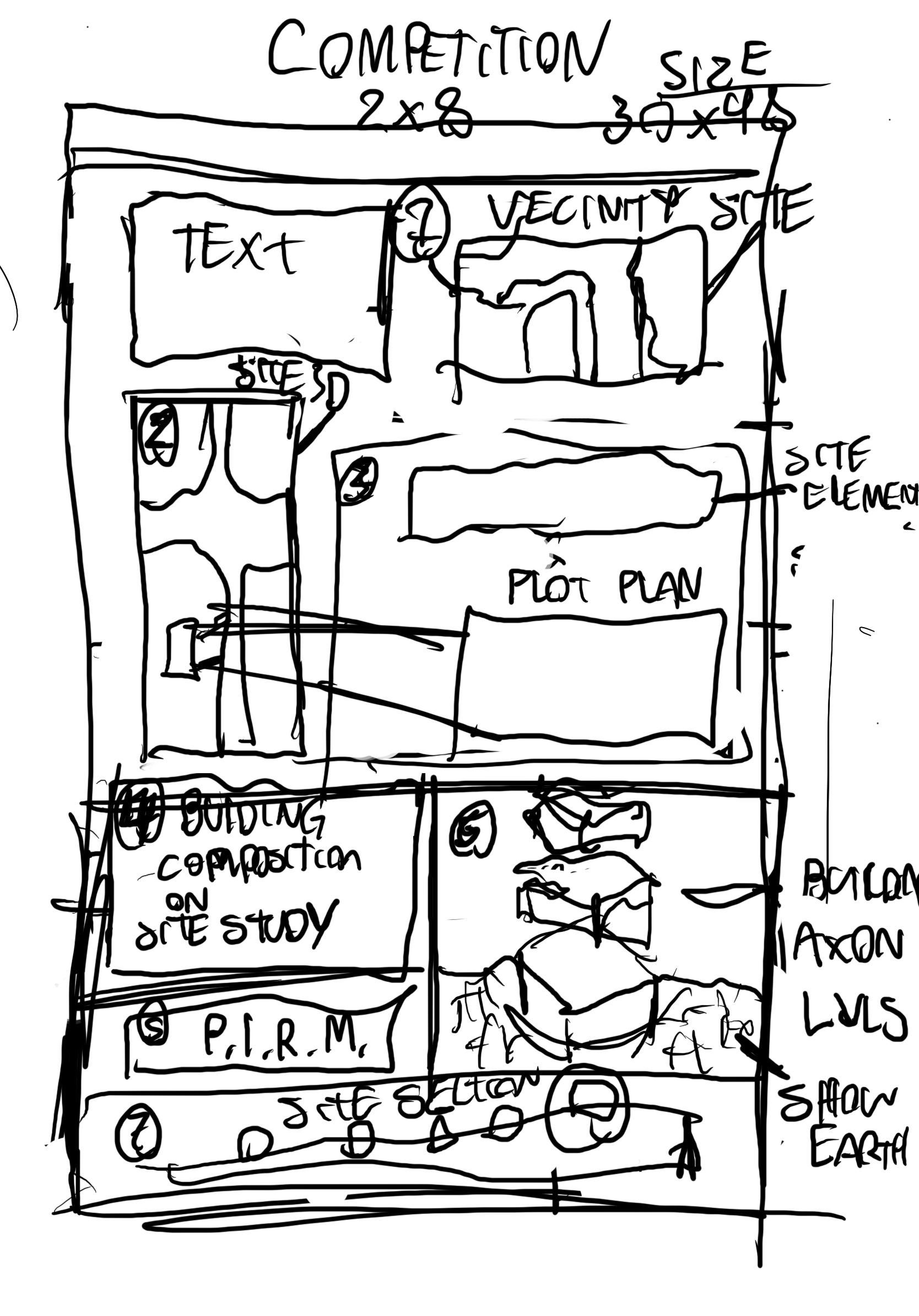

As the project became more refined, Adobe Illustrator was used to develop the final diagrams, layouts, and presentation boards that communicated both the housing proposal and the Terra-Link construction methodology.
The goal was not only to present a building, but also to explain the process behind it. Every diagram, section, and illustration was developed to show how wildfire resilience, material reuse, passive design, and compact housing could work together as a unified system.
From Studio Project to Award-Winning Proposal
 2025_Board_CollegeoftheCanyons_Benoit.jpg)
Dos Mantos was first presented through the 2025 ACLA 2x8 Competition, where it received recognition. The project was later adapted and refined for the 2026 California Masonry Competition, where it also received an award.
What began as an exploration of wildfire resilience, material innovation, and housing efficiency evolved into a proposal that demonstrated how existing technologies and thoughtful design strategies could be combined to address multiple challenges simultaneously.
The Larger Vision
At its core, Dos Mantos is about access.
Access to housing. Access to sustainable construction methods. Access to professional opportunities. And access to architectural solutions that are both practical and aspirational.
The project reflects my belief that many of the solutions we need already exist. The challenge is finding better ways to connect them, simplify them, and make them accessible to more people. Through Dos Mantos, I sought to demonstrate how architecture can heal not only through the spaces it creates, but through the systems it proposes and the communities it serves.