Sunny Days Ahead: a Wildfire Proof Community Center and Transitional Housing Area
by IntegerIguana in Design > Architecture
202 Views, 2 Favorites, 0 Comments
Sunny Days Ahead: a Wildfire Proof Community Center and Transitional Housing Area

.png)
.png)
Wildfires burn every day in California (according to fire.ca.gov, there have been over 1700 wildfires this year), and with global warming increasing the average temperatures, they're going to keep happening. The damage is disastrous. Across the 2018 and 2025 wildfires, around 40,000 people lost their houses (fire.ca.gov). This project isn't a solution to wildfires. It's going to take a lot more than a single building to change the problems of the world.
This project offers a community center/transitional housing area to help people impacted by wildfires and homelessness in California. Thousands of people (according to NBC news) have lost their homes and property as a result of the fires. Most temporary buildings are flammable and crowded, contributing to CA's homeless crisis. To make it worse, California is one of the most expensive places to live in the United States, driven by low housing availability and a high cost of living.
The solution? A greenhouse-esque transitional housing facility to support both those experiencing homelessness and the impacts of wildfires. This building is made almost entirely of glass and steel, preventing it from catching fire and burning down. Unlike the Crystal Palace Greenhouse, this one is not made of wood and contains very little flammable materials inside. As communities' needs change, so can the project. While it originally houses around 50 beds (which can each be used for one or more people), there is a lot of open space and flexibility, allowing for more beds or other structures to be placed as need be.
Most images have notes attached to explain them further.
Supplies

Tools
- Tinkercad for early concept modeling
- Forma Site Design for location and logistics
- Attempted to use Revit and may help others if they attempt to replicate these results
- Canva for floor plan creation
- A computer
- The internet
- Chat GPT for the realistic images based on my models since Revit (as mentioned later) was not functioning.
- Instructables as a website to upload this work
- Auto deck as a website to access Revit and Forma
Research
- Los Angeles Times for baseline information on the 2018 fires
- AP News for the image of the 2025 wildfire moon
- National Low Income Housing Coalition for the graph on homelessness and information
- HUB for urban economics for information on California homelessness
- United States Interagency Council on Homelessness for information on homelessness over the years
- fire.ca.gov for wildfire information from 2018 and 2025
- Salary.com for logistics on cost in Castiac
- The Signal SCV for information on homelessness in Castiac
- NBC news for homeless crisis and the CA fires
- Urban.org for homeless connection to wildfires
- Xometry to determine the possible building materials
- The National Library of medicine for specific studies
- UCLA.edu for homeless people's experiences with natural disasters
- Stanford.edu on California Homelessness
Two of these are linked as they have had the most significant impact on my research and planning phase.
Inspiration and future models
- The Crystal Palace Greenhouse for inspiration
- Were this to be made into a full product, a 3d printer for modeling and 3d printing filament
- Continuing the last point, glass and galvanized steel for the outside structure. (It would vary depending on scale but would likely be over a hundred feet of each.)
Background Information on Natural Disasters and Homelessness
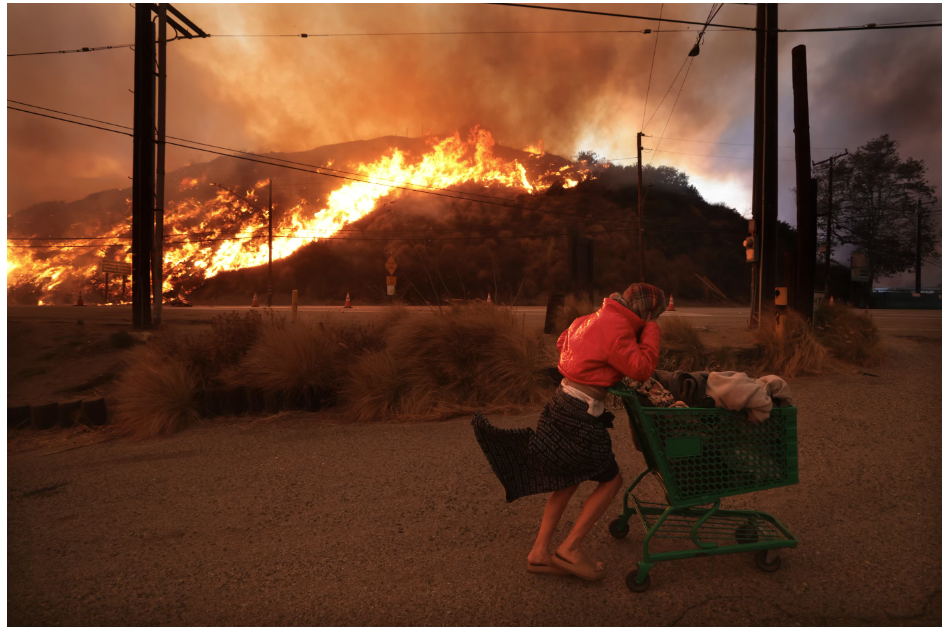
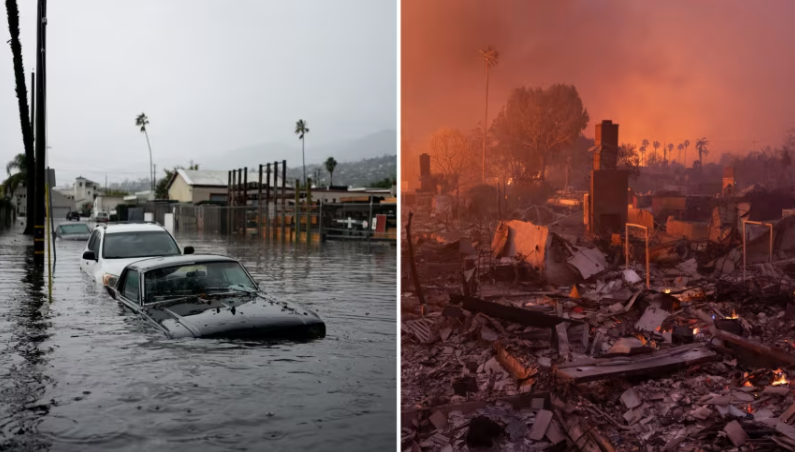
Natural disasters, according to Our World In Data, cause upwards of 50,000 fatalities per year. While this project focuses mainly on wildfires, (which can be human caused,) natural disasters can be influenced in their strength and impact by humankind. Sometimes, it's population density. Others, a lack of prevention strategies.When beginning this project, I decided to research how natural disasters can impact homelessness. What I found was surprising; there is an almost direct connection between homelessness and disasters. Looking back, it shouldn't have been as large of a surprise as it turned out to be, but it really opened my eyes to how important setting up systems to protect and prevent this is.
According to the National Coalition for the Homeless, '''help for the homeless, often hard to come by under normal circumstances, likely will be even more challenging in the storm’s aftermath.” Moreover, people living on fixed incomes, working poor families, and those who are homeless often do not have the resources to evacuate or even collect needed supplies." (nationalhomeless.org). When individuals are already homeless, being impacted by a natural disaster can reduce their chances of getting a home or permanent living space.
California is an especially dangerous area for Natural disasters. With a homeless population in the hundreds of thousands, each natural disaster leaves a significant amount of destruction behind. Making it worse, many parts of California do not have homeless shelters or transitional facilities for those seeking a home. When trying to save up to afford rent in such an expensive city, a safe, calming area should be created. As basic criteria, it should be relatively cheap, fireproof, and be able to house at least 100 people.
Transitional Housing Gaps in Society
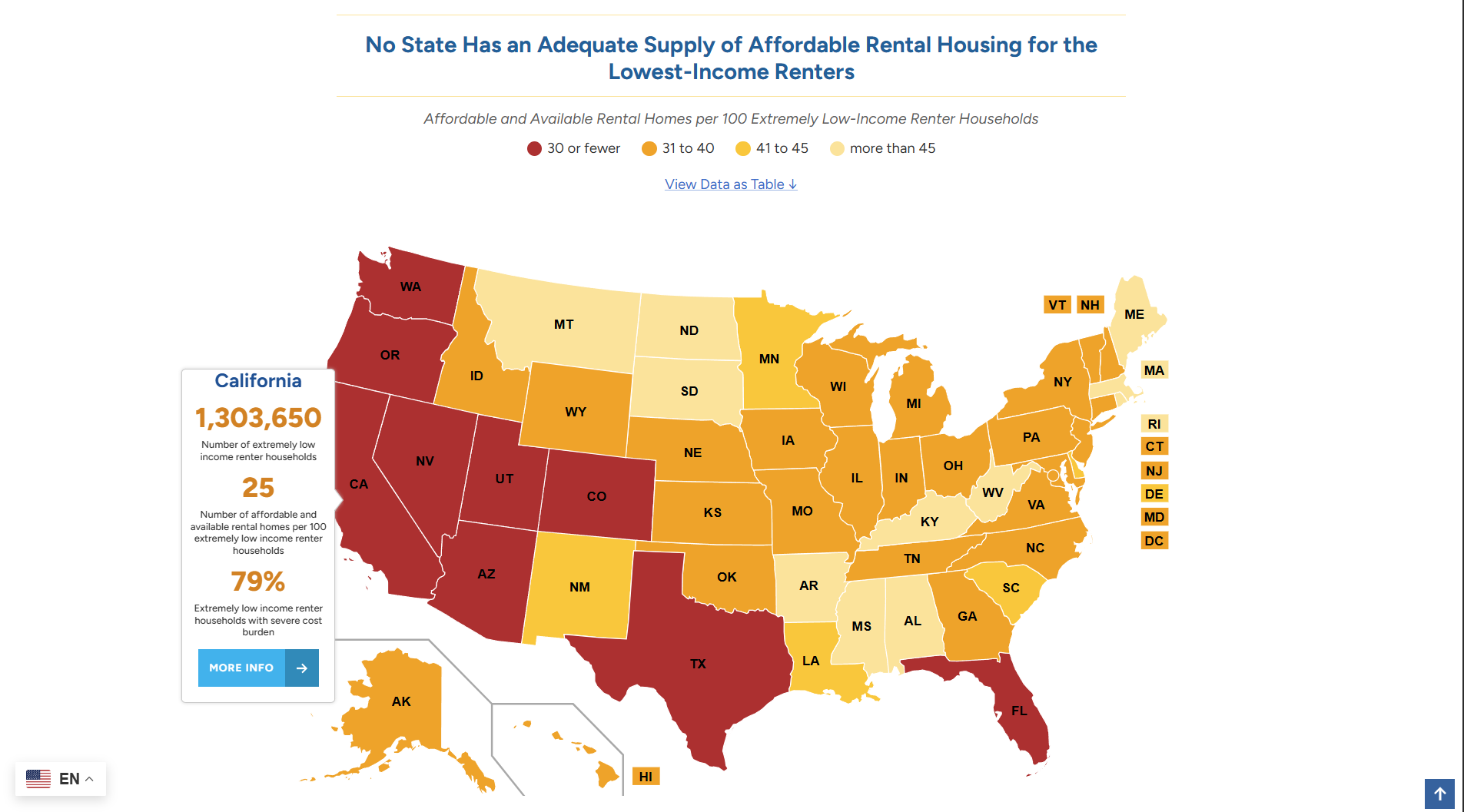
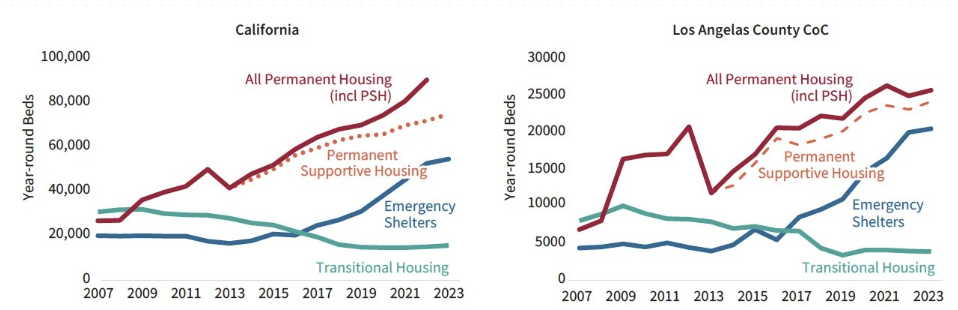
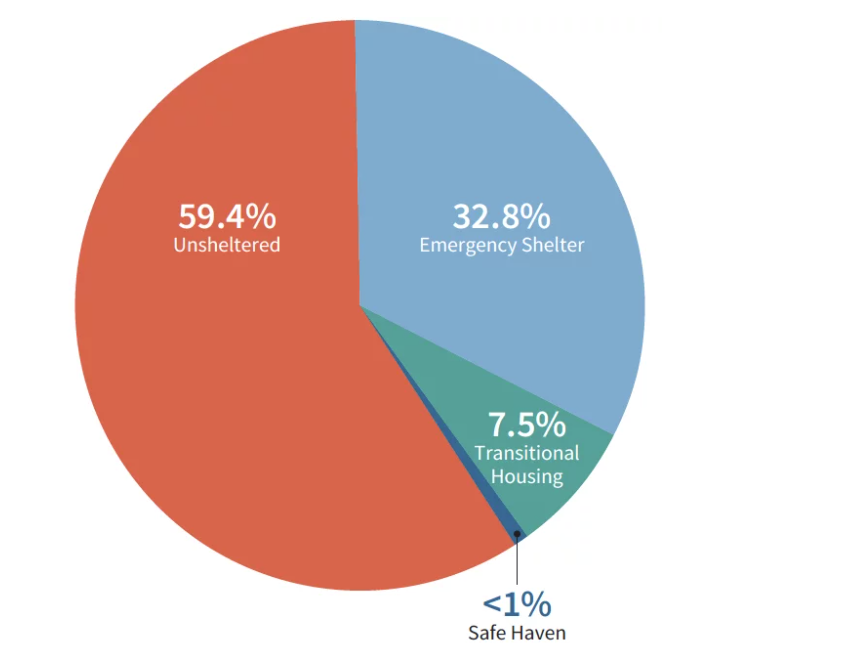
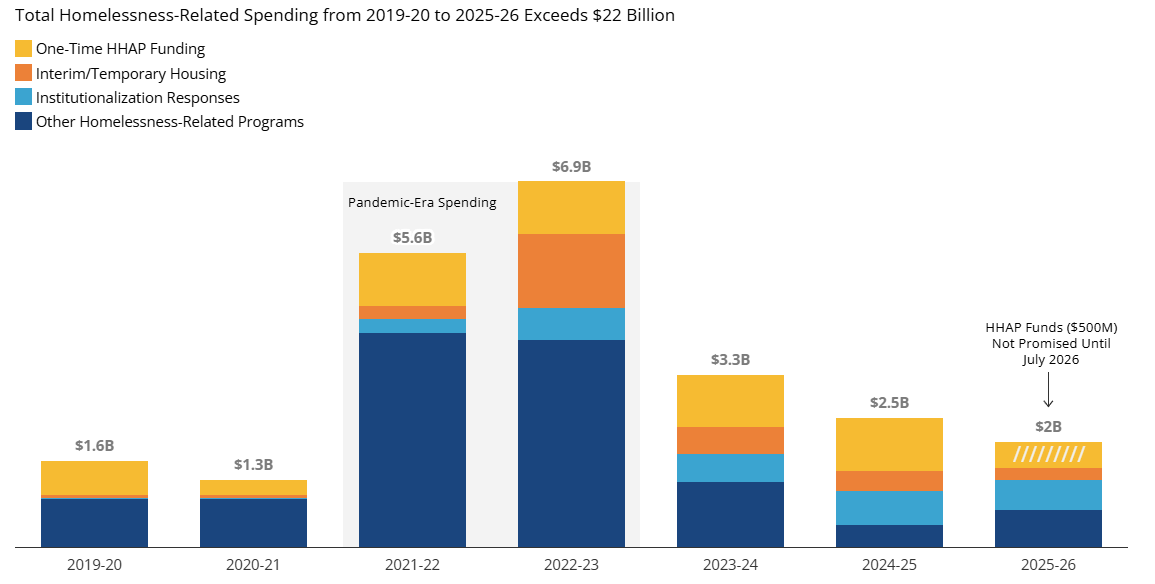
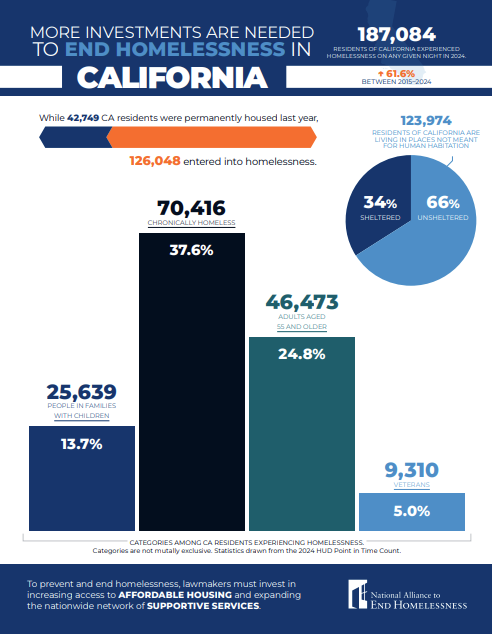
Transitional housing is one of the most looked-down upon (in terms of funding) forms of help for the homeless. Transitional housing facilities are, in essence, facilities for people who have been approved for housing or for permanent living spaces but still reside in shelters. While it would be useful to make this a homeless shelter, requiring approval and background checks increases the safety of staff members and helps prevent actions such as stealing or violence.
According to The Hub for Urban Initiatives, California has seen a significant drop in transitional housing "beds" or spaces by almost 50%. At the same time, as shown in the image with bar graphs, only about 1/3 of the budget as during COVID 19 is being used to help the homeless as before. One would think, "That must mean the homeless population has gone down!" However, it is the opposite. According to The National Alliance to end Homelessness, the homeless population from 2015 to 2024 has grown by "61.65." So, how can this issue be fixed? By creating (relatively) cheap, quick to be built, and safe places for anyone facing these problems. I believe a community center/transitional housing building could help the most to combat social stigmas and increase understanding on both sides. One could think of this as support rather than a direct fix. These issues that take place all across the US would require more work and effort than a community center (likely needing direct intervention). For now, though, this could help specific communities and protect both those housed and not.
Unless otherwise mentioned, images were taken from "Homelessness in California: Recent challenges and new horizons" on Stanford Institute for Economic Policy Research.
The California Wildfires
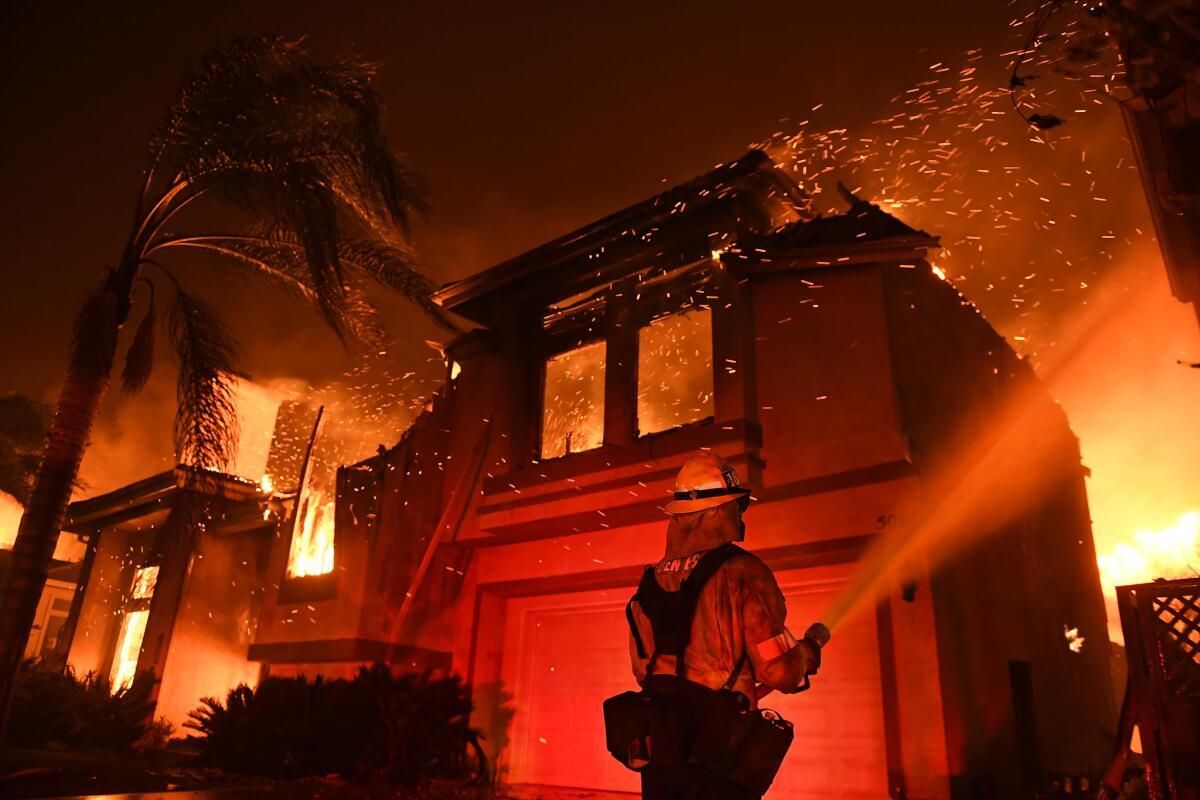
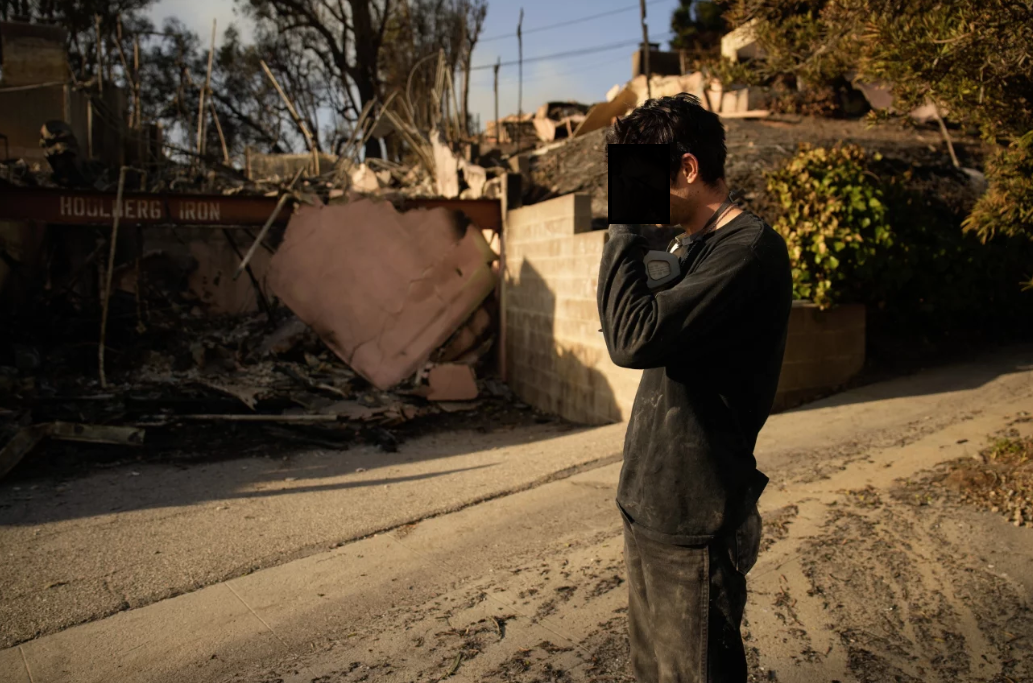
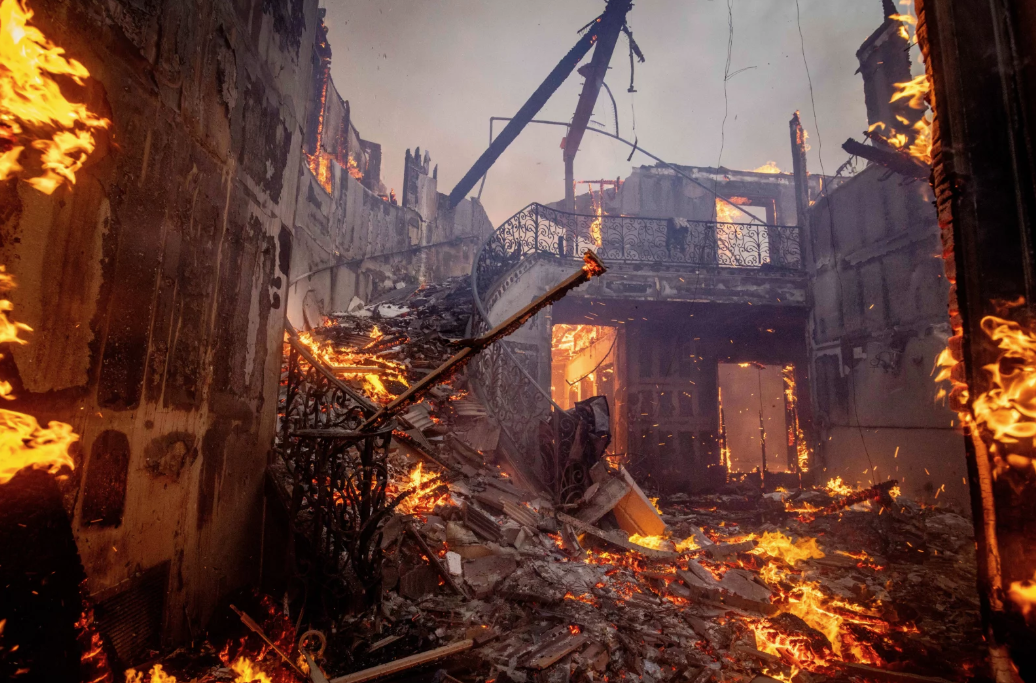
The California wildfires are, unfortunately, some of the most infamous natural (and human created) events of the last century. Thousands of people lost their homes to deadly blazes as in the 2018 Camp/Woolsey fires and the 2025 Gifford/Palisades fires. Both wildfires were human caused. The difference is that the 2025 wildfires took place in a much warmer and more chaotic environment due to global warming and its impacts. The worst part of all of it is the environmental damage and physical damage caused to structures, bringing (as mentioned earlier) over 40,000 people into homelessness (or at least one less home). Not to mention the mental health issues seeing your home burn down can cause for many.
Studies such as "Beneath the smoke: Understanding the public health impacts of the Los Angeles urban wildfires" by Tarik Benmarhnia a,b, Nicole A Errett c, and Joan A Casey c,d in the national library of medicine suggest that the wildfires make it increasingly difficult to secure housing even if it was a given before. in addition, there are many health risks when wildfires rage across the state, with breathing issues, mental health concerns, and systematic issues increasing as a result.
Wildfires are still a real issue in states like California today, and we must figure out how to prevent the spread and protect citizens caught up in the event.
Deciding the Plot
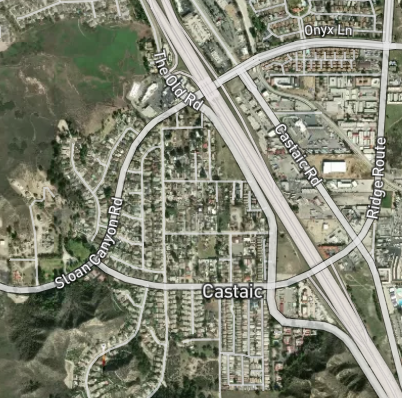
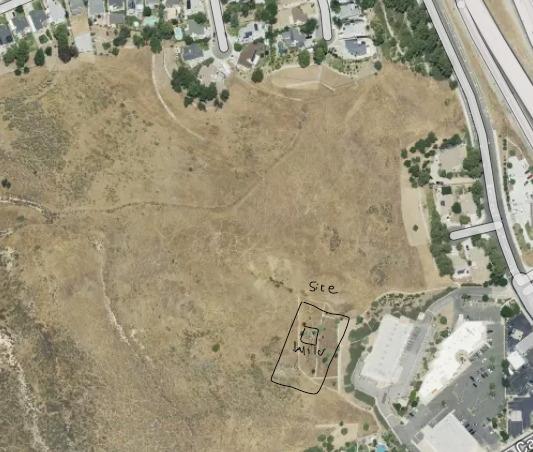
For this project, I chose Castiac California as a starting place.
Castiac, California does not have any "traditional" homeless shelters or transitional housing for the community. On top of this, Castiac is "one of America's most expensive cities," (salary.com) with an almost 30% higher average cost of living than the national high. As an incredibly expensive place to live in an area prone to wildfires without a homeless shelter or much support, it is the perfect place to build in. It would also help the community as a whole, as, according to The Signal SCV, "'We’ve been living here three years, and the homeless are becoming more and more of a problem,” Klauss (a resident) said. “We’ve watched tents being put up daily...homeless individuals set up an encampment just up in Castaic Road behind industrial and other businesses. The encampment has grown to 20-30 people over the years and can be seen from the third-floor of the apartments, she added" (TSSCV).
In other words, homelessness is an issue that impacts both those experiencing it and those witnessing it. The building, to ensure safety, would require potential residents to have a background check for the safety of the staff members. Even getting a few people off the streets could protect them and reduce the chance for things like wildfire smoke and outside residents to cause harm to them. Some seniors mention physical threats and stealing occuring, pointing towards a need for something to be done. Castiac could use some support for all of their residents, housed or not.
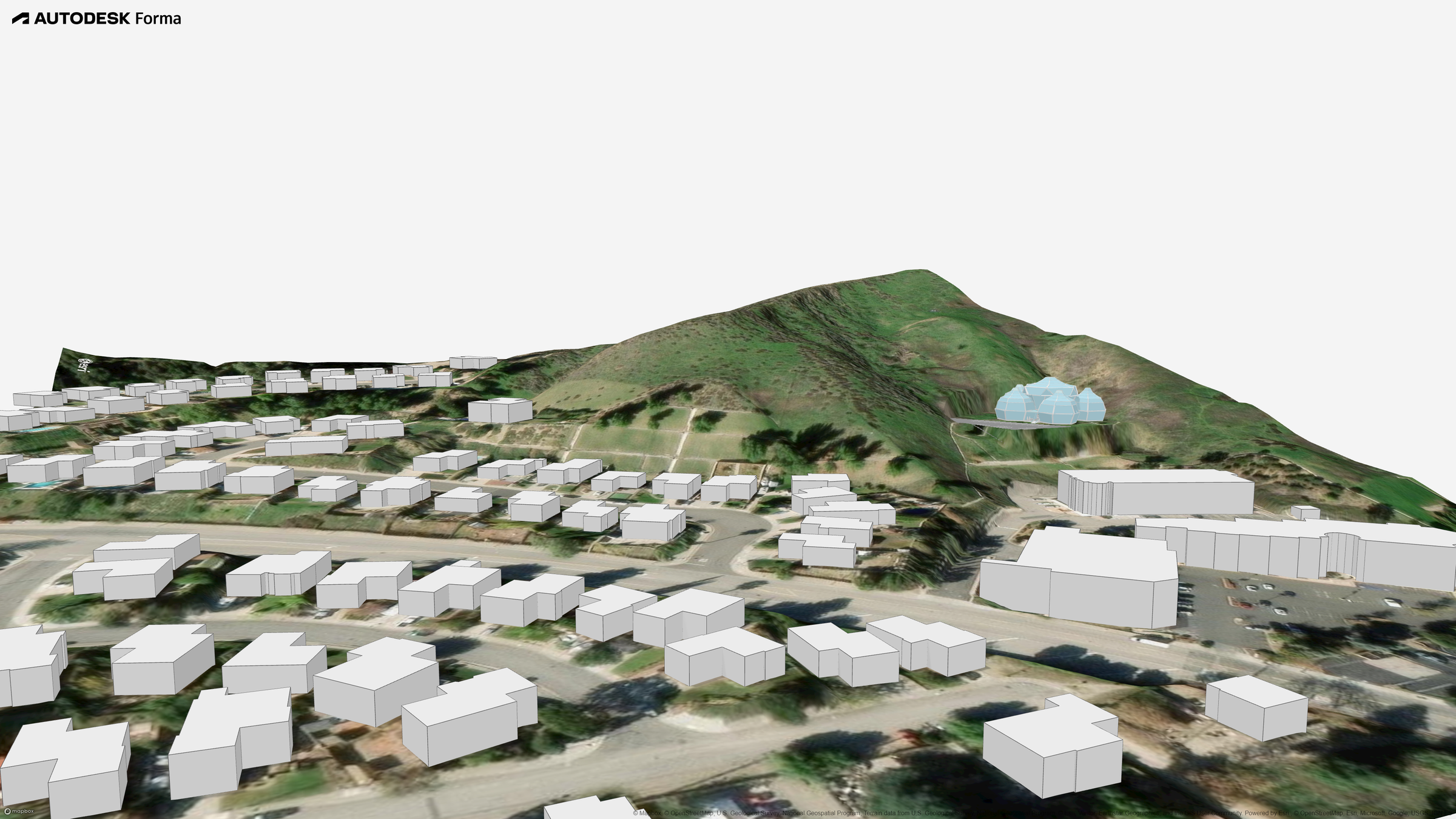
The plot location is across the street from where the complaints are being made.
Sketches
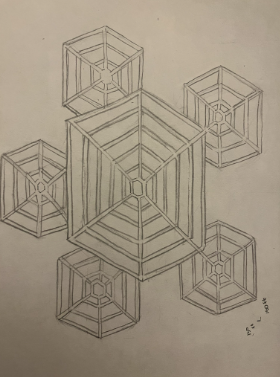
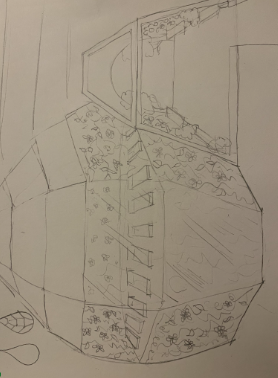
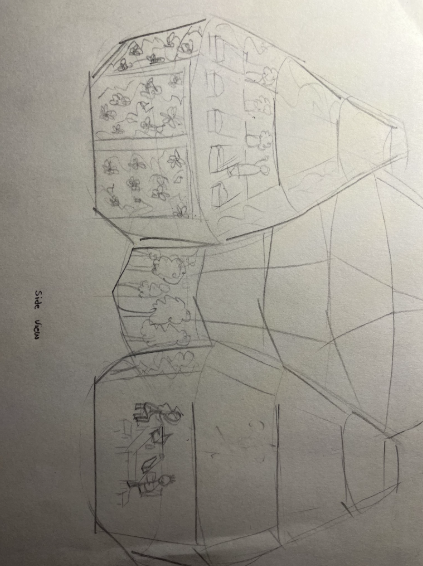
While it may be difficult to see, the gray cylinders (which would be on the bottom floor as seen in the next step) are plant beds, meant to both supply food to the community and increase biophilic qualities. An earlier iteration (within the brainstorming stage/early sketches) included hanging bamboo walls that would separate rooms and work as "living walls" of sorts. This idea was not included in the final draft as it was unrealistic with the glass ceiling and strictly steel structure. It would have also been flammable.
These are early sketches of what would become the final product. I mostly used these for inspiration before I began my floor plan and general design. The sketches are relatively accurate to the final product but were changed a bit to work with certain limiting factors I would later encounter. These sketches are less detailed than the floor plan, Tinkercad design, and Forma Site design since they served as more of a way to get ideas down than sketch each individual piece out. Some may find this to be a more important step to them, but it is really up to personal use and thinking styles. If this is being followed as an instructable, I'd say sketches can be very useful and should definitely be used to get a general idea before finalizing anything.
I made sure to include different buildings for different purposes, as will be outlined in the next step. Each part of the building is created specifically to serve the community and help others grow to appreciate and learn about each other. The building itself is about 150 by 150 feet in length and width, with a height of around 50 feet. It does not take up much space but still will be able to provide for both homeless and non-homeless populations in the area.
Floor Plan and Design
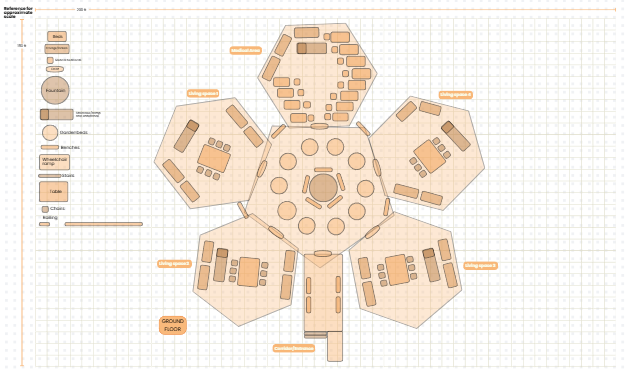
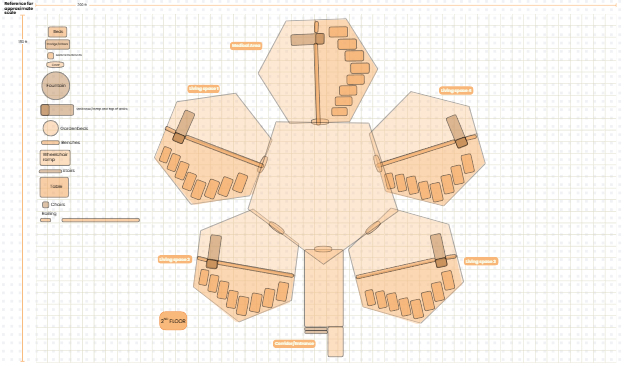
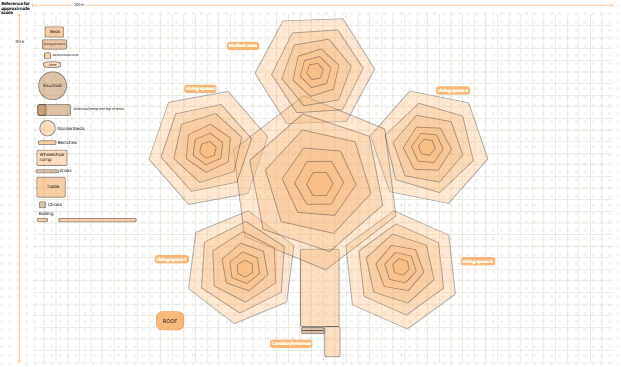
Attached is the floor plan. It was created with the people of Castiac in mind, containing a medical center, center (indoor) pavilion, and multiple living spaces for residents to relax. Were this to be a physical structure, some of the glass panels would ideally open for airflow while heaters could provide warmth in the cooler months of the years.
Below are the notes that are attached to the images, these may be read here instead.
The Ground Floor
This is the ground floor of the building, where most of the socialization would take place. As people enter the building, they are met with a fountain, several plant pots, and a large glass canopy-style ceiling above them. Then, depending on their needs, they can progress to either the medical area or one of the living spaces. The medical area has beds on the bottom floor to support those who may not be well enough or may not be able to move around freely to get care. Every room has storage that has locks on separate parts, giving a place for belongings to be protected. This would specifically help those experiencing homelessness as it is very rare to have a safe and secure place to keep their property. As residents continue in, there are tables, chairs, and a staircase/ramp. This can be configured based on the individual's need. Scattered around are benches to allow for socialization and comfort in an emergency setting. For most, this is a temporary living space. Bathrooms and showers could be placed either outside or on the edges of the facility to ensure quick and easy cleaning. The medical center could double as a mental-health facility to allow for those impacted to get care and comfort in difficult times. The center pavilion allows for communication and open conversations to take place, reducing the stress when these wildfires occur.
The Second Floor
The second floor of the building, unlike the first, is identical across rooms. Each room has 8 beds, fitting a total of 40 people. The capacity of the building could be anywhere from 50-100 people as the beds can be shared and more can be added as needed. The space allows for change to take place. There is a railing as well to protect people from falling and to prevent young children from injuring themselves.
The Roof and Its Structure
Finally, there is the roof. The roof has a unique geometric design that involves hexagons and trapezoids (as seen at a side view) to distribute load and allow for aesthetics. The pentagon in the center (this is the roof and is a hexagon) gives an easy branch for the 5 smaller hexagons around the edges, while the hexagon shape connects the buildings using glass and steel. The shape of the building mimics a flower, symbolising life and power even in the hardest of times. It could also be seen as branches out from a center where community comes first.
Tinkercad, Forma, & Revit Attempt
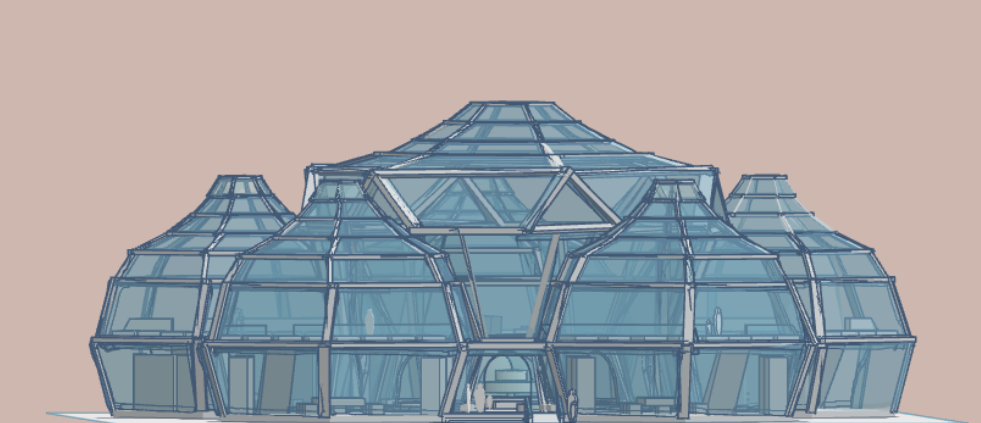
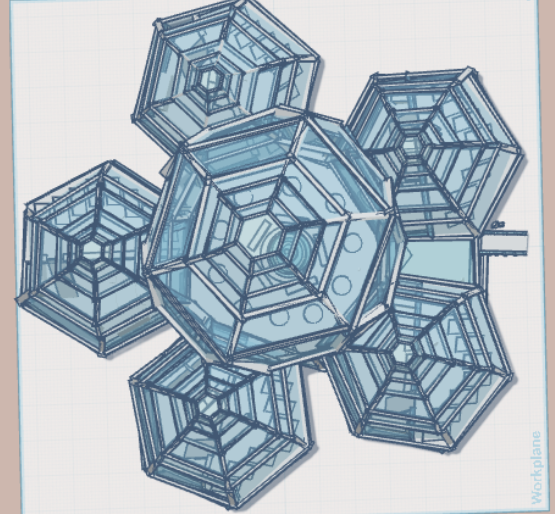
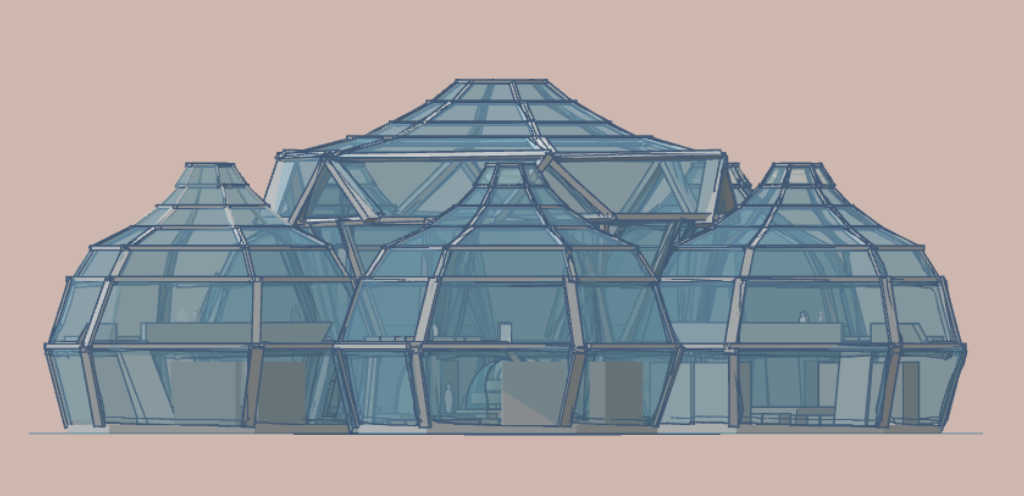
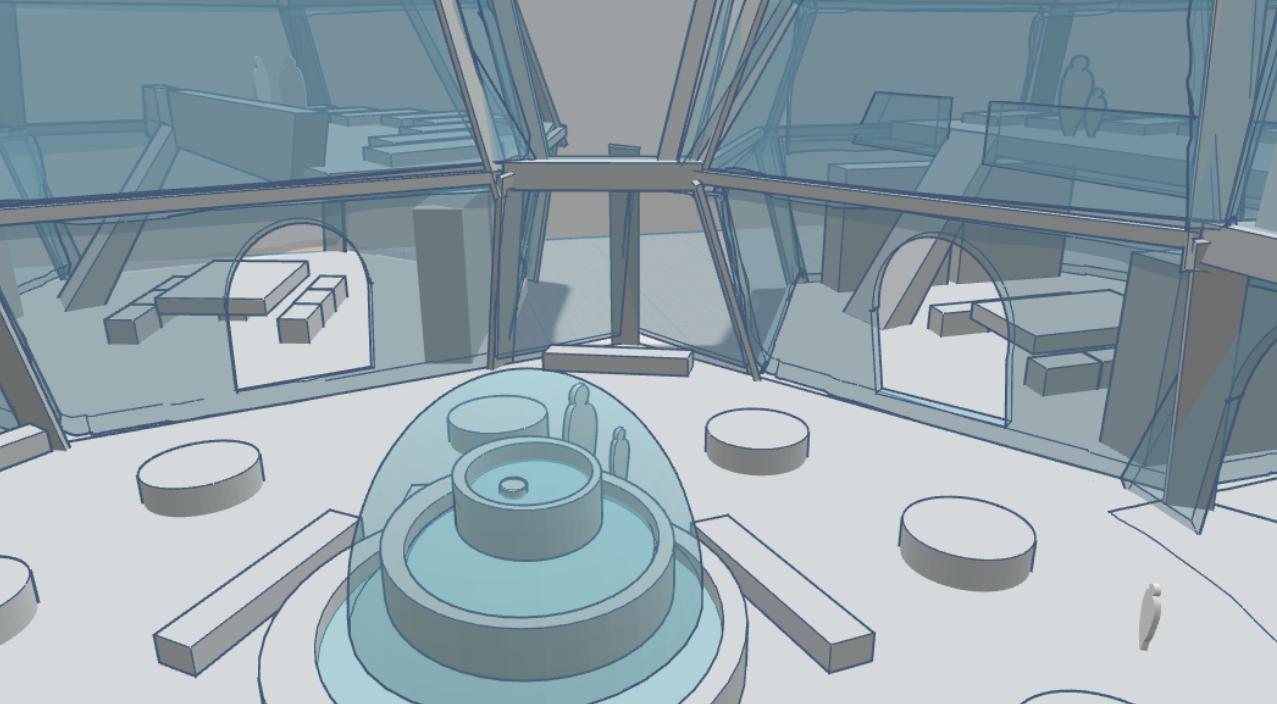
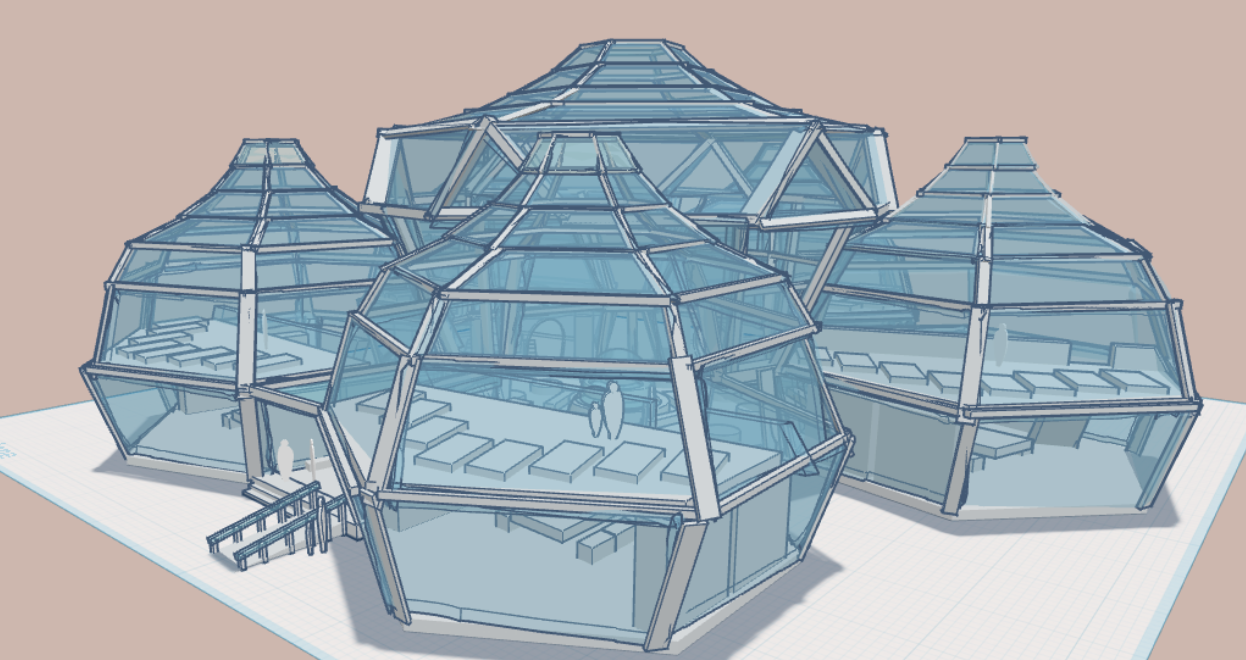
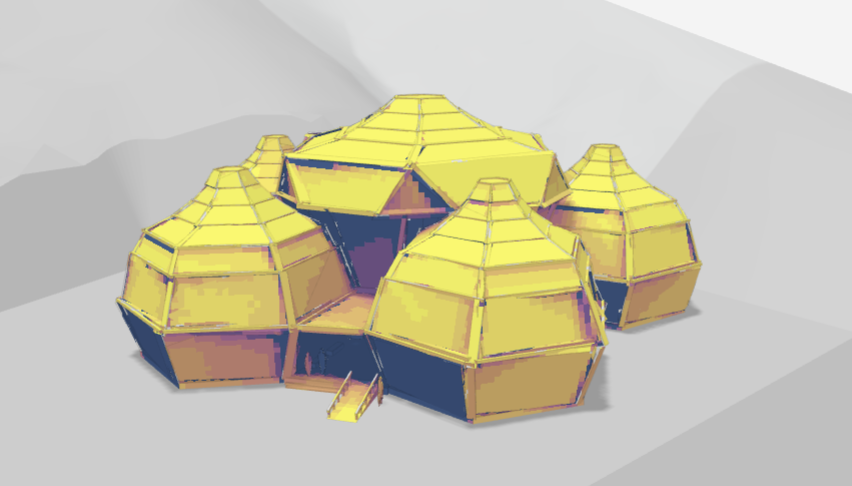
As I have used Tinkercad in the past, it was the main software I decided to use for this project. There were many early iterations to this project that each had their own flaws. While I originally created a rectangular structure with very few glass panels, I realized it was both flammable and unfriendly to an outside perspective.
Tinkercad
Early building and brainstorming:
- When I was about a third through the project, I realized I needed to find a website to use for 3d design. As Tinkercad has been a software I've been using since about second grade, I knew it would be the best option for me. While other softwares may work more efficiently or look more professional, it worked to help me get a design out and allow for my creative thinking process to take place. To begin, I reminded myself of how the site worked and took my sketches and floor plan to build the structure. The first thing I built was the roof, as I took the largest section, warped it, and used it for each of the smaller sections to save time. This built about half of each structure (although the roof had much less than half actually done).
Midstage building and problems:
- After getting through the roof and laying out the shape, I got to work on the mid to lower parts of the building. I decided to build each of the smaller teardrop shaped buildings before building the center. That's when I ran into the first of many problems. Since Tinkercad allows for the scribble shape to create custom designs, I tried to make each piece of glass individually. This turned out to be a major problem since the glass was not creating a seal and kept having shards poke out in different areas. On top of this, the main building had to have slightly different side panels to connect to the other 5 structures. Finding a way to scale all of this and fix most of the problems would take time, and I knew it would have to be fixed quickly if I wanted to actually make this a product.
Finishing the design and fixing problems:
- After speaking with my teachers and peers about the project, I realized that Tinkercad has a feature that allows for specific edits to be made in the building process. This tool helps scale drawings and other shapes to keep it constant instead of stretching it out in unprecedented ways when building. This helped me with the basic glass panels on the outside of the teardrop shaped structures and would eventually prove useful for the center area. When it came to the large center pavilion, it took many hours of trial and error to figure out a fix for the glass panels and custom fit. I decided upon triangles to help fill in some of the empty space left by the trapezoids, hoping it would make it more of a rectangular shape and fix the gaps that would let air and other natural hazards pass through in the event of a disaster. Luckily, it worked and allowed for the final 3d model on Tinkercad to be made.
Forma
Uploading the file from Tinkercad to Forma:
- As per the contest rules and advice Instructable posted, Forma was my next step. I wanted to upload it, map the building, and create new views of it to help process information and data better. Upon upload and download, I was able to "see" a spot where the building could be placed. It really helped with understanding the scale and use that the community center would have. However, when I tried to edit it, there were too many individual mesh triangles which almost caused the software to crash. I believe this is due to the Tinkercad scribble tool since it is not the same kind of shape as solid, easily made ones. I was able to eventually process sunlight data with some very minor issues (as it did not carry over the transparency from Tinkercad) and learned plot size and area design. While it did help me make a floor plan and parking lot area (along with flattened land for it to be built up on), the software was more of an addition than a main part of my project. I decided to mostly use Tinkercad for this project (as mentioned earlier) as I had used it many times in the past and was already comfortable with its processes. In the future, I may transition to Forma when our school organizes design and architecture projects for the students.
Revit
Attempting download:
- Having looked through previous entries and information, I heard Revit was a very useful program for visualization, more so than Forma. Unfortunately, my device was not allowing it to be downloaded (school restrictions) so I was unable to get access. For this reason, I turned to other visualization tools and mapping strategies to fix the problems.
Visualization

I used Chat GPT to generate the image of the finished product using my model in Tinkercad and Forma. While Revit was my first option, I experienced technical issues (likely due to my computer) and was unable to access it. This image serves mainly as visual potential for this product in the real world. Each of the images from Tinkercad may help with this as well.
An MP4 video is attached as a walkthrough. Please access this for a better understanding of the project.
Downloads
Future Fixes/uses
This project certainly isn't perfect. Until this becomes a real building that can be considered, approved, and tested by the government of California, all of the data points cannot be determined. While the Revit attempt was able to show lighting conditions, it was unable to show wind and population density given the Tinkercad model. Were this to be made (either 3d printed or as a building), there would need to be a few changes. For one, the blue panels that represent glass would need to be completely removed. 3d printers are (as far as I know) unable to print glass or transparent pieces without losing strength.
It would leave it as a shell-type structure and would make it easier to create physical models of. On top of this, finding a way to create more layers without losing building strength is very important. Since the building is many layers tall (except for the center, which could be altered), opening windows for air flow could become dangerous. Installing a spiral staircase/ramp was a scrapped idea due to time and ADA requirements for length. Additionally, I still want to incorporate a living wall structure, just in a different way than earlier suggested. If models could be easily printed, these ideas could all be tested. In the meantime, the model serves as a starting place for cities and individual projects to build off of to make it fit their needs.
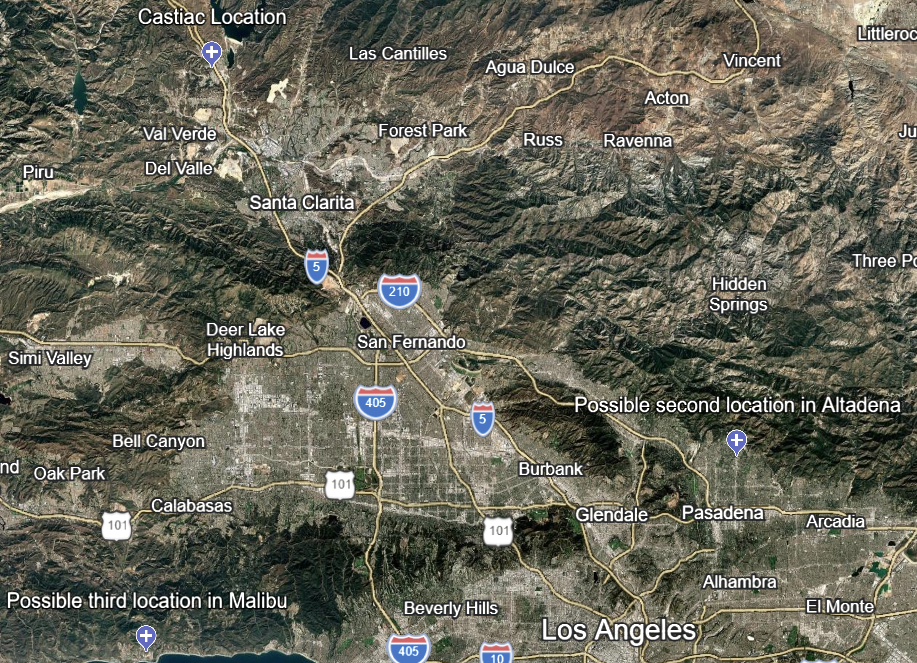
The Castiac location is only the very first iteration that could be sent out. Once data has been collected and changes have been made according to population needs, at least two other locations in California could use a structure like this. These places are in Altadena and Malibu, for their respective reasons.
Castiac Location
The Castiac location was selected, as mentioned before, for the following reasons:
- Nearby complaints
- Expensive living conditions
- No homeless shelter
Altadena Location
The Altadena location would be selected for slightly different reasons:
- The site of the Palisades fire and where most destruction occurred
- Closer to major cities nearby so easier for the community to access
- Lots of empty (damaged) land to build on and help bring people together
- Can work in tandem with other transitional housing efforts
Malibu Location
The Malibu location would also have a few new reasons:
- Extremely high costs for food and housing
- Small amount of homeless individuals (would work for a smaller building)
- Still experiencing impacts from the fires
These 3 locations form a triangle, attempting to reach anyone within and around these limits. Even if just a few people could be helped at a time, it would have positive impacts on the community and their interactions.
Finishing Thoughts and Effectivity
This project helped me grasp a deeper understanding of both architecture, the struggles people face during natural disasters, and how help can be done in simple, realistic ways. Along the way, I received feedback from both my teachers and peers, guiding me towards the final product. I truly couldn't have done it without them.
This building could support and build communities through its multiple uses. While it is small and may not be able to house the entire population of Castiac, it could be the first of many to pop up around America when need be. It is inexpensive (only steel and glass, small so doesn't require a ton of land), supportive, and living space that can be transformed as needs change. At the very least, it would help those struggling with homelessness and allow residents to feel more comfortable interacting with them. When plugging it into Forma site design, it was unable to calculate specific measurements like wind speed and population density as (just like Revit) it was both less compatible and I was less accustomed to the technology. Watching the introduction videos helped me grasp a basic understanding, but I chose to go with Tinkercad as I have used it since elementary school.
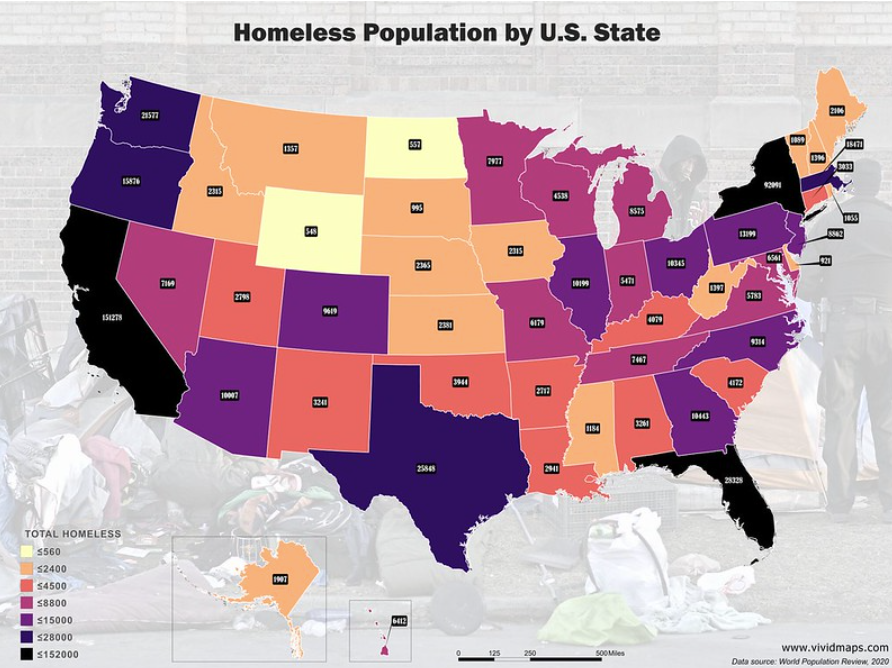
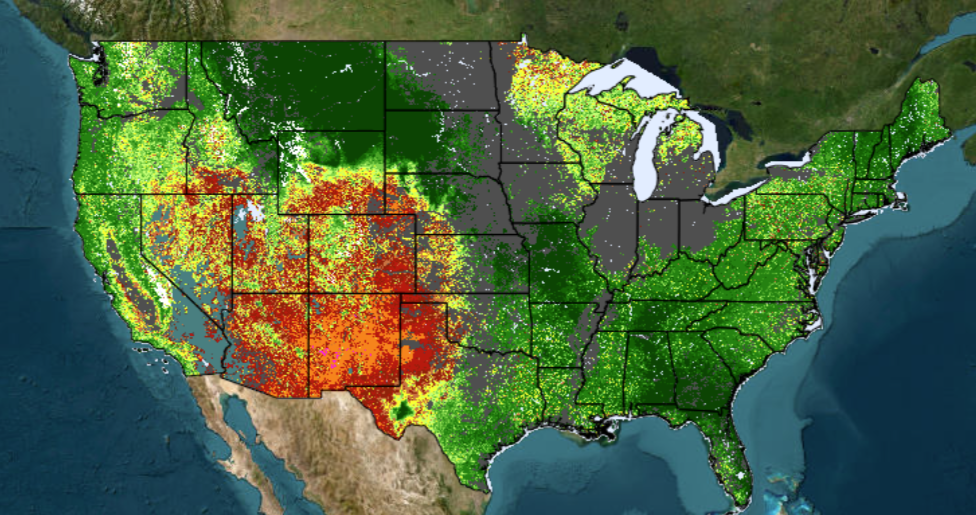
As time continues on, changes must be made to combat both homelessness and wildfires in today's society. The images shown above (from USGS and the world population review) detail how high risk areas for wildfires happen to be generally in the more homeless impacted states. We must act to prevent these issues from exploding in need and to help those who need it most. It doesn't have to be a billion dollar building for it to help people in need (and emergency situations). Starting small can allow for the data to get out there and for further improvements to be made. In the meantime, I hope this 3d model and visualization helps give an example of what could be done and shows how helping the community can start with small acts, like creating a community center and transitional housing area for emergencies. If we work together to make the world a better place, we can make more Sunny Days Ahead.
If those aforementioned states already have a high homeless population, the wildfires could make it much, much worse. For that reason, future locations aside from ones in California could be stationed here.
Final note: From a person who has volunteered at homeless shelters before, those experiencing homelessness and mental health issues are still human and deserve to be treated as such. The background check requirement is only necessary to protect the safety of staff members and is not intended to be exclusive, racist, or unreasonable. Help for the homeless doesn't have to look like dirty mattresses on the ground; it can be so much more. Whether or not this project ends up becoming a real building, it should be kept in mind that cleaner, more humanized structures should be created to help everyone, not just those who aren't struggling at the moment. The fact that both those transitioning from homeless to housed and those who have a house may be staying next to one another could help bridge the gap between the prejudiced and incorrect assumptions about both groups.
Thank you for viewing this project! This has truly been a very rewarding experience to learn about the struggles everyday people face in society, and understand more about what people have to go through in states more susceptible to natural disasters.
None of this text is AI generated or supported.