Sustainable and Resilient Community Center for Wildfire Healing and Recovery
by eitanmakestuff in Design > Architecture
66 Views, 0 Favorites, 0 Comments
Sustainable and Resilient Community Center for Wildfire Healing and Recovery
.jpg)
Natural disasters can detrimentally harm a community in just a matter of hours, but the recovery and rebuilding process can take months or even years. As homes, schools, businesses, and basic infrastructure are destroyed, victims need a place to gather and stay during the recovery. As a San Diego resident, after seeing several small brush fires in my city, I understand that wildfires are an unavoidable part of life in the region. But it was not until seeing the destructive and deadly Los Angeles wildfires and the displacement and chaos they created that I really began to understand the danger that uncontrolled fires pose to a community. I wanted to design a community space where the community could gather for support and recovery, before, during, and after a wildfire happens. My goal was to create a structure that is physically resistant to the harsh conditions created by wildfires, while being calming, practical, and supportive for its residents. Along with those priorities, I wanted to ensure that it was affordable, sustainable, and practical to build.
Hi, my name is Eitan and I am a student at Miracosta Community College in San Diego. In this Instructable, I will walk you through each step of my design process from start to finish, and show you how I designed a community center to combat the growing threat of wildfires.
Supplies
The basic construction supplies needed to build the community center are:
- Geopolymer concrete
- Dual-pane, double-tempered, insulated glass units
- Natural wood paneling
- Gravel, Faux Grass, and Dudleya plants
- Desks, tables, cabinetry
- Couches and chairs
Project Foundation
In recent years, wildfires have become one of the most destructive and deadly natural disasters facing communities in California. In 2025, multiple uncontrolled wildfires destroyed large parts of Los Angeles, a city home to over 3.8 million people. The Palisades and Eaton fires resulted in numerous fatalities, hundreds of millions of dollars in property damage, and long-term displacement for La residents whose houses burned down. Thousands of homes and community buildings were destroyed, leaving families with nowhere to go, while harsh weather conditions, power outages, and polluted air made finding new housing difficult.
In this project, I set out to design a sustainable, affordable, and resilient community center to support those affected by the fires. When a wildfire happens, people don't just need a place to escape the flames, but somewhere where they can breathe safely, sleep, charge devices, have access to clean food and water, communicate with family and friends, and begin the recovery process. Shelters like these should not be last-minute thoughts, hastily put together after the fact, but instead, a permanent building in areas where wildfires are prevalent.
The foundation of my design in a community center is meant to shelter and support victims both during and after a wildfire occurs. Instead of focusing on just the short-term relief, I wanted to create a solution for the long-term support cycle that families desperately need. My goal was to create a structure that is physically durable, calming to the inhabitants, and has the necessary resources to facilitate their recovery.
My design needed to be well thought out because wildfires present many dangers at once. The LA fires caused power outages, air pollution, traffic jams, blocked emergency response, created food and water shortages, and destroyed primary residences. My design takes care of all of these needs while taking into consideration the emotional well-being of the victims. In most disasters, emergency relief locations can be chaotic, stressful, and undignified. People are crowded into gyms or warehouses, just to wait in long lines for assistance from way too few emergency response staff. My project explores an alternative solution that is more purpose-built and accommodating.
Besides supporting the victims, it was important to me that my design was sustainable, resilient, and affordable. With the increasing effects of climate change and human impact on the environment, I wanted my design to be unobtrusive to the surrounding natural landscape, have a minimal carbon footprint during construction, and be as low-cost as possible without cutting important corners.
Software
.jpg)
For this project, I really wanted to challenge myself to use a variety of professional-grade software to make my design as realistic and feasible as possible. After some research, I found that Autodesk has a diverse BIM and CAD software suite, and so I set out to learn as much as I could about how to develop my design in the same way a professional architect would. I wanted to go through the entire architectural process, using the industry-grade tools I was able to access with my Autodesk student license.
Autodesk Revit
Revit is a Building Information Modeling, or BIM, software developed by Autodesk, used by many professionals in the industry to plan, design, and organize architectural projects. Revit was one of the top results when I searched for the best pro-grade BIM software, and so I set out to learn how to use it and improve my skills in this project. Many YouTube tutorials and exchange forums later, I now have a decent understanding of the Revit workflow, which makes designing and iterating on a building design much much easier.
Autodesk Fusion
Fusion is a Computer-Aided Design, or CAD, software also developed by Autodesk and used throughout the engineering disciplines. I chose Fusion because it's easy to use, beginner-friendly, and works with SAT and OBJ file formats that I ended up using later in the project.
Twinmotion
Twinmotion is a rendering engine used for real-time visualization of 3D models. I learned about it during my software research, and I chose it because it integrates directly with Revit, letting me automatically import my Revit models and update them as I work. For the final architectural renders for this project, I used Twinmotion's ray tracing feature, which creates a realistic light simulation and brings the final images to life. Twinmotion also has a huge collection of furniture, foliage, and other assets, which I used to stage my model and convey what it would look like after construction.
Materials Selection

Throughout my design, I carefully selected materials that would have a positive impact on the emotional well-being of the inhabitants, as well as be physically durable to stand up against the harsh conditions of a wildfire. After researching the different materials commonly used both in mental health recovery spaces and fireproof architecture, I created a list of materials that would be present throughout my design
Wood
Throughout the interior of the building, there is a subtle presence of natural wood finishes. Firstly, natural wood tones have been shown to have significant mental health benefits on home inhabitants, and for a community space where victims will be spending alot of time after a very stressful natural disaster, any design choices that can be made to create feelings of peace and tranquility are a must. According to a research paper by the University of British Columbia, natural wood tones can reduce stress levels by working to lower the sympathetic nervous system (SNS) activation, which is the "fight or flight" response that we sometimes feel under stress. I also chose wood finishes for the interior because I wanted a contrast to the brutalist feeling of the rest of the structure. So much of the interior and exterior is made of grey concrete, and so I wanted the inhabitants to have a warmer and more natural feeling in the living spaces.
Glass
Because the presence of natural sunlight was a very important part of my design, I knew I would need to, of course, have a ton of windows all around the building. However, for a structure that has to stand up to harsh heat and wind conditions, large windows can be challenging. After researching possible solutions, I found dual-pane, double-tempered, insulated glass units, known as IGUs. These windows are perfect for my use case for a few reasons. Firstly, IGUs are dual-pane, meaning that instead of one solid pane of glass, the window has two thinner ones, with a gap in between. This gap is often filled with a gas such as argon, which does not conduct heat as effectively as normal air. This means that even if it is super hot on the outside, in my case due to a wildfire, the heat is not easily transferred to the inside of the building, keeping the inhabitants cool. Secondly, the tempered glass makes it so that the windows can stand up to debris thrown around by the high winds. In my design, I used IGUs for all of the exterior windows and the central dome.
Geopolymer Concrete
For all of the main structural components of the building, I knew I needed a special material that was affordable, eco-friendly, and most importantly, heat-resistant. I liked the idea of concrete, as it is very easy to build with and transport, but I had concerns about its environmental friendliness and its heat resistance. After researching different types of concrete for different applications, I came across fly ash and slag-based geopolymer concrete. Traditionally, concrete made with Portland cement has a high environmental cost because of the huge amounts of carbon dioxide that are released during production. This special type uses fly and ground granulated blast-furnace slag, which are two industrial waste products that usually end up in landfills or waste facilities. Adding them to the concrete introduced more silica, alumina, and calcium, which create a stronger and more heat-resistant final product. Its dense structure helps to slow heat transfer and resist surface damage from debris. Studies have found geopolymer concrete to have better heat resistance and strength properties than regular concrete, while remaining affordable and eco-friendly.
Design Principles
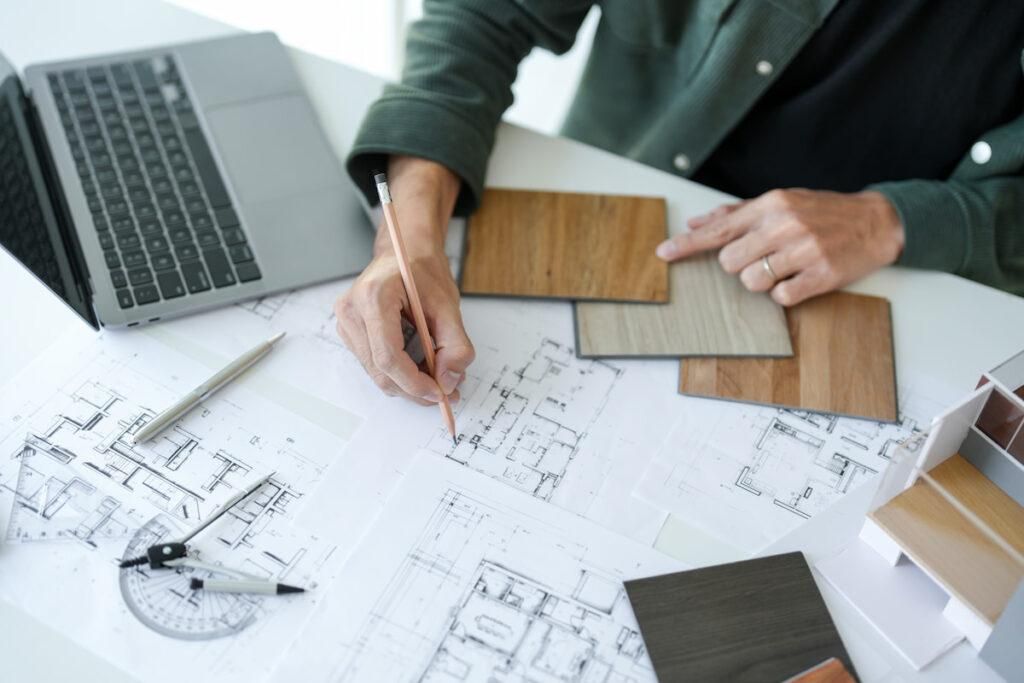
Before starting the building design in Revit, I wanted to lay out a set of design principles that I would follow. After some research on similar pieces of architecture, I created a list of design choices to keep in mind.
Rounded building design
Throughout the interior and exterior of the community center, I incorporated rounded shapes and forms, curved walls, and smooth transitions between spaces. Firstly, curved spaces and design elements have been shown to have a positive impact on an inhabitant's perception of a space and how they feel emotionally about it. According to a study by the National Academy of Sciences on the emotional effects of architectural contours, people are more likely to perceive a space favorably if the interior spaces are curved instead of sharply linear. And so, where possible, I incorporate curves and a smooth flow into the space. In addition to the emotional benefits, curved walls also contribute structurally. Curved walls stand up to wind and harsh weather conditions better, as they are not only stronger structurally but also help the wind flow around the building instead of fighting against it.
High Celings
Throughout the main gathering areas, including the lobby, library, classrooms, and recreational spaces, I designed the ceilings to be at least 12 feet tall. In emergency shelters, low and compressed spaces can make victims feel claustrophobic, stressed, and overwhelmed, especially when many people are occupying the same space. According to a study from the Journal of Consumer Research on the psychological effects of ceiling height, higher ceilings can promote feelings of freedom and peace, while lower ceilings can contribute to a chaotic and distressing atmosphere. The taller ceilings allow the residents to feel that they have the space to recover emotionally and physically.
Sunlight
Natural sunlight is one of the most important design features in any living space. It is well known that the presence of natural light has a massive, positive psychological impact on residents. According to Building and Environment, a study by Morales-Bravo and Navarrete-Hernandez, increased daylight in interior spaces can improve perceived happiness and reduce feelings of sadness and distress. For people who have been displaced by a wildfire, the presence of daylight can help restore calm and happy feelings and help restore the sense of a normal life. In my final design, there are windows incorporated into almost every part of the building. To let sunlight into the upper floors where the long-term residents will live, the central skylight allows a huge amount of sunlight into the center of the building.
Open Spaces
Having plenty of open space in any home is essential to reduce feelings of claustrophobia and stress. People feel more connected in open spaces compared to those with a lot of separating walls and divisions, and so I wanted to make sure that I included plenty of open space in my design. According to the Building and Environment study, spatial openness and a larger indoor environment were found to reduce stress indications and support recovery after stressful experiences. All of the main gathering areas, as well as the long-term housing, were designed to be as open as possible, giving community members space to rest, talk, and heal while feeling at peace in a larger community space.
Designing the Building in Revit
.jpg)
For the main architectural design, I used Revit to create the building structure, floor plan, and interior. I started by sketching the footprint of my building after doing some research on how large the space should be and the availability of the land in the area. The final building spans 160 by 230 feet, which is a good balance between available space and the room needed to support the community.
Then I planned out and designed each floor according to its use, and added the interior and exterior walls accordingly. After watching many tutorials, I was able to use the different elevations and 3D views to make it how I visualized it, with the walls curving and meeting how I wanted them to. I added the ribs on the exterior of the building for strength and reinforcement, and added railings to the inner balconies and outer terrace. I then calculated the desired spacing for the doors and windows, and created custom models in Revit so the spacing would work out just right. I added them along with a few other finishing touches, and the structure was complete.
Level 1 Floorplan
.jpg)
The first floor of the building is for the more immediate needs of the community before and during the wildfire. On the left side of the entrance is the library and reading area, easily accessible to community members wanting to stop by. To the right of the entrance is the emergency medical aid and assistance center, where victims can seek aid during an emergency or stock up on supplies if a wildfire is imminent or likely. In the center of the floor is the reception and check-in desk, and behind that is the communal seating area where people can meet up and socialize. To the left of the seating area is the classroom and workspace, and to the right is the gym. On either side of the building are elevators for accessing the other floors.
Level 2 Floorplan
.jpg)
The second floor of the building is for events and longer-term care. On the left side of the building is the resource center, where victims can coordinate with loved ones, plan their stay, and recovery. On the right side is the counseling center, where victims can receive emotional aid and deal with the loss and trauma of the fires.
Level 3 Floorplan
.jpg)
The third floor is the main recreational floor, where residents and community members can hang out, chat, catch up, and relax. Towards the front of the building is the outdoor terrace, complete with a lounge on the left, picnic tables in the center, and a children's playground and play area to the right. Inside is an indoor lounging space, as well as a workspace for those attending classes or working online.
Level 4 Floorplan
.jpg)
The top floor is dedicated to housing those displaced by the wildfires, without a place to go. There are 10 rooms in total, ranging in size to accommodate between 2 and 4 people each. These apartments are equipped with everything residents need to live their normal lives while they find new housing and begin to put their life back together.
Skylight in Fusion
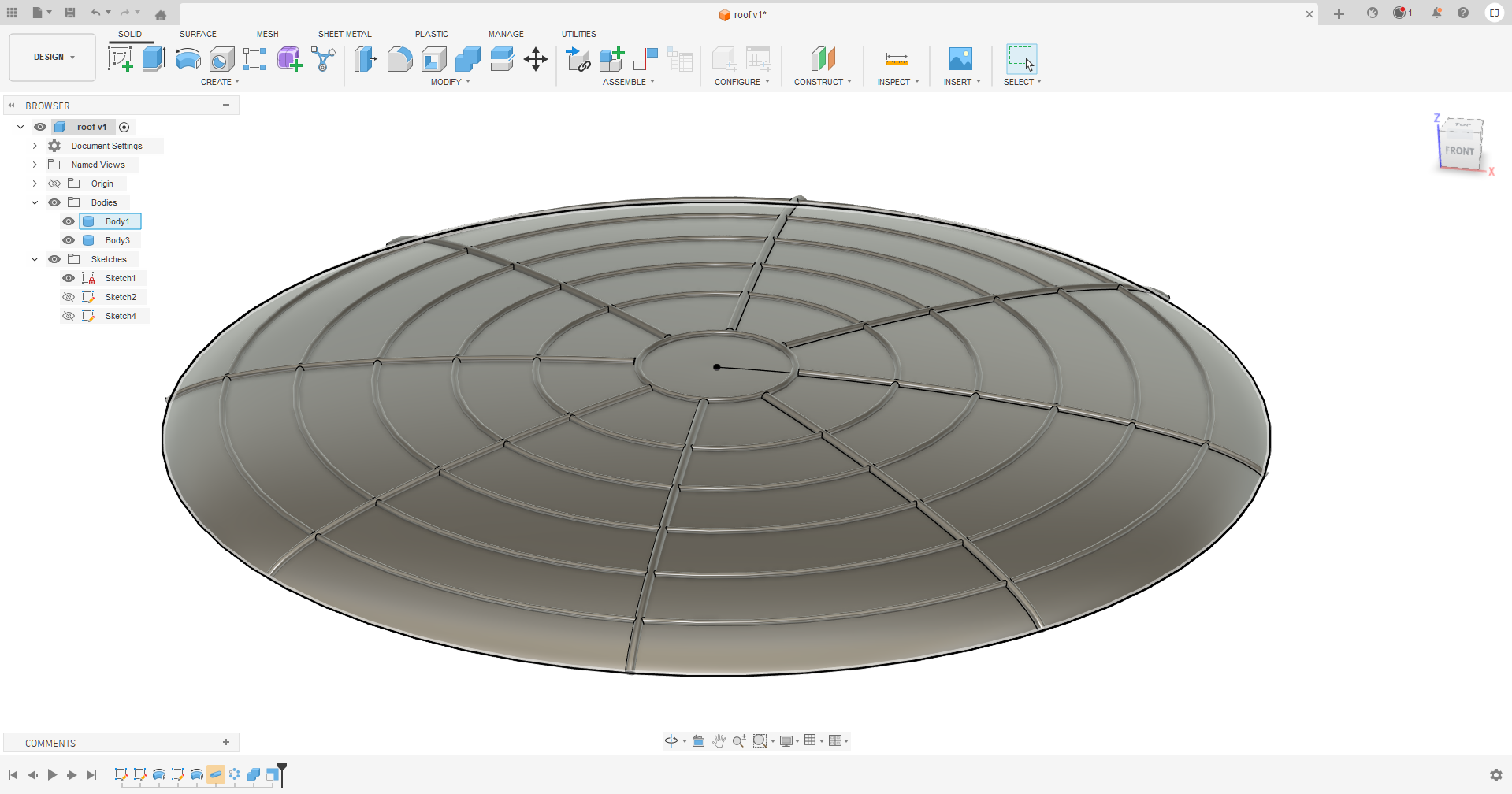
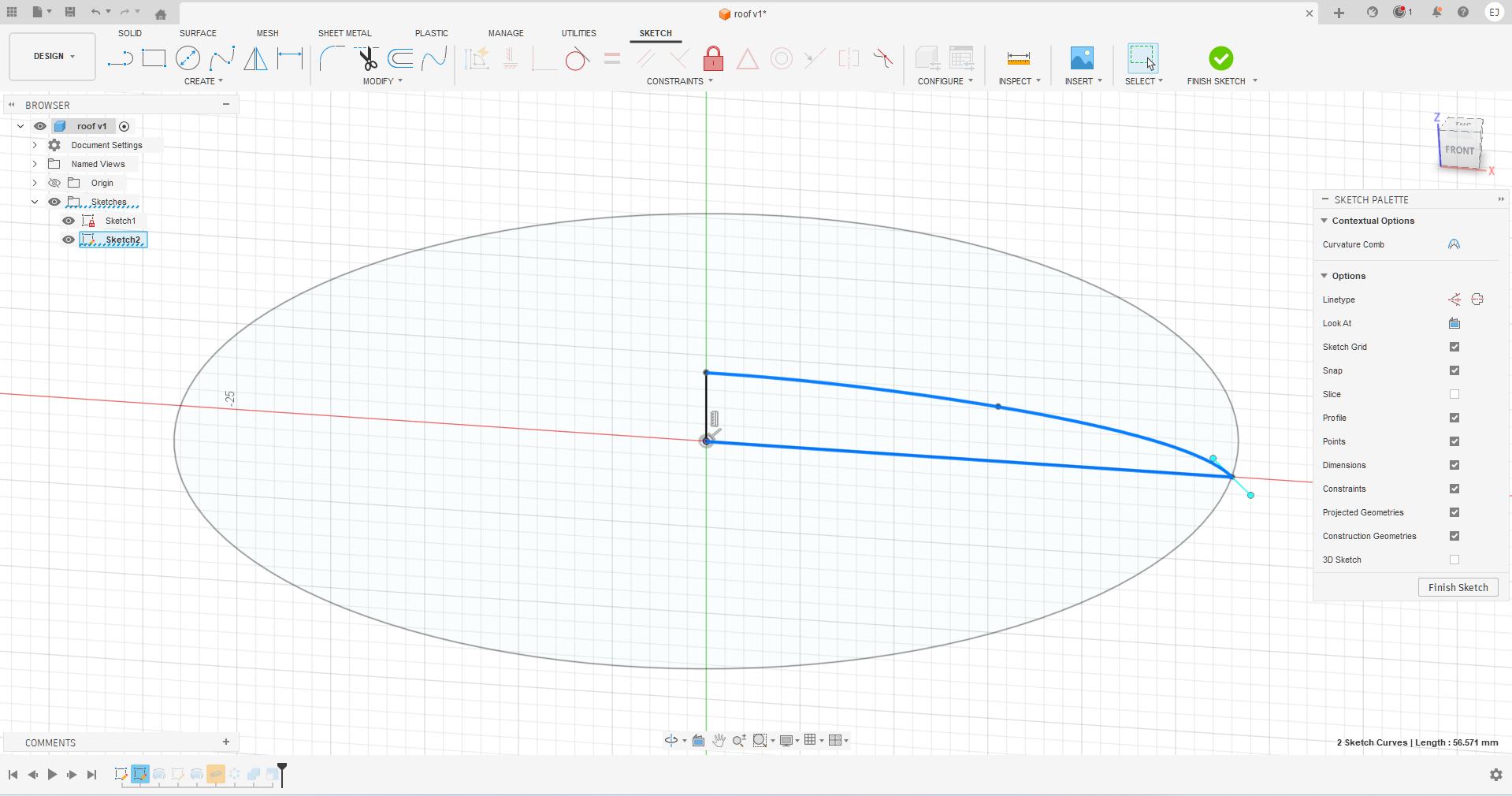
As part of the initiative to introduce as much natural sunlight into the building as possible and to create a stronger feeling of open space, I designed the building to have a large central seating area in the lobby, with the sunlight on the top floor. The dome on top of the building had to, of course, be glass, but I wanted it to have a cool design as well as be realistic, with panes of glass instead of just a solid block model.
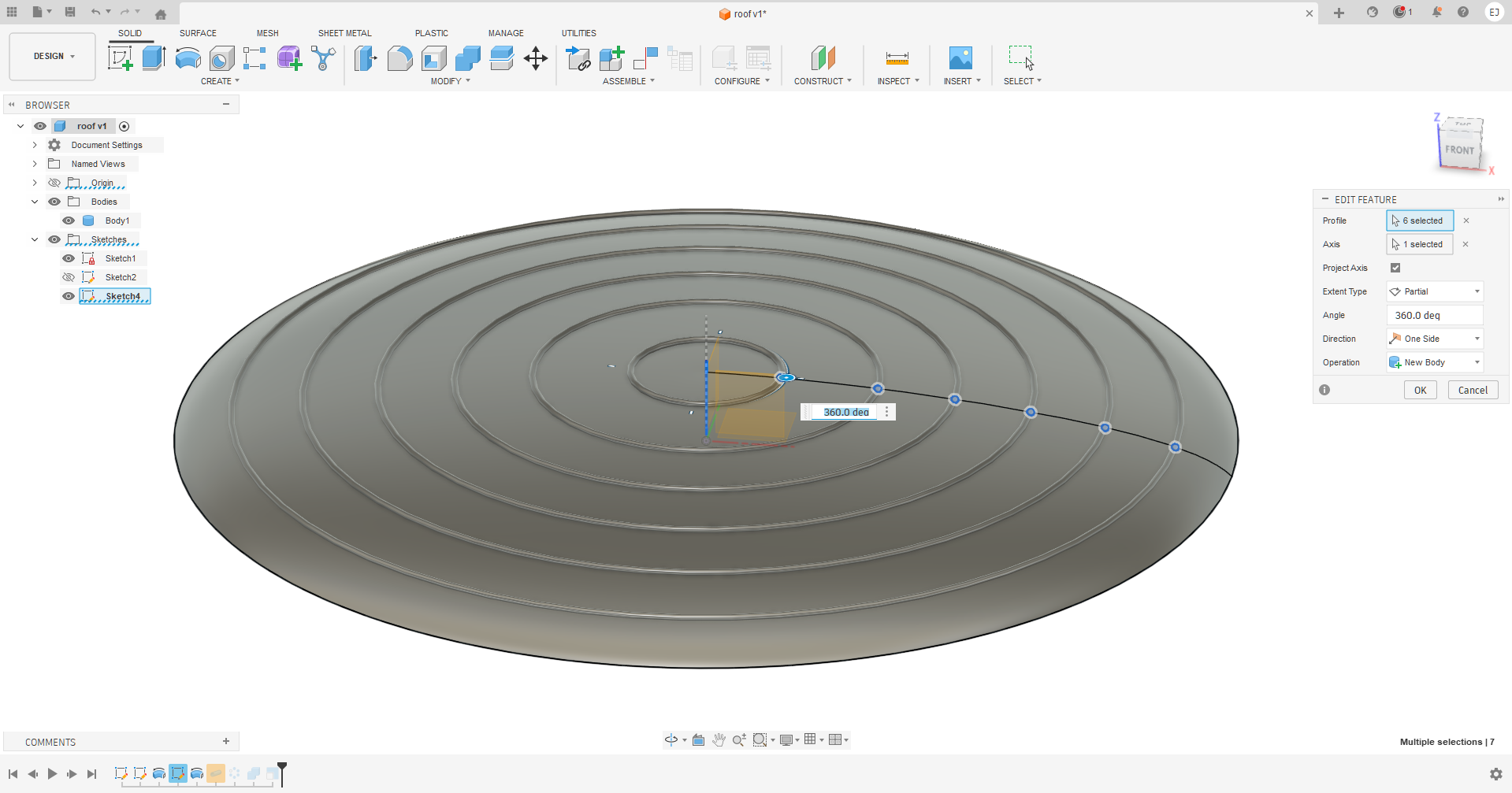
To create the dome, I used Autodesk Fusion. CAD software is perfect for modeling specific objects with geometry tools, and so I got started by creating a sketch of my skylight, which had a radius of 28 feet. I then created a sketch perpendicular to the first, for the profile of the dome. I wanted a nice curved surface so the light would diffuse nicely, and any rain or debris would not get stuck on top. I used the Spline tool to draw a smooth curved line for the profile, and then used the Revolve tool to extrude my sketch around the central axis to create the 3d shape.
Then, I started to make the frame for the glass panes to be secured to. I used a combination of Sketches and other geometry tools to model a frame structure, and then used the Circular Array tool to put the rest of the supporting beams in place. I repeated that process for the crossbeams, and the skylight was finished.
Exporting to Revit
Revit works really well with using CAD files as part of an architectural design, so I had no problem importing my dome model into my Revit workspace. I downloaded the frame structure and the glass components from Fusion as SAT files, and then imported and placed them into my Revit workspace. I really like the way it turned out, and I think that it matches the overall aesthetic of the building well.
Staging in Twinmotion
.jpg)
After completing the model of my building in Revit, it was time to stage the scene and take renders. Twinmotion was built to integrate directly with Revit, so I linked my Revit workspace directly to the Twinmotion scene. This way, my Twinmotion scene updated in real time as I made tweaks in Revit, and I didn't have to keep exporting and importing every time.
I began to go through my design, room by room, and stage it as it would be for use in a wildfire situation. I mainly used assets from the Twinmotion material and object libraries, as well as modifying a few for my use case.
Surrounding Grounds
.jpg)
I wanted the surrounding grounds to remain true to the purpose of the building, which is wildfire response, while keeping it aesthetically pleasing, resilient, and sustainable. The grounds are primarily covered in gravel, which, of course, is fire-resistant, as well as California native plants that have fire-resistant properties. After researching different varieties, I went with Dudleya plants for their beauty and high fire-tolerance. It is important that there isn't anything that can allow it to spread to the main building. In front of the building is a paved stone walkway leading from the street to the front entrance, which has large sets of double doors to allow for the flow of people and supplies.
Check in and Front Desk
.jpg)
Right after the entrance to the building is the front desk, where residents and victims can check in, communicate with staff, and coordinate their stay. The staff can offer information and basic supplies and answer any questions.
Library and Reading Area
.jpg)
An important part of any community center is a place where people can relax, read, and pursue their academic and intellectual interests. To the left of the entrance is the community library, where victims can take their mind off the fires and lose themselves in a good book. In between the rows of wooden bookshelves is a reading lounge where residents can enjoy their books, with beanbag chairs and comfortable couches. Towards the back of the library is the checkout desk, with library staff to assist patrons and make recommendations. Looking out to the front of the building is the study space, where residents can read alone or work in a designated space.
Library Render #2
.jpg)
Library Render #3
.jpg)
Library Render #4
.jpg)
Classroom
.jpg)
On the left side of the first floor is the community classroom. Here, kids who are displaced by the fires can still attend classes and continue their education. One of the harmful but often overlooked consequences of natural disasters like wildfires is the shutting down of educational facilities, where kids can go months without their regular education. The classroom I designed features desks for students to learn and work, as well as the equipment necessary for instructors to teach and give lessons.
Classroom Render #2
.jpg)
Gym
.jpg)
Staying in shape can be quite a challenge during an extended stay in an emergency relief environment. Having a gym is important because it gives people the space and equipment to regain their physical and emotional stability after a traumatic event like a wildfire. A dedicated fitness space gives people a healthy way to release stress and move their bodies. According to the CDC's research on physical activity benefits, exercise can promote brain health, lower blood pressure, and reduce anxiety, all very important things during trauma recovery. The gym is equipped with free weights, treadmills and stationary bikes, specific machinery, and space to do yoga.
Gym Render #2
.jpg)
Counseling Center
.jpg)
Wildfires can be quite a traumatic experience, and so I wanted to include a space where victims could speak with mental health professionals.
Counseling Center Render #2
.jpg)
Resource Center
.jpg)
Resource Center Render #2
.jpg)
Outdoor Lounge Space
.jpg)
Regular exposure to the outdoors has been proven to improve mental condition and recovery, and so I wanted to be sure to include it in my design. Of course, during an active fire, the air quality would make outdoor activity restricted, but before and after the fires, as well as on days where the quality is improved, the community needs an outdoor space to socialize and relax. The third floor consists of a large terrace, separated into three areas. On the left side is the outdoor lounge. The lounge features different seating arrangements, and a circular area of flame-resistant fake grass to give it that outdoors feel.
Outdoor Lounge Space Render #2
.jpg)
Picnic Tables
.jpg)
In the center of the outdoor terrace is a set of picnic tables for residents to enjoy their lunch, work outside, or just relax and take in some fresh air.
Picnic Tables Render #2
.jpg)
Terrace Playground
.jpg)
Children's Play Area
.jpg)
In the typical emergency response shelter, things can get cramped, and children especially, can become restless with nothing to do and nowhere to play. To make the experience as good as possible for the children affected by the fires, I added a playground and kids' play area to the right side of the terrace. It features a playground structure and jungle gym where parents can take their kids to play and blow off some steam, as well as a shaded play area for them to play with toys and enjoy yard games.
Children's Play Area Render #2
.jpg)
Children's Play Area Render #3
.jpg)
Family Apartment
The top floor of the building is home to 10 apartments designed to fully accommodate families of different sizes for a longer-term stay while they rebuild their lives. The elements of open space, wooden tones, and natural sunlight were important to the design.
Sleeping Area
.jpg)
Because I wanted to have as many units per floor as possible without making the interior feel crowded, space management was crucial. To conserve space and keep the apartment feeling open and spacious, I decided on bunk beds for the sleeping situation. At the base of each bunk is a nightstand to keep personal belongings in, and between them is a dresser for clothing and accessory storage.
Kitchen and Dining Area
.jpg)
In the opposite corner of the apartment is the kitchen and dining area. As someone who loves to cook, I couldn't imagine going for months without being able to prepare my own food, so I made sure to include a full kitchen and dining area in my design. The kitchen has all the appliances and preparation space needed, and is connected to an island for socializing, dining, and counterspace. In front of the windows is a dining table for family dinners, something that is important in times of distress. The kitchen also has wooden cabinetry for ingredient and appliance storage.
Kitchen Table
.jpg)
Lounge and Entrance
.jpg)
A family space is not complete without a comfortable lounge space for residents to relax and enjoy each other's company. Opposite the kitchen is a reading and lounging corner, with beanbag chairs and a bookshelf for storage. Beside the bookshelf is a combo washer and dryer, so families can do their laundry during an extended stay. Next to the entrance is a shoe shelf and a coat rack for easy storage.
Solar Array and Energy Storage
.jpg)
On the roof of the community center surrounding the dome is the solar panel array. The array is made up of 17, 18x8-foot solar panels, which can produce roughly 45-50 kiloWatts of peak power in ideal conditions. This allows the center to operate even when the power infrastructure is compromised due to the fires. It also makes powering such a large-scale building much more affordable and environmentally friendly, as it will not tax the grid and its power is completely clean. The solar array is connected to a large energy storage system housed beneath it that can store 300 kilowatt-hours of energy to power the lights, appliances, HVAC, and air filtration systems.
HVAC and Air Filtration
.jpg)
For my design, one of the most important safety considerations was making sure that the air inside the center was cool and clean. Wildfire smoke can take a normal air pollution level from 9 µg/m³ to hundreds in the surrounding area, and so very effective air filtration for the building was a must. Also, in cities like LA, the temperature can already reach over 100 degrees, so air conditioning is important for resident comfort.
My design utilizes MERV 15 prefilters and high-efficiency main filters as per the Environmental Protection Agency standards, as well as HEPA filtration for an added layer of protection. During normal conditions, the system would bring in fresh air from outside as most buildings do, but during a wildfire, sensors would scan for the presence of CO2 and other quality factors to determine if the advanced filtration should be turned on. This keeps the building power efficient, and the air clean and breathable.
Conclusion
Overall, I learned a ton from this project. I taught myself how to use Autodesk Fusion and Revit, learned alot about windfire-resistant design and what can be done to support community recovery, and expanded my knowledge about architectural design and the engineering process. I love the way it turned out, and I am excited to see what the community thinks of it. I have included all of my CAD, BIM, and Twinmotion files in a Google Drive folder linked below, if you would like to check them out for yourself.
Thank you so much for reading!
https://drive.google.com/drive/folders/1zQG6HSuxNPJraZKeZXy7brnqphGQYv0A?usp=sharing
Works Cited
Works Cited
AirNow. “AQI Basics.” AirNow, U.S. Environmental Protection Agency, www.airnow.gov/aqi/aqi-basics. Accessed 1 June 2026.
California Department of Forestry and Fire Protection. “Home Hardening.” CAL FIRE, www.fire.ca.gov/home-hardening. Accessed 1 June 2026.
Centers for Disease Control and Prevention. “Benefits of Physical Activity.” CDC, www.cdc.gov/physical-activity-basics/benefits/index.html. Accessed 1 June 2026.
Environmental Protection Agency. “Health and Environmental Effects of Particulate Matter.” EPA, www.epa.gov/pm-pollution/health-and-environmental-effects-particulate-matter-pm. Accessed 1 June 2026.
Environmental Protection Agency. Wildfire Smoke: A Guide for Public Health Officials. AirNow, 2021, www.airnow.gov/sites/default/files/2021-09/wildfire-smoke-guide.pdf. Accessed 1 June 2026.
Gao, Xinting, et al. “Evaluating the Impact of Spatial Openness on Stress Recovery: A Virtual Reality Experiment Study with Psychological and Physiological Measurements.” Building and Environment, vol. 269, 2025, Article 112434.
Groneman, Suzanne, et al. Resilience Valuation and Planning for Solar and Storage on Critical Infrastructure. National Renewable Energy Laboratory, 2024.
Klima, Kelly M., et al. “Thermal and Fire Resistance of Class F Fly Ash Based Geopolymers: A Review.” Construction and Building Materials, vol. 323, 2022, Article 126529.
Morales-Bravo, Javier, and Pablo Navarrete-Hernandez. “Enlightening Wellbeing in the Home: The Impact of Natural Light Design on Perceived Happiness and Sadness in Residential Spaces.” Building and Environment, vol. 223, 2022, Article 109317.
Meyers-Levy, Joan, and Rui Zhu. “The Influence of Ceiling Height: The Effect of Priming on the Type of Processing That People Use.” Journal of Consumer Research, vol. 34, no. 2, 2007, pp. 174–186.
University of British Columbia and FPInnovations. Wood and Human Health. Wood & Human Health Series, Issue 1.
University of California Agriculture and Natural Resources. “Right Plant, Right Place, Right Care.” UC ANR Fire Network, ucanr.edu/program/uc-anr-fire-network/right-plant-right-place-right-care. Accessed 1 June 2026.
Vartanian, Oshin, et al. “Impact of Contour on Aesthetic Judgments and Approach-Avoidance Decisions in Architecture.” Proceedings of the National Academy of Sciences, vol. 110, no. 2, 2013, pp. 10446–10453.