The Altadena Hearth: a Community Recovery Center for Eaton Fire Survivors
by Pavelmakesstuff in Design > Architecture
26 Views, 0 Favorites, 0 Comments
The Altadena Hearth: a Community Recovery Center for Eaton Fire Survivors

My name is Pavel, and I am a first-year student at MiraCosta College in San Diego. I like designing things and 3D printing them on my Ender 3 Pro. But this project is not really about any of that.
In the aftermath of a major disaster, recovery almost always centers on one thing: rebuilding houses. But houses are not the same as a community. The gathering places, the shared spaces, the centers where people met and made connections for decades, those disappear too, and nobody talks about replacing them. The result is a recovery process that addresses the physical damage while leaving the emotional damage untouched. Survivors get a cleared lot and a FEMA number. What they do not get is anywhere to go.
The Altadena Hearth is my answer to that gap. It is a community recovery center designed specifically for the survivors of the January 2025 Eaton Fire in Altadena, California. Every room exists because of a specific, documented problem that displaced residents face. The workshop is where someone can sit down with a volunteer and actually understand what their insurance settlement offer means or figure out whether the contractor who just knocked on their door is licensed. The library is somewhere quiet to read or just exist without anyone asking anything of you. The resting room is for people who are simply too exhausted to do anything else. And the courtyard is there because sometimes you just need to be around other people who get it.
This is the place I wish had existed when my relatives were evacuating with whatever they could grab in a few minutes.
Supplies
Software Used
- Autodesk Revit (student license, free at autodesk.com/education): The primary BIM modeling tool for the full building.
- Enscape: Used assets and for real-time architectural rendering directly inside Revit.
- Google Earth: Used for site research and aerial photography.
If you are an enrolled student, you can get Revit, and most other Autodesk software for free. You just need to go to autodesk.com/education and sign up with your school email. This is how I accessed all the tools for this project.
What the Data Says
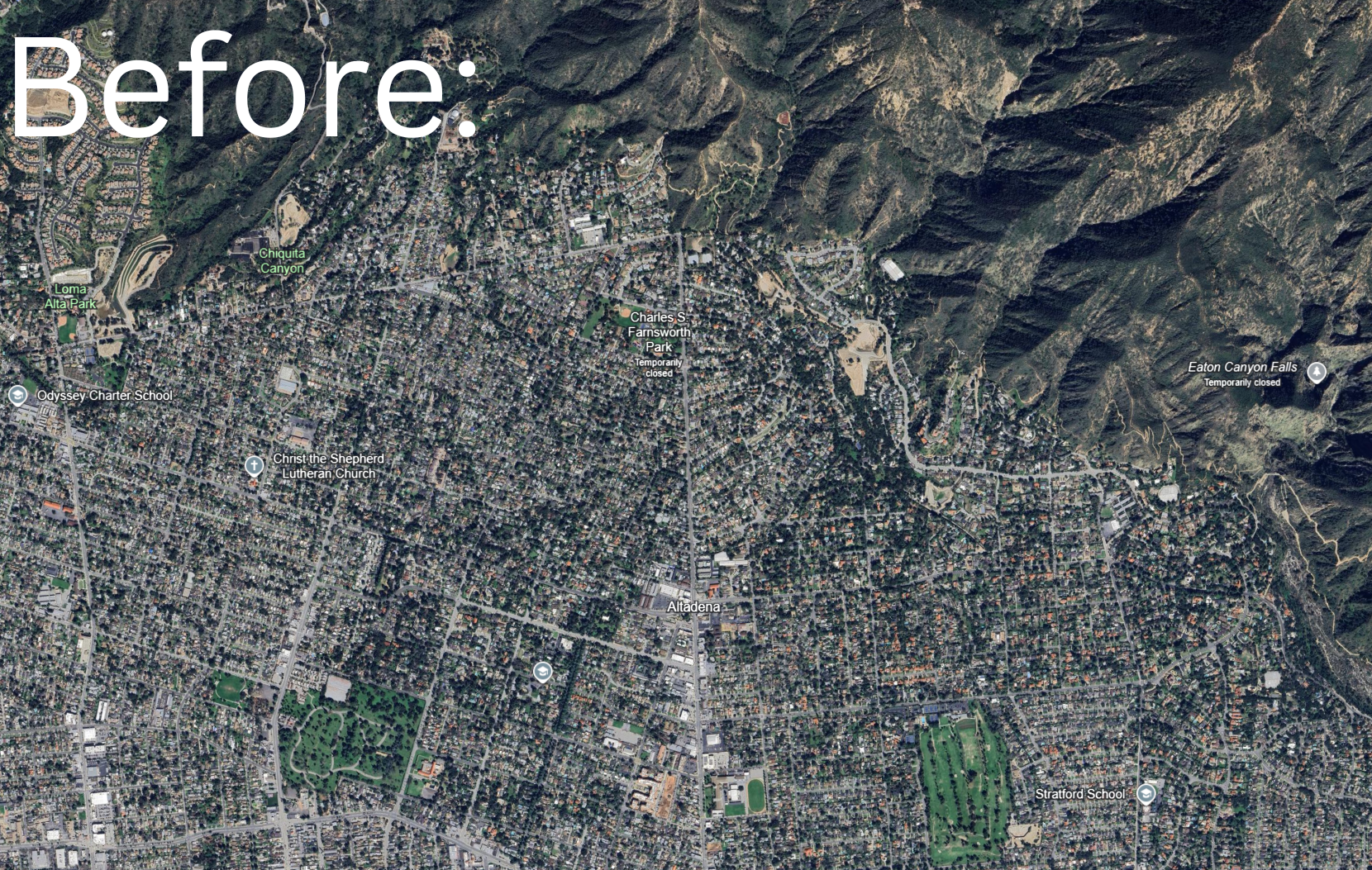

On January 7, 2025, at 6:18 PM, the Eaton Fire began in the San Gabriel Mountains near Altadena. After only 15 minutes, the winds created an ember storm that resulted in the ignition of fires one mile away from the initial fire location. These Santa Ana winds were so powerful that standing in the winds would be challenging, and covering one’s face became essential.
When it was eventually controlled 24 days later, the fire covered 14,000 acres, destroyed 9,413 structures, and took the lives of 19 people. This incident was the fifth deadlest and second most devastating wildfire to occur in California's history. It was determined that the cause of the fire was Southern California Edison power lines.
The real problem, however, lay in how long it took for the area to recover. By December 2025, eleven months since the tragedy, fewer than five tenths of a percent of the damaged houses had been reconstructed. In the meantime, more than three hundred lots had been sold, and close to half of those belonged to corporations and investors.
While almost all the lots had been cleared of debris by May 2025, around 88%, clearing a lot does not necessarily mean rebuilding a community. Thus, rather than designing one house, I decided to create a community center. Fixing homes was happening one by one, but the spaces that actually make up the community were being ignored.
Altadena’s History
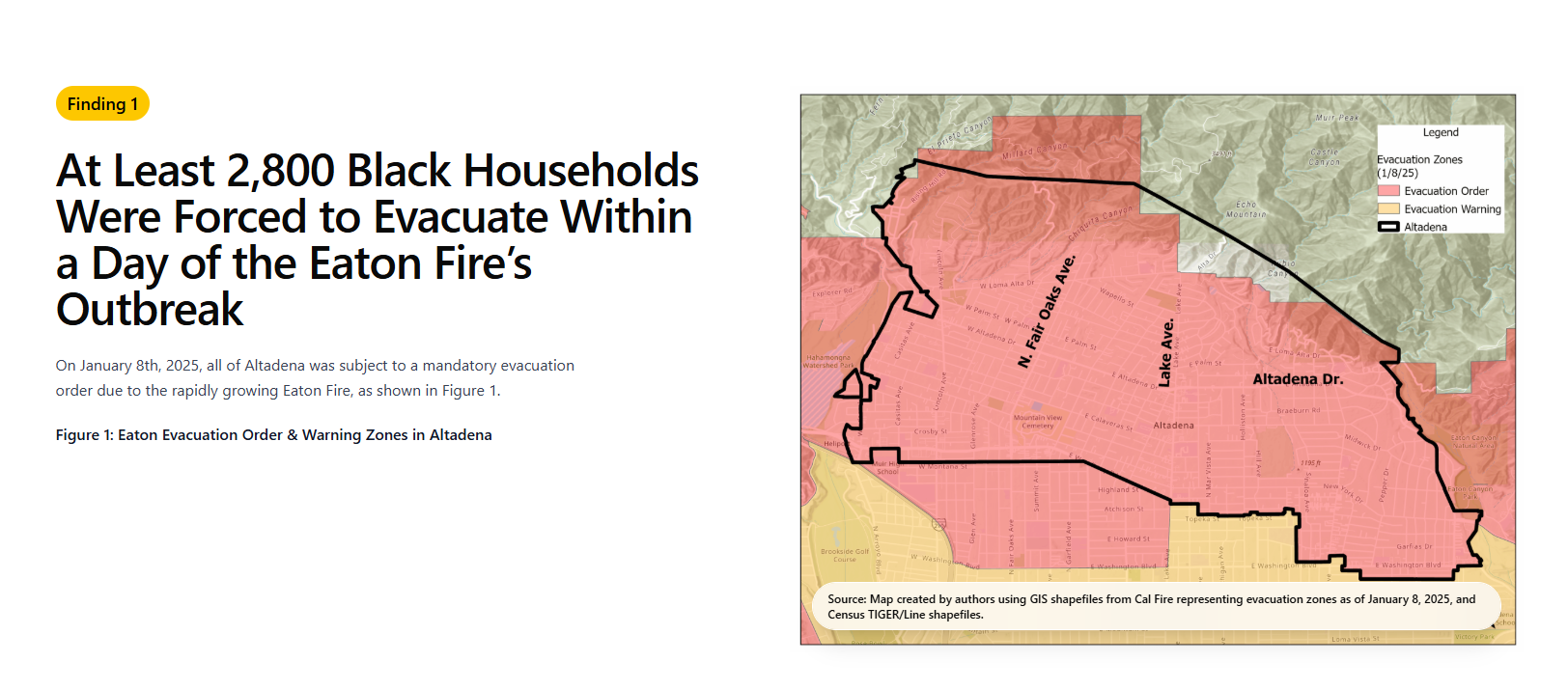
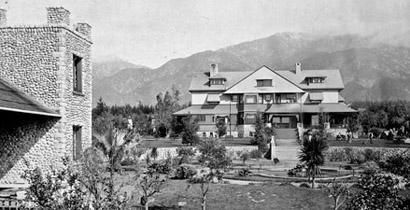
To design something that actually works for Altadena, I had to look at who this neighborhood belongs to and how the fire hit them.
Many historic Craftsman bungalows can be found throughout Altadena. It is a tight-knit community where people have called home for decades. Between the 1940s and the 1970s, the community evolved into one of the most significant centers for the African American middle class in California thanks to policies that allowed Blacks to buy property but prohibited them from doing so in other neighboring cities.
But decades of old housing boundaries meant these families were concentrated right along the mountain edge directly in the fire's path. A UCLA study showed exactly how hard they got hit:
- 48% of Black households were destroyed or severely damaged, compared to 37% of other homes.
- 57% of Black homeowners here are over 65, making it incredibly hard for them to deal with rebuilding stress or fight insurance companies while displaced.
With over 300 lots already sold to outside corporations, the actual community is at risk of being completely priced out and erased.
My project, The Altadena Hearth, is directly shaped by this. It uses traditional Craftsman design features so it feels familiar and fits the historic look of the neighborhood. More importantly, it is specifically designed as a supportive space for elderly residents and displaced families to get help, stay connected, and fight to keep their land.
Where I’m Building
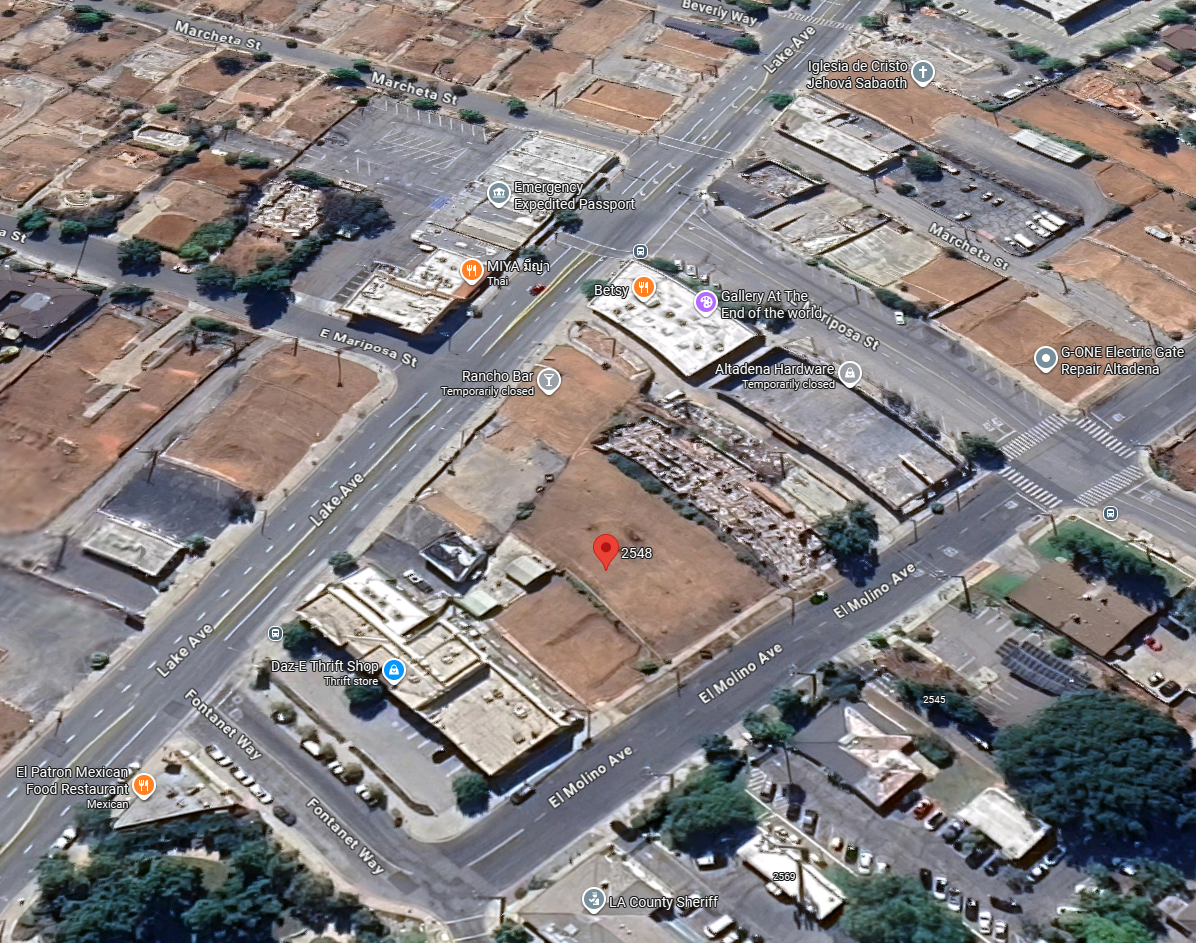
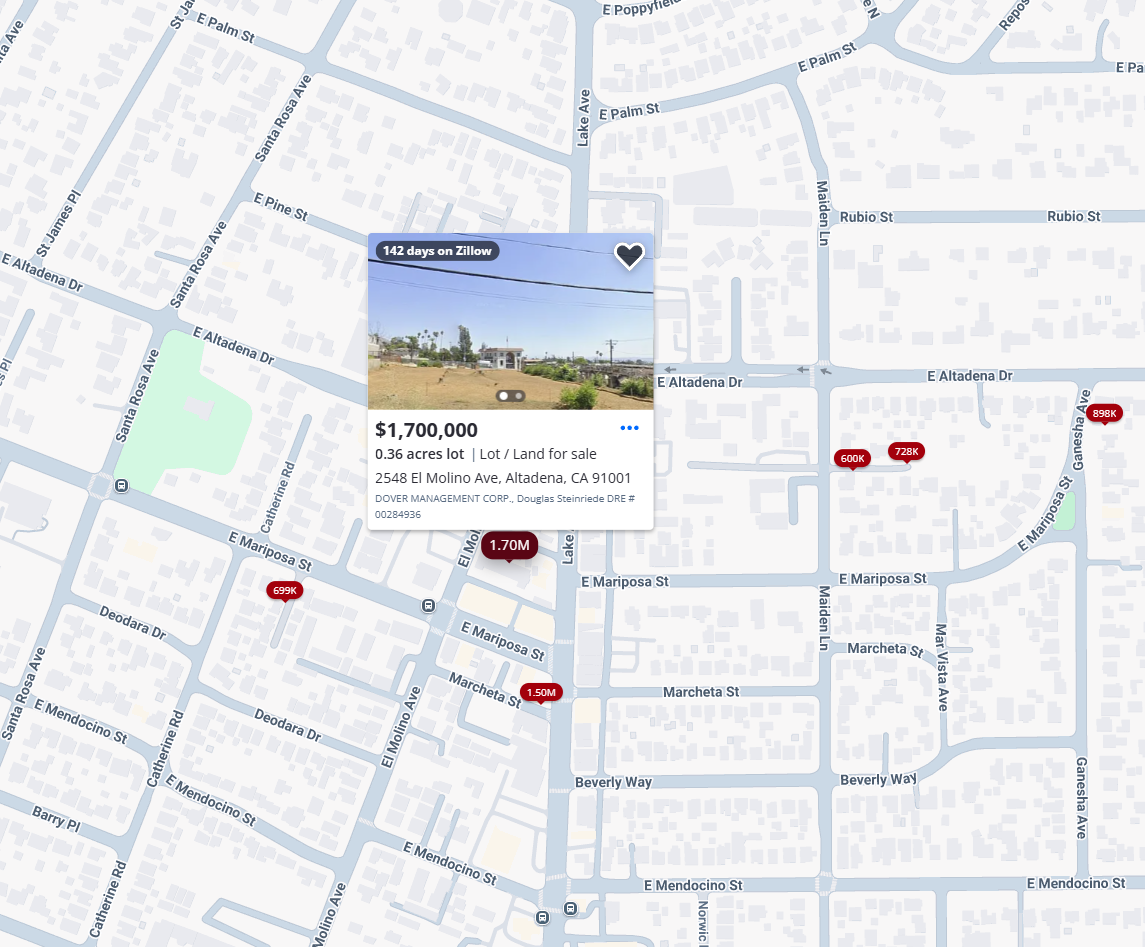
I chose to build on a plot of land at 2548 El Molino Ave.
The plot is a 0.36-acre vacant lot positioned right where El Molino Avenue intersects with Lake Avenue and East Mariposa Street. It sits right behind local commercial spots, with a cleared, dirt-graded footprint that makes it ideal for a new community build.
I chose this specific location for four main reasons:
- The site is directly within the hard-hit foothill area, meaning the recovery center is right in the community it serves rather than outside looking in.
- It is right off Lake Avenue, a major neighborhood artery, and has bus stops directly next to the property line. This makes it incredibly easy to reach for residents who might have lost their vehicles in the disaster.
- It is located directly up the street from the LA County Sheriff’s Altadena Station and right across from local commercial properties, keeping it tied to the active, surviving core of the neighborhood.
- The perfect size: At 0.36 acres, the lot provides roughly 15,600 square feet of space. This is the perfect amount of room to comfortably place a 10,500 square foot three-story facility.
The Problems I’m Solving
Problem 1:
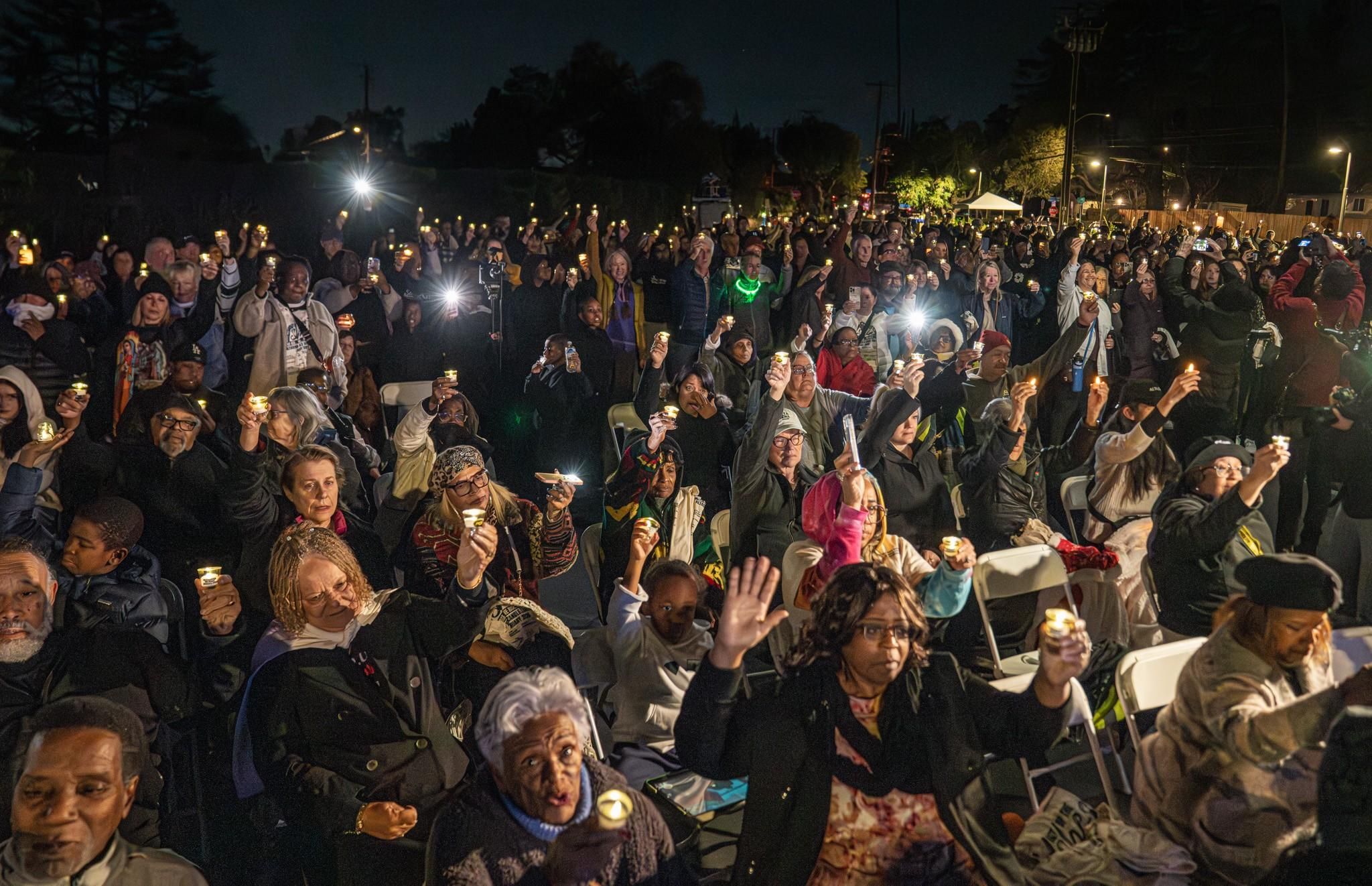
Survivors are scattered and isolated precisely when they need each other most. Research consistently shows that social connection is the strongest protective factor against long-term trauma. The Altadena Hearth gives the community a place to gather, support each other, and process what happened together.
Problem 2:
Rebuilding a home after a wildfire means navigating FEMA, insurance adjusters, contractor fraud, permits, and unfamiliar construction decisions, all while being totally exhausted and displaced. The building includes a resource library and workshop space where residents can access rebuilding guidance and connect with organizations like the Foothill Catalog Foundation.
Problem 3:
Displacement becomes permanent when there’s nothing pulling people back. For the thousands of Altadena families currently living somewhere else, a permanent, beautiful building that looks familiar, like their neighborhood.
Finding the Design
Before I opened Revit, I had to figure out what this building should actually feel like.
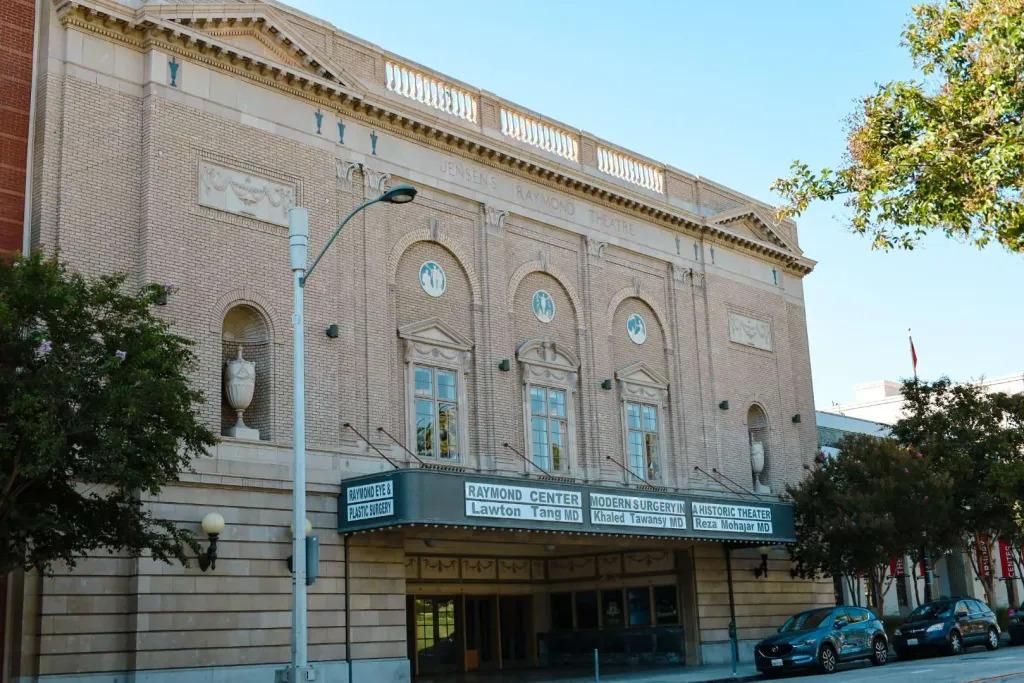
The first thing I knew was that it needed to look like it belonged in Altadena. That meant using bricks for materials and simple windows. Not something dropped in from outside, but something that looks like it grew out of the neighborhood. If the building feels foreign, it will not function as a community anchor. It has to look like it was always supposed to be there.
The second thing I knew was that it needed to face inward. Most public buildings face the street and treat the interior as functional space. But the experience of walking into a building matters, especially for people who are going through something hard. I wanted the act of entering to feel like arriving, like being received. That is where the courtyard came from. An open-air center court with a fountain, surrounded by rooms that all open onto it. From any room you can see the garden and the fountain. You can hear the water. You are reminded that other people are there.
The octagonal shape came directly from the courtyard idea. An octagon gives you eight faces, eight room zones, and a geometry that naturally pulls the eye toward the center. It is also unusual enough to be memorable without being strange. It does not look like a government building or a temporary structure. It looks permanent and considered.
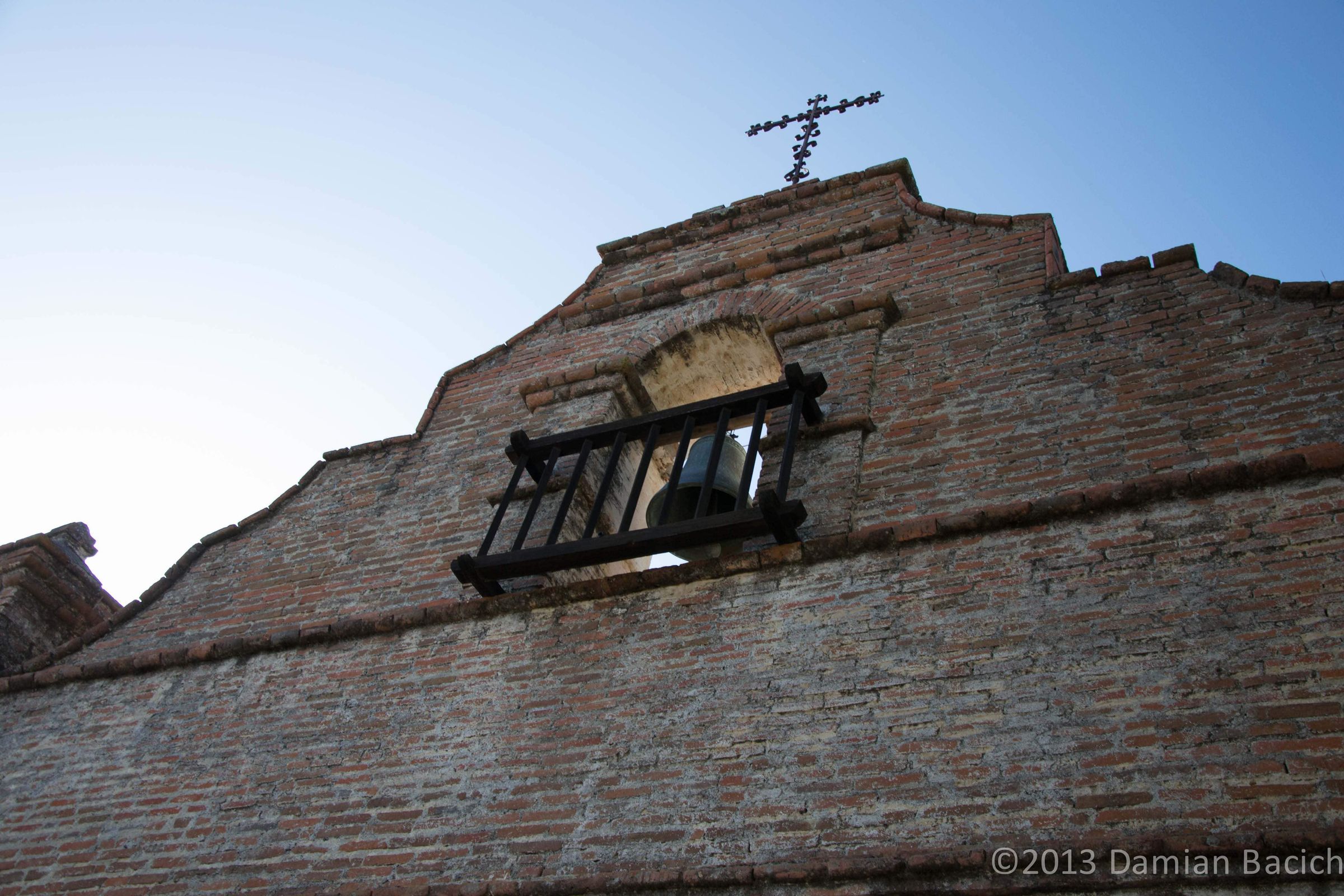
For references, I looked at Spanish mission courtyards for the inward-facing organization. Historic Pasadena civic buildings for the brick proportions and roofline character. And the surviving Craftsman homes in Altadena itself have the window details, trim color, and material palette. The goal was for someone who grew up in Altadena to look at the building and feel like they recognize it, even though it is new.
Modeling in Revit

With the concept clear, I built the full model in Autodesk Revit.
The exterior walls are modeled as brick. This is a non-combustible wall assembly, which is intentional given the fire history of the area. The windows are white-trimmed double-hung units arranged in a regular grid across all three floors of the facade.
The three-story height came from wanting the building to have a substantial civic presence on the street while keeping the footprint compact enough to leave room for outdoor space on the 0.36-acre lot. A single-story building of this program size would have covered most of the lot and left no room for the courtyard trees, the playground, or the landscaping that makes the exterior approachable.
The central courtyard is modeled as an open octagonal cutout of the building. The fountain is placed at the center of a circular stone path. Eight trees are planted in grass beds between the path and the courtyard walls. Four stone spokes paths connect the fountain circle to the room doorways. The courtyard is visible from every interior room on the ground floor through courtyard-facing windows and doors.
The ground floor contains the four primary program rooms: lobby, workshop, library, and resting room. Each room occupies one or two faces of the octagon and is separated from the others by partition walls with connecting doors. The upper two floors contain additional program space that I continued developing after completing the ground floor.
Outside the building, a curved stone path leads to the front entrance. Mature trees are placed along the property perimeter. On the south side of the building, a children's playground with a swing set and blue slide sits on a stone pad beside a secondary path. Open lawn fills the remainder of the site.
The Lobby Floor Plan

The lobby is the first space you enter from the front path. The interior brick wall faces you as you come in, with a row of intake counters running along it. This is where staff and volunteers sit to greet residents, direct them to the right room, help with sign-ins, and hand off paperwork. The counters are tall enough to work at standing or seated. Behind them, windows face the courtyard.
On the opposite side of the lobby, a seating area with sofas and a geometric area rug gives people somewhere to wait without feeling like they are standing in a line. The lobby is designed to feel more like a living room entry than a government reception desk. The parquet hardwood floor, the brick wall, and the courtyard light coming through the windows all work toward that.
The Workshop Floor Plan

The workshop is the working room. Cross-shaped worktables in the center of the space give multiple people room to spread out documents, open laptops, and work side by side without crowding each other. Additional work surfaces line the walls for one-on-one consultations. This is where residents sit down with trained volunteers to work through FEMA applications, review insurance settlement offers, check contractor license numbers, and understand permit requirements.
The room is designed for focused, practical work. It connects to both the courtyard and the exterior so that people can step outside if they need a break from a difficult conversation.
The Library Floor Plan

The library is an open reading and resource room. Unlike the workshop, it has no fixed desk arrangement. Bean bags, rugs, and sofas are spread across the floor. A small shelving unit along one wall holds resource materials, guides, and reference documents. People can sit anywhere — on the floor, on cushions, against the wall — to read, review information, or just be somewhere quiet that is not a motel room.
The room is deliberately low-pressure. There is no expectation of productivity. Courtyard-facing windows on one wall and smooth plaster on the other keep it from feeling heavy. The natural light from the courtyard garden makes it a more relaxed and healing environment.
The Resting Room Floor Plan
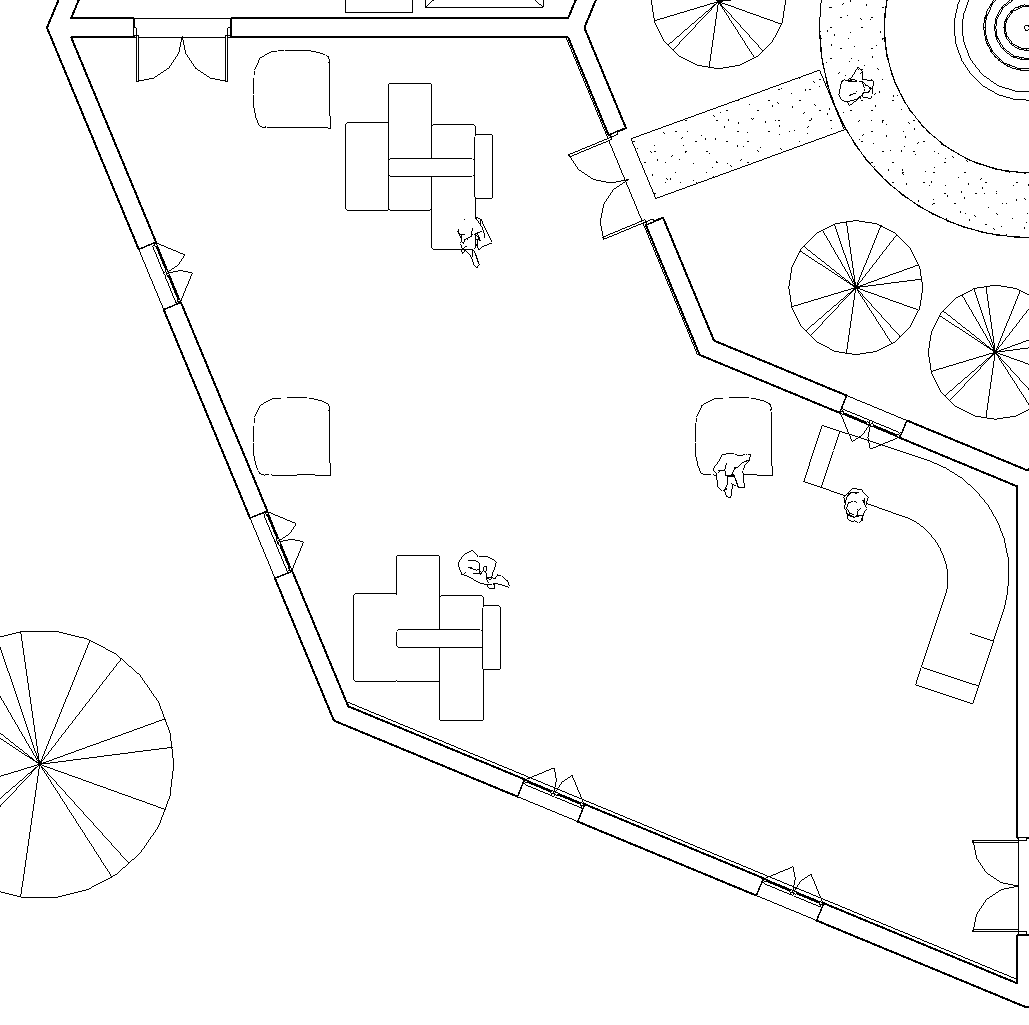
The resting room is the quietest space in the building. Sofas and navy bean bags are spread across a wide open parquet floor with no tables or desks anywhere in the room. A clerestory glazing strip runs along the top of the interior brick wall, bringing indirect light in from above the courtyard tree line without exposing the room to direct glare. Two doors connect directly to the courtyard.
This room exists because exhaustion is one of the least-addressed aspects of disaster recovery. People who have been displaced for months, fighting with insurance companies and living out of bags, are often simply too tired to engage with resources even when they are available. The resting room does not ask anything of the people who use it. It just gives them somewhere to be.
The Courtyard Floor Plan
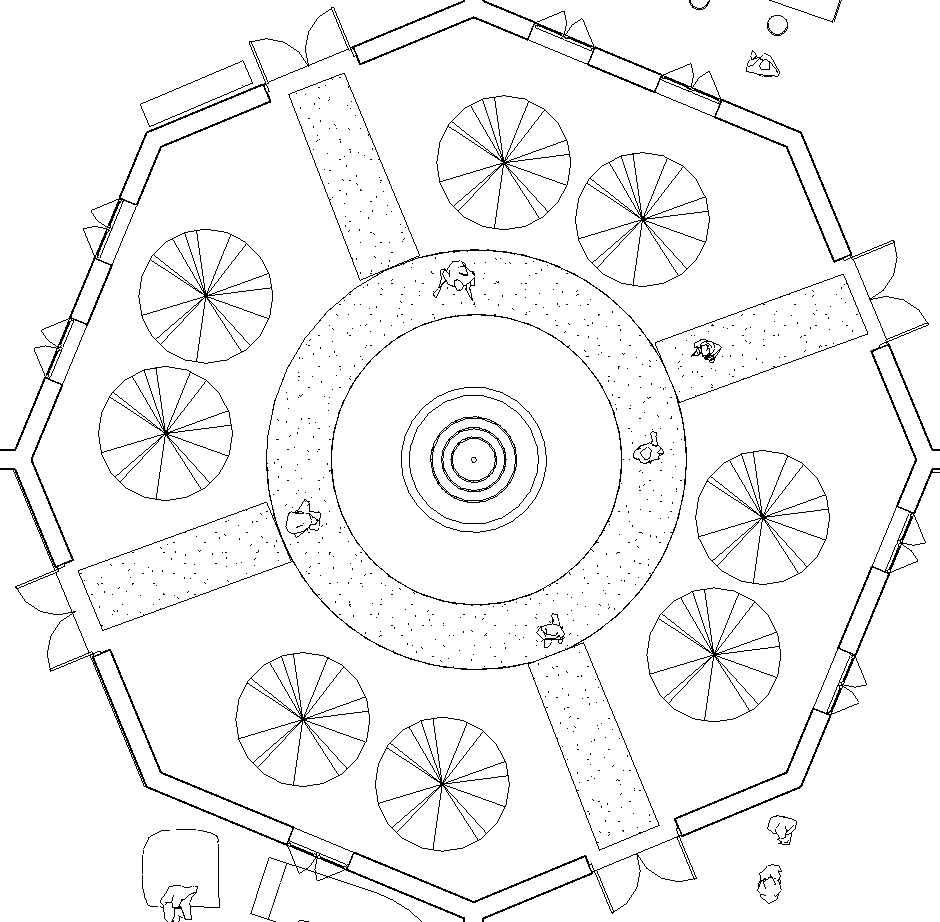
The courtyard is the heart of the building and the most important design decision in the project.
It is a fully open-air octagonal space at the center of the building. The three-tier stone fountain sits at the center of a circular stone path. Eight mature trees are planted in grass beds arranged around the path. Four stone spokes radiate outward from the fountain circle to the room entrances so that anyone moving between rooms passes through the garden.
The courtyard does several things at once. It is a source of natural light for every ground floor room because the building faces inward; the courtyard becomes the primary light source for the interior. It is a place to decompress between difficult tasks; stepping out of the workshop and into a garden with a fountain running is a very different experience than stepping into a hallway. And it is a social space that is always visible, so that people in any room are reminded that other people are present even when they are working alone.
The fountain specifically matters. Running water has well-documented effects on stress reduction. It also creates ambient sound that provides acoustic privacy. Conversations in the courtyard do not carry as easily into surrounding rooms because the fountain masks them. And it gives the courtyard a focal point that makes it feel like a place rather than just a gap in the building.
The trees were chosen to be tall enough to shade the courtyard paths while still allowing light into the rooms above. In the renders, they grow above the interior courtyard walls, visible through the clerestory glazing in the resting room and through the upper windows of the lobby.
Outdoors Renders
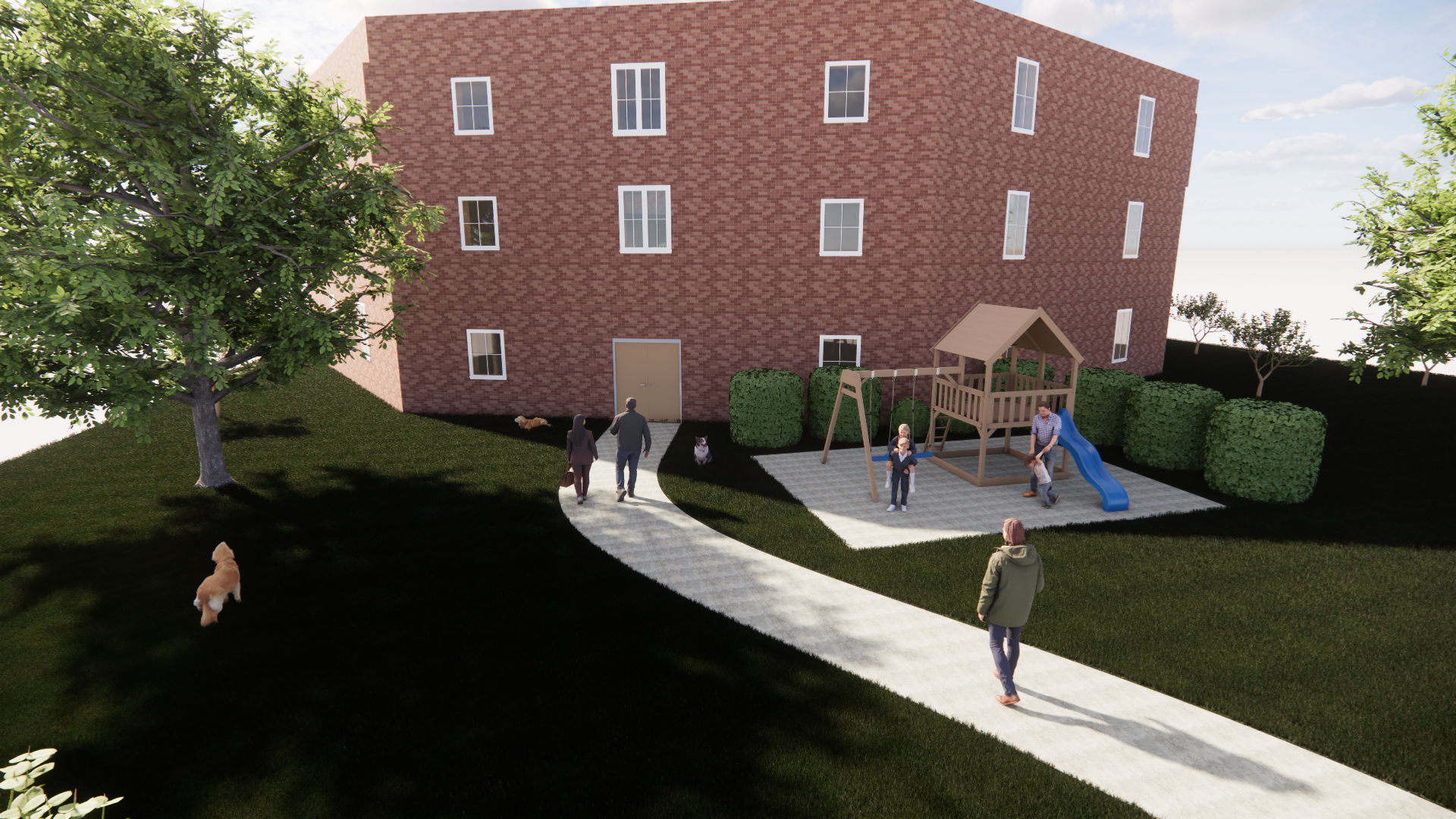
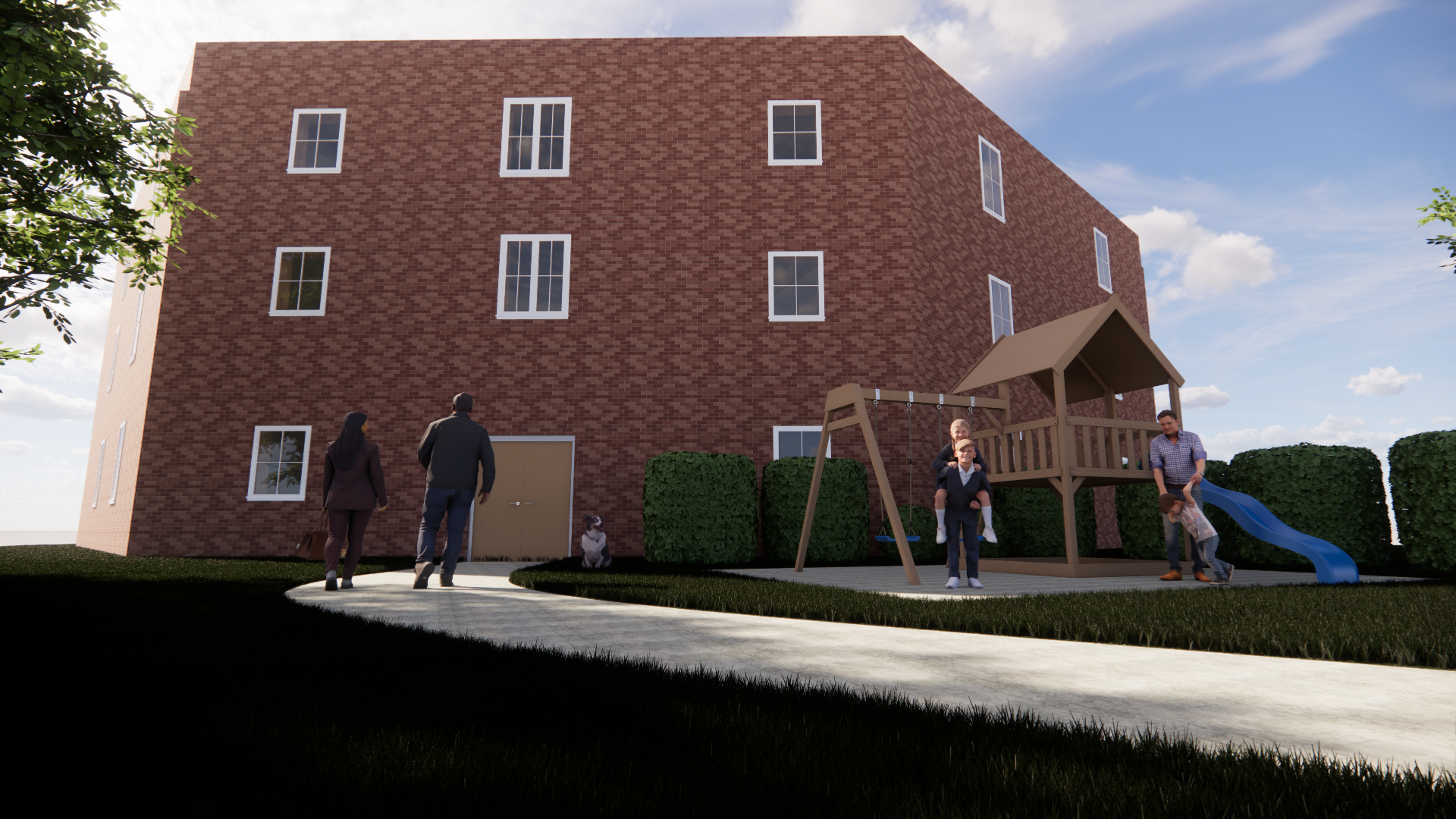
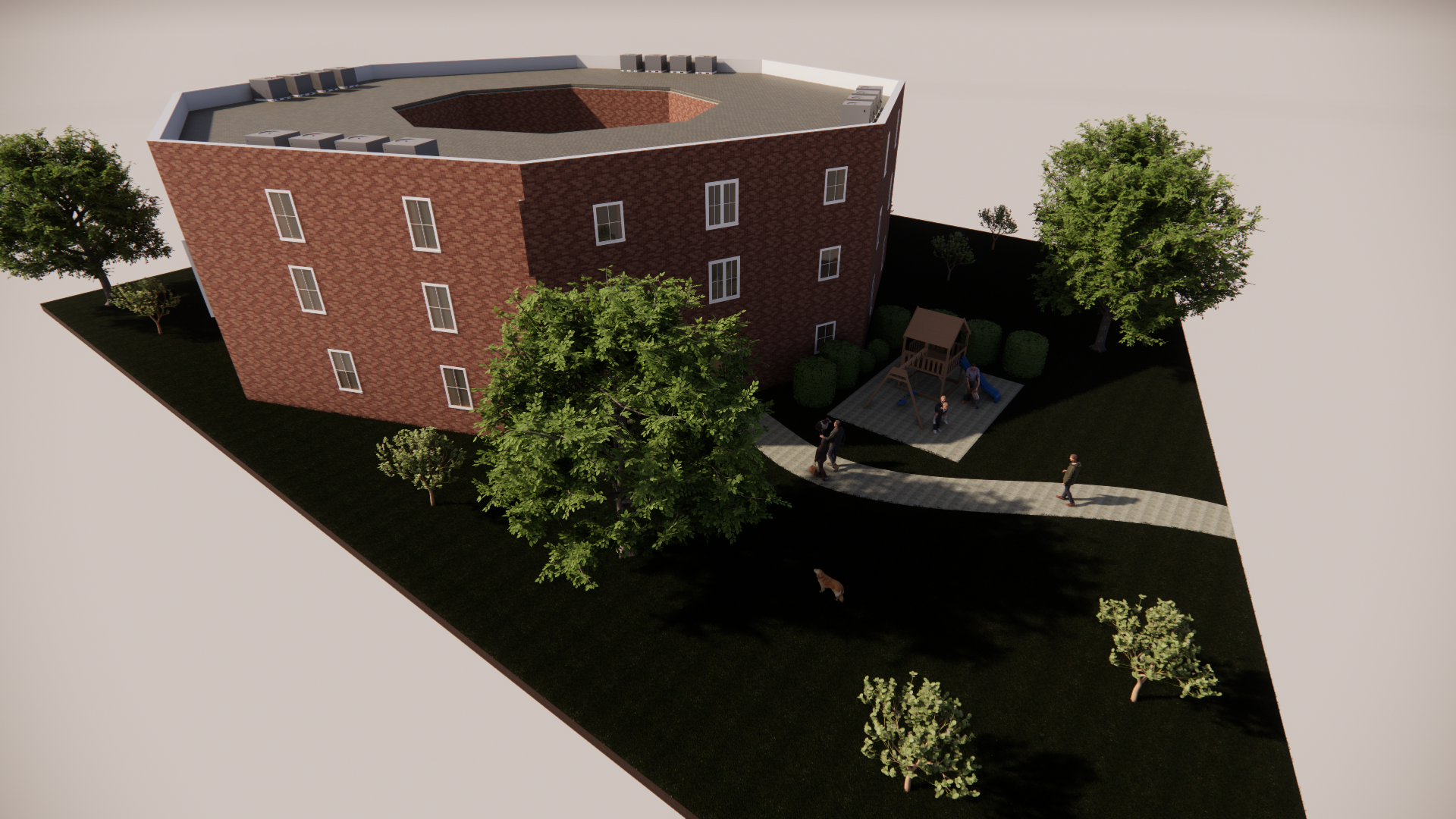
Once the model was complete, I used Enscape to generate real-time renders from inside and outside the building. Enscape runs as a plugin inside Revit, which means I could move the camera around the live model and render from any position. For my exterior shots, I decided to get a variation of high and low shots to capture every aspect of the outside. It was important here to set the correct time of day to get optimal lighting and have everything in the model visable.
Courtyard Renders
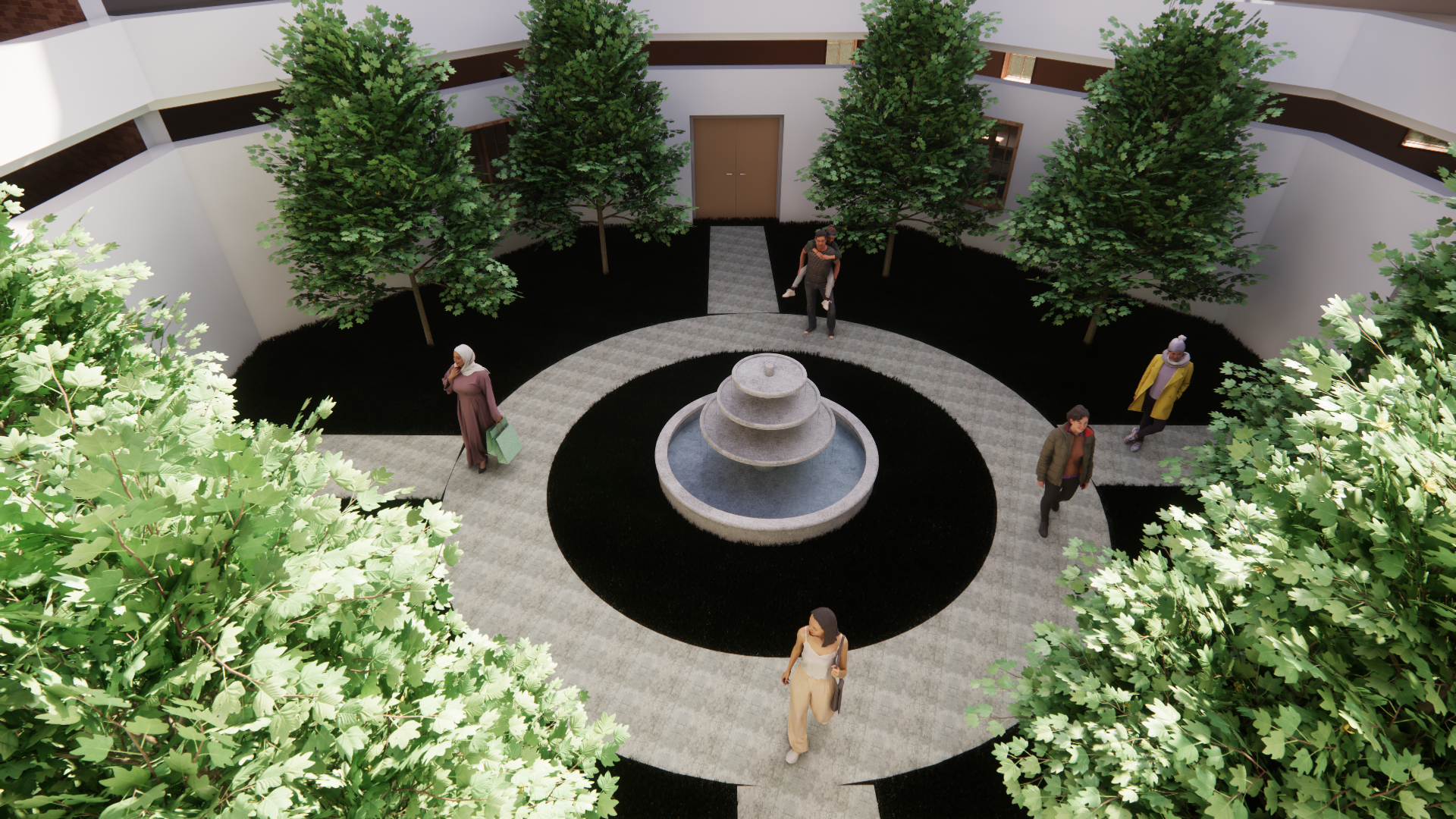
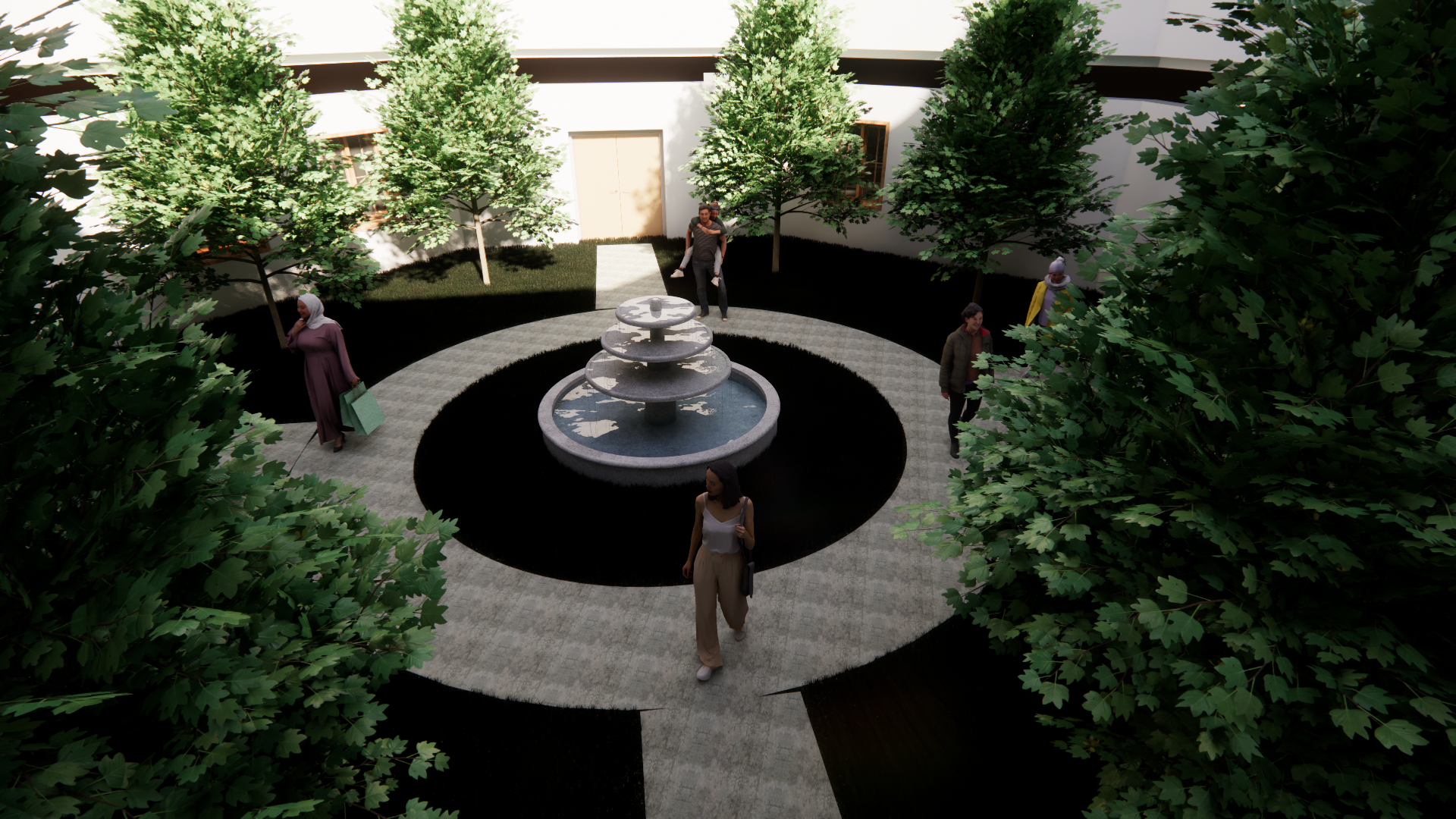
The courtyard was the most important space to render well because it is the heart of the building. I shot it from above looking down to show the full geometry. The circular fountain path, the eight trees, the four spoke paths leading to the room doors, and the upper floors of the building are visible above the courtyard walls. I also took a lower-angle shot from inside the garden to show the fountain at eye level with the tree canopy above. Getting the tree foliage to read correctly against the white courtyard walls required adjusting the time of day to avoid blowing out the sky. Here I also tried different sunlight angles to test out different shadow angles.
Lobby Renders
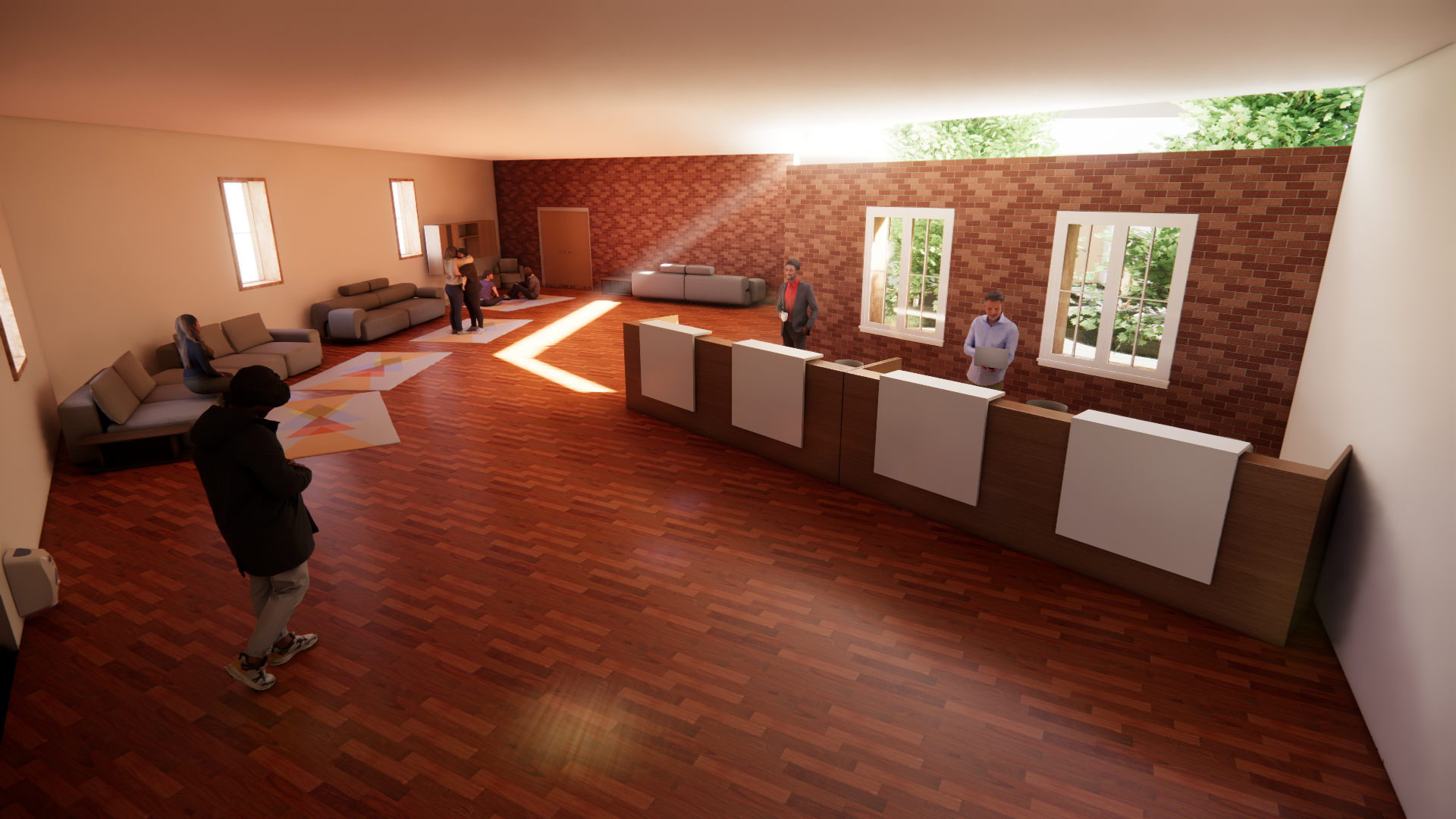
For the lobby I took multiple shots from different angles to show both the intake counter area and the seating side of the room but decided to settle on this shot. I wanted to capture how the courtyard light comes through the windows behind the counters and fills the space. The parquet floor reflects a lot of that light, so getting the time of day right was important here. I kept the camera at eye level to make the space feel lived-in rather than like a technical drawing.
Resting Room Renders
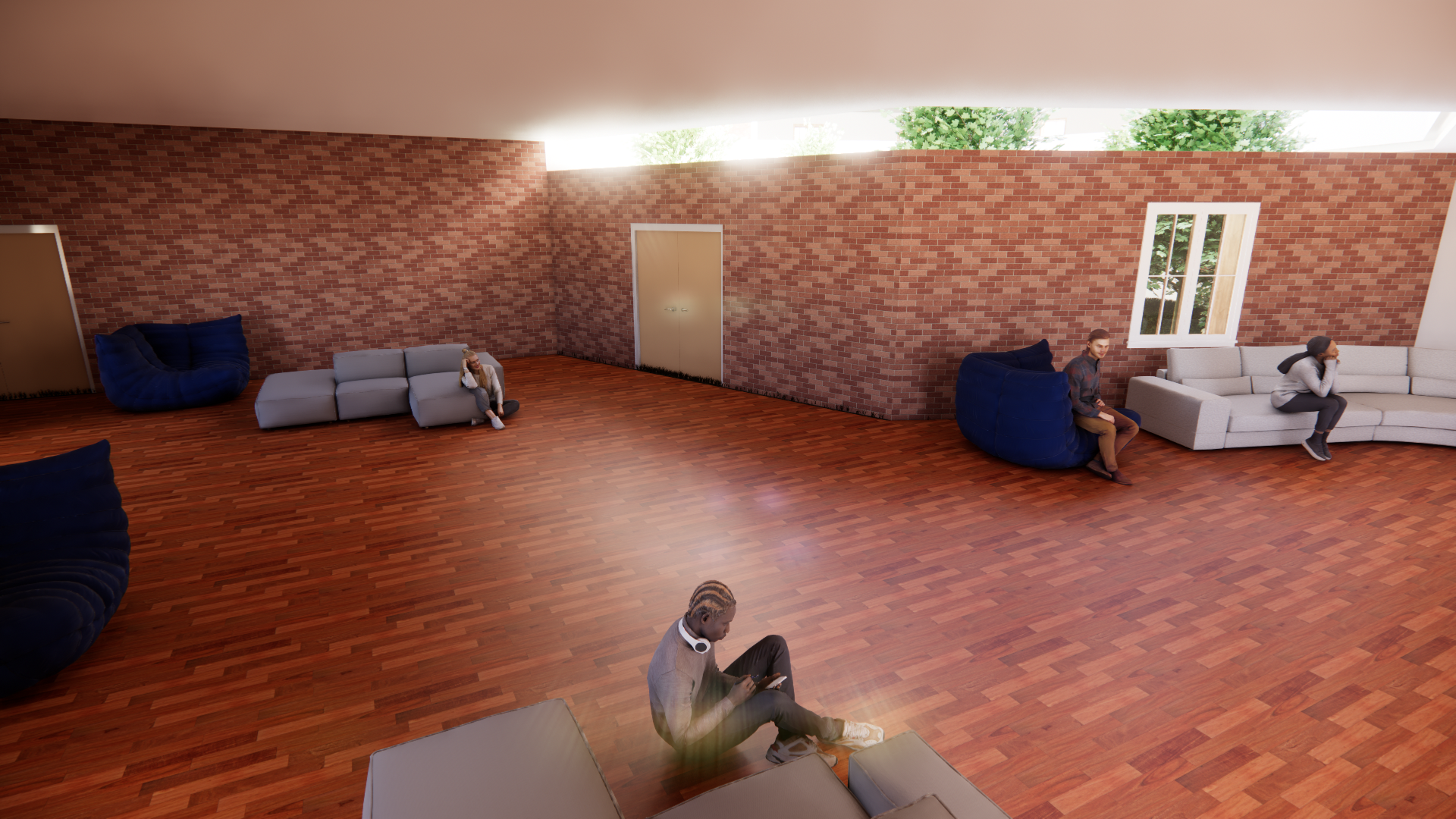
For the resting room I tested out different shots from opposite ends of the space to show how open and spread out it is. The main thing I wanted to capture was the light that came from the courtyard, and it is what makes the room feel calm without feeling dark. I kept people in the renders sitting on the sofas and bean bags on the floor to show how the room actually gets used.
Library Renders

For the library I shot from a high angle looking across the room to show the full floor layout. The rugs, the bean bags, the people reading on the floor, and the shelving along the wall. The library has light coming in from two directions, the courtyard-facing and outside windows, so I adjusted the sun angle until both sources were reading clearly without one washing the other out. I wanted the render to feel quiet and unhurried, which meant keeping the people in relaxed positions rather than standing or moving.
Workshop Renders
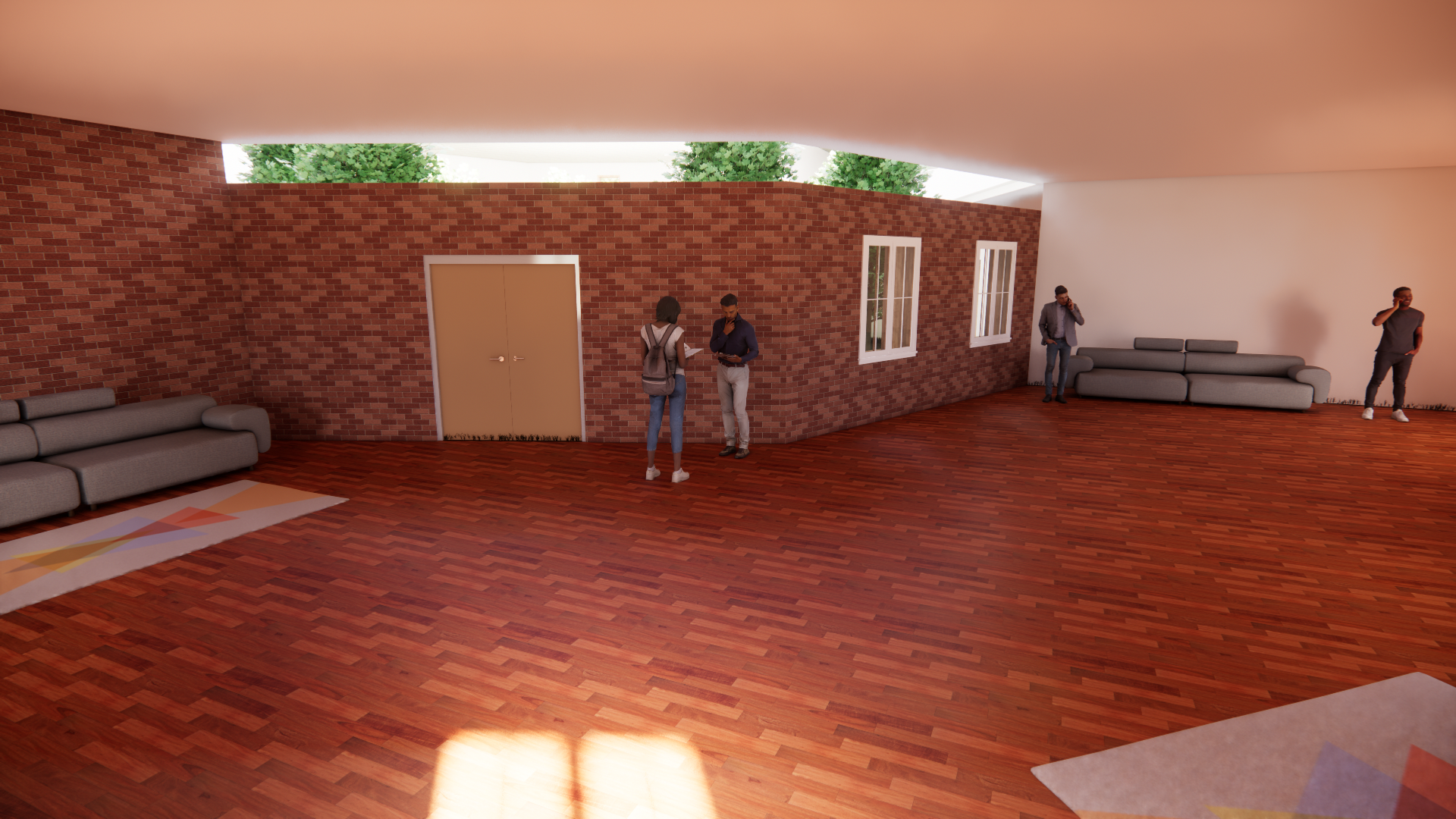
For the workshop I took shots that showed the full layout of the room. I wanted to make it clear that this is a functional working space, so I kept the camera at a level that shows the table arrangement and how multiple people can spread out and work at the same time. Getting the lighting right here was important because the room needs to read as bright and practical rather than dim, so I adjusted the time of day until the light coming through the outside-facing windows lit up the room.
What This Building Is Really For
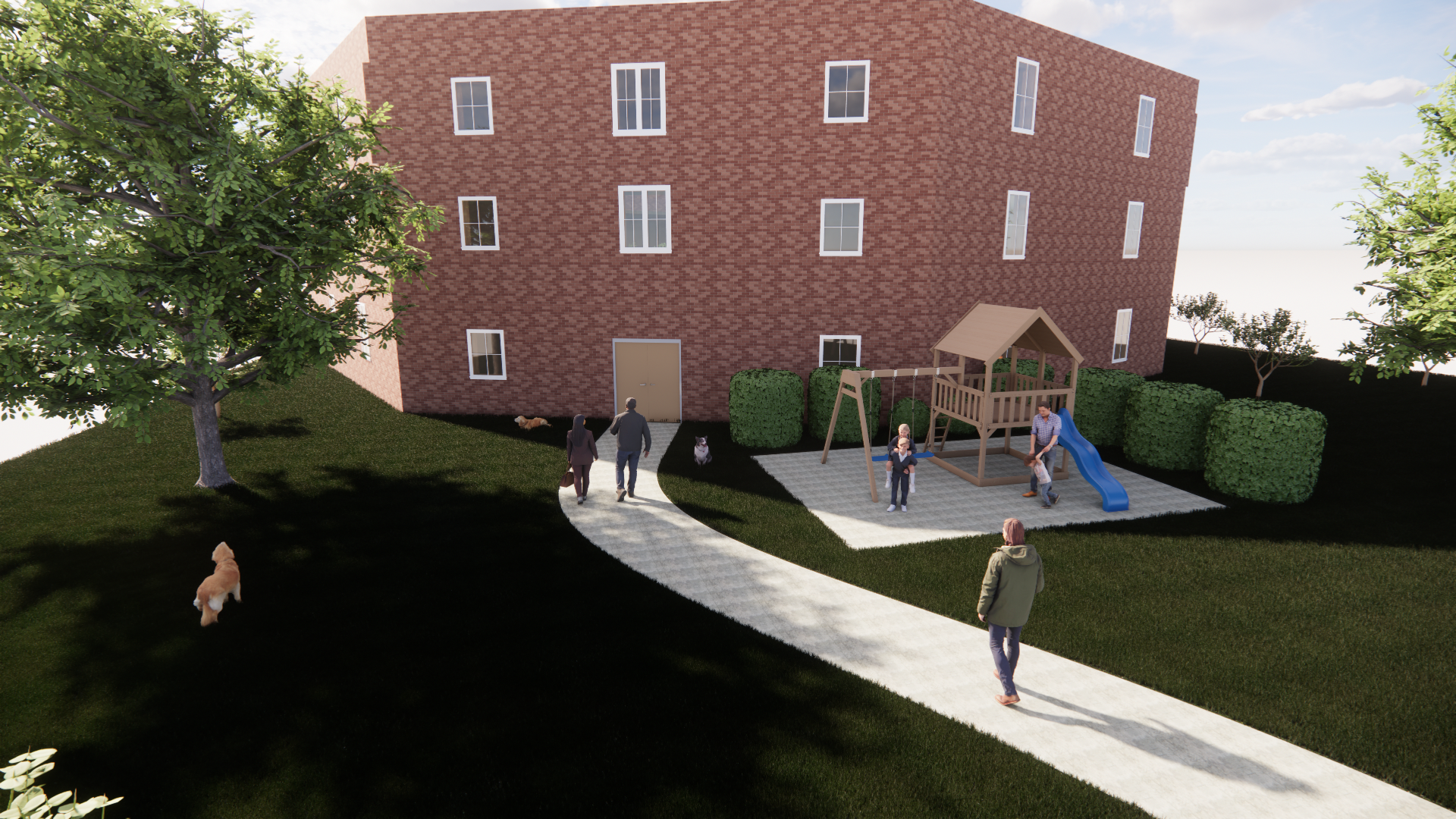
Step: What This Building Is Really For
On January 7, 2025, the Eaton Fire took 14,000 acres, 9,413 structures, and 19 lives in a single night. By December 2025, fewer than half a percent of destroyed homes had been rebuilt. More than 300 lots had already been sold to outside investors. A community that took generations to build was being quietly erased while its people were still living out of motel rooms and relatives' spare bedrooms.
The Altadena Hearth is not a monument. It is not a memorial. It is a tool.
It is a place where someone who lost their house can sit across from someone who knows how to fight an insurance underpayment and walk out with a plan. Where kids whose families are scattered across motels and relatives' couches can play outside while their parents figure out what comes next. Where people who have not seen their neighbors in months can see them again. Where someone who is just exhausted can sit down without anyone asking them to do anything.
The building is designed to be permanent. Not temporary relief infrastructure. A real building made of brick and stone, three stories tall, with a garden at its center and a fountain running in it. A building that looks like the neighborhood it serves, with the same brick, the same windows, and the same proportions as the Craftsman homes that defined Altadena for a century.
Some of those 9,413 structures belonged to my relatives. I was down in San Diego when it happened, just watching the notifications roll in and refreshing the fire map all night while my family dealt with it in real time. There was nothing I could do. This project is kind of my answer to that feeling. I am a first year college student and I do not have money or political power or any real way to fix what happened. But I know how to design things, and I had access to the software, and I had a reason to care. So I tried to build the thing I wished had been there. I hope it shows.
Works Used
Bloomberg. "Edison Reviewing Operations Around Start of Deadly Eaton Fire." January 9, 2025. https://www.bloomberg.com/news/articles/2025-01-09/edison-reviewing-operations-around-start-of-deadly-eaton-fire
Daily Sabah. "LA's 2 Fires Ravage Over 10K Structures, Prompting More Evacuations." https://www.dailysabah.com/world/americas/las-2-fires-ravage-over-10k-structures-prompting-more-evacuations
Altadena Heritage. "Green Man C House." https://altadenaheritage.org/green-man-c-house/
UCLA Bunche Center. "LA Wildfires: Impacts on Altadena's Black Community." https://bunchecenter.ucla.edu/reports/la-wildfires-impacts-on-altadenas-black-community/
Pasadena Star News. "Photos: Vigil Marks End of Week of Reflection on Year Since Eaton Fire." January 12, 2026. https://www.pasadenastarnews.com/2026/01/12/photos-vigil-marks-end-of-week-of-reflection-on-year-since-eaton-fire/
Just Move to Pasadena. "Pasadena's Brick Buildings." https://justmovetopasadena.com/brick-buildings/pasadenas-brick-buildings/
California Frontier. "What Were Spanish Missions?" https://www.californiafrontier.net/what-were-spanish-missions/
UCLA Latino Policy and Politics Initiative. "Rebuilding Altadena: Housing Recovery After the Eaton Fire." https://latino.ucla.edu/research/rebuilding-altadena-housing-recovery-after-the-eaton-file
LAist. "Corporations Are Buying Up Altadena Lots." https://laist.com/news/climate-environment/corporations-buying-altadena-lots