The Lattice Grove- Relief Center
by Gabriel Medina in Design > Architecture
145 Views, 1 Favorites, 0 Comments
The Lattice Grove- Relief Center

The Lattice Grove is more than a public community center; it is a meticulously engineered recovery ecosystem designed to confront the profound instability following major disasters. While traditional facilities often prioritize rapid, temporary shelter, this project recognizes that the destruction wrought by hurricanes extends far beyond structural damage to include the collapse of communal routines, leading to isolation, displacement, and long-term psychological trauma. By centering its mission on trauma-informed design and biophilic integration, The Lattice Grove provides a secure, universally accessible sanctuary that actively facilitates physical, emotional, and social restoration during the critical weeks following a crisis.
The structural foundation of the project prioritizes long-term resilience, utilizing an interlocking roof-to-foundation connection that creates a continuous load path to transfer massive uplift forces directly into the ground. This engineering choice increases wind resistance capabilities to 150 mph, ensuring the facility remains a reliable harbor when the community needs it most. This focus on permanence and stability is reinforced by the project’s deliberate layout, which employs a crescent-shaped form to create a sheltered, balanced environment that offers both communal openness and private, trauma-sensitive enclosure.
Unlike other community spaces that may feel cold or institutional, The Lattice Grove treats the built environment as a therapeutic partner. By integrating green roofs and biophilic elements, the design significantly improves emotional well-being and stress reduction. The facility flows intuitively between public anchors, such as the café and gathering spaces, to quieter, secluded zones for counseling and reflection, ensuring that the architecture supports every stage of the recovery journey. This holistic approach ensures that The Lattice Grove is not merely a building, but a vital piece of social infrastructure that strengthens community resilience and fosters healing long after the physical damage has been resolved.
Supplies
.png)

Fusion 360 to design the structure
Sketch Fab for the Low poly people assets and wheelchair
Research, Problem Finding, and Inspiration
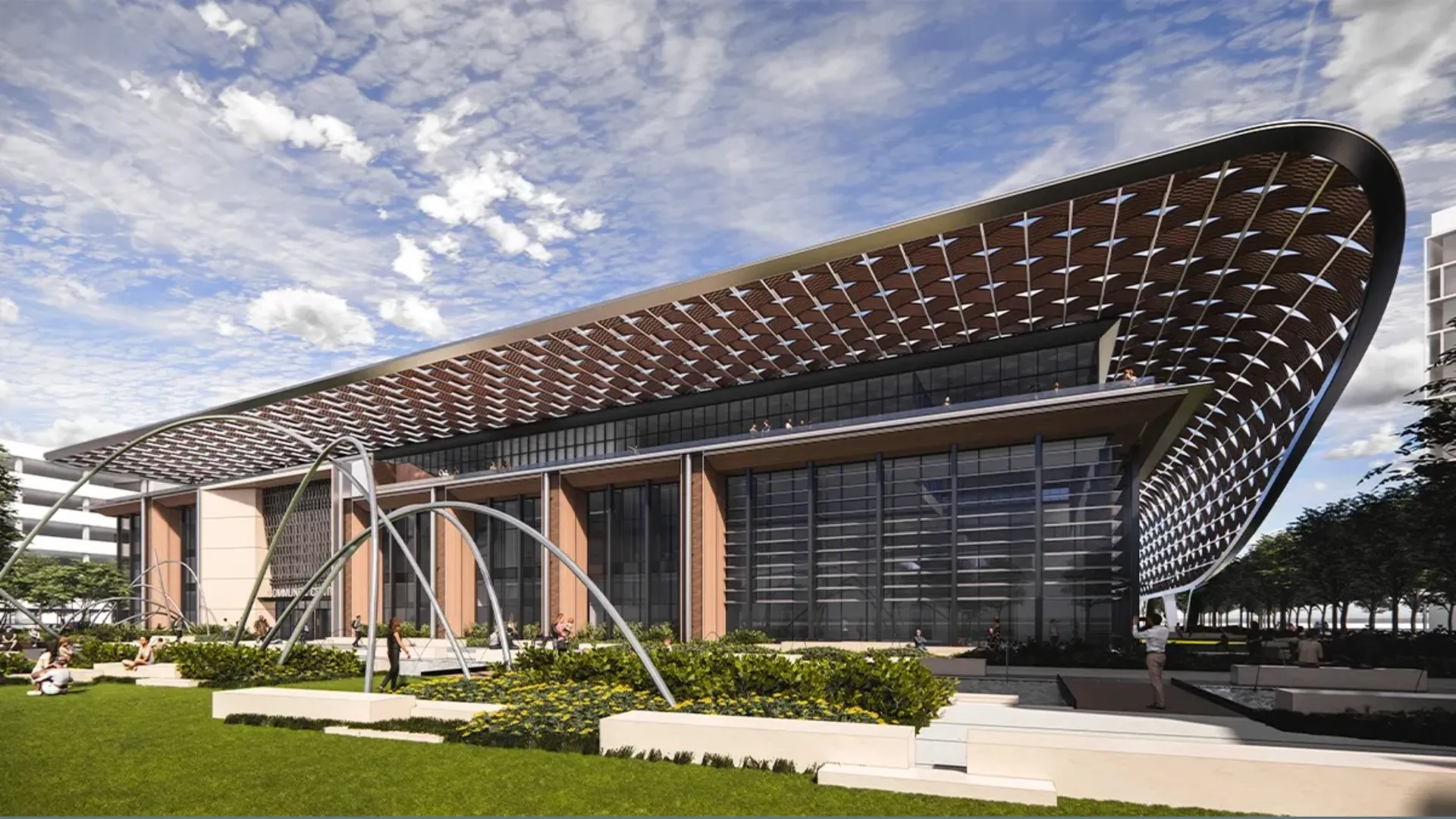
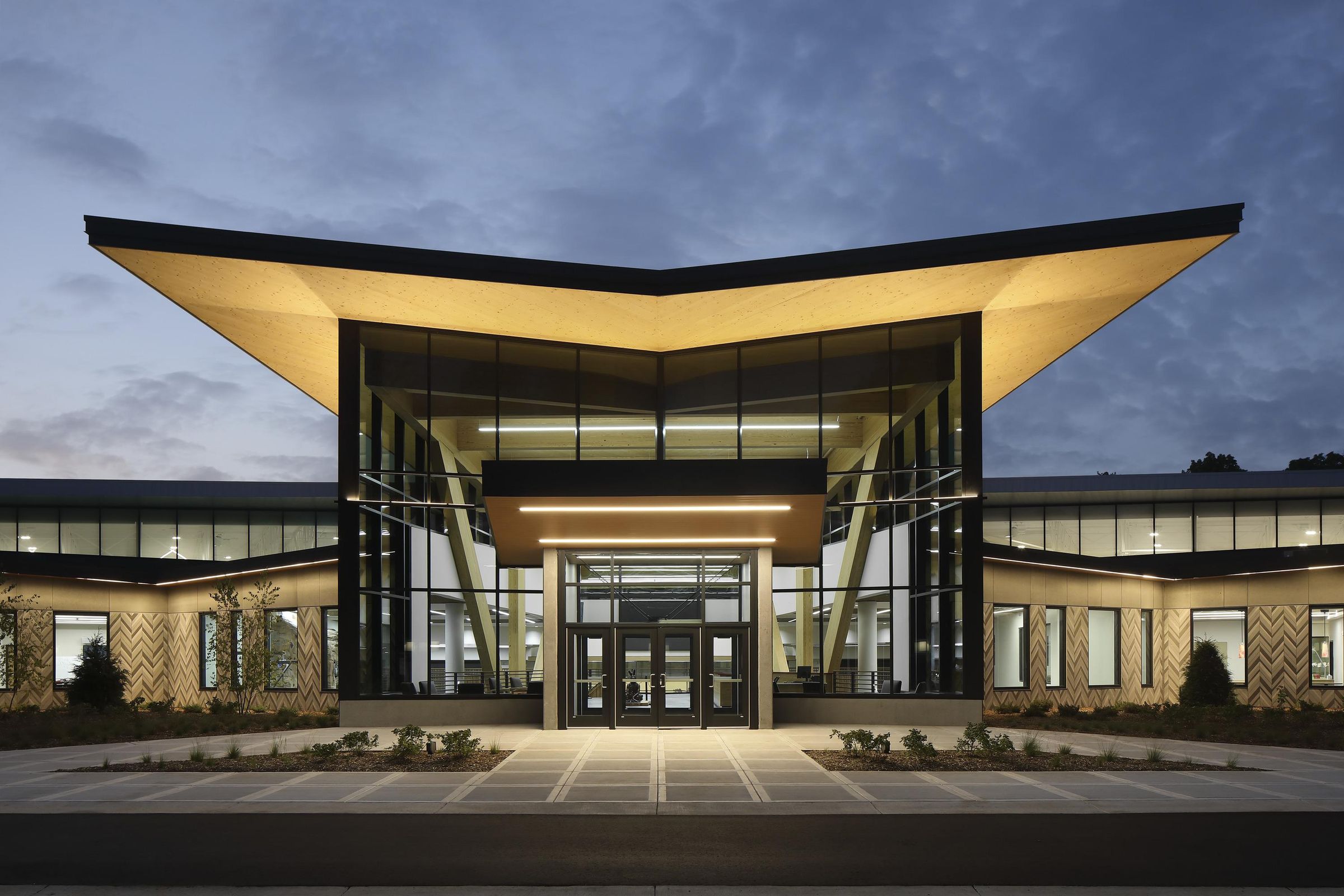
I started this project by looking at the real, recurring impact of hurricanes here in Florida. We’ve seen firsthand how disaster-driven displacement causes genuine psychological trauma, and that was the primary "Problem Finding" moment for me. I wanted to move past the cold, institutional feeling of standard emergency shelters and design something that actually feels like a place to heal.
When you look at my reference materials, you can see the two architectural styles I leaned on to guide my "Systems Thinking" approach. The first reference has this incredible, massive curved roof and a warm wooden lattice; I chose that because it completely rejects that temporary, "bunker" aesthetic and replaces it with something that feels safe and human. The second reference, with its soaring, wing-like canopy and huge glass entrance, showed me how to engineer an elevated profile that pulls in natural light—a key element in "trauma-informed design" to make sure people don't feel trapped.
By pulling these together, I came up with a blueprint that balances the heavy-duty structural survival we need for storm surges with the organic, soft curves that make a space feel like a sanctuary. It’s not just about a pretty building; it’s about moving from a clear community need to a technical, architectural solution that actually supports the physical and mental well-being of people going through a crisis.
Visualizing & Iterative Improvement
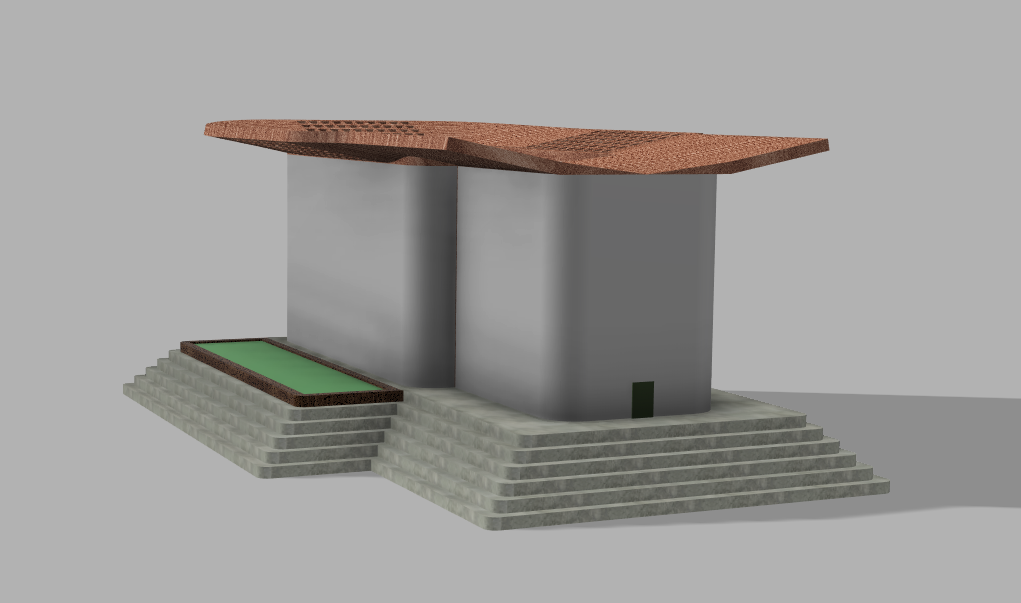

I find that I can map out the volume of the relief center much more effectively by jumping straight into a 3D environment, as it allows for a level of spatial visualization that 2D sketches just cannot capture. By setting up the primary massing this way, I was able to build a solid, scalable foundation that addressed the project's core structural needs from the very beginning. However, the engineering process really hit its stride when I focused on improving the design through several rounds of iteration. Initially, the model was a single solid body, which created a technical bottleneck for applying realistic materials. Using Creative Problem Solving, I redesigned the structure into a modular system. By separating the roof, walls, and other peripheral elements into distinct components, I gained the granular control needed to refine both the structure and the occupant experience.
This shift was critical for implementing biophilic principles. To move away from the rigid, institutional "box" aesthetic that often characterizes temporary shelters, I introduced an articulated timber screen that wraps around the building. This facade articulation performs two vital roles: breaking the massing by adding depth, texture, and organic curves to transform a standard, boxy volume into a more dynamic and inviting form; and establishing a biophilic connection by acting as a natural visual buffer that bridges the gap between the interior sanctuary and the outdoors. This creates a softer, more restorative environment that aligns with trauma-informed design, ensuring people feel safe and connected rather than trapped in a cold, metal bunker.
Ultimately, this modular approach did more than fix a technical texturing issue; it created a logical, scalable framework that mirrors how these structures would actually be assembled for efficient, real-world deployment. This modularity also opened up new possibilities for addressing the site specific needs of the relief center. By treating each section the foundation, the structural frame, and the roof canopy as an independent module, I can now easily adapt the design for different terrain types or environmental challenges without having to restart the modeling process from scratch. Moving forward, I plan to leverage this framework to integrate high-performance energy systems, such as solar-integrated roof panels and efficient rainwater collection units. By continuing to iterate on these individual components, I can ensure that the relief center not only provides immediate psychological relief through its biophilic design but also functions as a sustainable, long-term resource for the communities it serves.
Finding a Plot of Land

https://www.land.com/property/10-acres-in-columbia-county-florida/26650902/
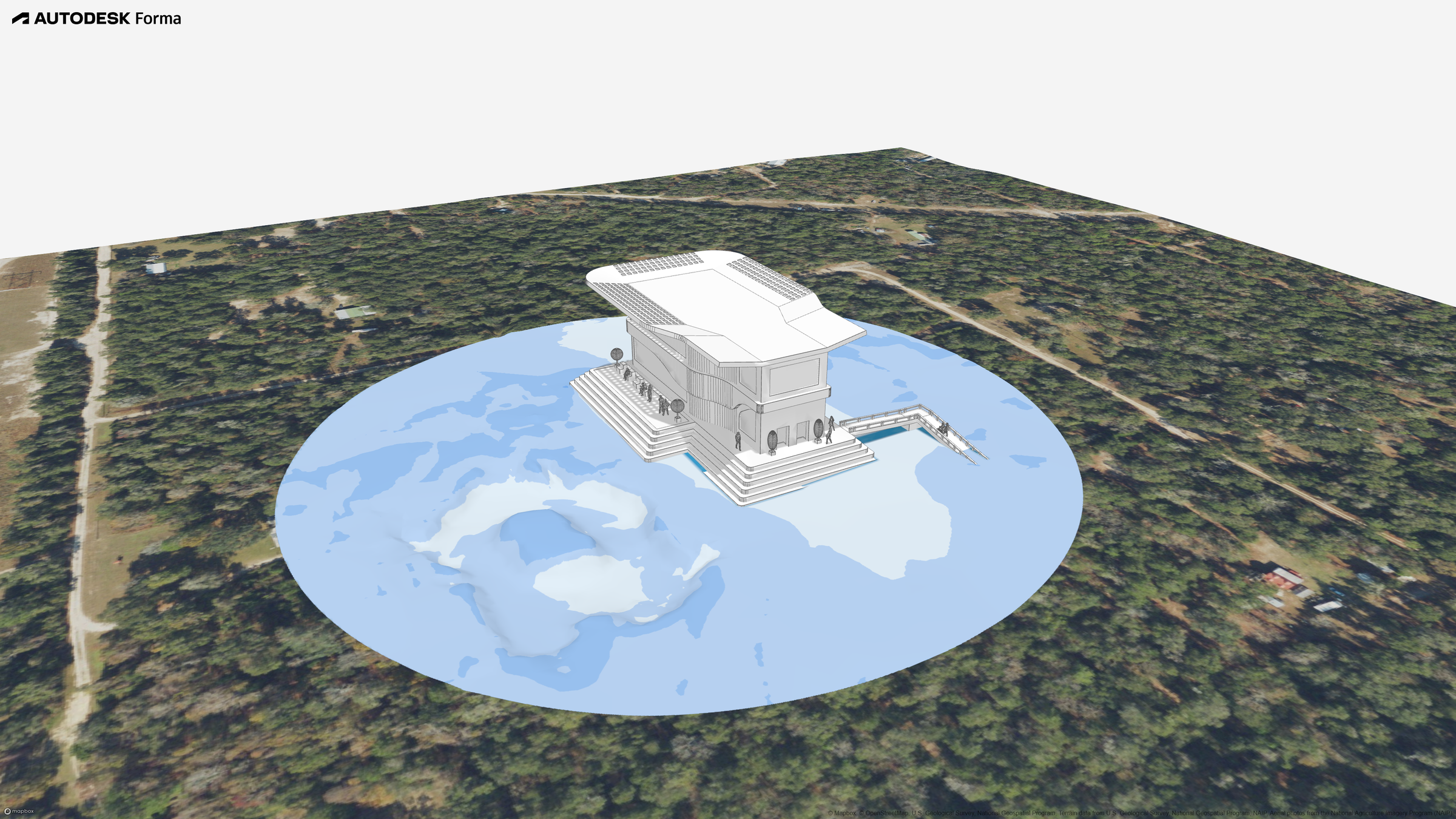
When selecting an ideal parcel for the relief center, the objective was to balance accessibility with long-term environmental resilience. Rather than choosing a site close to major cities—which are often at the highest risk for severe flooding—I opted for a 10-acre rural parcel in Columbia County, Florida. This location offers a significant advantage in terms of storm surge and flood mitigation, with a low flood risk rating of 4/10; even during heavy downpours, the risk of inundation is minimal compared to low-lying coastal areas.
To further enhance the safety and functionality of the site, I integrated specific environmental adaptations into the design. Although the land is inherently high and dry, the structure is elevated on a concrete podium to ensure that any surface runoff is diverted away from entrances, keeping all healing spaces functional during extreme weather events. Furthermore, the site’s dense surrounding forest serves as a natural barrier, breaking destructive hurricane winds into lower air currents. By analyzing localized wind speeds using Autodesk Forma, I positioned the accessibility ramp on the leeward, sheltered side of the structure, ensuring that occupants can reach the building safely even during high-wind emergencies.
Floor Plan


I used Gemini AI to generate the floor plan
So, the first floor is basically set up to be the go to spot the second someone walks in, especially when things are super chaotic after a hurricane. Everything starts at the Reception & Triage desk, which is right by the front door to help get people pointed in the right direction immediately.
Once they are checked in, the Recovery and Case Management area acts as the main hub where folks can start tackling the heavy-duty stuff like paperwork. We have the layout split up so it makes sense. On one side, you have the Health & Wellness Room, the Community Lounge, and private spots for when people just need a calm, quiet place to talk or destress. Right nearby, there are desks for Housing Support and Insurance Claims so people can get their immediate survival needs sorted out fast.
On the other side of the hall, we focus on the professional and legal side of things, with offices for Mental Health Support, Crisis Counseling, Legal Aid, and Emergency Aid applications. The coolest part has to be the Children’s Play & Childcare Area right in the middle. It is like a little anchor point that keeps the kiddos safe and occupied while the parents are dealing with all the adult-level recovery tasks. To wrap things up, the back of the floor features the Computer Lab and a Community Kitchen, which are just essential for people to get back into their normal routines or grab a bite to eat.
Once you head upstairs, the vibe shifts to focus on healing, learning, and getting creative.
The north side is all about sustainability, featuring an Urban Farming & Sustainability Learning Center where you'll find hydroponics, a seed library, and a space for cooking demos. Right next to that, there’s an office for managing the community garden and a lab for testing bio-materials. The very center of the floor is a cool open to below double-height space that keeps everything feeling bright and connected to the first floor.
On the west side, it’s all about health and making things. You’ve got a Physical Therapy studio, a couple of health clinics, and a flexible makerspace loaded with tools and an electronics station. Over on the east side, it’s a bit more focused on research and tech, with an Art Therapy Room, a Mind-Body lab, a Digital Research Station, and a Collaboration Hub for video conferencing.
Finally, the southern tip of the floor is the ultimate chill zone. It’s a meditation and wellness sanctuary complete with a reflexology path, some smooth river rocks, and quiet lounges where you can store your stuff and just decompress.
Wind Resistance
.png)
To ensure the structure can withstand severe weather, the design utilizes an interlocking system for the roof that significantly boosts its resilience. By anchoring the roof securely to the walls and continuing those connections down to the foundation, we establish a continuous load path that transfers massive wind forces directly into the ground. This setup is crucial because it counteracts the extreme upward pressure generated during a hurricane, preventing the structure from being pulled apart at the seams. Moving from standard materials to an engineered interlocking system increases wind resistance capabilities from approximately 70 mph to 150 mph. This jump in performance is not just an aesthetic choice; it is a fundamental engineering requirement for providing a reliable, long-term sanctuary that can endure high-velocity wind events.
Elevated Steps
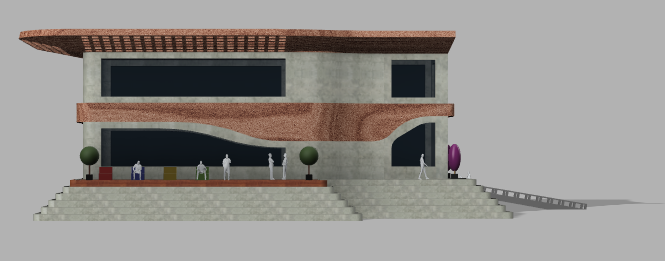
The Lattice Grove is built for one main purpose: to keep a community safe and connected when a hurricane hits. While most buildings focus only on staying standing, this project is designed as an "integrated recovery ecosystem." It understands that the real destruction of a storm isn't just broken windows or walls; it’s the long-term trauma, isolation, and loss of the community gathering spots that people rely on to feel normal.
The engineering isn't just there to look good—it is the foundation of the safety we provide. The design uses an interlocking roof system anchored directly to the foundation. This creates a continuous load path that transfers massive wind forces straight into the ground. By switching from standard shingles to an engineered interlocking system, we jump our wind resistance from 70 mph to 150 mph. This isn't just about avoiding damage; it is about providing a space that people can truly trust during the weeks of uncertainty that follow a disaster.
We also looked at how the layout of the building affects the people inside. Instead of an institutional feel, we used a crescent shape that creates a balance between being open enough for people to gather and private enough for those who need a quiet space to heal. By bringing in natural light and biophilic elements—like green roofs and direct views of the outdoors—the building itself helps lower stress and supports emotional recovery. The Lattice Grove is designed to be a place where community life doesn't just survive after a storm, but starts to heal right away.
Accessibility

Accessibility is not just a feature at The Lattice Grove; it is a core commitment to the independence and dignity of every community member. We recognize that true recovery is only possible when a space is usable by everyone, so we designed a wrap-around accessibility ramp that extends naturally from our elevated platform. This ramp includes a sturdy, dedicated railing system that provides stability and guidance, ensuring that all residents can reach the main entrance safely and on their own. By making this inclusive design a primary feature of the building, we ensure that every person in the community can move through the space with total autonomy, regardless of any physical mobility challenges they may face.
Rendering
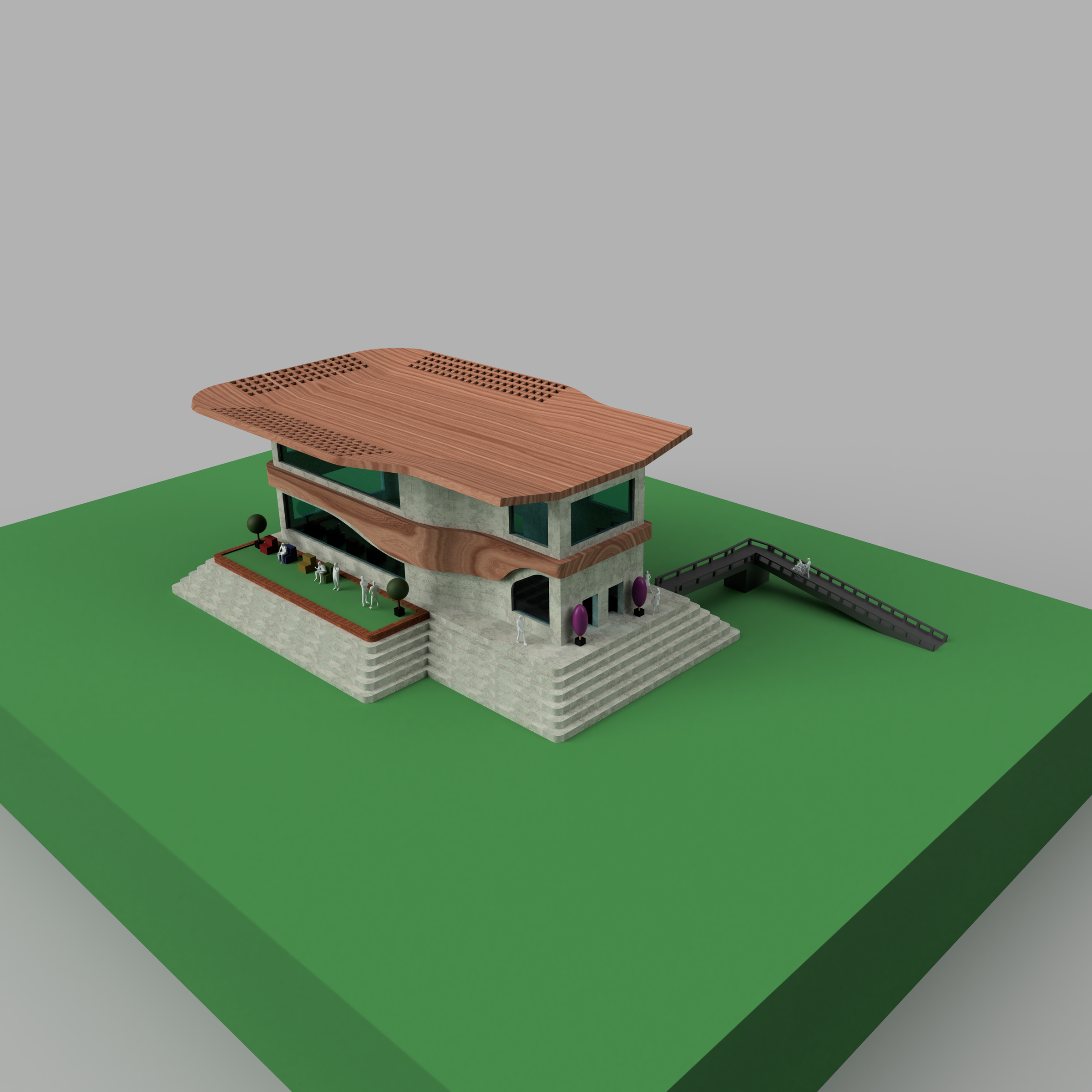
To finalize the design, I used Fusion 360 rendering to bring The Lattice Grove to life. This stage was essential for bridging the gap between my final design and a finished, human centric architectural vision. By applying realistic material textures in the rendering engine, I was able to see how the wooden lattice and canopy contrast with the concrete podium, confirming that the design achieves a warm, inviting feel that stands in sharp contrast to the cold, clinical aesthetic of standard emergency shelters.
I also used these visualizations to verify the final assembly of my wind-resistant features. Being able to see the rendered connections between the roof, walls, and foundation allowed me to confirm that the continuous load path I designed would look as structurally sound as it performs under pressure. Finally, by integrating the low-poly people and wheelchair models from Sketchfab, I was able to test the floor plan for real world usability and accessibility. These final renders serve as visual proof that the layout is functional, resilient, and designed to provide a dignified sense of peace for those who need it most.
Conclusion

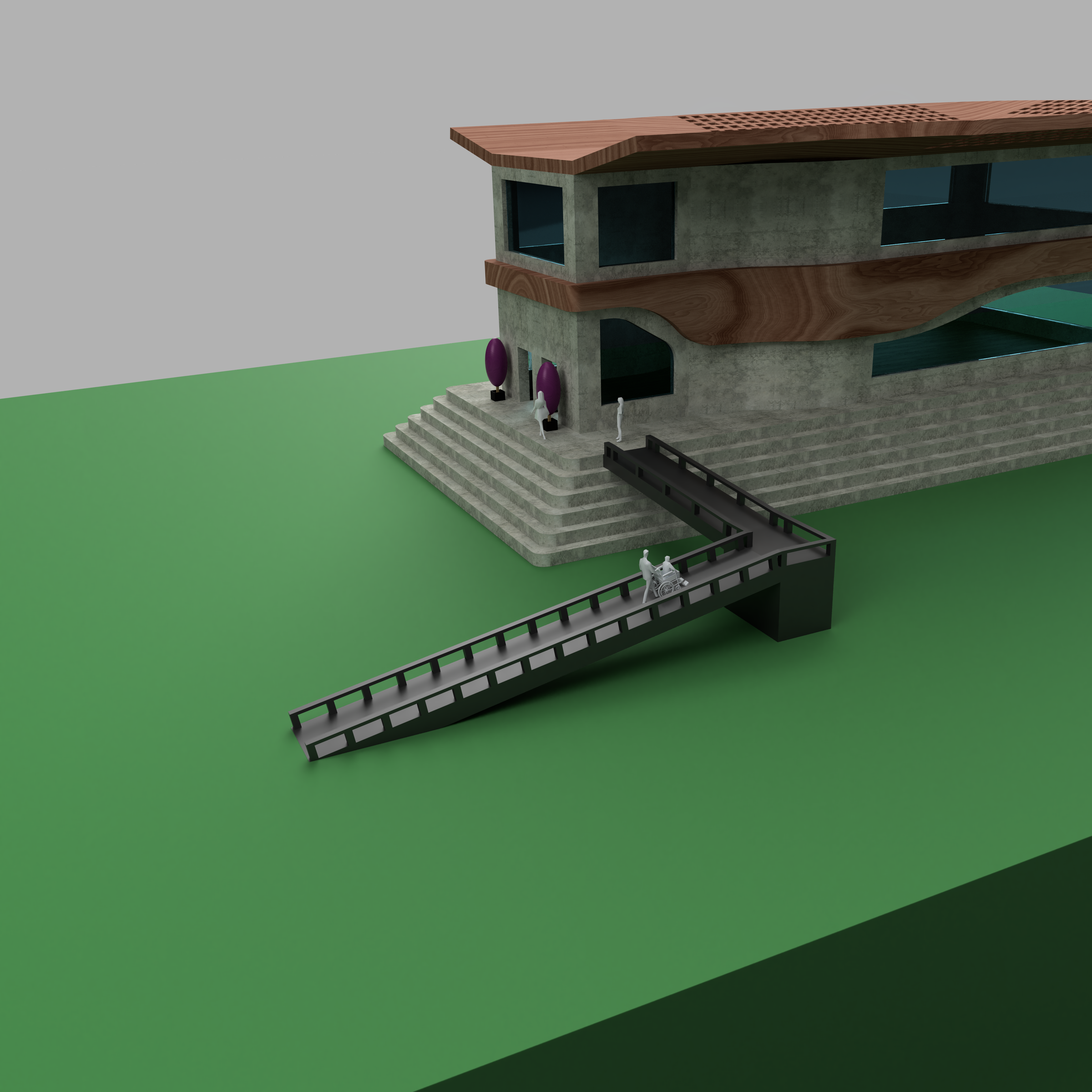
Ultimately, The Lattice Grove is built to be more than a temporary shelter; it is a permanent sanctuary designed for long-term community recovery. By combining heavy-duty, wind-resistant engineering with an architectural layout that keeps human dignity, social connection, and accessibility at the forefront, this project serves as a lasting foundation for community stability. My goal is to ensure The Lattice Grove acts as a constant, reliable space that carries residents through the entire recovery process—not just the first few days of a crisis. By focusing on both structural toughness and a restorative environment, the project bridges the gap between the chaos immediately following a disaster and the return to long-term stability and a normal life.