The Sri Lankan Lotus Resilience Complex
by Aya klink in Design > Architecture
57 Views, 3 Favorites, 0 Comments
The Sri Lankan Lotus Resilience Complex

Hi Everyone! We are students who started this project with a single, specific question: Why is the moment Sri Lankan communities need healing infrastructure the most, the exact same moment it disappears underwater?
Every year, Sri Lanka's monsoon floods kill people, destroy homes, and displace hundreds of thousands of families. In November 2024 alone, 475,225 people were affected and over 276,000 were displaced across 165 emergency relief centres, with more than 2,500 houses destroyed (ReliefWeb, Dec 2024). Schools close. Community halls fill with mud. Playgrounds vanish. And in the relief centres, people sit on cots in gymnasiums with nothing to do. No art, no music, no greenery, no space to process what just happened to them.
When most people think about disaster relief architecture, they think about shelter: tents, temporary housing, relief centres. Those things are necessary. But there is a second category of infrastructure that disappears entirely when flooding hits and that is the category nobody talks about.
The Lotus Resilience Complex is a floating, chain-anchored community healing structure designed specifically for Sri Lanka's flood-affected lowland communities. It is shaped after the blue lotus Sri Lanka's national flower and the primary symbol of resilience in Theravada Buddhism. Each of its eight petals contains a different evidence-based therapeutic program. And instead of closing when the monsoon floods arrive, it floats. The higher the water rises, the more visible and accessible it becomes from the surrounding community.
This Instructable documents every step of our design process: the research, the concept, the structural engineering, the Fusion 360 modelling, the marker renderings, and the physical model so that if you choose, you can replicate it too!.
Supplies
Every Material — What It Is, Why We Chose It, What We Rejected
We evaluated every material against three criteria:
(1) flood resilience — can it get wet repeatedly without degrading, warping, rotting, or losing structural integrity?
(2) local availability in Sri Lanka — can Thihagoda community members source, replace, and maintain it without specialist contractors or imported components? (3) sensory quality for a healing environment — does it contribute to the warmth, natural character, and calm atmosphere that the therapeutic programs require? We rejected specific materials we considered and explain why below.
Structure & Flotation
- HDPE shell + EPS foam-core pontoon hulls
Why: Unsinkable even if outer shell is breached. Zero corrosion in freshwater. Lasts 50+ years with no maintenance. We rejected fibreglass pontoons — cheaper but crack under UV exposure and flood debris impact.
- Grade 316 stainless marine chain, 19mm
Why: Grade 316 is the correct alloy for freshwater tropical exposure — Grade 304 would rust in 3–5 years. Available at Sri Lanka port suppliers. We rejected galvanised chain — zinc coating strips in freshwater over time.
- Hot-dip galvanised mild steel frame
Why: Galvanising provides 25–40 year corrosion protection in tropical freshwater exposure. We rejected stainless for the frame — prohibitively expensive and unnecessary for non-chain structural elements.
- Helical steel pile anchors, 600mm dia.
Why: Screws into soft alluvial soil without concrete — no concrete truck access needed at a remote floodplain site. Removable if site use changes. We rejected conventional concrete pile foundations — impractical in seasonally inundated soil.
- 150mm galvanised guide posts, 7m tall
Why: Standard pipe size, available nationally. Guides the building vertically without restricting rise. Driven 1.5m below grade for lateral stability.
Enclosures & Finishes
- Woven bamboo wall panels
Why: Bamboo is naturally moisture-resistant, grows abundantly in Southern Province, and is deeply embedded in Sri Lankan vernacular construction tradition. A 2023 Washington Post investigation confirmed bamboo as a star material for flood-resistant homes. We rejected concrete block walls as they wouls be too heavy for pontoon flotation loads and culturally incongruent with a healing space.
- Compressed earth blocks (above flood line only)
Why: Zero embodied carbon, made from local soil, excellent thermal mass for the Meditation petal's low-stimulus environment. Absolutely not used below maximum flood line — compressed earth and water do not coexist.
- UV-stabilised polycarbonate barrel-vault roofing
Why: Lightweight (critical for pontoon load), translucent (brings diffuse natural light into all petals), and completely waterproof. We rejected clay tile roofing because the weight would destabilise pontoons and tiles break under flood debris impact.
- FSC-certified teak decking
Why: Teak has natural oils that repel water absorption it is historically used in boat decking precisely because it survives repeated immersion. FSC certification ensures responsible sourcing. We rejected treated pine as it is cheaper but requires annual retreatment and splinters when wet.
- Natural rubber sheet flooring (8–12mm)
Why: Barefoot-safe, anti-slip when wet, cushioned for yoga and children's play, and locally produced in Sri Lanka (the country is a significant natural rubber producer). We rejected ceramic tile as it would be hard, cold, slippery when wet, and painful for barefoot practitioners.
- Lime plaster interior finish
Why: Breathable (prevents trapped moisture and mould between flood events), naturally anti-microbial, and beautiful. We rejected gypsum plaster as it would dissolve on contact with floodwater.
- Coconut-fibre acoustic panels
Why: NRC rating 0.70, locally produced in Sri Lanka, zero import cost, compostable at end of life. Used in Music petal and Meditation petal. We rejected foam acoustic panels as it would be petroleum-derived, imported, and incongruent with the natural material language of the complex.
Digital Design Tools
- Autodesk Fusion 360 — primary 3D model
Used for: all structural modelling, parametric component design, circular array, joint mechanism, full assembly. The Render workspace produced final presentation images.
- Pencil, graph paper, ruler all concept sketches
Used for: every stage before software. Hand sketches are photographed and included in this Instructable at each stage to show the evolution of thinking.
- Alcohol markers (Copic) — atmospheric renderings
B41+B95 for water; E34+Y08 for warm teak interiors; E35+E37 for bamboo walls; N2+N4 for the meditation petal. See Step 8 for full colour palette.
- 0.1mm fine liner — rendering detail linework
Used for: all hard edges, chain detail, structural framing lines after marker wash dries.
Physical Model
- PLA filament + FDM 3D printer
Used for: all pontoon hulls (printed white, sanded, primed, painted Humbrol #11 silver metallic). Print at 0.15mm layer height, 60% infill for solid feel.
- Foamcore board, 5mm
Used for: petal superstructure walls. Score back face gently for clean curves without cracking.
- 0.5mm craft wire or miniature hobby chain
Used for: anchor chain simulation. Paint gold before final photography so chains are clearly visible.
- 2-part clear casting resin, slow-cure (45–60 min gel)
Used for: water surface base. Tinted with blue + green ink. Slow cure essential — you need time to position the floating complex before it sets.
- Silk or paper lotus flowers (×6–8)
- Laser-cut balsa veneer
Used for: walkway bridge representations and bamboo-texture wall surface coverings.
- Humbrol #11 silver metallic + grey primer
Used for: pontoon hull finish. Prime first, then silver coat. Two thin coats better than one thick.
- White card + natural window light
Used for: photography backdrop. No flash. No overhead light. Natural window light from one side only gives depth and shadow to the model photographs.
Research & Problem Statement


Before designing anything, we researched the actual scale of Sri Lanka's flooding problem and the documented mental health consequences of disaster displacement. This was to make sure every design decision we made was solving something real and intentional.
Some key statistics we found that demonstrate the urgency of our project include:
475K
people affected by Sri Lanka floods, November 2024 alone
Source: ECHO / ReliefWeb, Dec 2024
~30%
of flood survivors develop PTSD — far higher than the general population
Source: Meta-analysis, Psychiatrist.com, 2024
20/25
Sri Lankan districts affected by flooding in 2024, this is a nationwide problem
Source: Wikipedia / NDMC, 2024
The 2024 Sri Lanka floods (May–June) killed at least 16 people, damaged over 12,000 homes, and forced more than 6,000 people to evacuate, with 5,000 placed in 52 temporary shelters. All schools in affected areas were closed. The November 2024 floods were far worse: 475,225 people affected, 2,516 houses destroyed, 276,000 people displaced. The pattern is consistent across every flood year on record.
The mental health data is equally stark. A 2024 peer-reviewed study (Akram & Mushtaq, Frontiers in Public Health, DOI: 10.3389/fpubh.2024.1434123) found that major flood displacement events are directly linked to "trauma-related disorders, mood disturbances, and social upheaval," and that vulnerable populations- children, elderly people, those already facing economic hardship, are disproportionately affected. Research on Sri Lankan displaced populations specifically found rates of common mental disorders nearly double baseline, with food insecurity and social isolation as the two biggest compounding factors (PMC4525724).
A Springer Nature geospatial study (2024) analysed the 2017 Nilwala River Basin floodm one of the river's many annual flood events, and found that 46 km² of the 109 km² tested in the Matara and Thihagoda divisional secretariat divisions were completely inundated. The same two divisions are named in Sri Lanka's Disaster Management Centre flood alerts every monsoon season.
The gap we identified: There are zero permanently flood-functional community healing spaces in Sri Lanka's flood-affected lowland districts. Every existing structure (community halls, schools, health posts, recreation centres) is built for dry ground and closes the moment flooding starts. The communities that lose the most are also the ones who lose access to the spaces that would help them recover.
We also researched what therapies actually help post-disaster communities. Clinical evidence consistently shows that Cognitive Behavioural Therapy (CBT) is the gold standard for PTSD but it requires trained therapists, private space, and a person willing to identify themselves as needing mental health support. In Sri Lanka, where mental health stigma is high and clinical infrastructure is limited, community-based non-clinical interventions art-making, music, gardening, structured play, communal eating serve as access points that work without anyone needing to admit they are struggling. The healing happens in the doing.
Links for research
https://news.un.org/en/story/2025/12/1166671
https://www.iom.int/search?keywords=sri+lanka&created=All&sort_bef_combine=created_DESC&antibot_key=NS8deXTdO6o-K1uLs1VdpMB_jRw87RCIHHP9ofndUp8
https://reliefweb.int/report/sri-lanka/sri-lanka-cyclone-ditwah-assessment-report-displacement-returns-needs-barriers-badulla-district-february-2026
Concept and Cultural Context: Why This Shape and No Other?






We want to be specific about why we chose the lotus, because it was not a superficial aesthetic decision. There were three independent reasons, and they all converged on the same answer.
Cultural meaning. The blue lotus (Nymphaea stellata) is Sri Lanka's national flower and the central botanical symbol of Theravada Buddhism, the spiritual tradition of approximately 70% of the Sri Lankan population. In Buddhist teaching, the lotus is the primary symbol of rising from suffering: it is rooted in mud, grows through water, and blooms in clear air above the surface. That is a precise description of what post-flood community recovery looks like. The metaphor is not decorative; it is the thesis of the project in plant form. When a Sri Lankan person sees this building for the first time, the form should communicate its purpose before they read a single word of explanation.
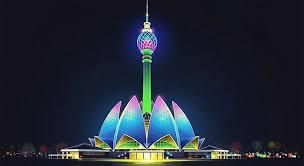
The lotus already has architectural precedent in Sri Lanka. The Colombo Lotus Tower, South Asia's tallest structure at 350m, completed in 2022, was designed as a lotus blossom as a symbol of national identity and renewal. We are not inventing a new symbol. We are taking an established architectural language and scaling it down from the skyline into the communities that need it most, at water level, accessible to everyone.
"The lotus grows in mud and water and blooms in light. Architecture for communities that have endured flooding should do the same thing."
Structural logic. The lotus plan, a central hub surrounded by radial petals, solves a genuine structural problem. A single large building in a flood zone creates enormous hydrostatic pressure on flat walls. By splitting the program into eight smaller oval modules separated by gaps, we dramatically reduce wall pressure: water flows between petals rather than slamming against a continuous facade. The Springer Nature flood study noted that the Nilwala River inundated 46 km² in a single event, the force of that moving water on a conventional building would be catastrophic. The lotus plant distributes and deflects it.
Engineering efficiency. Oval pontoon shapes distribute buoyancy load more evenly than rectangles. Rectangular pontoons have stress concentrations at corners; ovals have continuous load distribution around their perimeter.
Inspiration from other structures around the world:
Colombo Lotus Tower - Colombo, Sri Lanka (2022)
South Asia's tallest structure, designed as a lotus blossom as a symbol of national identity and renewal.
Lesson: The lotus already works as architectural language in Sri Lanka. We bring it to community scale.
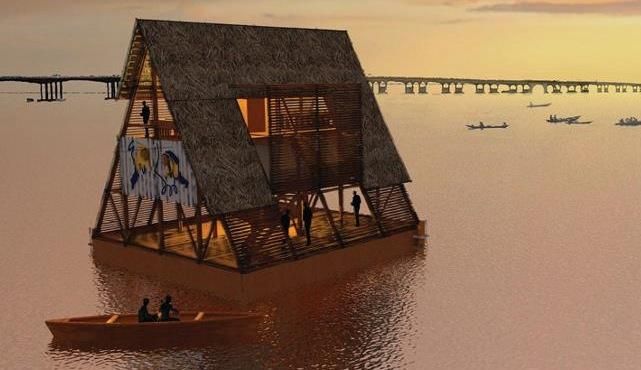
Makoko Floating School - Lagos, Nigeria (NLÉ, 2012)
A triangular floating community structure for a waterfront community with no dry land access.
Lesson: Floating community buildings are buildable, feasible, and transformative at the community scale.
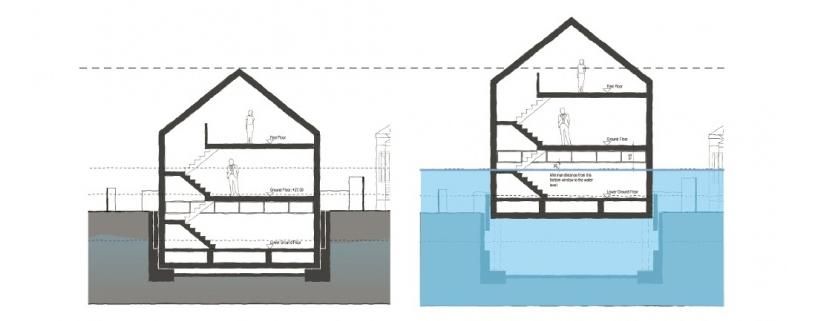
BACA Amphibious House -Thames, UK (2016)
First certified amphibious home in the UK floats on floodwater along guide posts, returns to ground as water recedes.
Lesson: Our guide-post and chain system is technically validated at building scale in real flood conditions.
Downloads

Where It Goes and Why?
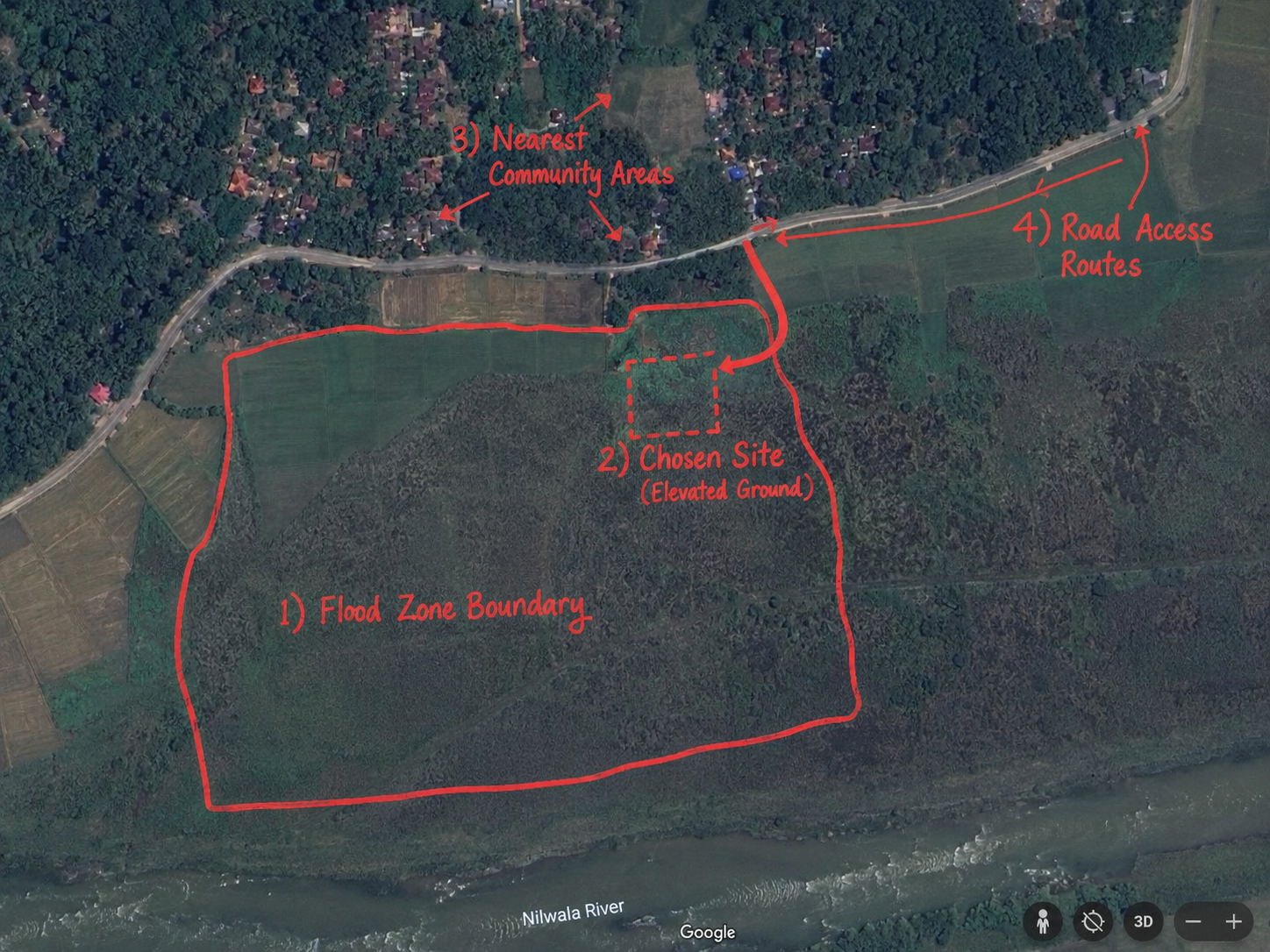
The site we had planned is a specific, named location selected after analysing flood frequency data, community density maps, and land availability across the Nilwala River basin. We chose it because it scores highest on all three criteria simultaneously and because no other healing infrastructure exists within 20km of the most affected communities.
Site coordinates: 5.9950° N, 80.5270° E — Thihagoda, Matara District, Southern Province, Sri Lanka.
Thihagoda is a lowland agricultural village approximately 17km inland from Matara, situated on the banks of the Nilwala River. The community is primarily agricultural: most families own or work small paddy rice plots, with coconut plantations and cinnamon farming as secondary income sources. The economy is subsistence-level for many households. Seasonal flooding which the community depends on for irrigation becomes devastating when the Nilwala overflows its banks during heavy monsoon rainfall.
Thihagoda is named explicitly and repeatedly in Sri Lanka's national flood alert system. The Disaster Management Centre's official flood warnings for the Nilwala River consistently identify Thihagoda as one of the highest-risk divisions: "low-lying areas of the Nilwala River valley situated in Pasgoda, Kotapola, Pitabeddara, Akuressa, Athuraliya, Malimbada, Thihagoda, Kamburupitiya, Matara, and Devinuwara D/S Divisions are at risk of experiencing flood situations" (Lanka News Web, October 2024). It is not occasionally flooded. It floods almost every monsoon season.
The 2024 Springer Nature geospatial study specifically selected Thihagoda and Matara divisional secretariat divisions as its study area precisely because they "experienced significant impacts" in the 2017 Nilwala flood, an event that inundated 46 of the 109 km² studied. The same flooding pattern occurs repeatedly: the paddy fields that provide the community's livelihood become a temporary lake, roads are cut, and community buildings flood.
The specific site within Thihagoda is an area of open seasonal floodplain on the eastern bank of the Nilwala, approximately 400m from the nearest cluster of residential buildings. During dry season (October–April), it is flat open ground that the community uses informally for drying crops and small markets. During monsoon season (May–September), it is submerged under 1.5–4 metres of river water depending on rainfall intensity. It has no permanent structures. It is owned by the provincial government. It is, in every conventional sense, "unusable" land which is precisely why it is perfect for a floating complex.
Why this specific site over any other point on the Nilwala:
We evaluated four candidate sites. Two had existing structures that would need demolition. One was adjacent to a protected wetland. Thihagoda had the right combination: open government land, central community location, no existing structures, maximum annual flood frequency, and proximity to the highest-density residential areas in the flood zone. A structure here is relevant every single year, not just in exceptional events.
Flood frequency: Annual monsoon flooding confirmed every year on record. The Nilwala River has an established flood history with the 2017 event inundating 46 km² in the study area alone. The 2023 floods specifically closed schools in the Matara district for multiple days. The 2024 floods put tourist hotels in Akuressa ( Nearby location) underwater for seven consecutive days (ReliefWeb DREF Operation MDRLK018, 2023).
Community density: Matara District has a population of 809,344 (2012 census) with significant proportions living in flood-vulnerable low-lying areas. The Thihagoda divisional secretariat serves thousands of residents with no recreational or therapeutic infrastructure rated for flood conditions.
Land geometry: Open, flat seasonal floodplain. No trees to interfere with pontoon rise. Bank access available year-round for maintenance. The flat geometry allows the complex to rest directly on the ground in dry season without a foundation, only the anchor pile footings penetrate the earth.
Agricultural economy: The paddy farming community here is precisely the population that loses its entire income to flooding. The Food & Market petal (Petal 8) and Horticultural Therapy petal (Petal 4) are designed to partially restore income and food security during displacement which is why the site's agricultural context is a design asset.
Design Concept: the Eight Petals

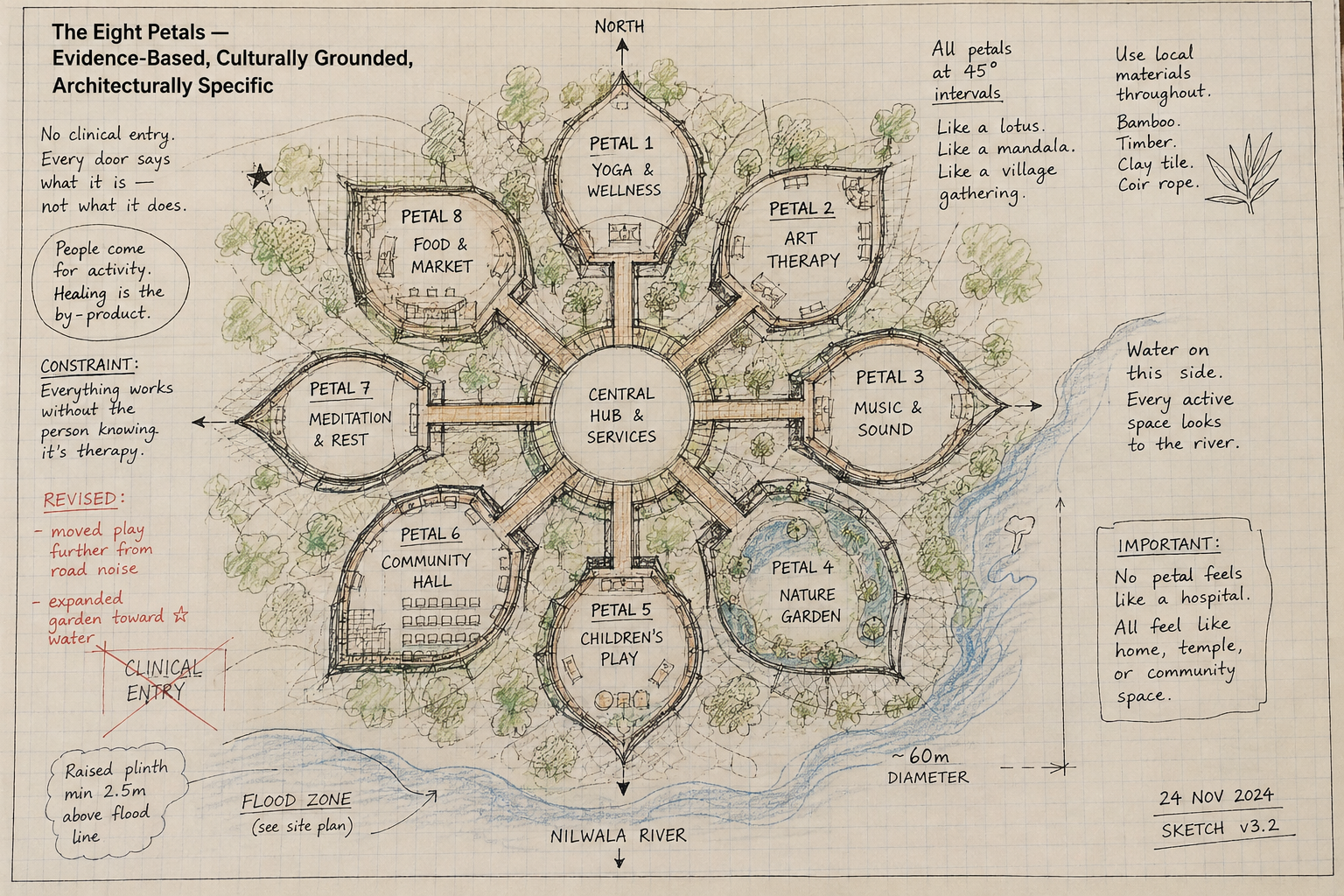




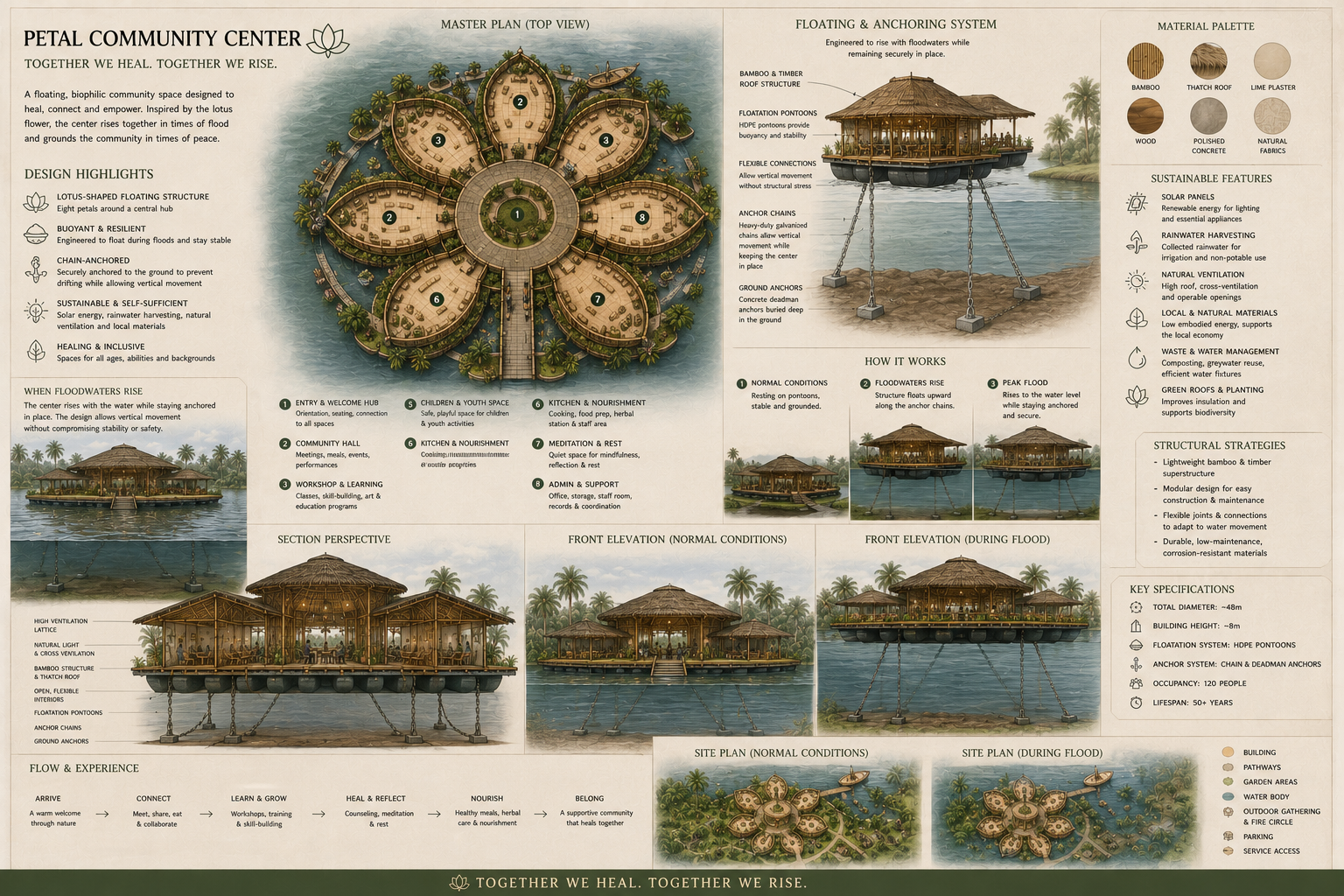
The Lotus Complex has one central hub and eight radiating petal-modules, each at 45° intervals around the hub. Every petal was assigned its function based on documented clinical evidence that the activity it hosts reduces post-disaster trauma, depression, and anxiety in communities similar to the ones we are designing for.
The critical design constraint across all eight petals was this: every healing program in this building had to work without the person knowing or admitting they were in therapy. In Sri Lanka, where mental health stigma is significant and clinical referral is limited, the path to healing is not through a door that says "Mental Health Centre." It is through a door that says "music room" "garden" or "children's play area." You come because you want to, and the healing happens in the doing.
Each petal and their function:
Petal 1 · Yoga & Wellness · Facing North
In PTSD patients, yoga improves arousal management, lowers cortisol levels, and modifies parasympathetic nervous system responses (Sciarrino et al., 2017, 7 RCT review). People who have experienced trauma lose touch with their bodies; yoga helps them re-establish that connection on a somatic level before they can comprehend information verbally. Open pavilion with rubber flooring, natural ventilation, and bamboo lattice. Other than mats, no equipment.
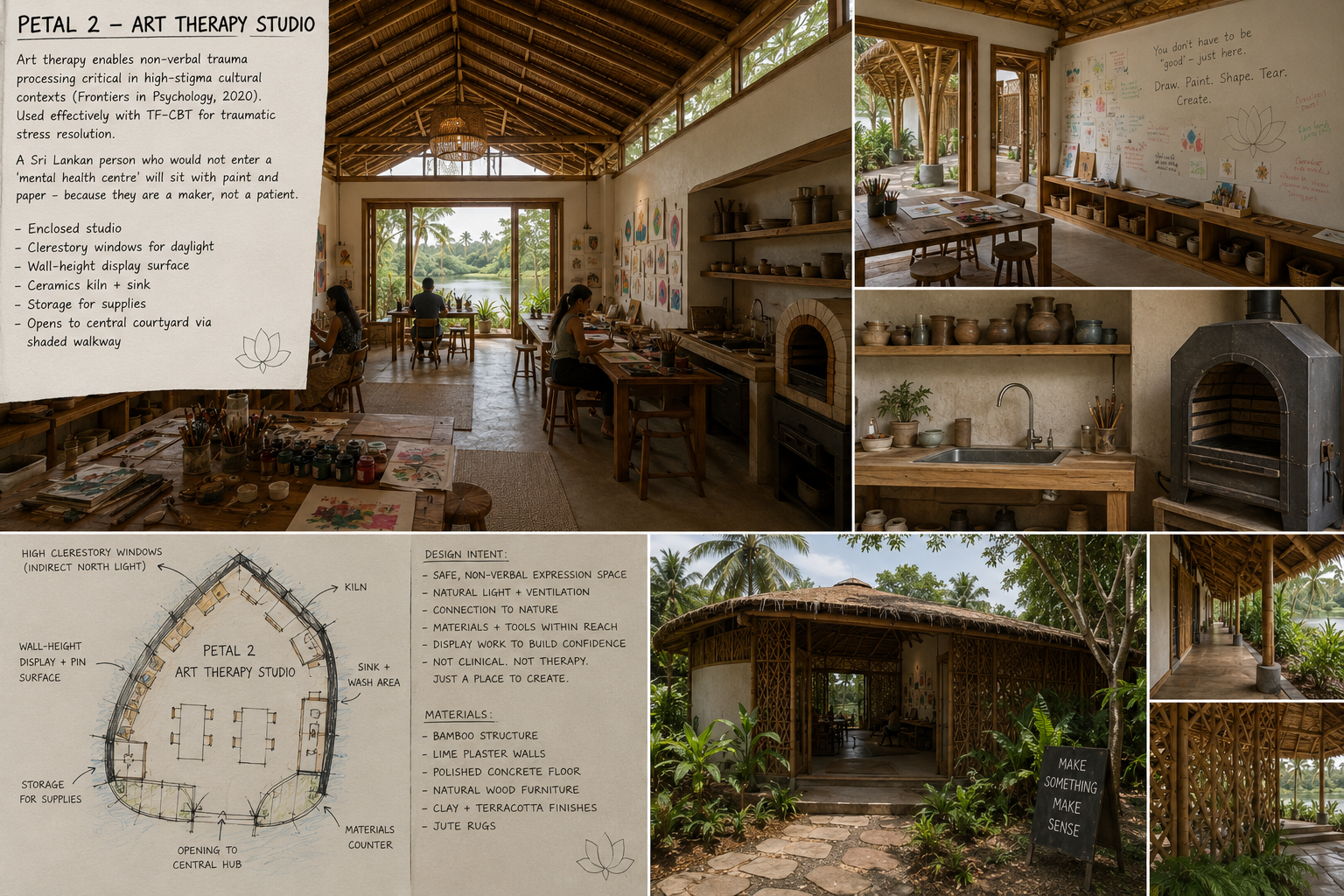
P2 · Art Therapy Studio · Facing North East
In high-stigma cultural situations, art therapy facilitates nonverbal trauma processing, which is crucial (Frontiers in Psychology, 2020). used successfully to resolve traumatic stress in conjunction with TF-CBT. Since they are creators rather than patients, a Sri Lankan who would not go into a "mental health center" will sit with paint and paper. The area would have a wall-height display, a ceramics kiln, clerestory windows, and an enclosed studio.
P3 · Music & Sound · Facing East
According to a 2024 meta-analysis of RCTs that especially included flood catastrophe survivors, music attenuates fear, melancholy, despair, anxiety, and over-arousal by raising dopamine and endorphins, lowering cortisol, and increasing cerebral blood flow (PMC11036901). Traditional Sri Lankan instruments include the rabana, veena, and thammattama. There would be an exterior stage that faces the water and an inner practice space.
P4 · Horticultural Therapy Garden · Facing South East
In catastrophe areas, horticultural therapy improves post-traumatic growth while lowering salivary cortisol, sadness, and moderate PTSD (Kotozaki & Shishido, Journal of Trauma Treatment, 2014). Serotonin is released when Streptomyces bacteria come into contact with soil (PMC9564959). Blue lotus at water level, floating raised beds, open trellis frame, and therapeutic herbs.
P5 · Children's Play · Facing South
Children's mental, physical, and social healing are all concurrently addressed by post-disaster play treatments (Kinoshita & Woolley, MDPI Children, 2015 Great East Japan Earthquake). The main defence against child PTSD, particularly during floods, is social support (PMC5912434). Floor-to-ceiling water-view window, single supervised entry, soft-surfaced, completely enclosed.
P6 · Community Hall · Facing South West
Pre-trauma factors had less of an impact on the development of PTSD than lack of social support (Brewin, Andrews & Valentine meta-analysis). One of the two main contributing elements to post-displacement mental disease in Sri Lanka is social isolation (PMC4525724). 120 seats can be accommodated in the largest petal, double-height, completely flexible, sliding wall panels.
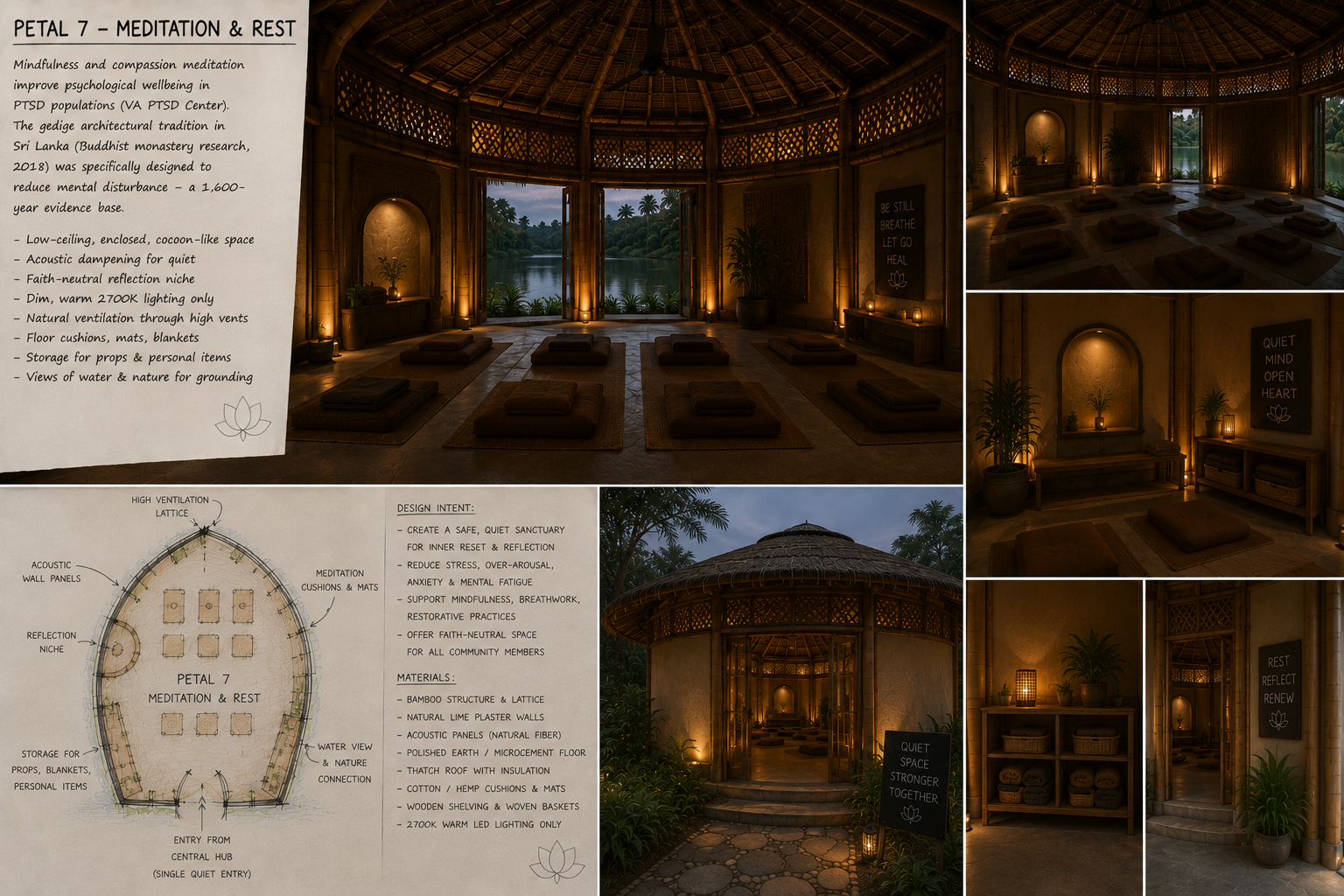
P7 · Meditation & Rest · Facing West
PTSD sufferers' psychological well-being is enhanced by mindfulness and compassion meditation (VA PTSD Center). The 1,600-year-old Gedige architectural heritage in Sri Lanka was created expressly to lessen mental distress (Buddhist meditation monastery research, 2018). faith-neutral shrine nook, low ceiling enclosure, acoustic damping, and just 2700K mood lighting.
P8 · Food & Market · Facing North West
The main humanitarian effect of the 2024 floods in Sri Lanka, according to WFP, is food insecurity. One important resilience characteristic in post-disaster recovery is economic participation as a producer rather than merely a recipient (Conservation of Resources Theory, HTI 2024). Emergency food storage, a communal kitchen and an open wet market are all installed two meters above the ground, always above the flood line.
Structural Engineering : Chain-Pontoon System
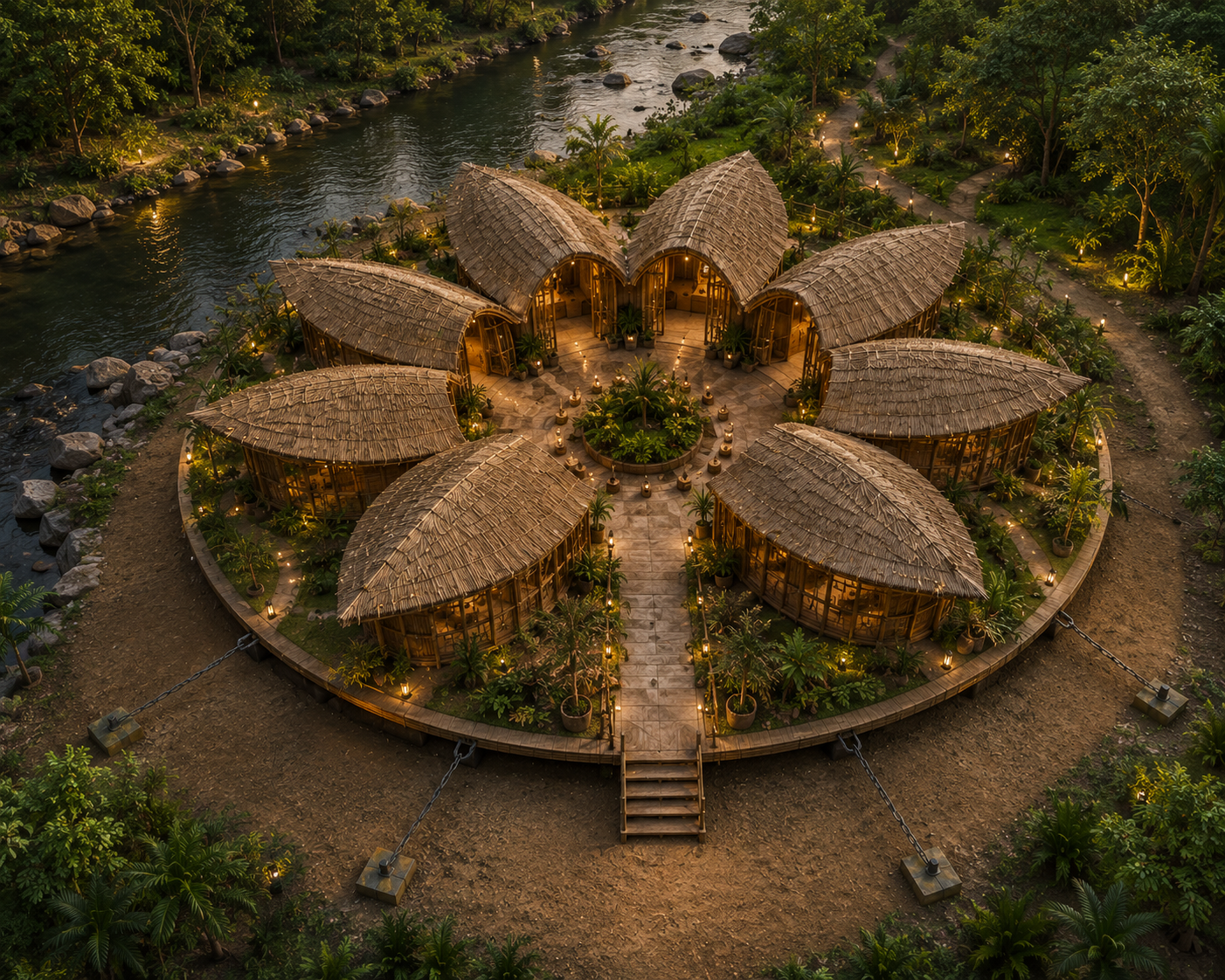
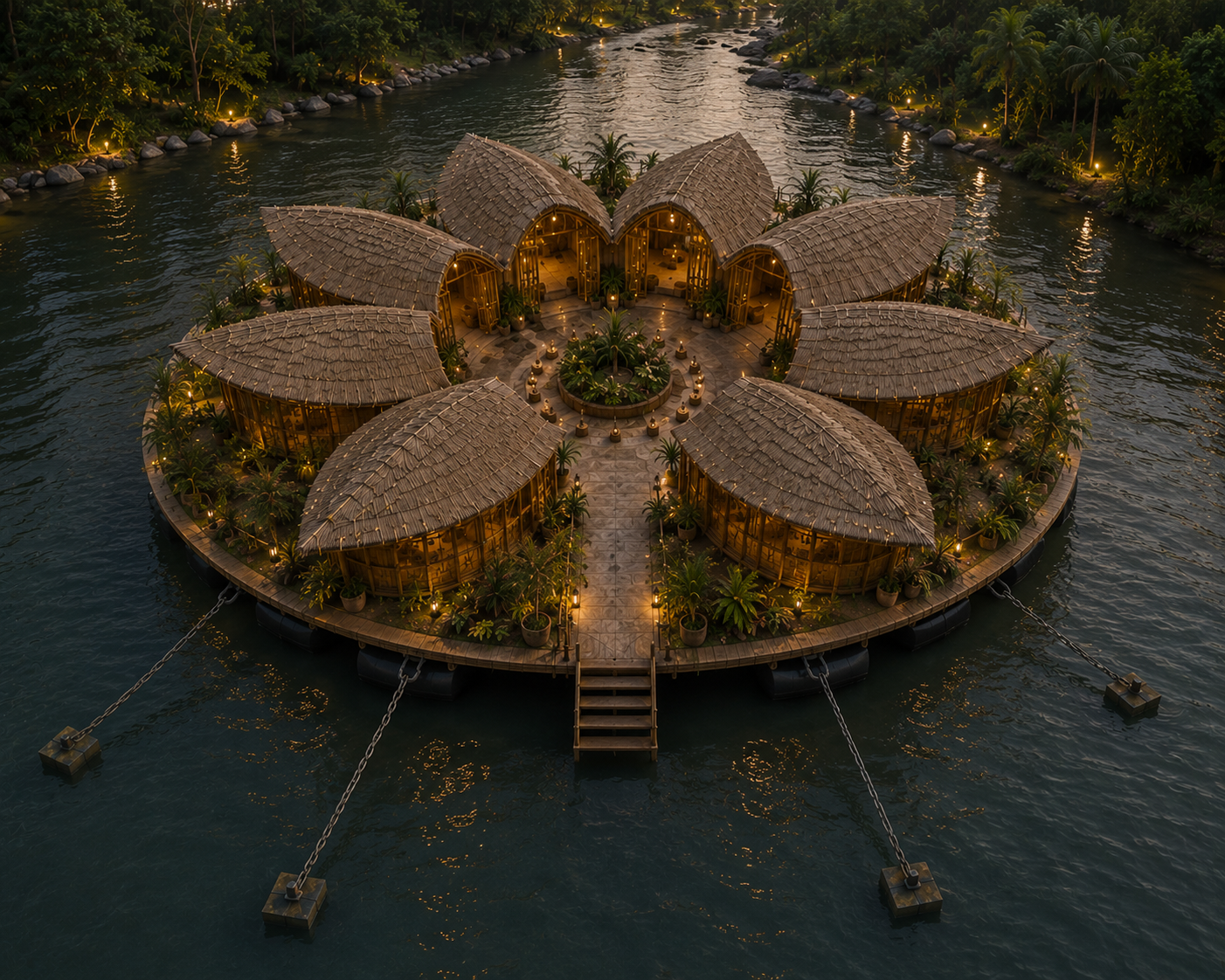
The amphibious structural structure is the most technically unique aspect of this project. The BACA Architects Buoyant Foundation system (UK, 2016), the Arx Pax SAFE Foundation (USA), and the floating research pavilion constructed by the University of Waterloo to test flood-resilient materials are some constructed examples that support the idea of buildings that float during floods. For a multi-module tropical monsoon climate application with a lotus plan geometry, we particularly modified those verified concepts.
The basic idea is straightforward: each module is supported by a steel pontoon foundation filled with foam that is sealed and offers positive buoyancy when submerged. Stainless marine chains are used to secure the module to bedrock. The module rises with the water, prevented from wandering laterally by vertical guide posts and horizontally by the chains, then returns to its initial ground position when the water recedes. According to ASME engineering studies on floating community structures, an anchor cable length extension of five feet "can accommodate about 40 feet vertical displacement in an extreme flood event" and "a 230-foot cable allows a 10-foot rise and fall."
Dry Season (Oct–Apr) - Ground contact
- Complex rests on ground. All 44 anchor chains slack. Walkways connect to shore at grade level. Accessible by foot. Functions as any normal community building.
Flood Rising (May–Sep) - Pontoons activate
- Rising water generates upward buoyancy force on HDPE pontoons. Complex lifts. Anchor chains tension, holding horizontal position. Telescoping gangway ramps extend to current water surface. Accessible by boat.
Flood Receding - Controlled return
- Water level drops. Complex descends along guide posts back to exact original ground position. Chains slacken. Zero structural damage. Immediately functional. No draining, no cleaning, no repair cycle required.
Complete Chain & Anchor Specifications
Chain grade & material - Grade 316 stainless steel marine chain — corrosion-proof in tropical freshwater flooding
Link diameter - 19mm (¾ inch) — standard marine hardware, available at port suppliers throughout Sri Lanka
Working load per chain - 6.5 tonnes minimum: 3× safety factor applied against calculated max buoyancy load per petal module
Chains per petal module - 4 chains (one at each pontoon corner clevis bracket)
Chains on central hub - 8 chains (two per cardinal compass point) — hub is heaviest module, double the anchor count
Total anchor chains - 44 chains across all 9 modules (8 petals × 4 + hub × 8)
Maximum design flood rise - 6.0 metres: exceeds the highest recorded Nilwala River flood peak in Thihagoda on record
Anchor pile type - Helical steel piles, 600mm diameter, 4m depth: suitable for soft alluvial floodplain soil without concrete footings
Guide post system - 150mm diameter galvanised steel posts, 7m tall, driven 1.5m below grade: module slides vertically along posts
Pontoon material - HDPE outer shell, expanded polystyrene foam core: unsinkable even if outer shell is breached, zero maintenance
Utility connections - All service pipes coiled with 8m slack: enough for full 6m rise. Waste pumped (not gravity-fed) per amphibious building standard practice
Power during flooding - Solar panels on all petal roofs, wired to central hub battery storage. Fully off-grid. Municipal power connection uses flexible armoured cable with 9m slack
Walkway Join:
The articulated walkway joint connecting each petal to the central hub is the most technically intricate component. Differential rise, which occurs when one module rises slightly higher or quicker than another during dynamic flooding, would cause the connection to buckle or crack if walkways were rigid. The automotive universal joint, a spherical ball-and-socket assembly with flanged end plates that permits ±30° of angular movement in any direction, serves as the model for our joint. We verified that the connection bent without failing in the physical model by manually introducing differential height to neighbouring pontoon bases. This particular detail demonstrates that we grasped both the concept and the structural issue.
Why this system is locally maintainable:
We specifically built against any component that needed specialised maintenance or import. Marine hardware vendors in Colombo, Galle, and Matara sell grade 316 stainless chain. Industrial suppliers across the country offer HDPE pontoon material. Standard steel pipe sizes that may be found at any construction merchant are used in the guide post system. Only visual chain inspection and tension testing using a basic mechanical gauge (which can be taught to a community member in an afternoon) are necessary for annual maintenance. An engineer or constant overview is not required to maintain this structure.
3D Modeling: AUTODESK Fusion 360

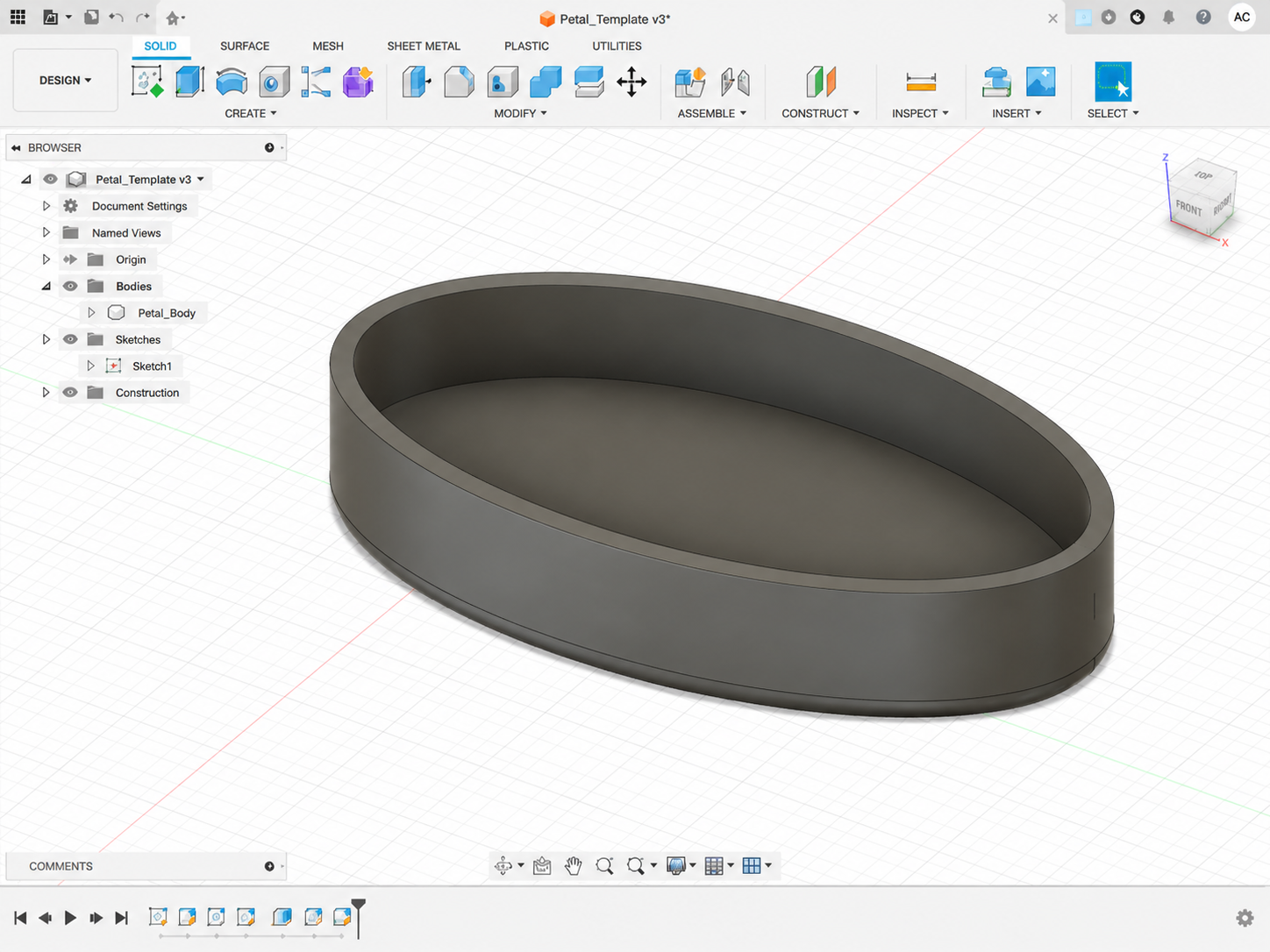
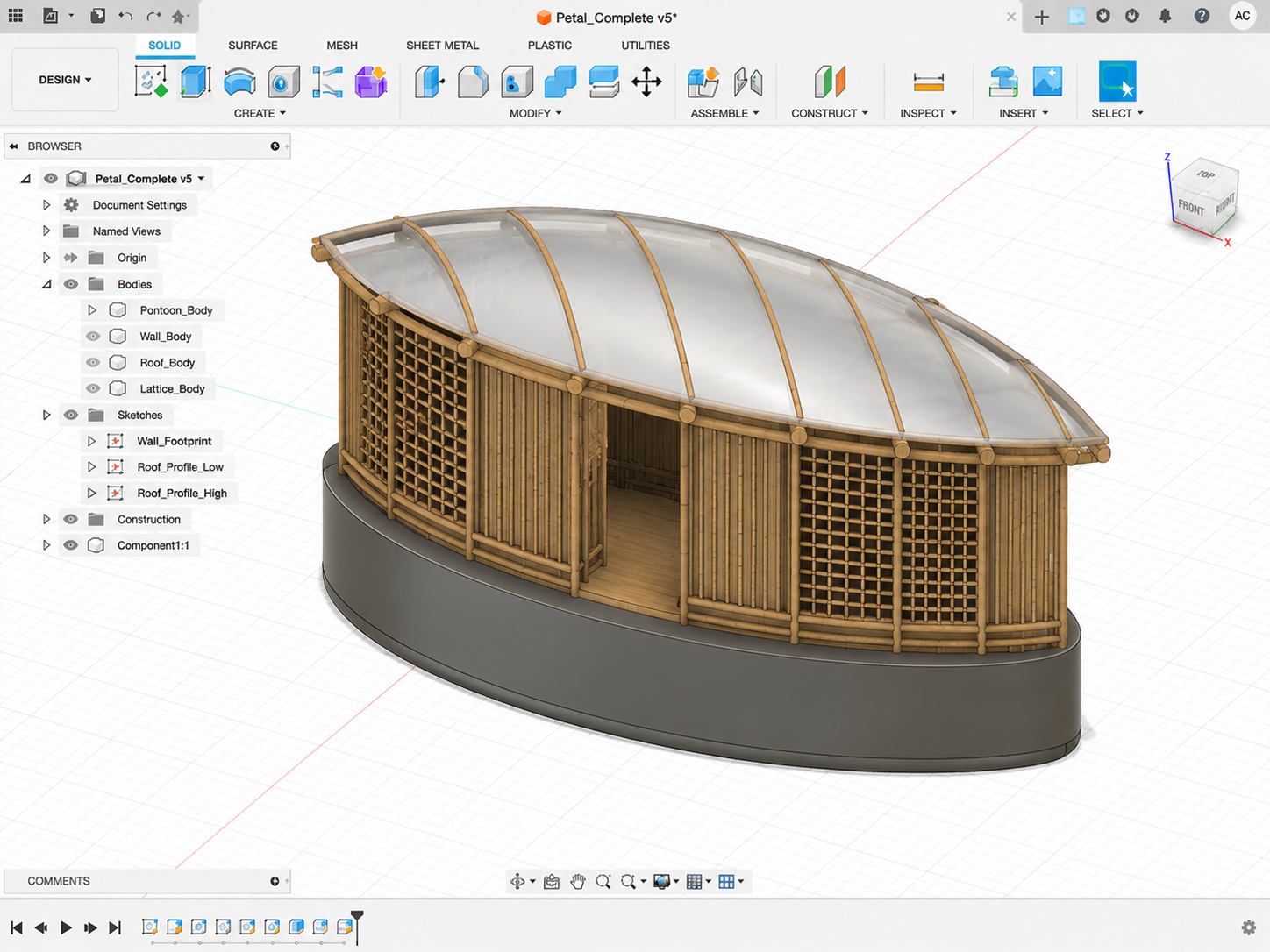

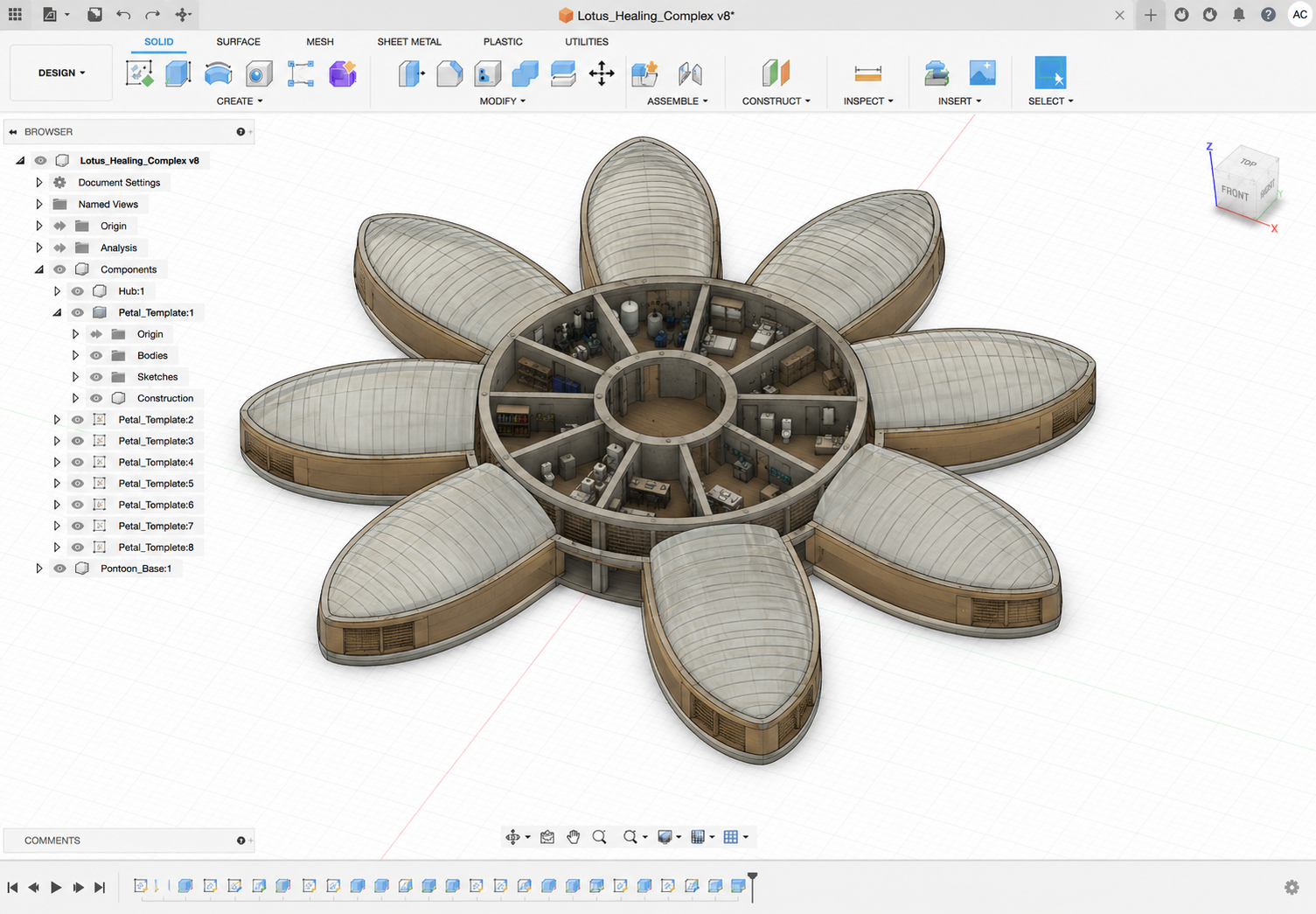

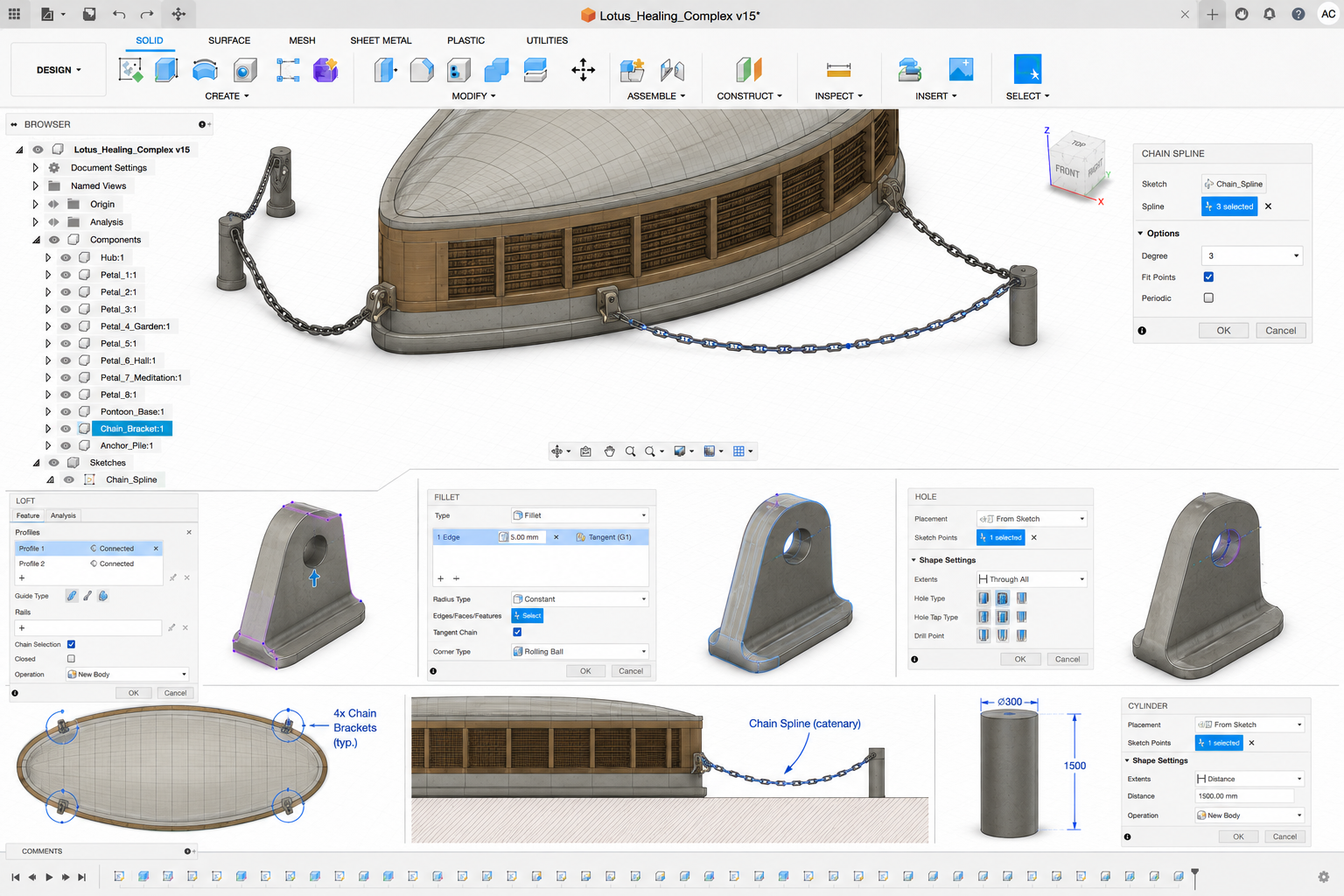
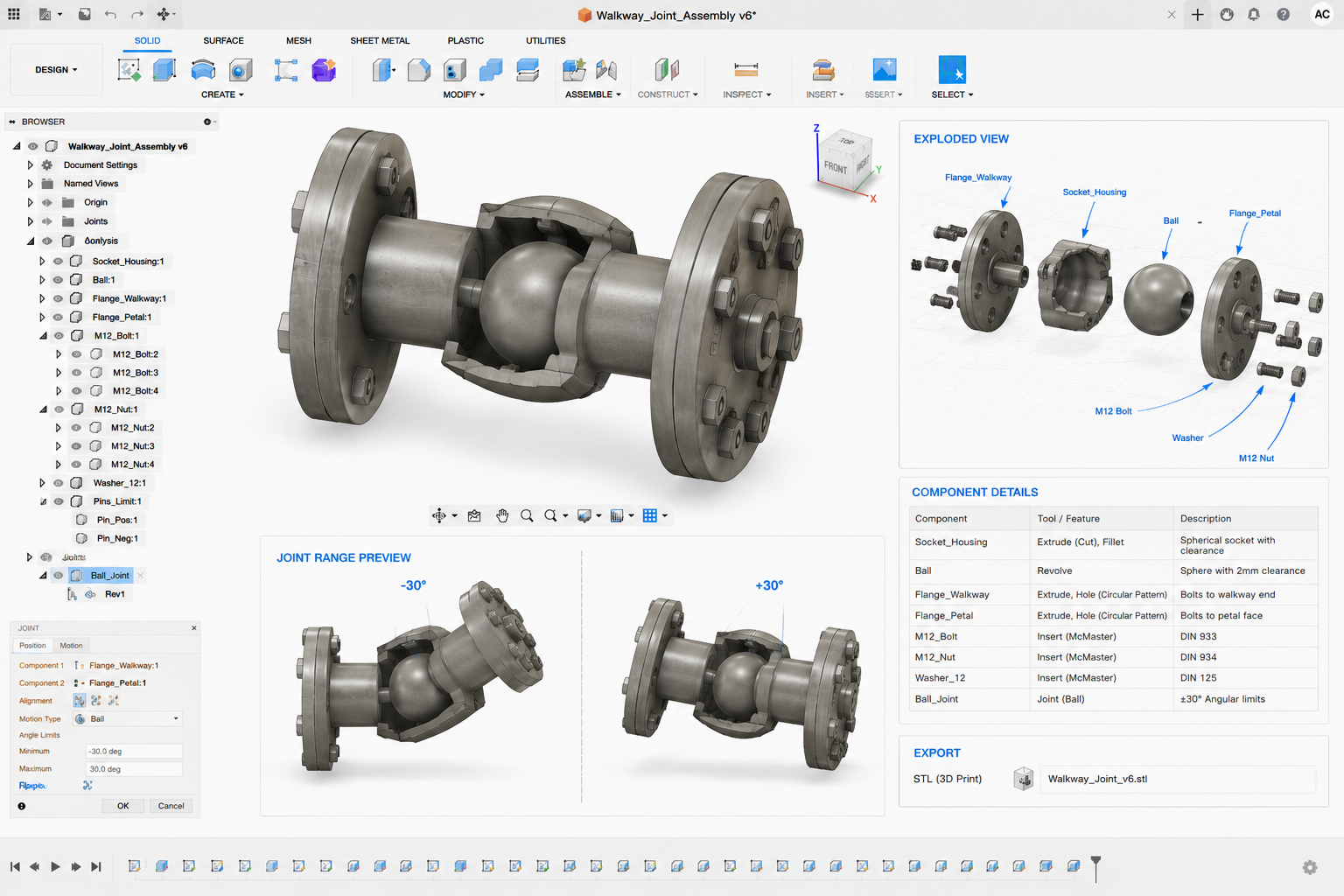
We modelled the Lotus Complex across approximately 8 hours of Fusion 360 work spread over 3 weeks. We started with Fusion 360 for everything structural. Below is the complete modelling sequence in the order we built it, including the mistakes we made and how we fixed them, because those mistakes contain information that another student attempting this kind of project should have upfront.
1 - Single petal pontoon base: the foundation of everything
Created a new component called "Petal_Template." Drew an ellipse on the XY plane (90mm × 50mm at 1:100 scale, representing 9m × 5m real-world). Used Extrude to create 6mm depth (representing 600mm real). Used the Shell command with 1.5mm wall thickness (150mm real) to hollow the interior, leaving a foam-fill cavity. Applied a 3mm chamfer on the lower perimeter edge to simulate the hydrodynamic chamfer that reduces resistance during rise. Named all faces before moving on.
Fusion tools: Sketch Ellipse → Extrude → Shell → Chamfer.
Mistake we made: Our first Shell attempt failed because we had not named the top face, Fusion couldn't identify which face to remove. Fix: Used the browser panel to select the face explicitly before running Shell.
2 - Petal superstructure: building one complete petal
On a new construction plane set 6mm above the pontoon top, sketched the petal's wall footprint (slightly smaller than the pontoon perimeter to create a visual base). Extruded walls to 32mm height (3.2m real). Created the barrel vault roof using the Loft tool between two sketch profiles — a flat rectangle at wall-top height and a curved profile 8mm higher at the apex. This gave the characteristic curved polycarbonate roof form. Added bamboo lattice side screens as thin extruded rectangular arrays using the Rectangular Pattern tool.
Fusion tools: Construction Plane → Sketch → Extrude (walls) → Loft (roof) → Rectangular Pattern (lattice).
Mistake we made: The Loft between our two profiles created twisted geometry the first time because the profiles had different numbers of sketch points. Fix: Reordered the loft profiles and added matching point guides at each end.
3 - Central hub
Created a new component "Hub." Drew a circle (120mm diameter / 12m real) on the XY plane. Used Offset to create a concentric inner wall ring (8mm wall = 800mm real). Used Construction Planes to divide the interior into 8 radial service zones using the Divide Body tool — each zone houses one utility function: electrical switchboard, water cistern, waste pump, first aid room, storage, emergency food reserve, coordination office, and bathrooms. Extruded the hub to 40mm (4m real) for the ground floor. Added a second floor mezzanine at 24mm height (2.4m real) using a new offset construction plane.
Fusion tools: Circle → Offset → Construction Plane → Divide Body → Extrude (multiple).
4- Circular array: creating all 8 petals simultaneously
This is the most powerful step in the entire model. Right-clicked on Petal_Template in the browser and selected "Make Component." Then: Create → Pattern → Circular Pattern. Selected the entire Petal_Template component, set the axis to the hub centre vertical axis, set quantity to 8, angle to 360°. In 3 seconds, all 8 petals appeared at 45° intervals around the hub. The key insight: because they are component instances linked to the template, any change to the template updates all 8 simultaneously — we used this to rapidly test different roof heights and wall configurations.
Fusion tools: Make Component → Circular Pattern (Component type, not Feature type — Feature pattern does not work for full assemblies)..
Mistake we made: We initially used Feature-type circular pattern instead of Component-type. Feature pattern fails for complex multi-body components. Fix: Deleted pattern, confirmed the petal was a proper component in the browser (showed as a component icon, not a body icon), then re-ran as Component circular pattern.
5 - Differentiating three specialist petals
After the circular array, we broke the component link on three petals to give them distinct forms. Petal 6 (Community Hall): doubled the floor area by extending the ellipse dimension and applied a double-height extrusion (64mm / 6.4m real). Petal 7 (Meditation): used the Loft tool to create a low compressed-earth barrel vault between a tall profile at the centre and a low profile at the walls — the opposite of a standard barrel vault, giving it a cave-like compressed feeling. Petal 4 (Garden): deleted the solid roof and replaced it with an open trellis using a 3D Rectangular Pattern of thin members across the top plane.
Fusion tools: Right-click component → Break Link → modify freely.
6 - Chain brackets and anchor chain detail
Created a new component "Chain_Bracket." Modelled a clevis bracket using Loft (trapezoidal body) + Fillet (smooth transitions) + a through-hole for the chain pin using the Hole tool. Placed four bracket instances on each petal pontoon at the corner positions. Drew the chain catenary curve using the Spline tool — a gentle downward curve from bracket to anchor pile — to show the correct mechanical form of a chain under its own weight. Created the anchor pile as a simple extruded cylinder penetrating the ground plane. This level of detail demonstrates that we understood the chain connection at a component level, not just as a concept.
Fusion tools: Loft → Fillet → Hole → Spline → Cylinder.
8 - Articulated walkway joint sub-assembly
Created as a completely separate assembly: "Walkway_Joint." A spherical socket cut from a rectangular body, a ball that fits within it with 2mm clearance, and two flanged end plates that bolt to the walkway and petal faces, respectively. Used Fusion's Joint tool with the "Ball" joint type to demonstrate ±30° freedom of movement. Saved the joint sub-assembly as a separate exportable STL component for 3D printing. This piece has the most complex part count of any component in the model.
Fusion tools: Revolve (ball) → Boolean Cut (socket) → Pattern (bolt holes) → Joint: Ball type. Screenshot: The joint assembly in mid-flex position, at maximum ±30° angle
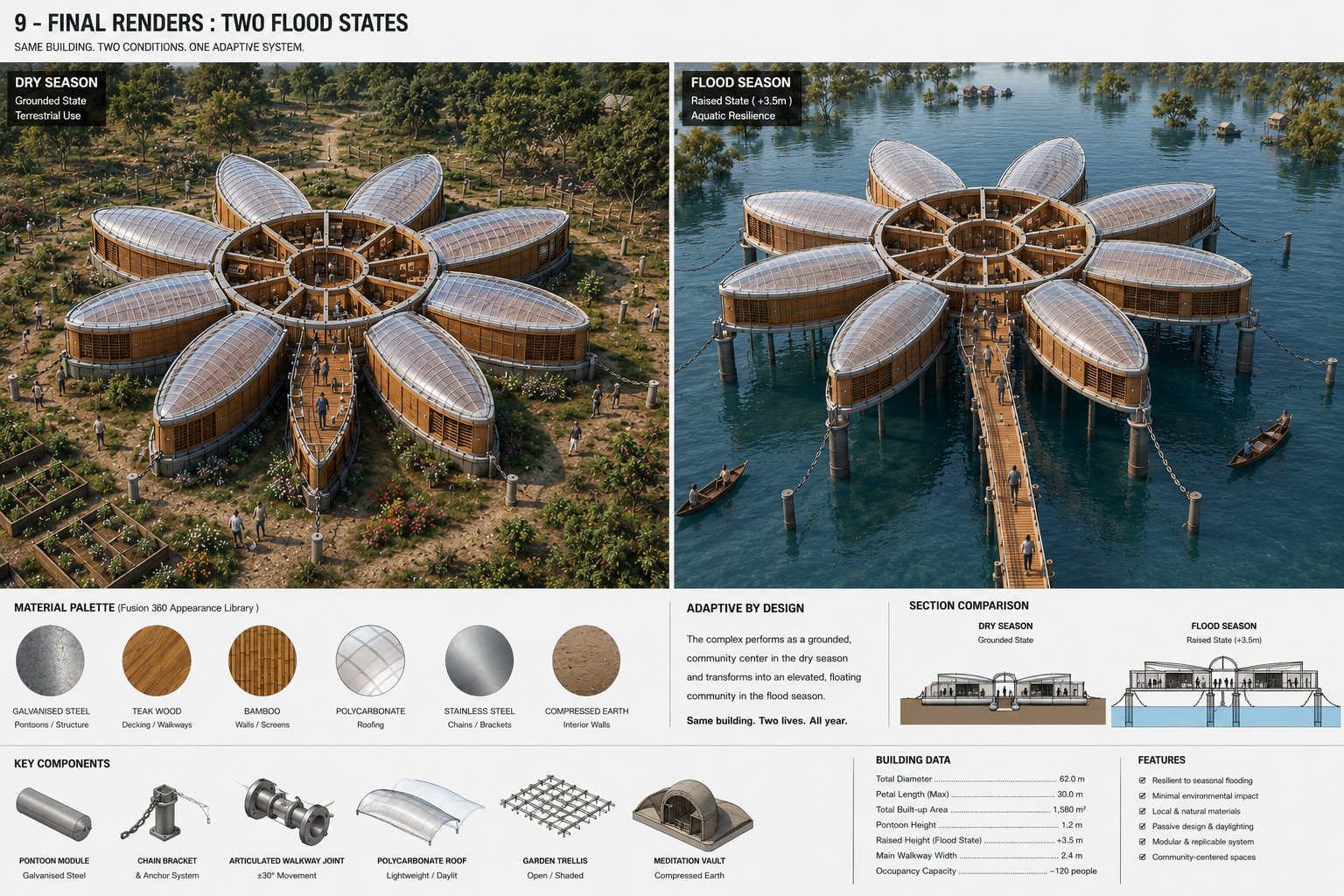
9 - Final renders : two flood states
Produced all renders in Fusion's Render workspace. Assigned materials from the Fusion library: galvanised steel for pontoons, teak wood for deck surfaces, polycarbonate transparent for roofs, bamboo for walls. Key render 1: dry-season state, complex at ground level, terrestrial landscape environment. Key render 2: flood-season state, complex raised 3.5m above ground, water plane created as a flat blue-tinted glass material body at the bottom of the composition. These two renders of the same building in two conditions are the most effective visual argument for the project. Include them side by side in this step.
Fusion tools: Render Workspace → Appearance (materials) → Environment (HDRI outdoor) → Render.
Marker Rendersings

.png)
Fusion renders communicate structure whilst marker drawings communicate feeling. They answer the question Fusion cannot answer: what is it like to be inside this building? We produced four targeted marker renderings, each chosen to communicate a specific emotional truth about the complex that no specification could express.
We used Copic alcohol-based markers on 180gsm marker paper. Marker paper is essential, standard cartridge paper bleeds and the colour pools at edges. The technique in all four renderings is identical: (1) pencil underdrawing to establish perspective and proportions; (2) lightest colour washes first, working from background to foreground; (3) medium tones building up depth in 2–3 layers; (4) darkest accents and detail lines added last; (5) 0.1mm fine liner for all hard architectural edges after markers are fully dry.
Rendering 1: Exterior, Flood State - View from a Boat
What to draw and how?
A little wooden boat approaching from the east shows the complex at full flood level. The composition is divided horizontally: the upper two thirds are the complex, warm against the chilly sky, while the lower third is water (flat, dark, with lily pad shapes and the community hall's reflected glow visible in the surface). Simplified as downward diagonal lines retreating into dark water, chains can be seen below the waterline. Slightly out of focus, four or five blue lotus blossoms (lighter hue, soft edges) float in the foreground. A single gangway walkway descends to water level from a petal. At the gangway entry is a human figure that is both modest enough to create scale and noticeable enough to give the impression that it is occupied.
Water colours - B41 base wash, B95 deep water, BG72 reflections. Work wet-into-wet for soft transitions.
Complex colours - E34 teak decking, Y08 lit windows, E37 bamboo walls, W2 polycarbonate roof.
Sky - B000 at horizon, B41 higher up. Keep it pale — complex must be the warmest element.
Lotus flowers - BV000 + YR000 petals, Y15 stamens. Apply before water layer is fully dry for soft edges.
Rendering 2: Interior - Community Hall During a Meal
The feeling that this building is trying to create, made visible.
What to draw and how?
individuals seated around the community hall's tables. Glimpses of blue ocean can be seen through the gaps on the left and right of the fully open sliding wall panels. Although the composition features bamboo walls, a teak floor, and a double-height ceiling, the focus is on human interaction rather than architecture. Draw six to eight figures, including a youngster running, some standing, and others sitting. It's late afternoon, and the low light from the water-side openings creates warm pools on the teak floor and shadows beneath the tables. The quality of light is crucial. This drawing isn't technical. It is a representation of a moment. Interior colours - E34+Y08 for light pools on floor. E37+E35 for bamboo walls. T2 for table surfaces.
Figures - E11+E13 skin tones. Keep figures loose — suggestion of people, not portraits.
Water glimpses - B41+B95 through the open wall panels. Must be cooler than interior to create depth contrast.
What to avoid - Do not detail the architecture too much: the people are the focal point. Architecture is background.
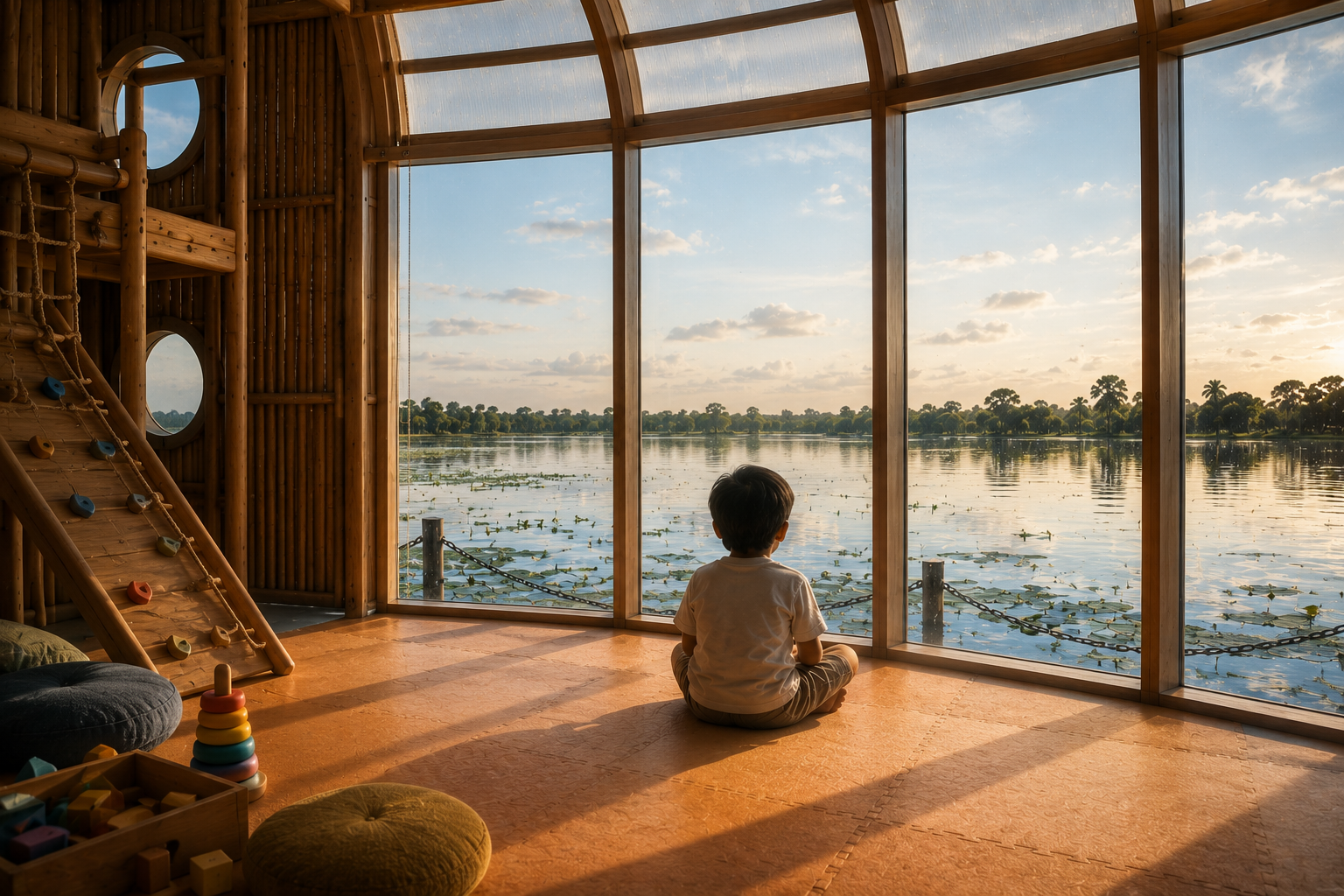
Rendering 3: Children's Play Petal - Child at the Water Window
What to draw and how?
A child, maybe 6 or 8 years old, is sitting cross-legged on Petal 5's rubber floor, facing away from us, and staring out the floor-to-ceiling polycarbonate window. Outside the window are flooded paddy fields that have been transformed into a level blue lake that reaches a line of trees. The youngster is at ease. They lean slightly forward with curiosity rather than fear, and their posture is relaxed. The interior is cosy, with a wooden climbing structure visible on the left and a plush rubber floor. The outside is blue and cool. This picture encapsulates the project's main idea: a child in a warm, safe place staring out at the flood that would have otherwise taken everything from them without fear.
Child figure - E11 skin, dark hair in N8, light clothing in W1 or YR000. Small, establishes scale without dominating.
Interior - Y08+E34 warm rubber floor. E37 climbing structure. W2 polycarbonate window frame.
Exterior through window - B41+B95+BG72 water. G14+G17 distant tree line. Sky in B000. Cooler and softer than interior.
Light direction - Light coming from the window (exterior). Interior is in warm shadow. Window is the brightest element.
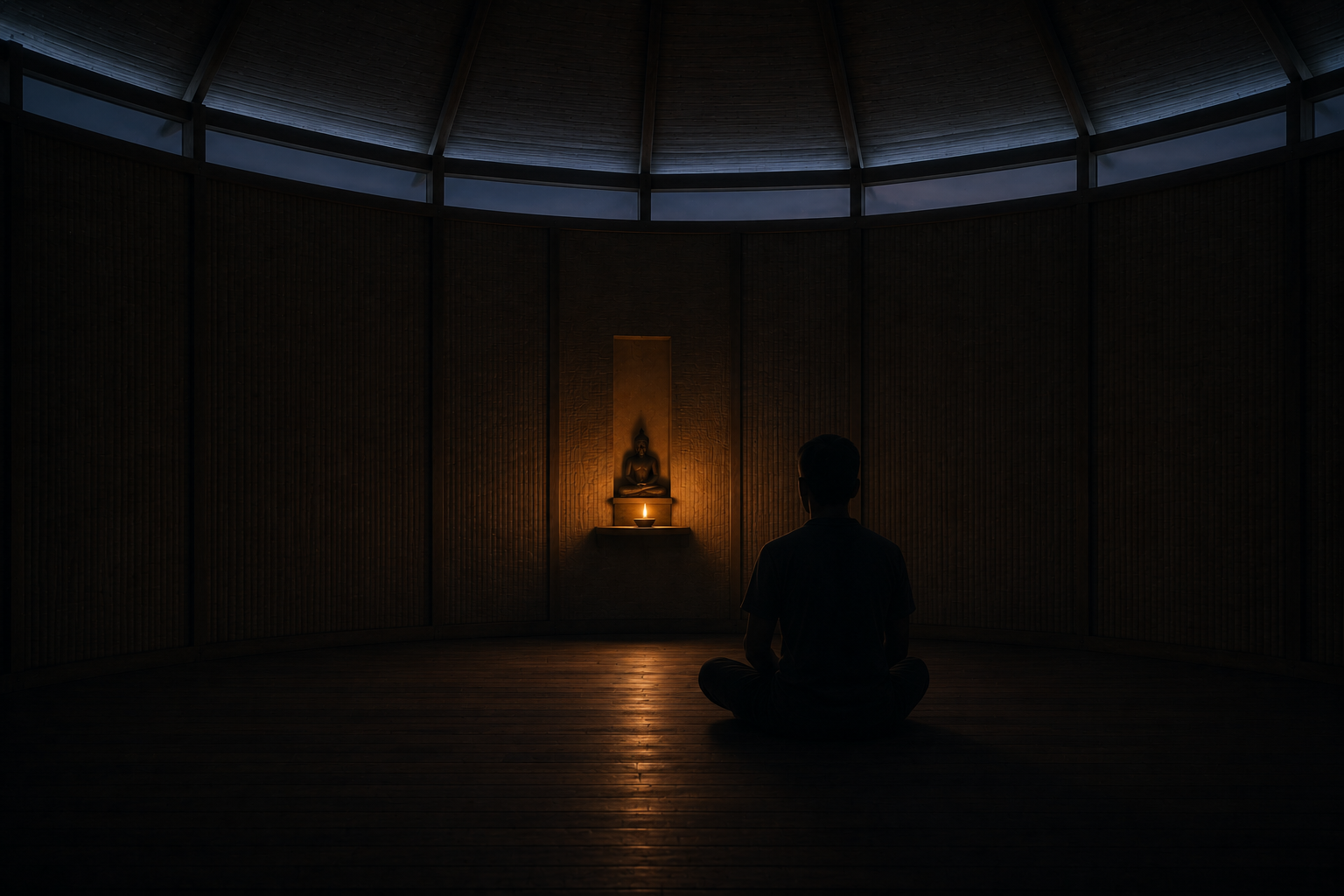
Rendering 4: Meditation Petal - Interior at Dusk
What to draw and how?
The interior of the Meditation flower at nightfall. In the middle of the space, just to the right of the composition's midpoint, is a single figure sitting in meditation. You can just make out the low curved ceiling from above. The solitary oil lamp in the shrine niche, which casts a tiny golden pool on the east wall, is the only source of light in the nearly dark walls. It's practically a silhouette. The lamp light flickers to the floor. Out of the four renderings, this one is the quietest and most restrained; the technique is this constraint. Out of all the drawings in the set, use the fewest colours possible. No amount of architectural detail can convey calm as well as the nearly monochromatic colour scheme.
Wall tones - N2 lightest visible surface, N4 mid-shadow, N6 deepest corners. Three greys only.
Lamp light - Y08 at the niche, Y15 immediate glow, YR18 outer warmth. Tiny area — big impact.
Figure - Almost silhouette. N6 dominant, N4 for faint edge light on shoulder. No face detail.
Building the Physical Model


Scale: 1:200.
The lotus geometry experienced as a three-dimensional object, the chain-anchor mechanism as a physical working system, and both the dry-state and flood-state configurations from a single physical object using an embedded magnet system are the three things that the model was intended to illustrate that photographs and renders cannot. The focal point is the resin water foundation, in which the complex floats at flood height, surrounded by lotus flowers and taut chains. Every build choice contributes to that end result.
1: 3D print and finish all pontoon hulls
Export each petal's pontoon hull and the central hub as separate STL files from Fusion. Print in white PLA at 0.15mm layer height, 60% gyroid infill (gives solid feel and good weight distribution). At 1:200 scale, each petal pontoon is approximately 45mm × 25mm × 3mm. The central hub disc is 60mm diameter × 3mm. Allow 6–8 hours total print time. Post-print finishing: sand all surfaces to 400 grit (removes layer lines, essential for clean paint adhesion), apply grey primer spray in two thin coats (allow 30 min between coats), apply Humbrol #11 silver metallic in two thin coats (allow 45 min between coats). The silver finish reads as galvanised steel the correct visual language for an industrial pontoon base.
Print the articulated walkway joint sub-assembly separately at 1:50 scale (enlarged for legibility) and display it beside the main model with a label explaining its function.
2: Build differentiated petal superstructures in foamcore
Make the walls of each petal by cutting foamcore. Use a new blade because blunt blades produce ragged edges by compressing foam instead of cutting it. For curved walls, use a pin tool to score the foamcore's rear face in a grid pattern without cutting through. Then, gently bend the foamcore so that it bends smoothly. Important visual distinctions between petals: The tallest and most open structure is Community Hall (P6); Meditation Petal (P7) features a softly curved roof and the lowest, most confined profile. The Garden Petal (P4) has a trellis constructed from crossed balsa slivers in place of a complete roof. Apply laser-cut bamboo texture paper or 0.5mm balsa veneer strips to every foamcore wall surface. Identical petals undermine the idea that each petal should be visibly different from its neighbours.
Problem we encountered: Our first attempt at curved foamcore walls cracked on the outer face. Fix: The score pattern on the back face must be in the direction of curvature (parallel to the bend axis), not perpendicular to it.
3: Install the magnet dual-display system
Make 6 mm holes in the base of the central hub and four symmetrical locations on the outer pontoon ring prior to constructing the complex. N52 neodymium magnets measuring 6 mm by 2 mm should be press-fitted into these holes (8 in the complex base). On a foamcore base board that is 5 mm thick, mark the appropriate locations. Press-fit eight matching polarity magnets into the base board after drilling matching holes in it. Test: the complex should lay flat when placed directly on the board (dry-state) and hold securely in the "flood-height" position (raised 15 mm above board level on tiny foamcore risers). Without the need for a visible mechanism, the magnets enable quick switching between the two display layouts.
The resin pour will conceal the foamcore risers, which act as internal spacers rather than visible components and should be painted dark grey to keep the complex at flood height.
4: Wire chain anchors and attach guide posts
Cut 35mm lengths of 0.5mm craft wire, which is equivalent to 7m of chain at 1:200. To suggest a chain catenary, bend each piece into a loose S-curve. As an alternative, purchase a 0.5mm tiny figure chain from a jewellery supply or hobby store; in macro photos, actual chain links read better. Using a little drop of super glue on a 1mm wire loop eye, attach four chain wires per petal pontoon at the corner locations. Attach chains to pin-anchor locations after running them down to the base board. To make guide posts, cut 35mm lengths of 1.5mm brass rod (available from hobby suppliers) and adhere them vertically at the guide post locations for each petal. Before final photography, paint all chains gold so that bare or chrome wire doesn't show up in pictures.
Problem we encountered: Our initial wire chains lacked apparent tension and kept flopping.
Fix: Before adhering, each wire was bent into a taut catenary shape and held in place with a tiny drop of matte gel medium.
5: Final photography — the cover image
Place the model in indirect natural window light (not flash or direct sunlight) on a white card base in front of a white card backdrop. Place your camera lens about 30 mm above the resin surface and stand at eye level with the water's surface. The lotus blossoms may be seen in the foreground at half-blur from this viewpoint, which depicts the complex floating above the blue lake. Take at least twenty pictures: five at eye level, five from immediately above (bird's-eye), five of close-up chain details, and five in the dry-state arrangement (complex removed from resin, placed on separate ground board). For the Instructable, choose your top 8–10. Your cover image is the eye-level flood-state shot with lotus flowers in the background. It ought to be the first picture that people see.
Light angle is nearly the only factor that separates an excellent model photo from a bad one. Before shooting a single picture, adjust the model in relation to the window for 10 minutes. You may achieve the necessary depth and shadow by using soft side light from one window and a white card reflector on the other side.
Final Reflection: What We Could Have Done Better
We want to be very clear about what this project is and isn't. The building is not complete. It has not been structurally engineered in accordance with building codes. It won't stop Sri Lanka's flooding. No building project addresses the causes of Sri Lanka's flooding, which are caused by the country's monsoon geography, deforestation, and increasingly intense rainfall brought on by climate change.
This project proposes a radically different interaction between architecture and catastrophe. All of Sri Lanka's current flood-response infrastructure, including shelters, relief centers, and emergency hospitals, is intended for a future in which flooding is only a brief interruption to everyday life on dry land. However, flooding is a common occurrence in the communities of Thihagoda, Kamburupitiya, Akuressa, and numerous other Nilwala River towns. The calendar is what it is. Instead of creating an idealised version of the calendar in which the flood does not occur, architecture intended for those communities should be created for that calendar.
The flood is not resolved by the Lotus Complex. It declines to use the flood as an excuse for closing. That distinction is crucial.
"Architecture that heals is not architecture that hides difficulty. It is architecture that gives people a dignified, beautiful, warm place to meet it."
What surprised us during this project: The most unexpected finding was the degree to which the flood engineering needs and the healing design requirements matched. We anticipated that a building's structural stability would be compromised in order to make it therapeutically powerful, or vice versa. Rather, we discovered that they supported one another at nearly every decision-making stage. The complex's structural resilience and therapeutic power stem from its openness to nature and water, which allows water to flow through it rather than against it. Among the most flood-resistant materials are bamboo, teak, and natural rubber, which were selected for their therapeutic sensory attributes. The most effective buoyancy geometry is the lotus shape, which was selected due to its cultural significance. In this instance, resilience and beauty proved to be synonymous.
What we would do differently next time: On the flat roof portion of each petal, we would install a living green roof made of real blue lotus plants, creating an actual ecosystem that grows above the structure while it floats. Put a flood-level marker column, a vertical pole bearing the high-water level of each significant Nilwala flood since 1990 on the outside face of the central hub. As proof that the town has survived every flood to date and will survive the next one as well, the building should display the community's flood history. Additionally, we would incorporate a quick-release mechanism into the chain connections so that, in the case of a major flash flood, the complex could be unmoored and relocated upstream, away from current and debris, returning to its moored position after the flood stabilised.
This is intended for those that were impacted by: The Nilwala floods of 2024. Those which damaged the paddy harvests of 20,064 farmers. The households in the 2,516 homes that were demolished in November 2024. the kids whose schools were shut down for several days or weeks. the old individuals who are idle and sitting in gyms. The parents will rebuild after three, four, and five floods. People who already know how to survive are the target audience for this building. It provides them with a lovely location from which to accomplish it.
A note on replicability: Every component of this design was selected so that Sri Lankan communities could implement it without the need for specialised foreign contractors. Marine gear from port providers in Colombo, Galle, and Matara is used in the pontoon system. The construction using bamboo and compressed earth adheres to Sri Lankan building customs that are already followed by regional artisans. Maintenance for the chain and guide post system only involves visual inspection. Instead of creating a single prestige item for a particular location, we intended this to be a paradigm that could be built throughout several Nilwala River communities—progressively funded, locally built, and community-owned. Anywhere there is dirt and water, lotuses bloom. This building should as well.