What Affects the Appearance of an Afterimage?
by marinazz in Workshop > Science
97 Views, 0 Favorites, 0 Comments
What Affects the Appearance of an Afterimage?

This project focuses on afterimages and how they can be influenced. To be more specific, an afterimage is an image that appears in your eye after you have finished looking at the object/image.
Problem Statement
What factors affect the appearance of an afterimage?
Purpose in detail:
The first scientific theory was that afterimages had different effects on people with and without glasses. We decided to expand the experiment and procedure after discovering that our hypothesis was correct and that people who wear glasses have a harder time seeing the afterimage than people who don't wear glasses. Our next scientific question was: what are the variables that influence how images are formed after they are taken? We were hoping to figure out what other factors could influence how we interpret afterimages and what causes them before we realized that whether or not someone wears glasses affects how they perceive afterimages.
Background Information
Positive Afterimage
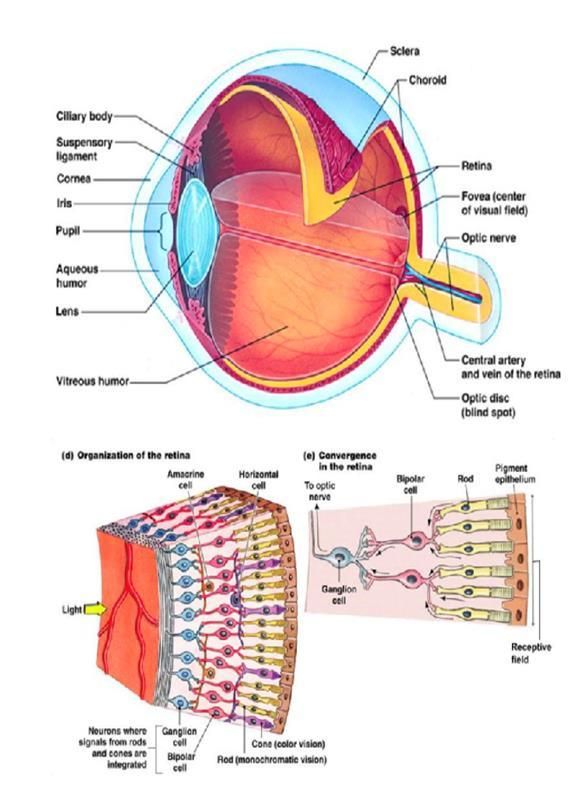
A positive afterimage occurs when the colors of the original object or photograph are maintained. This happens when you look at a brightly lit area, and then look away but continue to see the image. The original image creates nerve impulses, these nerve impulses will cause the image to continue for a short period of time. After the cells in the retina have been exposed and are energetic and functioning it takes some time for that response to cease. Positive afterimages happen quite often. However, we do not notice them because they can last as little as 500 milliseconds.
Negative Afterimage
A negative afterimage occurs when you see the inverse color of the original photograph. An example of this is when you stare at a red image for a period of time and when you look away you should see a green afterimage. This is explained in the opponent-process theory of color vision.
The Opponent Process Theory of Colour Vision:
The opponent-process theory of color vision is that our color spectrum is controlled by three receptor cells with opposing actions. The three receptor cells are the red/green, the blue/yellow, and the black/ white. According to this theory, these cells can only detect one of the colours at a time. That is why we don’t see red\green or blue\yellow colours. According to the opponent-process theory of colour vision, after staring at a red and green photograph for a long period of time, you exhaust the red and green cone cells. Then, when you look at a blank What are the Variables that Affect Afterimages? Kaylin Harder Age 14 | Inuvik, Northwest Territories $1000 Shad Scholarship Award - Intermediate screen, the red/green cone cells are still exhausted so the only cone cells that can fire are the blue and yellow cells.
Myopia (Nearsighted)
Myopia, also known as nearsighted, is when your vision lets you see closer objects more clearly, and further objects become blurry. This occurs when the length of your eye is larger than the optical length. This means that the length of your eye is stretched, it’s longer than normal. This causes the light to connect in front of the retina, not directly in the tissue like it should. Generally, myopia develops at a young age and continues to worsen over time. However, concave lenses in glasses can help to correct myopia because they spread out the light before it reach the natural convex lenses in our eyes, therefore letting the image focus directly on the retina.
Hyperopia (Farsighted)
Hyperopia also known as farsightedness is the opposite of myopia. It allows you to see objects further away more clearly and the objects that are close appear to be blurry. This occurs because the eyeball could be to short or the eye may have defects such as: a flat cornea or an odd curvature. Hyperopia could be present from birth, however, many people can outgrow the condition. To help correct hyperopia people use convex lenses because they add additional precision so the optical vision of the lenses connects to the retina as well as the natural convex lenses in our eyes.
Hypothesis
If the participants in our experiment were tested based on three different categories: gender, glasses, and brightness, then there will be varied results showing that females without glasses will be able to see afterimages for a longer period of time in a bright room compared to males because women are usually known to have stronger vision than men since a girl’s physical body and mental state matures more quickly.
Extra information:
Gender
Girls will see the afterimage longer than boys because their physical bodies and mental states mature more quickly.
Glasses
The afterimage will last longer because it’s easier for their eyes to get fatigued and they won’t be able to focus as well.
Brightness
The afterimages will last longer when the room is dark because the rods and cones have to adjust to less light.
Variables

Independant variables:
The gender of the participants, whether they had glasses, and brightness.
Dependent variables:
The color of the afterimage that the participants viewed, and the duration the participants saw of the afterimage.
Control variables:
The space in which the experiment occurred, in addition to having no other people in the room, and the room being quiet.
Materials
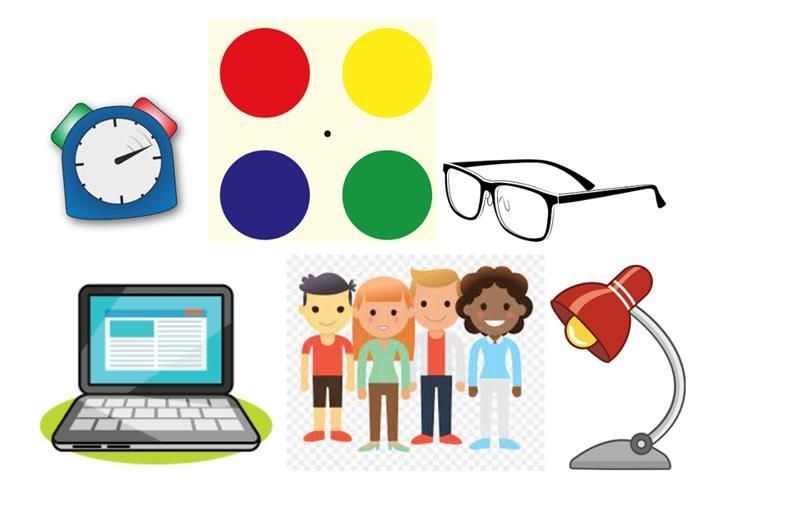
- Stopwatch
- Image
- Subjects (Humans)
- Laptop (To record)
- Glasses
- Light source (brightness)
Procedure

How did I conduct the experiment? What steps did I take?
The procedure for this experiment was as follows:
- We first received consent from our six participants. We explained to them how the experiment would work and asked if they had any questions in regard to the process.
- Then, we took them into a quiet room with the lights on and showed them the image.
- Next, we told them to look at the image for 30 seconds with their glasses on and then look at the blank paper and mention what colors they saw, then wait another 30 seconds to see if the color had changed.
- Finally, they have to tell us the time when the afterimage faded.
- We repeated the same process as step 3 yet this time we informed them to take their glasses off and record their findings.
- Then, we repeated the same process as step 3 however, the only difference was that the room was not bright meaning the light source was off, we executed this process while our subjects were with and without glasses.
https://drive.google.com/file/d/1qzXLXetTs0fYhzYQmG4wb3Jg-jdpp5MB/view?usp=sharing
Data
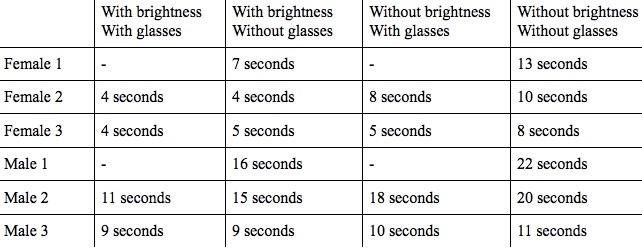
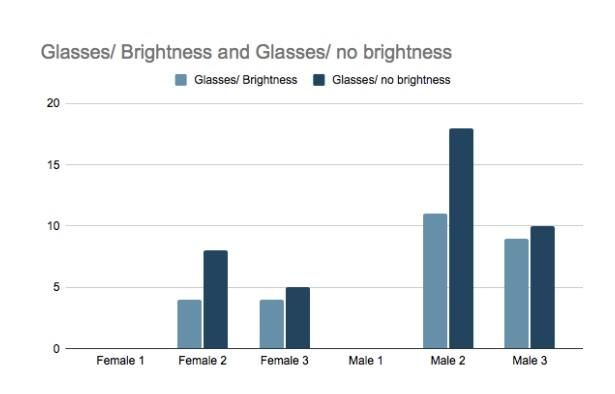
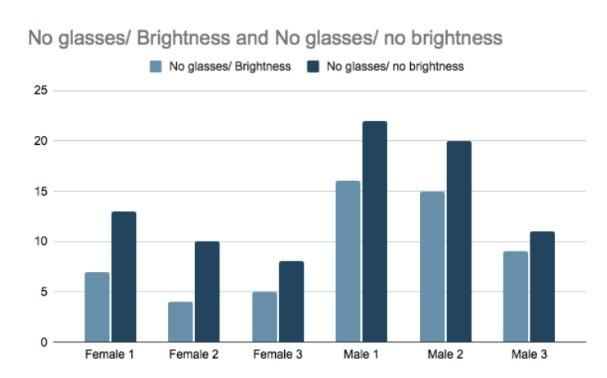
For how long did the participants see the afterimage?
Data Analysis

After collecting our experimental results we realized an outstanding positive relation between male and female when the light source was off. Surprisingly, both genders were able to see an afterimage for a longer period of time without a light source (brightness). The data we collected from the experiments showcase that people with glasses are only able to see the afterimage for a shorter period of time. In fact, the afterimage faded almost instantly for them. On the other hand, without glasses they saw the afterimage for a longer period of time. In addition, the results showed that males can see afterimages longer than females.
Results

To sum up the experiment, we concluded that our hypothesis is mostly incorrect because data proves that males can see afterimages longer than females can (refer to the table). In addition, our data proves that a room with less brightness will allow the participants to see afterimages for a longer period of time. However; part of our hypothesis was correct, people wearing glasses barely saw the afterimage compared to people without glasses. Since, participants who wore glasses saw an afterimage however, it faded almost instantly.
Conclusion

Evaluating the hypothesis
Do my data results support my hypothesis? Why or why not? No. We thought that females without glasses in a bright room will see the afterimage for the longest period of time. However; in reality, the results proved otherwise. Males in a less bright room and without glasses, see the afterimage the longest.
Evaluating the method
What were the strengths and weaknesses of the experiment? Was my data reliable?
The strengths of this experiment are learning more about the effects of afterimages on a variety of standards, which opened up our minds on how changing and alternating variables will cause drastic changes.
The weakness is that we tested several criteria at the same time which made the experiment and collecting data a bit confusing.
The data is very reliable since we gathered information from a good number of people. We also created a video that shows the results of the experiment.
Improving the experiment
What would I change in the experiment? What other questions could I investigate? Instead of using a lot of categories that we test on, we can use one and make it a bit more complex to strengthen the experiment and make it less confusing.
Conclusion
In conclusion, we found out that our hypothesis was mostly incorrect based on the three tested categories: gender, glasses, and brightness. The results indicated that girls did not see the afterimage longer than boys, in fact, boys saw the afterimage longer than girls. There was great difference with glasses so our findings are correct about that. The afterimages did last longer when the room was dark. This study suggests that the two main variables that affect afterimages are gender and the brightness of the room.
Applications & Service As Action

What is the importance of this research to humans?
An afterimage is a visual image seen after the stimulus has been removed. This reveals that color contrast shows how the spatial relations between colors can influence color appearance. What you saw before has an influence on what you see now.
How can it be applied in practice?
Afterimages can be an interesting visual phenomenon to observe. They can also be an important tool for helping researchers better understand how color vision and the visual perceptual system work.
What did you learn from this research?
From this research we were surprised to conclude that a female's afterimage fades quicker than the male’s afterimage since a female's physical body and mental state matures more quickly.
21st Century Skills Reflection

The 21st-century skills are more important to students now than ever before. They not only provide a framework for successful learning in the classroom, but ensure students can thrive in a world where change is constant and learning never stops. And they are also tremendously important for our world’s well being.
Project-based learning boosts student engagement and understanding. In addition, students are more focused on projects and make critical interdisciplinary connections through the use of critical thinking, collaborative skills, communication skills, and creative skills. Without those skills, we would get nowhere in this project. Especially since we’re working online, we need to acquire those skills in order to flourish and succeed.