Whistler Community Dome: a Geodesic Shelter for Wildfire Season
by 2027024 in Design > 3D Design
3 Views, 1 Favorites, 0 Comments
Whistler Community Dome: a Geodesic Shelter for Wildfire Season
.jpg)
Purpose
The purpose of our structure is to provide a safe, pollution free community space in Whistler, British Columbia. Over the last few years, western Canada has experienced an unprecedented number of forest fires, this having stemmed from extreme heat and dehydration. These issues culminated when Lytton B.C. reached a record high temperature of 49.6 °C (121.3°F) in June of 2021. This subsequently led to almost the entirety of the community burning to the ground. Residents in nearby Whistler also experienced the high temperatures and similarly faced the risk of fires. Forest fire smoke and pollution engulfed the region for the next few weeks making it unsafe for residents to leave their homes for significant periods of time. We aim to create a structure/dome that at times of need can provide a safe community environment, and during times of stability, a place that facilitates community connection and involvement.
Supplies
- ABS 3D printing filament
- Glass Acrylic
- Foam Boards
- Glass Glue
- Super Glue
- Trotec Speedy 300
- Bambo Lab X1-Carbon
Fusion and Early Design Brainstorming


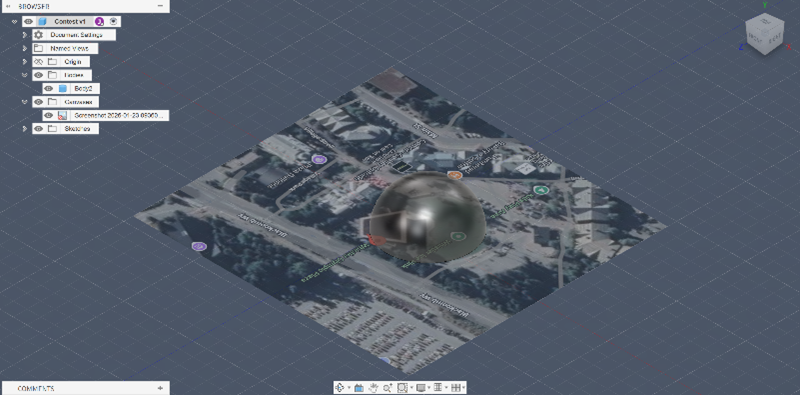
The design process began with research into geodesic dome structures, looking at real-world examples for inspiration. The group then moved into Fusion 360 to start developing the initial concept. Early models focused on establishing the overall shape and scale of the dome, experimenting with different panel layouts and proportions. Several iterations were made as the team worked to find a design that balanced structural strength with visual clarity. The final Fusion model included the dome framework, the base layout for Olympic Plaza, and placement for key elements like the stage and trees. This planning stage was essential for guiding the rest of the build and ensuring all the pieces would come together during assembly.
Topography and Base Design


The base was cut from its original circular shape to better fit Olympic Plaza and allow clear access points. Layered curved pieces were added to represent Whistler’s mountain terrain. These layers create elevation changes and define areas for trees, the stage, and gathering space inside the dome. The final base supports the structure while reflecting the natural landscape.
Prop and Element Design


Using the Bambo Lab X-1 Carbon the group successfully printed the Whistler stage as well as printing our custom-made tree design. We also used the 3D printer to create the frame of the dome, which was divided into dozens of triangles and a collection of hexagons. They would be glued together and then mock glass made from acrylic would fill in the panes. The Trotec Speedy 300 was used to laser cut the acrylic, requiring a lot of precision by the operator. There were two different types of triangle designs, one isosceles triangle and one equilateral triangle. The materials were now all gathered and ready to be assembled.
Assembly


Using super glue and a series of carefully interlocking joints, the frame for the main dome structure was assembled with precision and patience. Each connection had to be aligned properly before bonding, as even slight misalignment would compromise the overall symmetry and strength of the structure. The triangular framework distributed force evenly across the surface, which is why this geometric approach has been used in dome construction for generations. Once fully assembled, the structure measured approximately 18 inches in diameter, forming a stable hemispherical skeleton that could support the outer shell.
With the frame secured and hardened, the final stage focused on enclosing the dome. Acrylic triangles were individually fitted into the openings, ensuring a tight, uniform seal along every edge. Glass glue was then applied carefully along the seams to secure each panel permanently in place. This step required steady hands and attention to detail, as excess adhesive could affect the transparency and overall appearance of the dome. Once all panels were installed and the adhesive cured, the structure transformed from an exposed skeletal frame into a complete, enclosed dome. The finished result combined structural integrity with clarity, demonstrating both the strength of triangular engineering and the practicality of modern materials.
Completion and Final Touches
.jpg)
.jpg)
With the dome fully assembled and enclosed, the remaining elements were placed onto the base to bring the model together. The 3D-printed trees were positioned along the layered terrain to reflect Whistler's natural landscape, and the stage was secured into its designated spot on the plaza. Each piece was carefully arranged to match the intended layout, keeping gathering areas and access points clear and functional.
After everything was set in place, the group cleaned up any excess glue and made small adjustments to alignment where needed. The finished model demonstrates how a geodesic dome could serve Whistler as both a safe shelter during wildfire season and a community gathering space during everyday life. The use of 3D printing, laser cutting, and hand assembly allowed the team to bring the concept to life at a detailed and manageable scale.